
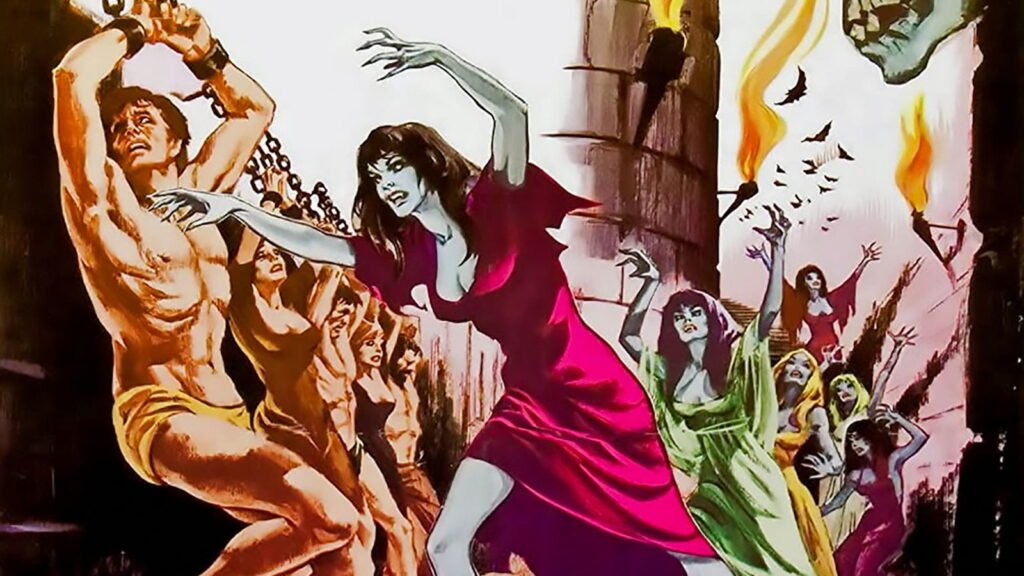
The Vampire Lovers (1970) is the Hammer Gothic horror film where Ingrid Pitt’s vampire works two great houses under three names. She arrives at the first as Marcilla, a countess’s daughter left in a general’s care while her mother visits a sick friend. She presents herself at the second as Carmilla, the same countess’s niece, delivered by a carriage that breaks down at exactly the right gate. And on the grave she has been slipping back to all along — the grave nobody hunting her can find — the carved name is Mircalla Karnstein. Three names, one woman, and every armed man in Styria looking for somebody else.
Quick Specs
- Director: Roy Ward Baker
- Screenplay: Tudor Gates
- Adaptation: Harry Fine, Tudor Gates and Michael Style
- Based on: Carmilla by Sheridan Le Fanu — serialised 1871–72, collected in In a Glass Darkly (1872)
- Producers: Harry Fine and Michael Style
- Executive producer: Louis M. Heyward
- Cinematography: Moray Grant
- Editor: James Needs
- Music: Harry Robinson; music supervisor Philip Martell
- Production companies: Hammer Film Productions, American International Pictures and Fantale Films
- Distributors: MGM-EMI Distributors (UK); American International Pictures (US)
- Première: London, 3 September 1970
- Release: UK, 4 October 1970; US openings — Chicago, 28 October 1970; Los Angeles, 25 November 1970; New York, 3 February 1971
- Running time: 91 minutes (UK); 89 minutes (US)
- Classification (original): BBFC ‘X’ certificate — the revised, 18-and-over X
- Budget: £165,227
- Setting: Styria, Austria — prologue 1794, main action decades later
Three names, one vampire
Get this straight before anything else, because the film’s whole machinery runs on it. Marcilla, Carmilla and Mircalla are not three women, and they are not three characters. They are one vampire wearing her own name in three arrangements — the anagrams are Sheridan Le Fanu’s own device, carried over from his novella intact. Mircalla Karnstein is the true name, the one on her grave and on the portrait hanging in ruined Karnstein Castle. Marcilla is the name she is planted under in the first household, introduced as the Countess’s daughter. Carmilla is the name she uses in the second, introduced as the Countess’s niece. The households compare notes far too late, and when two fathers finally stand in front of that portrait, they are each looking at a different houseguest and the same girl.
The story
Styria, 1794. A female vampire of the Karnstein family lures a man out of a tavern and kills him, then returns to her grave to find her shroud stolen — and Baron Joachim von Hartog waiting. Hartog is hunting her to avenge his sister, and he takes her head. He goes on to destroy nearly all the Karnsteins. The one grave he never finds belongs to Mircalla.
Decades later, General Spielsdorf gives a ball for his niece Laura’s birthday. A neighbouring countess, called away to a sick friend, leaves her daughter Marcilla in the General’s care. Laura befriends her. Marcilla’s interest in her new friend is plainly more than friendship, and Laura begins to waste away — nightmares of a giant cat attacking her, a gradual anaemia — until she dies and two puncture wounds are found on her breasts. By then Marcilla is gone. Know this much before the reference books muddy it for you: Laura is the General’s niece. More than one respectable catalogue calls her his daughter, and it is wrong every time it does it.
The Countess strikes again, staging a carriage breakdown near the home of Roger Morton, the General’s friend, and leaving her “niece” — Carmilla, now — with the Mortons. Carmilla turns her attention to Morton’s daughter Emma, who resists the romantic approach but sickens exactly as Laura did, while the vampire feeds on village girls in between. Emma’s governess, Mademoiselle Perrodot, is seduced and becomes Carmilla’s accomplice. The butler Renton, the doctor and Morton himself ward Emma’s room with garlic flowers and crucifixes, so Carmilla kills the doctor on the road and subjugates Renton to strip the wards away. When she flees with Emma, Perrodot begs to be taken along. Carmilla kills and drains her instead.
At the ruined Karnstein Castle, Morton, the General and the aged Hartog stand before Mircalla’s portrait and recognise the same girl under both aliases. Carl Ebhardt, Laura’s fiancé, rides back and drives the vampire off with a dagger held as a cross; she dematerialises to her coffin in the crypt, where the General stakes her through the heart and cuts off her head. One major catalogue hands those final blows to the Baron instead; the fuller plot account and the contemporary record give them to the General, and so does this page. The portrait’s image turns to a fanged skeleton. Emma recovers. And throughout the whole film, a man in black has stood at the edges of scenes, watching and occasionally laughing. Nobody explains him. The film never tries.
Carmilla was there first
Joseph Sheridan Le Fanu (1814–1873), the Irish writer Hammer turned to here, published Carmilla before Bram Stoker had built so much as a castle. The novella was serialised in the magazine The Dark Blue in 1871–72 and collected in his In a Glass Darkly in 1872 — a full quarter-century before Dracula appeared in 1897. It is one of the foundational vampire tales: a female vampire, Mircalla Karnstein, preying on young women in Styria, told by one of her intended victims. The film keeps Le Fanu’s architecture with unusual fidelity — the ball, the staged carriage accident, the governesses, the portrait, the anagram names — and then does the one thing 1872 could not: it makes explicit the desire the novella carried as subtext. Carmilla had reached the screen before, as the basis in whole or part of Dreyer’s Vampyr (1932) and Roger Vadim’s Blood and Roses (1960). This is Hammer’s version, and the start of Hammer’s own Karnstein line.
The cast
Everything stands or falls on Ingrid Pitt, and she stands. Born 21 November 1937, Pitt was 32 years old when the cameras rolled in January 1970, and still 32 at the London première — playing a vampire presented on screen as a girl in her late teens, and carrying it entirely on presence. She never returned for the sequels, and the Karnstein films never quite replaced her.
Second billing in the posters, a different function in the film: Peter Cushing plays General Spielsdorf, whose household is infiltrated and whose niece is the first casualty. He is not Van Helsing here, and he is not a vampire expert — he is a grieving military man who has to go and find the expert. Cushing’s role bookends the film: prominent at the start, gone for the long middle, back for the climax. The experienced hunter is Baron Joachim von Hartog, played by Douglas Wilmer, the man of the 1794 prologue, aged by the main action. Around them: Madeline Smith as Emma Morton, the second household’s daughter; Kate O’Mara as the governess, Mademoiselle Perrodot (listings sometimes promote her to “Madame” — the film’s own form is Mademoiselle); Dawn Addams as the Countess, Mircalla’s travelling companion, who plants her in both houses under shifting relationships; George Cole as Roger Morton, Emma’s father; Pippa Steel as Laura; Jon Finch as Carl Ebhardt; Ferdy Mayne as the doctor; Kirsten Betts as the first vampire, the blonde woman of the prologue — Betts is her credit here, Lindholm the name she was later known by, one actress either way; and John Forbes-Robertson as the Man in Black, who watches, and laughs, and is never explained.
The film the censor read first
Before a frame was shot, Hammer sent Tudor Gates’s script to chief censor John Trevelyan, who warned them about the lesbian content and pointed out that his office had cut five minutes from The Killing of Sister George. Hammer’s reply deserves its immortality: the lesbianism was Le Fanu’s, not theirs. Trevelyan backed down. But do not let anyone sell you the cosy version where the Board simply waved this film through — correspondence dated 6 May 1970, Trevelyan writing to Hammer’s Aida Young, shows him still unhappy with material in the finished film “even for our ‘X’ category.”
That category itself had just changed under the film’s feet. On 1 July 1970 the BBFC raised the X certificate’s age bar from 16 to 18, and this film, released that October, carried the revised X. The Abertoir Horror Festival’s programme notes call it “the first Hammer Horror to embrace the possibilities” of the new certificate, and Hammer’s official history agrees the film was built to exploit the freedoms the revised X offered. BFI Screenonline’s biography of Roy Ward Baker simply calls it “the sexually explicit The Vampire Lovers” — among Hammer directors, that is a filmography entry that needs no further adjectives.
Making it
The film began with producers Harry Fine and Michael Style, who approached Hammer with Carmilla. Fine suggested filming it; in Gates’s account, James Carreras sold it to American International Pictures “instantly,” on the poster. Fine, Style and Gates formed their own company, Fantale Films, to make it — Fantale is theirs, not a Hammer subsidiary — and the finished picture is a Hammer and AIP co-production, with AIP as both co-producer and American distributor, and AIP’s Louis M. Heyward as executive producer. AIP wanted a vampire film with more explicit sexual content to exploit a relaxing censorship climate, and AIP wanted insurance too: Cushing was brought in at their wish for a known male lead, a small but pivotal part. Gates also recalled, in interview, that AIP gave Hammer $400,000 and that Fantale held a 25% profit stake — his figures, carried here as his account only, and never to be blended with the documented budget of £165,227.
Principal photography began on 19 January 1970 at Elstree Studios, with locations in the grounds of Moor Park Mansion in Hertfordshire standing in for Styria, and wrapped on 4 March 1970. The set lore that has followed the film ever since — told here as lore, the way the set told it — is that Pitt’s fangs kept falling out during the attack on Perrodot, dropping into Kate O’Mara’s cleavage, until Pitt fixed them in place with chewing gum taken from a crew member’s mouth. However the fangs behaved, the film’s place in the Hammer ledger is fixed: it was the last Hammer film financed with American money. The ones that followed were backed by Rank or EMI.
Release, and what the money actually says
The London première came on 3 September 1970; the AFI Catalog, drawing on Daily Variety, records that Pitt, O’Mara, Pippa Steel, Kirsten Betts and Madeline Smith signed up that evening as blood donors for the National Blood Transfusion Service, which is the kind of publicity arithmetic you have to respect. The UK general release followed on 4 October 1970 on the ABC circuit. America got it in stages: Chicago on 28 October 1970, Los Angeles on 25 November 1970, and New York not until 3 February 1971.
The budget is a rare clean number for a film of this era: £165,227, carried by two independent sources. A total gross is the opposite — no verified total exists, so this page prints none, and any figure you see elsewhere presented as one should be treated accordingly. What the period trades recorded, as catalogued by the AFI from Variety’s charts, is this: $27,000 in Chicago’s first week, $11,500 in San Francisco’s first week, and a cumulative American gross of $151,675 after several months. Those are period trade figures, quoted in that frame and no other. The qualitative verdict needs no such caution: the film was a box office success — “very lucrative,” in the words of one of its chroniclers — and it performed well enough to build a trilogy on.
What the critics made of it
The first notices were split down the middle. Variety, reviewing on 16 September 1970, found the story “not great” and the dialogue “fairly flat,” while conceding the script had “all the needed ingredients.” A. H. Weiler in The New York Times, on 4 February 1971, was warmer: the film was “a departure from the hackneyed bloody norm… professionally directed, opulently staged and sexy to boot.” The Monthly Film Bulletin dissented outright: “Rather below par, even by recent Hammer standards… with the innovation of an exposed nipple or two to support the lesbian angle.”
Time has been kinder than the Bulletin. Dave Kehr called the film the product of “the last significant surge of creative energy” at Hammer. Leonard Maltin gave it two and a half stars as a “rather erotic Hammer chiller.” Donald Guarisco wrote that it “pushes the ‘bloodshed & bosoms’ formula of the Hammer hits to its limit” and became “an enduring cult favorite” — which is about the most accurate eight-word review the film ever got. Rotten Tomatoes currently aggregates the film at 76% from 17 reviews, with an average rating of 5.8/10. The film has lived on accordingly: an MGM DVD in 2003, doubled with Countess Dracula; a Scream Factory Blu-ray on 30 April 2013; and a Collector’s Edition with a new 4K scan on 21 December 2021.
The Karnstein line
The Vampire Lovers is the first of the Karnstein Trilogy, followed by Lust for a Vampire (1971) and Twins of Evil (1971) — all three derived from Le Fanu’s Carmilla, and all three scripted by Tudor Gates. Pitt does not return in either sequel, and the later films reach back into the Karnstein family rather than continuing Mircalla’s story in any strict line, so treat the trilogy as three tellings around one cursed house, not as chapters. What the first film started is larger than the trilogy anyway. In 1970 Hammer made the vampire film the censor had read in advance, under a brand-new adults-only certificate, out of a novella that had been waiting ninety-eight years for somebody to film what was actually on its pages. Dracula had the fame. Carmilla had the priority — and, for one Styrian autumn, she had Ingrid Pitt.