
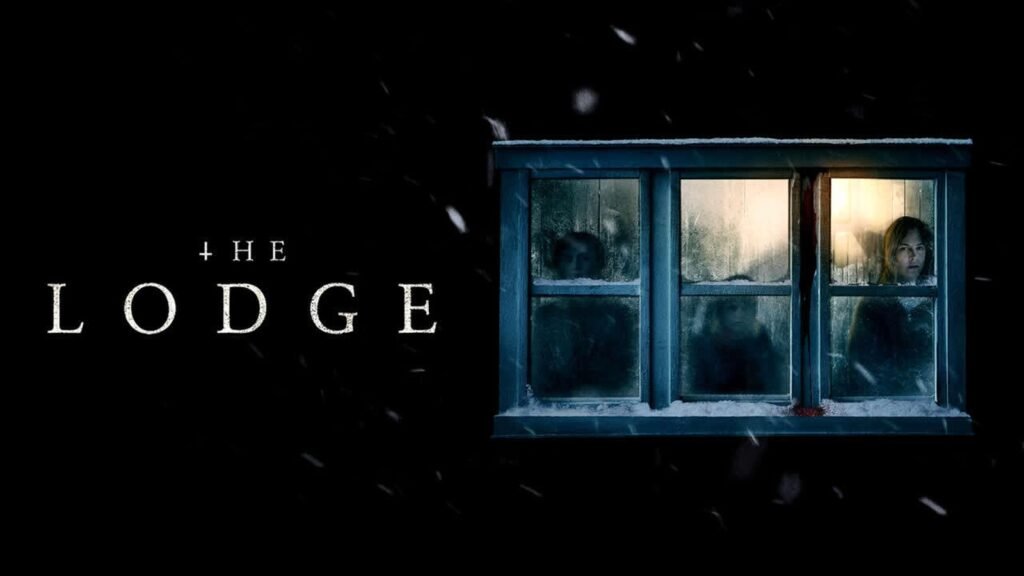
The Lodge (2019) is Hammer and FilmNation’s snowbound psychological horror film, where two grieving children fake a purgatory for their father’s bride-to-be. Grace Marshall is spending Christmas in a remote Massachusetts lodge with Aiden and Mia Hall, the children of the man she is about to marry — children who blame her for their mother’s death, and who have done their homework on hers. She was raised in an extremist Christian cult led by her father, and she was its sole survivor when it ended in mass suicide. So when Grace wakes one morning to find every belonging in the lodge gone, the food gone, her medication gone, the clocks reading January 9 and the children calmly explaining that they may all be dead already — the trap is not built out of jump scares. It is built out of her own childhood.
Know whose film this is before the billing fools you. Alicia Silverstone’s name sits high on the poster, but she plays Laura, the children’s mother, and she is gone in the opening movement — her exit is the wound everything else bleeds from. This is Riley Keough’s film, carried on her face for long, quiet stretches, and it is the English-language debut of Austrian directors Veronika Franz and Severin Fiala, the pair behind Goodnight Mommy. It is also, not incidentally, a Hammer film — the old house’s name on a picture with no castle, no cape and no fog machine, just snow, silence and a woman coming apart.
Quick Specs
- Directors: Veronika Franz and Severin Fiala
- Screenplay: Sergio Casci, Veronika Franz and Severin Fiala, from an original idea by Sergio Casci
- Producers: Simon Oakes, Aliza James and Aaron Ryder
- Starring: Riley Keough, Jaeden Martell, Lia McHugh, Richard Armitage, Alicia Silverstone
- Cinematography: Thimios Bakatakis
- Editor: Michael Palm
- Music: Danny Bensi and Saunder Jurriaans
- Production companies: Hammer Film Productions and FilmNation Entertainment
- US distributor: Neon
- Première: 25 January 2019, Sundance Film Festival (Midnight section)
- US release: 7 February 2020 (limited)
- Running time: 108 minutes (one major tracker lists 100 — the conflict is noted below and left standing)
- Certificate: R (US)
A Christmas arranged like an ambush
Richard Hall tells his estranged wife Laura that he plans to marry Grace — a woman he met while researching a book about the cult she survived. The divorce is not final. Laura goes home and shoots herself, and her children, teenage Aiden and young Mia, file the blame exactly where children would: on the younger woman who was standing where their mother used to be. Six months later Richard drives Grace and the children to the family’s remote lodge for Christmas, an enforced bonding exercise in a house full of Catholic iconography, and then work calls him back to the city. Three people who should never have been left alone together are left alone together, in the snow, with a generator, a gun cabinet and Mia’s dollhouse — a miniature of the lodge itself, built for the film to match it.
The children have prepared. They have dug into Grace’s past and found the footage: her father’s followers laid out dead, draped in purple silk, duct tape reading “sin” across their mouths. Grace, sleeping badly and knocked off her psychiatric medication routine, dreams of her father preaching. Then she wakes to the emptied house. Her clothes, her pills, her dog — gone. The food, the Christmas decorations, the children’s own belongings — gone. The generator is dead, the clocks have jumped to January 9, and Aiden has an explanation ready: he dreamed the gas heater suffocated all three of them in the night. They are dead. This is purgatory. And a girl raised to believe in exactly that place has no antibodies against the idea.
The purgatory that wasn’t
Here is the thing this page will not pretend otherwise about, because the film’s cruelty depends on it: nothing supernatural happens in The Lodge. Not one thing. Over days of cold, hunger and withdrawal, Grace comes apart on schedule. Walking out for help, she circles through the snow and arrives back at the lodge. Buried outside she finds a memorial-framed photograph of the children and a newspaper report of all three of them dying of carbon-monoxide poisoning on 22 December 2019. Aiden offers her proof of their condition: he hangs himself in the attic, and hangs there, and does not die. She finds her dog frozen to death outside — the film is careful, and so is this page: it never says the children killed the dog. It says they took everything else, and the cold did the rest.
Only when she is fully broken do the children confess, and the confession is an inventory of stagecraft. They drugged her. They hid her medication, her clothing, her possessions — and their own — in a crawlspace. The hanging was faked. The voice of her dead father, preaching at her through the empty house, was recordings played over a wireless speaker. Two children built a haunting out of a crawlspace and a Bluetooth speaker, aimed it at the one woman alive guaranteed to believe it, and it worked past the point where telling the truth could switch it off.
Belief outlives the hoax
Because that is the film’s real subject, and it is why the ending lands like a dropped coffin lid. Grace does not recover when the trick is explained — she converts. The purgatory was fake; her belief in it is the most real thing she owns, the one thing her upbringing built to last. She flagellates herself at the hearth. She burns Mia’s doll as an idol. When Richard returns, she tries to prove their shared death by firing his revolver at herself — the chamber is empty, which she reads not as luck but as doctrine: the dead cannot die. Then she shoots Richard dead with it. The children flee, wedge the car in the snow, and are marched back inside at gunpoint. The final tableau is a liturgy: Aiden and Mia seated at the dinner table beside their father’s corpse while Grace sings “Nearer, My God, to Thee” — and tapes the word “sin” over their mouths, the way her father’s followers were found. The hoax is over. The religion it impersonated is still running.
The people in the snow
Keough plays Grace as a woman apologising for existing in a house that has already convicted her, and the performance is the film — watch how much of it happens in her face while she is trying, and failing, to be believed about ordinary things. Lola Reid plays Grace as a child, in the footage and the memory of the cult. Jaeden Martell is Aiden, the elder child and the production’s stage manager; period festival listings bill him under his earlier professional name, Jaeden Lieberher — same actor, earlier name, and the listings are not wrong, just old. Lia McHugh is Mia, whose grief runs quieter and whose dollhouse watches the whole film. Richard Armitage plays Richard, a man whose talent for leaving rooms is the plot’s engine.
And then there is the casting fact that sounds invented and is not. Grace’s father, the cult leader Aaron Marshall, is played by Danny Keough — Riley Keough’s own father. The sermons Grace cannot escape are her character’s father’s voice and her own father’s face, folded into one. Silverstone, as Laura, has essentially one movement of the film and spends it devastatingly: an estranged wife, not yet an ex-wife, hearing that her marriage is being replaced, in a performance measured in minutes that the remaining hundred are all spent paying for.
The dollhouse that watches back
The screenplay began as an original idea by Sergio Casci, sold to Hammer, who offered it to Franz and Fiala. The directors rewrote a significant portion of it — including the ending, which Franz said “didn’t work.” They shot the film in the winter of 2018 outside Montreal, in and around a lodge on a golf resort closed for the off-season; the story’s Massachusetts is a place the production never went. Cinematographer Thimios Bakatakis framed the interiors from above or below eye level, never at it, so that even an empty room feels supervised. In interviews, the directors have described preparing the children by taking Martell and McHugh out together — climbing, skating — to build a sibling bond, while keeping Keough apart from them before the shoot, so the distance the camera needed would already be in the room.
The dollhouse is the design idea the whole film is hung on, and it runs one way only: the dollhouse was made to look like the lodge, and then the lodge was photographed to look like the dollhouse. Fiala, in the directors’ own account: “We tried to film… the actual lodge as if a dollhouse, and then we had this dollhouse created, which looks like the lodge, and we wanted the audience never to be too sure where they are right now.” Miniature or full-size, the film keeps cutting between the two scales without telling you which one you are standing in — a house being played with by somebody, from outside its walls.
Hammer’s name, FilmNation’s money
Get the machinery right, because it is the revival era in miniature. FilmNation Entertainment fully financed the film and handled international sales; Hammer produced it. Neon neither financed nor produced anything — Neon is the American distributor, full stop. Hammer’s chief in this period, Simon Oakes, is a hands-on producer on the film, alongside Aliza James and Aaron Ryder in the release credits. The layers moved on the way: Hammer’s own September 2017 announcement had Oakes and Marc Schipper as the Hammer producers with James executive producing; by release, Schipper sits in the executive row and James is a producer. Print the release form — it is the one on the film. For a company whose name was built on The Curse of Frankenstein in 1957, this is the modern shape of the same job: find the material, attach the directors, put a producer’s hands on it, and let the money come from a partner built for money.
Thirteen months from Sundance to the snow
The film premiered in the Midnight section of the Sundance Film Festival on 25 January 2019, and Neon acquired the American rights at the festival. Then the wait began. Neon first dated the release for November 2019, abandoned that date, and finally opened the film limited in New York and Los Angeles on 7 February 2020 — thirteen months after the premiere, a 2019 film that most of its audience could not see until 2020, and it should be filed as exactly that. It opened to $76,251 from six theaters, expanded on 21 February to 322 theaters — one widely read reference says 320; both box-office trackers’ ledgers say 322, and 322 is what stands here — and peaked at 395 the following weekend. Then the world closed. The run was cut off in mid-March 2020 with the total standing at $1,666,564, a figure that still circulates as the film’s gross; it is a snapshot of a run interrupted, not a final number. A drive-in weekend the following July, eight theaters in the strangest summer in cinema history, finished the job: the final domestic total is $2,138,907, with $1,068,341 more from international territories — about $3.2 million worldwide, printed at that rounding and no finer. No production budget for this film has ever been published by the trackers, so this page prints none.
What the critics took home
The contemporary notices circled the same two facts: the dread works, and Keough is the reason. Dennis Harvey, reviewing out of Sundance, found the film “at its best in fostering a sense of stylish dread and orchestrating some harrowing individual sequences,” and suggested taking it on the terms of ’60s and early-’70s Italian giallos. Brian Tallerico called it “a truly unsettling movie, the kind of horror film that rattles you on an almost subconscious level,” and advised: “Just check in.” Jeannette Catsoulis found an atmosphere “so wintry in tone and setting that no movie-theater thermostat will banish its chill,” while judging the unease stronger than the narrative carrying it. Benjamin Lee gave it four stars of five and called it “an accomplished beast… taking the film to a place that’s both staggeringly grim and hopelessly sad.” Justin Chang held that it “paled in comparison” to Goodnight Mommy, while naming Keough “the movie’s strongest asset… no less powerful in her quieter, more recessive moments” — and Michael Roffman called her performance “career-best,” praise this page reports as his, not ours.
The aggregates, with their state declared: Rotten Tomatoes carries the film at 75% from 184 reviews, average 7/10, under a consensus praising Keough’s lead performance and the film’s darkly atmospheric horror — its page currently leads with that consensus rather than the number itself. Metacritic stands at 64 from 31 critics. The numbers agree with the notices, for once: a cold film, correctly received, that waited a year in the cold for its audience and then had its run ended by an empty world. It deserved the February it got. It deserved a longer one.