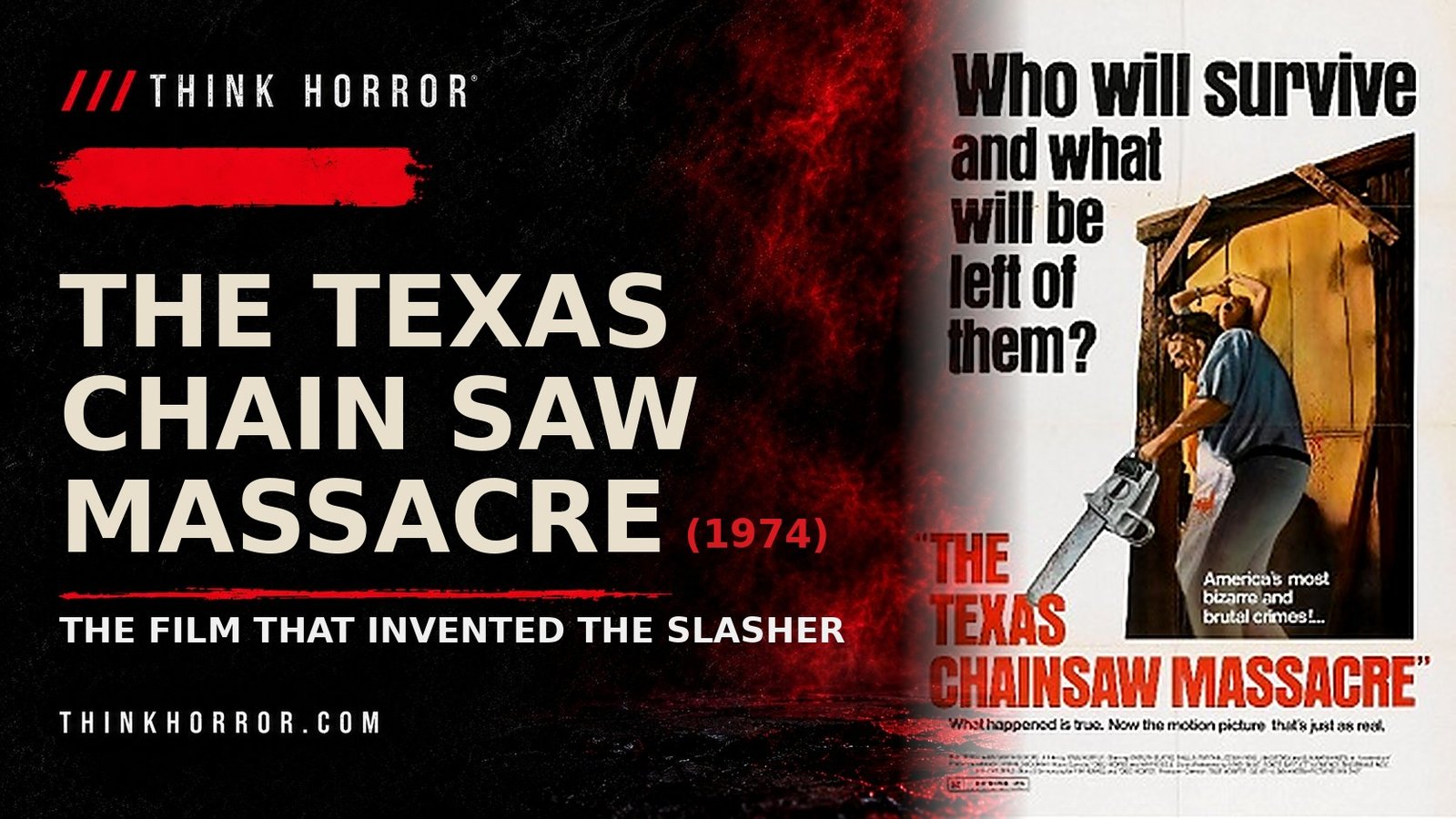
The Texas Chain Saw Massacre is the most influential horror film ever made — a sun-blasted fever dream that invented the modern slasher for less than most studio pictures spend on catering.
You know the sound before you know the movie. A generator coughs. Metal teeth spin up into a whine that climbs until it isn’t a machine anymore, it’s a scream that learned mechanics. August in Texas, 110 degrees, and you’re running through dead brush in the dark with that sound behind you — and it is not getting tired, fiends. It does not get tired. That’s the whole film, right there: the heat, the noise, and the running.
Welcome back to the crypt. Tonight we pay respects to the grandfather of them all — the little independent film that Cannes invited, Britain banned, the Museum of Modern Art collected, and every slasher you’ve ever loved quietly stole from.
Watch the Trailer

Quick Specs
- Director: Tobe Hooper
- Writers: Kim Henkel and Tobe Hooper
- Producer: Tobe Hooper
- Cast: Marilyn Burns, Gunnar Hansen, Edwin Neal, John Dugan, Teri McMinn
- Studio: Vortex, Inc.
- Distributor: Bryanston Distributing Company
- Release: October 11, 1974
- Runtime: 83 minutes
- Rating: R
- Budget: $80,000–$140,000 (reported)
- Box office: $30.9 million (reported)
The Review
The facts first, because the legend usually shouts over them. In the summer of 1973, a young Texan named Tobe Hooper took a cast of unknowns out around Round Rock and Austin with 16mm cameras, a reported budget somewhere between $80,000 and $140,000, and a script he’d written with Kim Henkel about five friends who run out of gas in the wrong county. It premiered in Austin on October 1, 1974, went nationwide ten days later, and returned a reported $30.9 million. Half a century on, it sits in the Library of Congress’s National Film Registry (inducted 2024) and in the permanent collection of the Museum of Modern Art, where it has lived since 1981. The films you grew up on grew up on this one.
The setup is brutally simple. Sally Hardesty (Marilyn Burns), her brother Franklin (Paul A. Partain) and three friends — Jerry, Pam and Kirk — are road-tripping through a Texas of dead armadillos and desecrated graves when they pick up a hitchhiker they’d give anything to un-pick-up, then wander, low on gas, toward the old family homestead. Next door stands a house that looks empty. It is not empty. Inside lives a family of laid-off slaughterhouse men who never stopped working, and guarding its door is Leatherface — played by Gunnar Hansen as a hulking, squealing, terrified animal in a mask of human skin, who kills the way you’d swat a wasp that got into the kitchen: fast, frightened, and without a flicker of malice. That is the film’s deepest cut. The monster isn’t evil. He’s just on shift.
What Works
Everything — but start with the paradox at the film’s heart: the most notorious gore film ever made is barely gory. Hooper shot it hoping for a PG rating, keeping the camera’s eye on reaction, sound and implication — a hammer’s fall you hear more than see, a meat hook rendered in silhouette and screaming, a freezer door. The MPAA slapped the uncut print with an X anyway, because the feeling of violence here is total even when the blood isn’t. Fifty years of imitators have drenched themselves red trying to recreate an effect Hooper achieved with a sound mix: that camera-flash screech on the soundtrack, bone wind-chimes, a generator’s drone, and the saw itself, idling and revving like the film’s second heartbeat.
Then there is the realism, which is really just poverty turned into style. Shot in genuine 100-degree heat over seven-day weeks, dressed with real animal remains the crew scavenged from slaughterhouses and roadsides, the film doesn’t look designed — it looks found, like evidence. Hansen researched his role by studying how people with intellectual disabilities move and speak, and played Leatherface as a man who never learned to talk properly; the result is a killer who changes masks the way we change expressions, fussing over his household even as he destroys its guests. And Burns — Burns runs, screams, bleeds and breaks for the entire last act in what may be the most punishing performance ever asked of a horror lead. The “final girl” starts here, in her eyes, at that dinner table. The last twenty minutes are a single sustained note of hysteria that no film before or since has held as long or as well.
What Doesn’t
We keep it honest in this crypt, even at the altar. Franklin will test some of you — he is written to whine, to slow the group, to be the weight the others carry, and on a first watch his scenes in the van can feel like the film idling. A few lines of the road-trip dialogue have the flat ring of a tiny crew working too fast to polish them. And the dinner sequence — the film’s agonizing centerpiece — is so sustained in its cruelty that some viewers check out rather than lean in; that’s a design choice, but it costs Hooper a few souls every screening. That’s the whole of the charge sheet. Nits, on a masterpiece.
So the verdict. The record here is not in dispute: 85% on Rotten Tomatoes, Certified Fresh; an 82% audience score across more than 100,000 ratings; a 92 on Metacritic — universal acclaim — and a shelf of honors (Cannes’ Directors’ Fortnight in 1975, the Registry, MoMA) that no other slasher can stack. Stephen King said he’d testify to its redeeming social merit in any court in the country. Quentin Tarantino called it one of the few perfect movies ever made. The crypt sees no reason to argue with either man.
Full disclosure, fiends, because this house keeps no secrets: this is a desk verdict — built from the verified record above and fifty years of consensus. Some films you grade. This one you measure the others against.
Harper’s verdict: 5 ravens — Buried with honors.
Trivia & Facts
- Hooper deliberately kept the on-screen gore minimal hoping for a PG rating. The MPAA rated the uncut film X; only after several minutes were cut did it come back with an R.
- The “true story” was marketing. The plot is fictional; what the film borrows from real life is Ed Gein of Plainfield, Wisconsin — arrested in 1957 after fashioning masks and furniture from exhumed corpses. Gein’s crimes also inspired Psycho and The Silence of the Lambs. Gein had no chain saw and no cannibal family — those are Hooper and Henkel’s inventions.
- The saw itself came to Hooper, by his own account, in a crowded Montgomery Ward hardware department at Christmas 1972, eyeing the chain saws and thinking: “I know a way I could get through this crowd really quickly.”
- Britain effectively banned the film for a quarter-century. After an early London run, the BBFC refused it outright; it wasn’t passed uncut — with an 18 certificate — until March 19, 1999.
- The dinner scene was shot in one marathon session of roughly 26 to 28 hours, in heat the cast remembered reaching 120°F inside the house, with the food on the table genuinely rotting. “That was a smelly mess,” Burns said later.
- When Grandpa “tastes” Sally’s blood, the blood is real: by Hansen’s account in his book Chain Saw Confidential, the prop’s blood tube kept failing, so the protective tape came off the blade and Burns’s finger was cut for the shot.
- Some of the skeletons decorating the farmhouse were real human skeletons imported from India. “It was less expensive than plastic reproductions,” Hooper explained. The narrator, a young John Larroquette in his first film work, has claimed he was paid for the opening narration in marijuana.
- Note the title’s spelling: Chain Saw, two words — and note too that the family has no surname in this film. “Sawyer” didn’t arrive until the sequel.
Harper’s Extras
- Our full wiki entry on The Texas Chain Saw Massacre (1974) carries the deep record — production history, releases and the franchise trail that starts here.
- Read it alongside our Halloween (1978) review: four years after Chain Saw, Carpenter took its bones — the masked killer, the final girl, the holiday — and built the slasher’s box-office king.
- The man behind the saw gets his due on our Tobe Hooper page, and the whole bloodline runs through the Texas Chainsaw Massacre franchise hub — nine films and counting, all chasing this one’s shadow.
Where to Watch
Streaming now (checked October 2026) on Amazon Prime Video, Peacock, Philo, AMC+ and Shudder — and free with ads on Tubi, Pluto TV and Plex. Rent or buy it on Amazon Video, Apple TV and Fandango At Home. However you watch it, watch it loud and watch it in the dark.
Frequently Asked Questions
Is The Texas Chain Saw Massacre based on a true story?
No — despite what the opening narration and the posters claim. The story is fictional. Its one true-life thread is Ed Gein, the Wisconsin murderer and grave robber whose skin masks and bone furniture echo through Leatherface and the farmhouse set. There was no chain saw, no family, and no Sally.
Why is it spelled “Chain Saw” in the title?
Because that’s how Hooper titled it in 1974 — two words. Later sequels and the 2003 remake closed it up to “Chainsaw,” which is why our franchise hub spells it the modern way while this film’s title keeps the original spacing.
Is it really as gory as its reputation?
Surprisingly, no. Hooper shot for a PG rating and kept most violence implied — sound, reaction and editing do the work. Its reputation comes from how completely it makes you feel the violence, not from what it shows. The MPAA still gave the uncut version an X.
Why was it banned in Britain for so long?
The BBFC refused the film a certificate after its early London run, judging its sustained menace beyond cutting. Through the video-nasties era it stayed refused for home video too, and the board didn’t pass it uncut — with an 18 — until 1999, nearly 25 years later.
Is Sally the first “final girl”?
She’s the blueprint. The film is credited with pioneering the elements the slasher genre was built on — the power tool as a murder weapon, the big masked killer, and the lone surviving heroine who outruns him. Four years later, Halloween gave the blueprint a name and a holiday.
Check your gas gauge twice, fiends, and never — ever — accept a dinner invitation after dark in Texas. Until the next nightmare. Harper out.
The weekly roundup
One letter a week, from the crypt.
- New reviews, with the ravens
- New wiki entries and news
- Cool stuff worth your night
Weekly. No spam, unsubscribe in one click.