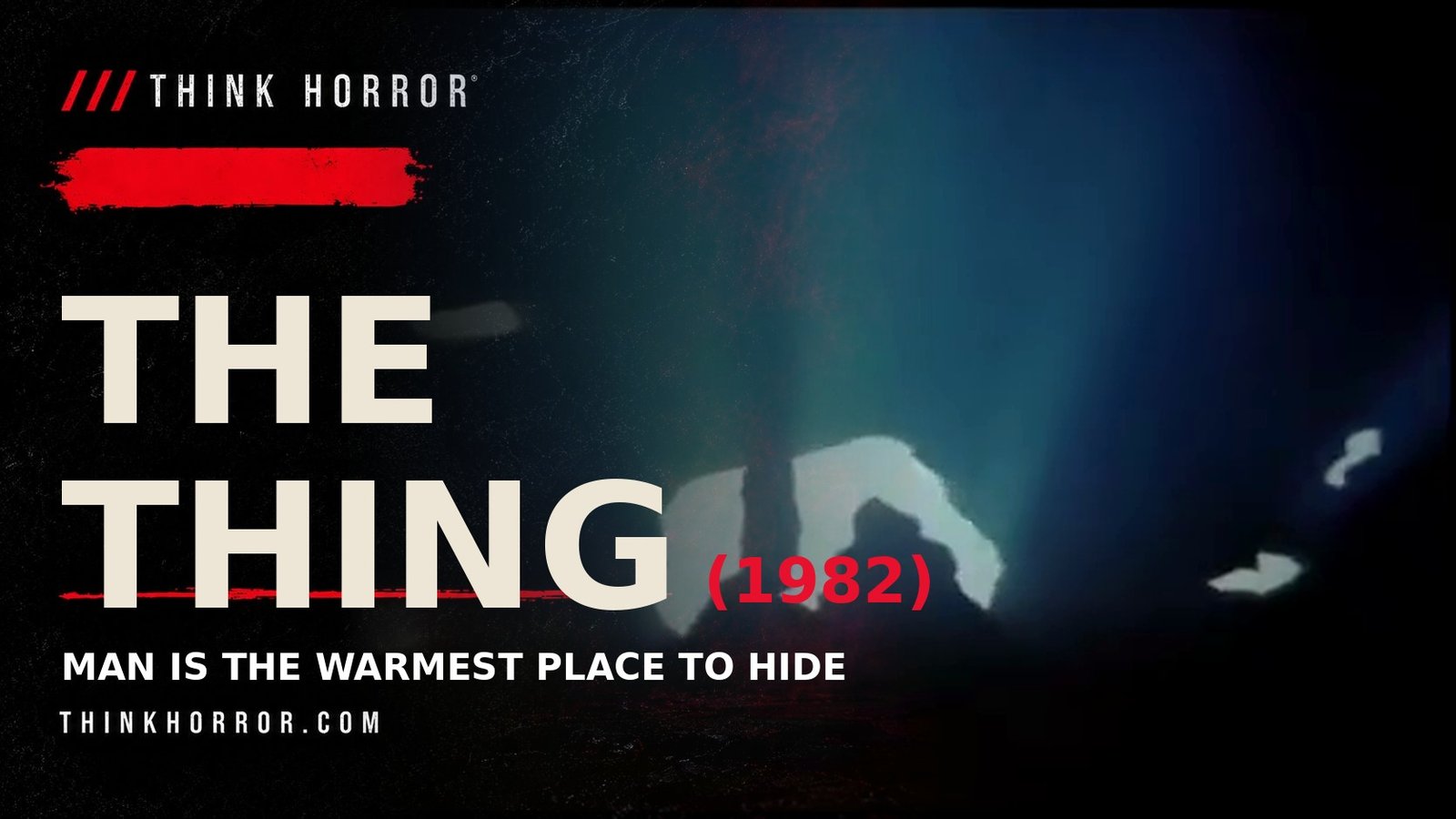
The Thing is John Carpenter’s Antarctic nightmare of paranoia and practical effects: twelve men, one perfect imitation, and no one left to trust.
You’re bound to a couch in a room that smells of kerosene, watching a man heat a wire and lower it toward a dish of your blood. If the blood rears from the heat, you die where you sit — and every man tied down beside you is hoping it rears for somebody else. Outside: a thousand miles of ice, and something wearing a face you know. Welcome to Outpost 31, fiends. Mind the dog.
Welcome back to the crypt. Tonight’s file is horror’s great resurrection story: the film its own summer buried — dismissed by critics, outrun by a friendly alien — that clawed its way back on home video to be crowned the finest horror film ever made. John Carpenter’s The Thing. Dress warm. Trust nobody.
Watch the Trailer

Quick Specs
- Director: John Carpenter
- Writer: Bill Lancaster (screenplay; from the novella “Who Goes There?” by John W. Campbell Jr.)
- Producers: David Foster, Lawrence Turman
- Cast: Kurt Russell, A. Wilford Brimley, Keith David, Donald Moffat, Richard Masur, Charles Hallahan, David Clennon, Richard Dysart, T. K. Carter
- Studio: The Turman-Foster Company
- Distributor: Universal Pictures
- Release Date: June 25, 1982
- Runtime: 109 minutes
- Rating: R
- Budget: $15 million
- Box Office: $19.6 million (North America, original run)
The Review
John W. Campbell Jr. published “Who Goes There?” in 1938 — a dozen men at the bottom of the world, and a monster that doesn’t hide from its victims; it becomes them. Howard Hawks filmed it loosely in 1951. Producers David Foster and Lawrence Turman later wanted the faithful version, and it landed with John Carpenter, fresh off Halloween and Escape from New York, on Bill Lancaster’s screenplay and a $15 million studio budget — the big leagues, at last.
Antarctica, winter 1982. A Norwegian helicopter roars into Outpost 31 chasing a sled dog; within minutes both Norwegians are dead and the dog is in the kennel, watching. What it does to the other dogs that night is the film’s first masterstroke of horror, and it is only warming up. The Americans find the Norwegian camp a madhouse of charred corpses, and bring home a twisted, two-faced body their biologist, Blair (A. Wilford Brimley), autopsies into a conclusion: the organism doesn’t just kill its host. It digests him and wears him, cell for cell, memory for memory, perfect. Helicopter pilot MacReady (Kurt Russell) becomes the coldest head in a station where the blood supply has been sabotaged, the radio smashed, and Blair — having run the arithmetic of what this thing would do to civilization — has to be locked in a tool shed. There is no rescue coming. There is only the test.
Then came June 25, 1982, and the cruelest opening weekend in horror history. E.T. — the other alien of that summer, the one who phoned home — had opened two weeks earlier and swallowed the culture whole. Blade Runner opened the same day, and died beside it. Carpenter’s film debuted at number eight with $3.1 million, fell out of the top ten in three weeks, and finished with $19.6 million against its $15 million budget. Carpenter has never pretended it didn’t scar: “I take every failure hard. The one I took the hardest was The Thing,” he said in 2008. “The movie was hated. Even by science-fiction fans.” Home video reversed the verdict. Reversed it is.
What Works
- The paranoia is the monster. This is a film about the death of trust, engineered like a trap. Every set piece removes one certainty — the blood bank, the kennels, the locked shed — until twelve men who wintered together are pointing flamethrowers at each other’s faces. The blood test, men bound to a couch while MacReady works down the row with a heated wire, is horror’s greatest interrogation scene: a whole film’s dread in a petri dish.
- Rob Bottin’s effects are still the benchmark. A chest that opens into a mouth. A head that tears itself free, grows spider legs and tries to walk out of the room. A dog that splits like a flower. All of it physical — rubber, mechanics, foodstuffs and genius — shot in unforgiving light. Computer creatures have chased these transformations for forty years, and have yet to catch them.
- The ensemble plays suspicion, not terror. Russell’s MacReady is all beard, hat and cold arithmetic — a leader nobody elected, ruling by dynamite and threats. Brimley charts Blair’s slide from scientist to saboteur to something worse. Moffat’s Garry loses command in real time; Keith David’s Childs carries the last question mark. Nobody screams for the camera. Everybody watches everybody.
- It looks and sounds like the end of the world. Dean Cundey bathes the exteriors in runway blue and traps the men in warm, smoky interiors that never feel safe. Ennio Morricone’s score — an orchestral master writing in Carpenter’s own minimalist synth language — pulses like a heartbeat through a wall: two notes, patient as ice.
What Doesn’t
- The men are shorthand. The film gives you jobs, tempers and tells — the cook, the dog man, the geologist — and for some viewers the crew blurs before the dying starts. Deliberate design; the station is a chess set, not a family. But the distance, cold as it is, wasn’t the planned kind.
- One effect creaks. After two hours of flawless transformations, the finale’s giant Blair-Thing puppet reads, at modern resolutions, as exactly what it is — a very large puppet, briefly. In a film this exact, seconds show.
- The first freeze is slow. The opening half hour is methodical to the edge of stillness. Fiends in a hurry may drift before the kennel door opens. Stay. The film is loading its rifle.
The ledger tells the strangest double story in the crypt. Today’s record: a 92% Rotten Tomatoes audience score earned across four decades, an 84% critics’ score — Certified Fresh, ninety reviews counted — and, in 2025, selection for the National Film Registry. Against that stands one stubborn number: a Metacritic score of 57, “mixed or average” — because Metacritic’s count for this film is built from the original 1982 notices, the reviews that called it instant junk. Print both, Harper says. The 57 isn’t the verdict on the film. It’s the evidence in the case against 1982.
Full disclosure, fiends, because Harper keeps an honest crypt: this is a desk verdict — built from the verified record, the box-office ledger, the awards shelf and the critical consensus, not a fresh team screening. Nobody on the Think Horror crew re-screened the film for this review, and we won’t pretend otherwise. Some films you grade. This one you simply record.
Harper’s verdict: 5 ravens — Buried with honors.
Trivia & Facts
- The effects nearly killed their maker. Rob Bottin was 21. He spent over a year living on the Universal lot, took no days off, slept on sets and in locker rooms — and during filming was hospitalized with exhaustion, double pneumonia and a bleeding ulcer. By his own account he “hoarded the work.” The benchmark was set by a young man who would not go home.
- The Dog-Thing was built by a legend who refused the credit. Stan Winston built the kennel horror — a hand puppet worn by makeup artist Lance Anderson — then declined an effects credit, insisting Bottin deserved the sole honor. Winston took a quiet “thank you” instead.
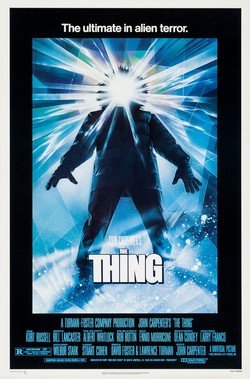
- The poster was painted in a day, and delivered wet. Drew Struzan, given a briefing and almost no information, produced one of the great horror posters in 24 hours. In his own words: “I conceived it, painted it, and my art was delivered to the studio all within 24 hours… when they put it under the glass to photograph it, the paint stuck to the glass because the thing was still wet!”
- The score was insulted, shelved, and then won an Oscar. Morricone’s music was nominated for a Razzie for Worst Musical Score in 1982, and much of his hour of material went unused. Pieces of that unused score later turned up in Quentin Tarantino’s The Hateful Eight — and Morricone finally won his Academy Award for it. One score, two verdicts, thirty-four years apart.
- Keith David acted the film one-handed. David broke his hand in a car accident the day before he was due to start. He filmed with two pins in it, wearing a surgical glove under a black glove painted to match his skin — why Childs’s left hand stays out of sight for the first half.
Harper’s Extras
- The Thing (1982) — the full wiki file: the complete production history of Outpost 31, in crown-jewel depth.
- John Carpenter — the wiki file: the master himself, from Dark Star to the long synth afterlife.
- Halloween (1978) — Harper’s review: Carpenter’s other untouchable. Four years earlier: a knife, a mask and a shoestring. Here: $15 million and Antarctica. The world wasn’t ready for either.
- Crank it: Morricone’s main theme — two synth notes pulsing like a heartbeat under the ice. A maestro imitating his director.
Where to Watch
As of November 5, 2026, it’s streaming on Amazon Prime Video and AMC+, with AMC via TV Everywhere; rent or buy it on Amazon Video, Apple TV Store or Fandango At Home — and the full seasonal board lives in our Halloween Watch Guide.
Frequently Asked Questions
Is The Thing a remake of The Thing from Another World?
Not exactly. Both films adapt John W. Campbell Jr.’s 1938 novella “Who Goes There?” — the 1951 film loosely, changing the creature into a vegetable Frankenstein, while Carpenter’s version returns to Campbell’s actual nightmare: the perfect imitation. Same source; the 1982 telling is the faithful one.
Who was the Thing at the end?
The film refuses to say, and the refusal is the ending. Asked at a preview what happened, Carpenter said it was up to the imagination — and the man replied, in Carpenter’s telling, “Oh, God. I hate that.” Forty years of arguments over that shared bottle settled nothing. That is exactly the temperature the film wants to leave you at.
Why did The Thing flop in 1982?
Timing, tone and competition. E.T. had made the world’s favorite alien two weeks earlier; Blade Runner opened the same day; the summer was stacked with Poltergeist and Star Trek II. Against all that stood the bleakest film a major studio released that year, and the critics savaged it. Home video did what theaters wouldn’t.
Is the 2011 film called The Thing a sequel?
A prequel. It tells the story of the Norwegian camp — the burning madhouse MacReady and Copper fly into — and ends moments before the 1982 film begins, assuming you’ve seen what the dog is running from.
Until next time, fiends — keep the lights low, keep the flamethrower fueled, and if the dog has been watching you a little too long — test the blood. Harper will leave a flare burning for you.
The weekly roundup
One letter a week, from the crypt.
- New reviews, with the ravens
- New wiki entries and news
- Cool stuff worth your night
Weekly. No spam, unsubscribe in one click.