Jaws: The Revenge (1987), the fourth Jaws film, sends a grudge-holding great white shark to the Bahamas after the Brody family. It also roars.
The teaser promised us that man’s deepest fear had risen again. What actually rose, in the summer of 1987, was something else: a shark with a memory, a mileage log, and a personal vendetta against one specific family from Amity Island — a film so determined to continue a story that had ended perfectly in 1975 that it forgot to bring the story with it.
Welcome back to the crypt. Tonight’s file is a cautionary tale about sequels, and this Jaws The Revenge review comes with a confession up front: the crypt reveres the first Jaws the way it reveres very few things on this Earth. Which is precisely why what was done to it in 1987 has to be documented, in full, for the record. Some files we open with pleasure. This one we open with a mop.
Watch the Trailer

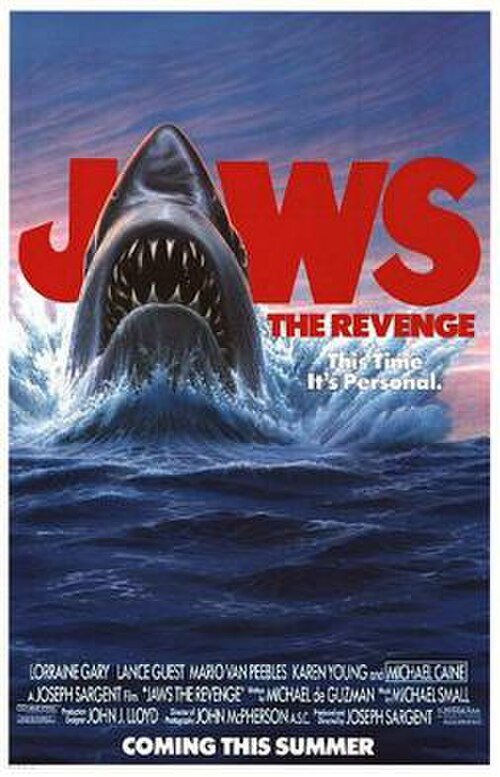
Quick Specs
- Director: Joseph Sargent
- Writer: Michael de Guzman, from characters created by Peter Benchley
- Starring: Lorraine Gary, Lance Guest, Mario Van Peebles, Karen Young and Michael Caine
- Studio: Universal Pictures
- Release date: July 17, 1987
- Runtime: 89 minutes
- Rating: PG-13
- Verdict: 1.5 ravens — taking on water
The Review
Chief Martin Brody is dead — a heart attack, we are told, though Ellen Brody believes the fear killed him. Ellen still lives on Amity Island, near her younger son Sean, now a police deputy like his father. A few nights before Christmas, Sean is sent out alone to clear a log from a channel buoy. The shark takes him in the dark harbour while, up on the dock, a choir of carolers sings Christmas songs loud enough to cover his screams.
Hold onto that scene, fiends, because it is the best one in the film by a distance that embarrasses everything after it — genuinely cruel, genuinely well-staged. Sean’s older brother Michael flies in for the funeral with his wife Carla and little daughter Thea. Michael is a marine biologist working in the Bahamas, and when the family retreats there to heal, Ellen becomes convinced of the film’s thesis: the shark that killed Sean is the same one coming for the rest of them. She can feel its approaches in her bones. And because this is that kind of film, she is right — the shark duly appears in the warm Bahamian water, where the film itself admits great whites are never seen, and begins working through the family’s social calendar: a research dive, a sunken ship, a banana boat full of tourists.
What Works
- Sean’s death is the real thing. The Christmas kill is directed with a meanness the rest of the film never finds again — a man eaten in silence under cover of carols, in the harbour his father made safe. Joseph Sargent was a genuine craftsman (he made The Taking of Pelham One Two Three), and for about four minutes, you can tell.
- Lorraine Gary plays it like a real movie. Gary came out of retirement for this, and she refuses to wink. Her Ellen is a widow drowning in grief and certainty, and she gives the film its one defensible idea: maybe there is no curse — maybe this is simply what unprocessed grief looks like from inside it. Writer Michael de Guzman said the film was “a story of obsession and fear,” and that whether Ellen’s belief was true would “be left up to the audience to decide.” In Gary’s scenes, that better film keeps flickering into view.
- Michael Caine is having a lovely time. As Hoagie, the cheerful pilot courting Ellen, Caine is warm, funny and completely unbothered — a man enjoying the Bahamas in character and, by every account, out of it too. He is never less than watchable, which in this film counts as heavy lifting.
- The score has more dignity than the script. Michael Small treats the material like a thriller that matters, and every time John Williams’ two-note theme surfaces, the old dread stands up for a second before the film sits it back down.
What Doesn’t
- The premise is a shark with a grudge and a travel itinerary. A great white identifies one family, kills a son in Massachusetts, then swims roughly fifteen hundred miles to the Bahamas to continue the feud — against people connected to the deaths of other sharks, in other films, some of which this one pretends never happened. Revenge is a human motive. The shark is not a wronged party in a courtroom drama; it is a fish. The moment the film asks us to believe it keeps a list, the terror drains out and the comedy leaks in.
- Ellen remembers things she never saw. As the finale approaches, Ellen flashes back to the great moments — including her husband’s victory over the first shark, an event that happened miles out at sea while she was ashore, in a film she was barely in. Flashbacks are supposed to belong to the person having them. These belong to the marketing department.
- The shark roars. Roars. Repeatedly. And in the climax it rears out of the water and stands on its tail, thrashing like a defendant addressing the court. The mechanical shark’s troubles are visible in shot after shot — the film won the year’s Golden Raspberry for Worst Visual Effects, which feels less like an insult than a coroner’s finding.
- The middle hour is a tourism film. Junkanoo festivals, conch research, poolside drinks, a gentle middle-aged romance — pleasant footage of the Bahamas, interrupted from time to time by the monster, as if the shark had wandered into the wrong production and was too polite to leave.
- It cannot even end once. There are two endings: in the original American version the impaled shark bleeds out and Jake dies; in the revised version the shark simply explodes on impact — using footage borrowed from the first film’s ending — and Jake climbs out of the water alive. A film unsure how to kill its own shark is a film that was never sure of anything.
The ledger, for the record: made for $23 million, it grossed $51.9 million worldwide — the lowest of the franchise, barely breaking even and ending the series outright. It was nominated for seven Golden Raspberry Awards and won Worst Visual Effects. And it was made at a sprint: greenlit in September 1986 and in cinemas the following July — under nine months, the fastest production in the series, with the final draft of the script dated nine days before filming began. You can see every one of those nine months on the screen.
Full disclosure, as the crypt’s rules require: Think Horror’s verdicts are the desk’s own, from our own screenings, with the wider critical and audience weather consulted for calibration. The calibration here was not a close call in any direction.
The Verdict: Jaws: The Revenge earns 1.5 ravens — taking on water. One real scare, one committed performance, one charming movie star on holiday — and a roaring shark with a family vendetta, in the sequel that ended a perfect franchise by forgetting what made it perfect. Watch the first four minutes. Then go back to 1975, where the water is fine.
Trivia & Facts
- The house that Jaws built. Filming in the Bahamas kept Michael Caine from collecting his Academy Award for Best Supporting Actor (for Hannah and Her Sisters) in person. His verdict since is the most famous review the film ever got: “I have never seen it, but by all accounts it is terrible. However, I have seen the house that it built, and it is terrific!” In his memoir he summed the production up as “the time when I won an Oscar, paid for a house and had a great holiday. Not bad for a flop movie.”
- The studio chief’s wife. Lorraine Gary was married to Sidney Sheinberg, the head of Universal who greenlit the film. Her own cheerful account of the negotiation: “I made a good deal on this film, but I didn’t make as good a deal as I would have if I weren’t married to Sid.” This was her final film role.
- Both awards, same performance. Gary was nominated for the Saturn Award for Best Actress and the Golden Raspberry for Worst Actress for playing Ellen Brody — the industry genuinely could not decide, which may be the most accurate review of all.
- The ones who got away. Roy Scheider and Richard Dreyfuss both declined to return. Scheider appears only in archive footage from the 1975 film, uncredited — which is to say, the only great performance in the movie is twelve years old.
- A sequel that skips a sequel. The Revenge ignores Jaws 3-D completely and follows on from Jaws 2 — one Universal press release earnestly described it as the “third film of the remarkable Jaws trilogy.” Its working title was Jaws ’87.
- Lance Guest had survived this before. Guest, playing Michael Brody, had form with classic horror sequels: he dropped out of UCLA to star in Halloween II (1981).
- Familiar faces in Amity. Lee Fierro cameos as Mrs. Kintner — the mother who famously slapped Chief Brody in the original — and Mario Van Peebles’ father, Melvin Van Peebles, appears as Nassau’s mayor.
- Thea. Little Thea Brody is played by Judith Barsi, a gifted child actor whose life was cut short the year after the film’s release. A generation knows her voice — she was Ducky in The Land Before Time — and the crypt notes her here with respect.
Harper’s Extras
- The tagline is the epitaph. “This time, it’s personal” was meant as a promise. It plays now as a confession — the film really does seem to have had something against the Brodys, and against the audience’s memory of 1975.
- Universal’s water is never safe for long. The studio’s other great water monster — older, lonelier and considerably better behaved — keeps his own file in our Creature from the Black Lagoon records. And for the modern version of the haunted-water idea done right, see our Night Swim review — a film that name-checks Jaws as an influence and earns the comparison more than this sequel ever did.
- The series ended here, and stayed ended. No fifth film, no remake: after The Revenge, the most imitated title in horror simply stopped. The 1975 original’s reputation ultimately did what the studio would not — it protected itself.
Where to Watch
As of November 7, 2026, Jaws: The Revenge streams on Peacock in the US, the current streaming home of the whole Jaws franchise. It is also available to rent or buy on Amazon Video, the Apple TV Store and Fandango At Home. If you are settling in for all four films, start with 1975 and savour it. You will know when the evening has peaked.
FAQ
Is Jaws: The Revenge a sequel to Jaws 3-D?
No. It ignores Jaws 3-D entirely and follows on from Jaws 2 — Michael Brody is a marine biologist again, and the events at SeaWorld are never mentioned.
Why does the shark want revenge?
Because the film needs it to. The story treats Ellen’s conviction — that the shark is hunting her family specifically — as fact, though the filmmakers said the question of whether her belief was real was meant to be left to the audience. Actual great whites neither hold grudges nor, for the record, roar.
Are there really two different endings?
Yes. In the original American ending, the impaled shark bleeds out and Jake dies of his wounds. In the revised ending used internationally and on home video, the shark explodes when impaled and Jake survives.
Has Michael Caine really never seen it?
By his own oft-repeated account, no — he has only seen the house it paid for, which he reports is terrific.
That is tonight’s file, fiends: the sequel that made it personal, and lost. Until next time — check the water, mind the carolers, and if a shark ever follows you to another country, tell someone. Preferably the coast guard, not the tourism board. Sleep tight.
The weekly roundup
One letter a week, from the crypt.
- New reviews, with the ravens
- New wiki entries and news
- Cool stuff worth your night
Weekly. No spam, unsubscribe in one click.