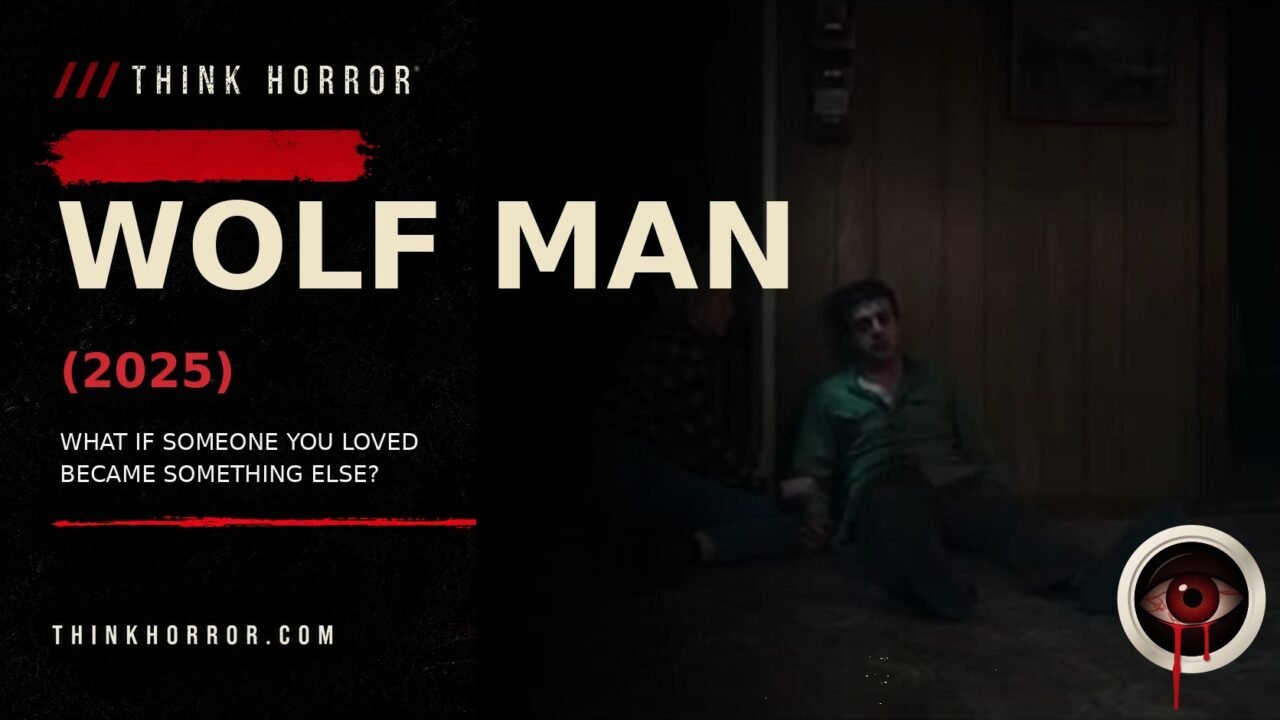
Wolf Man (2025) is Leigh Whannell’s reimagining of the Universal classic, recasting lycanthropy as a degenerative disease that eats a father from the inside out.
There is a moment, about halfway through this film, where Blake Lovell — infected, feverish, losing his teeth and his language — vomits up one of the werewolf’s fingers. It is disgusting, startling and completely serious, and it tells you everything about what Leigh Whannell was trying to build: not a monster movie about a man who becomes a wolf, but a tragedy about a man who becomes a patient. The tragedy works in pieces. The monster movie around it keeps apologising for existing.
Welcome back to the crypt. Every Wolf Man 2025 review has to start with the pedigree, so here is ours: Whannell’s The Invisible Man (2020) is one of the finest modern monster films ever made, and this is the same director, the same studio, the same playbook — take a Universal monster, strip him to one location and one idea, and make the idea hurt. The idea here is a good one. The film built around it is a slow, sad, underpowered thing that keeps its wolf on a leash it never slips.
Watch the Trailer

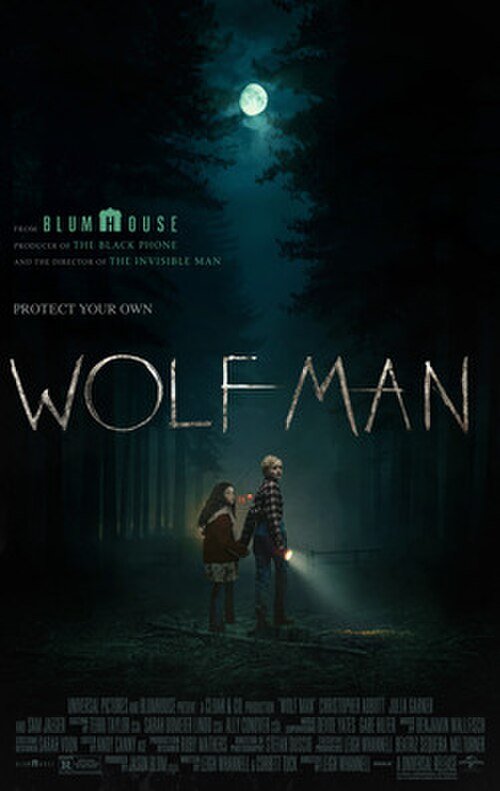
Quick Specs
- Director: Leigh Whannell
- Writers: Leigh Whannell and Corbett Tuck
- Starring: Christopher Abbott, Julia Garner, Matilda Firth and Sam Jaeger
- Studio: Blumhouse Productions / Universal Pictures
- Release date: January 17, 2025
- Runtime: 103 minutes
- Rating: R
- Verdict: 2.5 ravens — on life support
The Review
Oregon, 1995. A hiker has vanished in the mountains, and the locals mutter about “hill fever” — a sickness carried by the wildlife, which the region’s Native tribes called ma’iingan odengwaan: Face of the Wolf. On a hunting trip, young Blake Lovell sees the thing standing in the trees, and his father Grady hustles him up into a hunting blind and spends the night on the radio, asking his friend whether they should go out and hunt it. Thirty years later, Blake (Christopher Abbott) is a writer in San Francisco, married to journalist Charlotte (Julia Garner), father to Ginger (Matilda Firth) — and turning, slowly, into his father: the same temper, the same raised voice he hates in himself. Word arrives that Grady, missing for years, has been declared dead. Blake inherits the childhood home and drives the family north to pack it up and, he hopes, repair the marriage on the way.
In the trees near the house, something steps in front of the truck. It kills their guide, and in the scramble it rakes Blake’s arm open. The family barricades itself inside while the thing outside tests the doors — and the scratch begins its work. Teeth loosen. Sounds sharpen unbearably. His wife’s voice stops resolving into words. Over one long night, in one house, Blake Lovell degenerates — while the creature outside, the one he keeps fighting off to protect his family, turns out to be carrying a secret tattooed on its arm.
What Works
- The disease concept is genuinely harrowing — when the film commits to it. Whannell has said the transformation was modelled on neurodegenerative illness — ALS killed a close friend of his — and it shows in the details: the lost motor control, the aphasia, the family learning to read a face that can no longer speak. The sound design is the masterstroke: as Blake’s hearing mutates, human speech stretches, doubles and decays under him — the film literally layers dialogue in reverse to put you inside a mind losing language. There are passages here that no other werewolf film has ever attempted.
- Christopher Abbott’s body does the acting. Abbott prepared by studying animal movement, and his degeneration is a physical performance of real commitment — the posture going, the head starting to move in short animal checks, the eyes still arriving at recognition a half-second after the body has moved on. He is frightening and pitiable in the same shot, which is exactly the assignment.
- The practical effects honour the lineage. The transformation is prosthetic, staged in increments — designer Arjen Tuiten’s work, applied for up to seven and a half hours a day — and shot in practical light shifts that flip the scene into “wolf vision” without a cut. When Blake chews through his own trapped foot to keep hunting his family, the film’s body horror earns its R outright.
- The ending lands. No spoilers beyond the shape of it: the film closes in that hunting blind from 1995, with Ginger — the one person who could always tell what her father was thinking — translating for him one last time. It is the saddest ending of any Universal monster film, and it is honestly earned.
What Doesn’t
- The wolf himself is a letdown. After all that build, the finished creature is more sick man than wolf — patchy, thinning, underlit, photographed like the film is slightly embarrassed by him. The design was first revealed to the public not in the film but on a costumed performer at a theme-park Halloween event months before release, where it was widely mocked; the film never fully recovers the mystique that moment spent. Lon Chaney Jr.’s 1941 silhouette this is not.
- The pace is a sedative. One location and one night is a discipline; it is also, here, a drag. The middle hour circles the same rooms, the same doors, the same whispered conferences, and the tension that the opening builds so carefully leaks away between set pieces. The Invisible Man escalated. This one idles.
- Charlotte is underwritten until she isn’t. Julia Garner is a superb actor handed a character defined by reaction for two acts — Garner herself researched the stages of grief to give the role an inner arc the script largely leaves her to supply. She supplies it, but you can feel her doing the script’s work for it.
- The scares are rationed past the point of tension. Whannell’s restraint worked when the threat was invisible; a werewolf film that keeps its werewolf in the dark, at a distance, or off-screen for long stretches starts to feel less like discipline and more like doubt about its own monster. The few full-blooded attacks — the pet door, the greenhouse — prove the film could have cut loose more often.
The ledger, for the record: made for $25 million, it grossed $36.8 million worldwide — opening in third place with $10.9 million, a fraction of what The Invisible Man had managed on barely a quarter of the budget — and quietly ended its director’s run of Universal monsters. It found its audience later, the modern way: it became a streaming hit, topping charts a year and more after the cinemas had written it off. There is something fitting in that. This is a small, sad film that was sold as a big one.
Full disclosure, as the crypt’s rules require: Think Horror’s verdicts are the desk’s own, from our own screenings, with the wider critical and audience weather consulted for calibration. The weather on this one was genuinely split, and so is the crypt — the idea deserves better than the film around it, and the film deserves better than its reputation as a punchline.
The Verdict: Wolf Man earns 2.5 ravens — on life support. A brave, mournful reinvention with a great performance rotting at its centre, let down by a wolf that never quite arrives and a pace that mistakes slowness for dread. Whannell set out to make the werewolf film as a hospice drama. He got about two-thirds of the way there — and the two-thirds will stay with you longer than most whole films do.
Trivia & Facts
- This was almost Ryan Gosling’s film. The project began as Gosling’s own pitch — he was to star, with Derek Cianfrance directing, from a script described as in the vein of Nightcrawler. Both men left in late 2023 over scheduling; Gosling kept an executive producer credit, and Whannell — who had been attached years earlier, then left himself — came back to direct the version he had co-written with his wife, Corbett Tuck.
- It started as a universe; it ended as a eulogy. A Wolf Man reboot was first announced in 2014 as part of Universal’s Dark Universe, the shared monster universe that The Mummy (2017) killed on arrival. It took The Invisible Man’s success to revive the character — as a standalone, which is how the monsters have worked best ever since.
- The director’s homework was impeccable. During production in New Zealand, Whannell held weekly screenings for his crew: The Shining, The Thing, The Fly, Under the Skin — and Amour, Michael Haneke’s drama about a couple facing one partner’s decline. That last title is the key to the whole film.
- An old team, reassembled. Cinematographer Stefan Duscio, composer Benjamin Wallfisch and editor Andy Canny all returned from The Invisible Man — the light-shift “wolf vision” was achieved practically on set, by dimming and re-aiming lights mid-take rather than in post.
- Whannell is in the film — barely. The director voices Dan Kiel, the friend on the other end of Grady’s radio in the 1995 prologue, declining to go hunting for the thing in the trees. Sensible man.
- The reveal that reframes everything. Spoiler, plainly marked: the werewolf stalking the family is Grady — Blake’s father, infected in 1995 and still out there. Blake recognises his father’s military tattoo mid-fight. The monster was family; it usually is.
Harper’s Extras
- The files agree. Our Wolf Man (2025) wiki file carries the full production record, and the original still waits in our The Wolf Man (1941) file — Lon Chaney Jr., Jack Pierce’s makeup, and the saddest monster of the classic era, against whom every successor is measured.
- January strikes again. Universal and Blumhouse opened this one in the same mid-January slot as our Night Swim review a year earlier — the calendar’s designated sacrifice. Wolf Man is the better film by a distance, and the slot treated them much the same.
- What the crypt is watching. The film’s second life on streaming suggests the audience eventually found the movie Whannell actually made. If a sad, slow, serious werewolf picture sounds like your evening, this one may play better in your living room than it ever did in a cinema that expected it to roar.
Where to Watch
As of November 7, 2026, Wolf Man streams on Hulu in the US, where it arrived in October and climbed the film chart. It is also available to rent or buy on Amazon Video, the Apple TV Store and Fandango At Home.
FAQ
Is Wolf Man (2025) connected to The Invisible Man (2020)?
Only by personnel and studio. Both are standalone reimaginings of Universal monsters directed by Leigh Whannell for Blumhouse; they share no story, characters or universe.
Is there a full transformation scene?
Not in the classic sense. The change is gradual and clinical — teeth, hearing, language, posture — charted across the night in prosthetic stages, rather than one showcase set piece under the moon.
Why does the wolf look so different from the classic Wolf Man?
By design. Whannell and prosthetics designer Arjen Tuiten built the creature as a sick, degenerating man rather than a furred beast — the look was controversial from its first public reveal at a Halloween theme-park event months before the film opened.
Do I need to see the 1941 film first?
No — this is a full reboot with new characters. But the 1941 film is seventy minutes, features one of horror’s great tragic performances, and will deepen everything this one is attempting. The crypt recommends the double bill in that order.
That is tonight’s file, fiends: the wolf that came in from the cold and sat down by the fire to die. Until next time — if someone you love starts losing their words, hold their hand, barricade nothing, and call it what it is early. Some transformations you cannot fight. You can only witness them kindly. Sleep tight.
The weekly roundup
One letter a week, from the crypt.
- New reviews, with the ravens
- New wiki entries and news
- Cool stuff worth your night
Weekly. No spam, unsubscribe in one click.