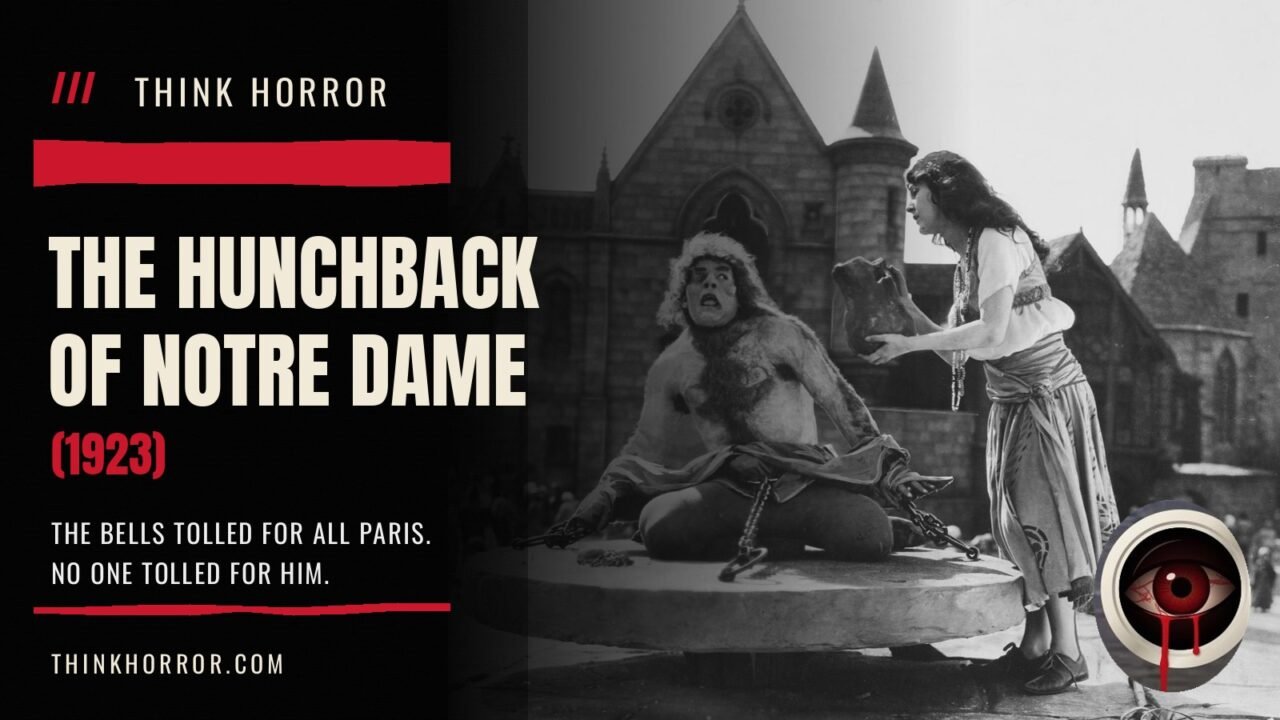
The Hunchback of Notre Dame (1923) is Universal’s silent Gothic epic about Quasimodo, the deaf bell-ringer of Notre Dame, and the dancer who shows him kindness. Before there was a Frankenstein’s monster — before Universal had a horror department at all — there was this: a prestige picture built like a cathedral and a leading man who turned himself into a gargoyle to star in it.
Welcome back to the crypt. A word of honesty before we climb the bell tower: this is a horror film wearing a costume drama’s clothes, and it knows it. Paris, 1482, is rendered as a beautiful machine for cruelty — a city that flogs its bell-ringer for the entertainment of a crowd, then goes to Mass. The monster everyone points at is the kindest creature in the story. The real monsters wear robes, carry sceptres and quote the law. A hundred years on, that arrangement has not dated a day.
Watch the Trailer

Quick Specs
- Director: Wallace Worsley
- Writers: Edward T. Lowe Jr. (scenario) and Perley Poore Sheehan (adaptation), from Victor Hugo’s novel Notre-Dame de Paris (1831)
- Starring: Lon Chaney, Patsy Ruth Miller, Norman Kerry, Brandon Hurst and Nigel de Brulier
- Studio: Universal Pictures
- Release date: September 6, 1923
- Runtime: 117 minutes (original); the Kino Lorber restoration runs 100 minutes (editions vary, up to 110)
- Rating: Not Rated
- Budget: $1.25 million (estimated)
- Box Office: No verified figure
The Review
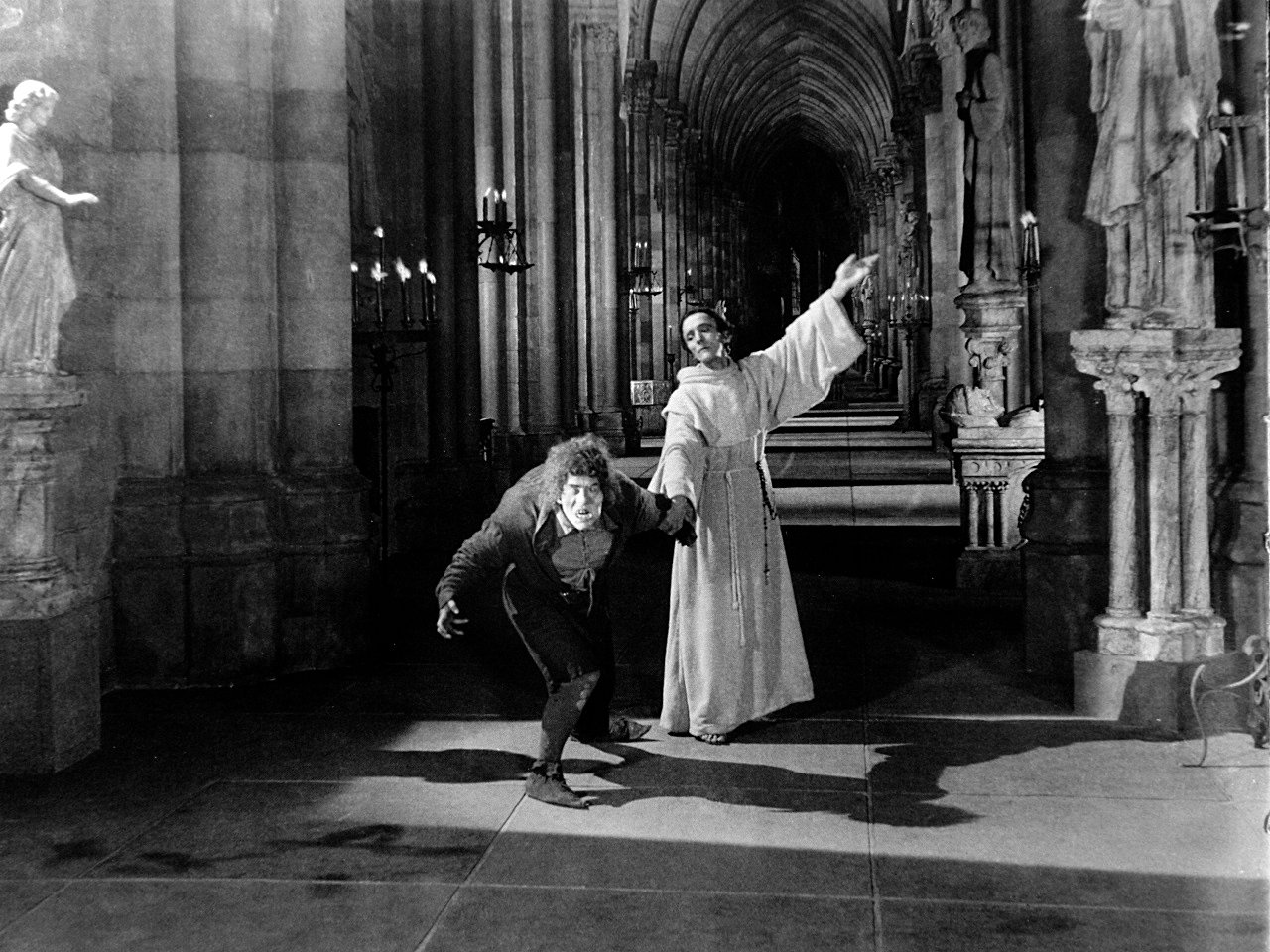
Paris is celebrating the Festival of Fools, and the joke is on everyone. In the square before Notre Dame, the crowd elects the ugliest face in the city as its Pope of Fools — and the face that wins is not a mask. It is Quasimodo (Lon Chaney), the cathedral’s deaf, half-blind bell-ringer, a man the city has made into its favorite entertainment: something to jeer at between sermons. Watching from the cathedral is Dom Claude (Nigel de Brulier), the saintly archdeacon who raised him. Pulling the strings from the shadows is Dom Claude’s brother Jehan (Brandon Hurst), who commands Quasimodo the way a man commands a dog, and who has developed an appetite for Esmeralda (Patsy Ruth Miller), the Romani dancer performing in the square below.
That triangle — the dancer, the devil who wants her and the gargoyle who worships her — is the whole engine, and the film winds it patiently. Jehan orders Quasimodo to snatch Esmeralda off the street. The attempt fails; Captain Phoebus (Norman Kerry) rescues her, and Quasimodo is sentenced to be flogged in the square. What follows is the scene the entire picture hangs on, and one of the great scenes in silent film. Chained to the pillory, whipped, then left in the sun crying out for water while the crowd that adored an hour of his humiliation laughs at him, Quasimodo is saved by the last person Paris would expect: Esmeralda, the woman he tried to abduct, climbs the steps and holds a cup to his mouth. Chaney’s face in that moment — gratitude breaking through a lifetime of expecting the boot — is worth every dollar Universal spent on the sets, and they spent a fortune on the sets.
Because the sets deserve their paragraph. Universal rebuilt fifteenth-century Paris across nineteen acres of its backlot — the cathedral square, the streets, the Court of Miracles where Clopin (Ernest Torrence) rules a kingdom of beggars — across six months of construction, at a cost no two studio histories agree on. Only the cathedral’s lower half stands full-scale; the towers are a hanging miniature, and you will never catch the join. Director Wallace Worsley moves thousands of extras through this city like weather. The spectacle is not decoration. It is the argument: a whole civilization, beautifully built, organized around cruelty — and one deformed bell-ringer floating above it in the towers, closer to heaven than anyone below him.
The picture exists because two men refused to let it die. Chaney had bought the rights to Hugo’s novel himself back in 1921 and carried the project like a relic until it found its unlikely champion in Irving Thalberg, Universal’s brilliant young production chief, who talked studio founder Carl Laemmle into the most expensive production in the company’s history by describing this Gothic horror story as a love story. Filming ran from December 1922 to June 1923, with Worsley conducting his thousands of extras through an early loudspeaker system, a novelty that let one director hold an entire medieval city in his hand.
Patsy Ruth Miller, barely eighteen when the cameras rolled, has the hardest job in the picture: she must be worth all of it — a beggar king scheming, a captain risking himself, a priest’s brother damning himself, and a bell-ringer dying by inches. She plays Esmeralda not as a saint in waiting but as a working dancer with quick feet and quicker wits, kind the way busy people are kind, without making a ceremony of it — which is precisely why the pillory scene devastates. She does not forgive Quasimodo grandly. She simply sees a man dying of thirst where Paris sees a joke, and climbs the steps.
Chaney is the reason the film survives, and he survives it completely. This is the performance that made him a star outright: the twisted posture held for hours, the face built from cotton, collodion and sheer will, and underneath the grotesquerie an actor playing not a monster but a man who has been told he is one so often he has made a roof over the bells out of the sentence. When Esmeralda is framed for a stabbing she did not commit — Jehan’s work, naturally — Quasimodo tears her off the scaffold itself and hauls her into the cathedral, swinging her overhead and howling the one word that matters: sanctuary. It is the film’s loudest moment, delivered by a deaf man in a silent picture, and it lands like a thunderclap.
The last act is a siege. Clopin’s underworld army storms Notre Dame to drag Esmeralda out, and Quasimodo defends his church the way he has defended everything he loves — alone, from above, with beams, stones and a cauldron of molten lead poured onto the square. It is thrilling and it is heartbreaking at once, because the audience understands what Quasimodo cannot: that Jehan is already inside, knife in hand. The hunchback kills his master and is stabbed three times in the back for his trouble, and the film closes on the choice it has been building toward for two hours — the dying bell-ringer in his tower, pulling the rope of the great bell one last time, ringing his own passing over the city that never once rang for him.
Harper’s verdict: 4.5 ravens — Paris is the monster; Chaney is the miracle.
What Works
- Chaney, entirely. The makeup is legendary, but the acting underneath it is the miracle — a complete performance built from posture, hands and one working eye. Every movie monster with a heart, from Karloff’s creature onward, is walking in this man’s shadow.
- The Paris set. Nineteen acres of working medieval city, real cobblestones, statues ten feet tall. Modern productions render this in a computer and it weighs nothing; this weighs everything.
- The pillory scene. Cruelty, spectacle and grace in a single sequence, and the moral hinge of the film: the victim of the attempted kidnapping is the only person in Paris who climbs the steps.
- The cathedral assault. Silent spectacle at full power — crowds, torches, molten lead — staged with a confidence most action films today cannot afford.
- The supporting shadows. Brandon Hurst’s Jehan is silk and rot, and Ernest Torrence’s Clopin presides over the Court of Miracles like a king holding court in a sewer — because he is.
What Doesn’t
- The ending has been declawed. Hugo closes his novel in a charnel house; the film closes with a rescue and an embrace. Esmeralda lives, Phoebus gets the girl, and the tragedy Chaney is playing toward is softened at exactly the moment it should cut deepest. More on this in the FAQ — it is the film’s one real act of cowardice.
- The pageant pacing. The middle of the film sags under processions, subplots and society business at Madame de Gondelaurier’s. A modern viewer’s thumb will itch. Push through it; the last act pays.
- Phoebus, scrubbed clean. In the novel he is a vain seducer who abandons Esmeralda without a backward glance. Here he is a matinee hero. The film loses some salt — and some of Hugo’s contempt for respectable people, which is the book’s real subject.
- The surviving prints. Roughly fifteen to twenty minutes of the original film are simply gone, and battered public-domain dupes of this picture are everywhere. See it in the restored edition or you are seeing a rumor of it.
Trivia & Facts
- It was sold as a love story. Universal’s young production chief Irving Thalberg pitched this expensive Gothic production to studio founder Carl Laemmle as “a love story” — which, in fairness, it is. It cost about $1.25 million — a fortune for 1923 — and became Universal’s biggest silent success.
- A premiere with a warm-up act. The film was first shown at a Carnegie Hall benefit screening on August 30, 1923, then opened at New York’s Astor Theatre on September 2, ahead of its September 6 general release — a roadshow rollout for a picture Universal knew was an event.
- Chaney owned the bell tower. He had acquired the film rights to Hugo’s novel himself in 1921, which bought him unusual creative control — he functioned as an uncredited producer, was paid $2,500 a week, and applied his own makeup — three hours a day in the chair by most accounts, three and a half by others.
- The hump, honestly weighed. By the best modern research — Chaney biographer Michael F. Blake’s — the hump itself was plaster and weighed roughly fifteen to twenty pounds. Strapped into the full harness and cast, the total ran far higher — later accounts say about fifty pounds all in, though they do not agree. The fifty-to-seventy-pound rubber hump of later retellings is publicity inflation, and the crypt declines to repeat it as fact.
- Chaney did not do the famous stunts. Studio publicity said otherwise, but the dangerous cathedral work — the climbs and slides audiences gasped at — was performed unbilled by stuntman Joe Bonomo.
- The set that outlived its century. Laemmle ordered the Paris sets built solidly for reuse, and Universal used them for some forty years — until they were destroyed not by demolition but by the 1967 backlot fire.
- A future master swept the floor. Among the assistant directors on this production was a young William Wyler, who would go on to become one of the most decorated directors in Hollywood history.
- It survives by accident. No complete 35mm print is known to survive. The negative and every 35mm print are gone; the picture lives only because Universal sold 16mm “Show-at-Home” prints in the 1920s and those humble copies endured.
Harper’s Extras
- The house that Quasimodo built. Our Universal Monsters file traces the golden age this film made possible — this is where it truly begins, eight years before the lightning struck at the same studio.
- Eight years later, the monster talks back. Pair this with our file on Frankenstein (1931) and you can watch Universal learn the lesson this film taught it: that a monster played with sympathy can carry a prestige picture — and an entire studio.
Where to Watch
As of November 9, 2026, The Hunchback of Notre Dame is in the public domain and easy to find in the US: it streams free with ads on Tubi, Pluto TV, Plex, The Roku Channel and Xumo Play, free without ads at the Internet Archive and on Kanopy with a library card, and with a subscription on Prime Video. Print quality varies enormously — the edition Harper recommends is Kino Lorber’s Blu-ray of Universal’s 4K restoration, which runs 100 minutes and looks like the cathedral was built yesterday.
FAQ
How much did Quasimodo’s hump really weigh?
Less than the legend says, and it was burden enough. Chaney biographer Michael F. Blake’s research puts the plaster hump at roughly fifteen to twenty pounds; with the full cast and harness added, the load doubled him over — later accounts put the total at about fifty pounds, though they do not agree. The seventy-pound rubber hump found in listicles traces to no reliable source at all.
How does the ending differ from Victor Hugo’s novel?
Completely, and deliberately. In Hugo’s 1831 novel, Esmeralda is hanged; Quasimodo, watching from the tower, pushes his master to his death and then disappears — his skeleton is found years later in the charnel vault, locked in an embrace with hers, where he had lain down beside her body and starved. The film spares her: Esmeralda survives and ends in Phoebus’s arms, and Quasimodo dies alone in his bell tower. The film also splits Hugo’s villain, the archdeacon Claude Frollo, into two brothers — a saintly Dom Claude and a wicked Jehan — so that the Church itself would not have to carry the sin.
Which version should I watch?
Kino Lorber’s 2021 Blu-ray, drawn from Universal’s own 4K restoration, running 100 minutes with a modern score (some editions run up to 110 — check the disc). The film entered the public domain in 1951, so free copies are everywhere, but many are battered, incomplete dupes of dupes. Even the restoration cannot give you everything: the 1923 original ran about 117 minutes, and some fifteen to twenty minutes of it are lost for good.
Is The Hunchback of Notre Dame in the National Film Registry?
No — and the crypt records this with genuine surprise. For all its reputation and influence, the 1923 Hunchback has never been selected for the Library of Congress’s National Film Registry; check the complete listing and it simply is not there. One of the registry’s more curious empty chairs.
The weekly roundup
One letter a week, from the crypt.
- New reviews, with the ravens
- New wiki entries and news
- Cool stuff worth your night
Weekly. No spam, unsubscribe in one click.