You are standing in front of the mirror, and the mirror is not being kind. The castle is cold in the way only old stone can be cold. The candles are doing their best and failing. And the face looking back at you has started to slip — a little softer here, a little greyer there, the years arriving the way winter arrives in the mountains: all at once, and then never leaving.
Now imagine someone told you there was a way back. Not a cream. Not a prayer. A bath. A bath drawn in the blood of girls who still have their whole lives ahead of them, and a mirror that would finally, finally, tell you what you want to hear. That is the bargain at the heart of Countess Dracula, and the woman making it would sell you the whole castle to keep her face.
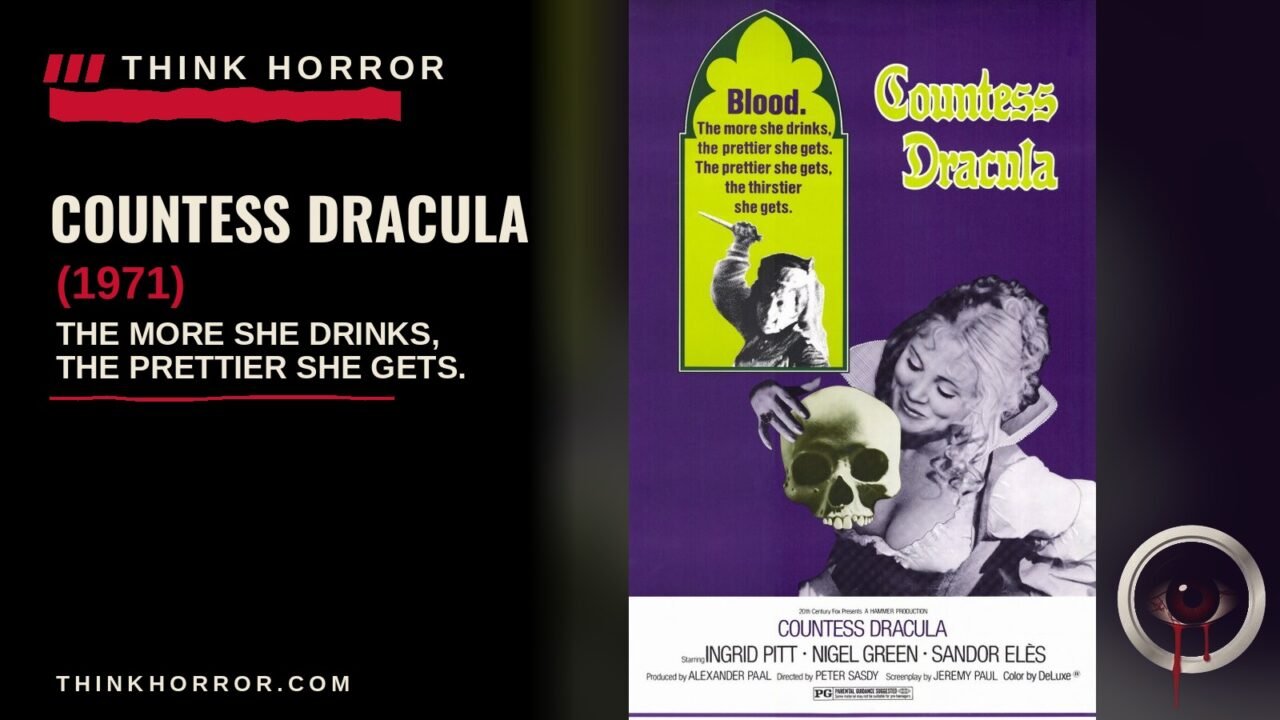
Countess Dracula is Hammer’s blood-bath fairy tale — an aging countess, a stolen face, and a mirror that never lies.

The Review
Here is the first thing you need to know, and Hammer knew it too: there is no Dracula in this film. No cape, no fangs, no Christopher Lee gliding in from the fog. The title is a con, and a deliberate one — the studio’s most famous name slapped on a picture about a Hungarian countess who was never a vampire at all. What she is, is worse in a way vampires never manage. She is a woman who has looked at what time is doing to her and decided that other people should pay for it.
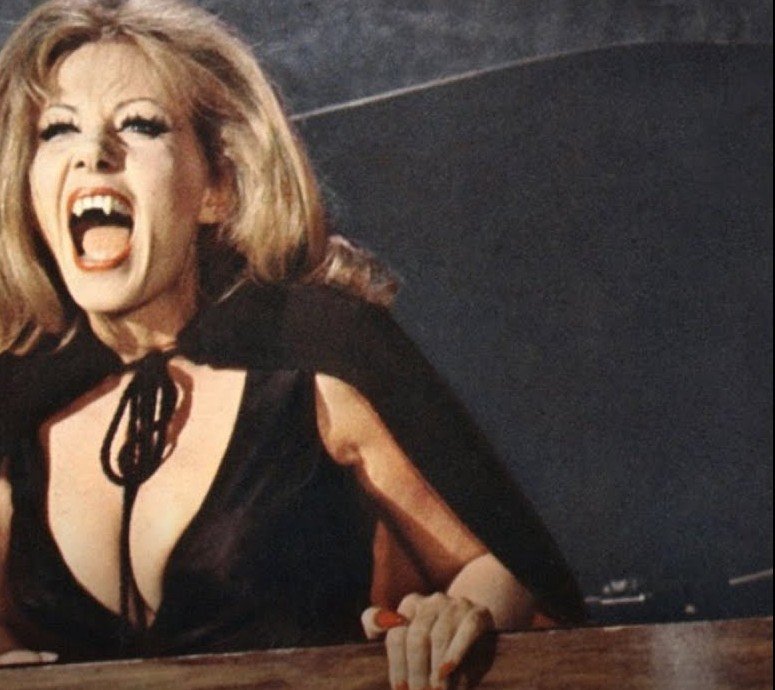
Ingrid Pitt is that woman, and she is the whole reason this film still matters. She plays the widowed Countess Elisabeth Nádasdy in two registers at once: the crone, shuffling through her own castle in heavy old-age makeup, and the beauty, young and gleaming and terrible, after the blood has done its work. The switch between the two is the film’s great trick, and Pitt sells it completely. Watch her in the transformation scenes — the way her body straightens, the way her eyes change, the way she starts to move like someone who owns every room she walks into. It is a performance built out of posture and appetite, and it is superb. The film around her is not always equal to it, but Pitt never lets go of the part.
The story comes from the legend of Elizabeth Báthory, the Hungarian countess accused of murdering young women to keep herself young, and the film keeps the legend’s shape while changing the name on the door. Elisabeth is a widow with a castle, a fortune, and a face she no longer recognises. Her steward and lover, Captain Dobi, played by Nigel Green with a soldier’s bluntness and a schemer’s patience, helps her take local girls — quietly, efficiently, the way you would run any other household business. Her maid Julie, played by Patience Collier, does the rest. And when the blood works, Elisabeth does what any woman who has just been handed her youth back would do: she falls in love with a handsome young lieutenant named Imre Toth, played by Sandor Elès, and she decides to become someone else entirely to keep him.
That someone else is her own daughter. Ilona, played by Lesley-Anne Down — sixteen years old when this film came out, and already carrying herself like a grown actor — is locked away in the woods while her mother walks around in her name, wearing her youth like a borrowed dress. It is a vicious idea, and the film knows it is vicious. The scenes where Elisabeth-as-Ilona plays the innocent girl for Toth have a queasy charge to them, because you know exactly what she is and exactly what she is doing, and the film never lets you forget the girls in the cellar who paid for the performance.
Sandor Elès makes a fine romantic lead, all cheekbones and uniform, and Maurice Denham, as the castle historian Fabio, is the film’s conscience — the one man who starts putting the pieces together and understands what the blood is for. Denham does wonderful work here, fussy and frightened and brave in the exact proportions the part needs. And Green is the film’s spine: Dobi is not a villain in the scenery-chewing sense, he is a working man who has hitched himself to a monster and is too deep in it to climb out. The scenes between Green and Pitt have the tired, married rhythm of two people who have been committing crimes together for years.
Peter Sasdy directs it the way he directed Taste the Blood of Dracula the year before — elegantly, slowly, with a camera that loves candlelight and stone. This is not a film in a hurry. It takes its time with the castle, the costumes, the rituals of a household that runs on secrets. Some of that patience pays off beautifully: the film looks far richer than its budget, because Hammer Films got to shoot on sets left over from Anne of the Thousand Days, and Kenneth Talbot’s cinematography makes the borrowed grandeur feel earned. The castle is drab in the right way — vast, echoing, sparsely populated — a place built for a court that has already left. Harry Robertson’s score does the rest, all low strings and unease.
But the patience has a price, and the price is the middle of the film. Once the premise is set and the machinery of the murders is running, Countess Dracula settles into court intrigue — who suspects whom, who is lying to whom, the slow knotting of the household — and the intrigue is not quite strong enough to carry the running time. The film is at its best when it is about Elisabeth and the mirror, about wanting and what wanting costs. When it wanders away from her into the castle’s politics, it thins out. Howard Thompson put his finger on it when the film reached America: the direction is smooth and pointed, the dialogue has a crisp, cutting edge, and then the last act runs out of gas, along with the desperate old woman. He was right about the last act. The film’s ending arrives more as a pile-up than a climax, and you can feel the picture hurrying to close its accounts.
David Pirie, writing at the time, called the acting extremely poor, and he was not entirely wrong about the supporting players — some of the smaller performances are stiff in that particular way Hammer’s later films could be stiff. But he also saw what the film actually has: it frequently takes on a nightmare quality, and Pitt brings to the part a potent aura of physical corruption that is especially effective in the transformation scenes. That is the film in one sentence, really. It is not a great Hammer film. It is a flawed, strange, sometimes tiresome one with a great central performance and a premise that never stops being disturbing.
And that premise is what lingers. This is a film about a woman who refuses to be erased by age, and who chooses murder over invisibility. The horror is not supernatural — there is nothing here that could not happen in a house with enough money and enough silence. Elisabeth does not need fangs. She needs a bath, a steward, and a castle full of people who look the other way. The Bathory legend has always been about that, underneath the blood: not the monster in the dark, but the aristocrat who decided other people’s lives were hers to spend. Sasdy and Pitt understand that, and when the film remembers it, it is genuinely chilling.
There is one more thing worth saying plainly, because the title tries to hide it: this is not a vampire picture, and it is better for not being one. Hammer Films made this in the early seventies, when the Dracula series had run its course and the studio was casting around for new blood, so to speak. Taking the Bathory legend and refusing to make her a vampire was a real choice, and it gives the film its own queasy identity — historical horror, gothic horror, a fairy tale with the sugar scraped off. The blood here is not magic. It is just blood, and that is the point.
So the ledger, plainly. Come for Pitt, who is magnificent, and stay for the atmosphere, the sets, the slow dread of a house that eats girls. Forgive the sagging middle and the rushed ending. The mirror never lies, and neither does this film about what vanity costs when it has a castle and a steward to do its bidding.
Quick Specs
- Director: Peter Sasdy
- Screenplay: Jeremy Paul
- Starring: Ingrid Pitt, Nigel Green, Lesley-Anne Down, Sandor Elès
- Music: Harry Robertson
- Cinematography: Kenneth Talbot
- Editor: Henry Richardson
- Producers: Alexander Paal
- Production Company: Hammer Film Productions
- Distributor: Rank Film Distributors (UK); 20th Century Fox (US)
- Premiered: 31 January 1971 (London)
- Runtime: 93 minutes
- Rating: PG
- Budget: Not disclosed
- Box Office: Not reported
- On This Site: Ingrid Pitt
Spoiler Section
Here is the turn the film keeps hidden until it cannot hide it any longer: not all blood works. Elisabeth kills a prostitute called Ziza, and the blood does nothing for her at all. Fabio, the historian, has the answer in a book — only the blood of a virgin will restore her. So the hunt narrows. A peasant girl, bought in the marketplace like a sack of flour, is the next to die, and by then the film has shown you exactly how cheap a life is in this castle.
Fabio tries to tell Toth the truth, and Dobi kills him for it before the words get out. Then Dobi, who has been loyal until loyalty stops paying, exposes Elisabeth to Toth himself — shows him the old woman under the young face — hoping to drive the lieutenant away from her. It does not work. Elisabeth forces Toth into marrying her anyway, dragging him to the altar with the whole machinery of the house behind her.
And then the real Ilona comes home. Dobi had brought her back as a sacrifice, and Julie — who loved the girl like a daughter — frees her instead. The wedding goes ahead with the true daughter in the room, and the moment the priest pronounces the blessing, Elisabeth’s stolen youth deserts her. She ages in front of everyone, years arriving all at once, the mirror’s revenge delivered in public. She lunges for her daughter with a knife, and in the struggle she kills Toth instead — the young man she murdered all those girls to keep.
The law is swift and unromantic after that. Elisabeth, Dobi and Julie are all sentenced to death, and the film’s last image of them is the three of them in a cell, waiting for the hangman. Outside, the peasants curse her as a devil woman and as Countess Dracula — the name the film has been holding back the whole time, finally spoken by the people she preyed on. It is not a supernatural ending. It is a hanging. And that, for Hammer, is the bleaker choice.
Trivia
- Ingrid Pitt’s voice in the film is not her own — she was dubbed by Olive Gregg, and the dubbing is uncredited.
- The castle was not built for this film at all. Hammer shot on sets left over from Anne of the Thousand Days (1969) at Pinewood Studios, which is why the picture looks far grander than its budget.
- The images in the opening titles are parts of an 1896 painting by the Hungarian artist István Csók, showing Báthory and the torture of young women.
- The British Board of Film Classification asked for cuts for violence. Hammer appealed, and the film went out uncut in the UK.
- Lesley-Anne Down was sixteen when the film came out. This was not her debut — that was The Smashing Bird I Used to Know in 1969 — but Ilona was one of her first film roles.
- The real Elizabeth Báthory lived from 1560 to 1614. The film’s “Nadasdy” is her married name — her husband was Ferenc Nádasdy.
- Sasdy and his producer Alexander Paal were both Hungarian émigrés working in England. Sasdy was born in Budapest and left Hungary after the 1956 revolution, which makes this the most authentically Hungarian take on the Báthory legend Hammer ever made.
- Countess Dracula was Sasdy’s second Hammer feature, following Taste the Blood of Dracula (1970). He would go on to direct Hands of the Ripper the same year.
Where to Watch
As of November 11, 2026, you can watch it free with ads in the US on Tubi, The Roku Channel, Plex, Shout! TV and Fawesome, with Prime Video’s free-with-ads tier carrying it too, and it turns up on the Shout! Studios and Cultpix services as well. If you would rather own it, Amazon Video has it to rent or buy. No subscription home in the US — it lives on the free-with-ads shelves, which suits a Hammer picture of this vintage just fine.
The Verdict
Countess Dracula is a middling Hammer with a magnificent centre. The middle sags, the ending hurries, and some of the supporting play is stiff enough to creak — but Pitt is superb, the premise never stops being disturbing, and the transformation scenes are the real thing. This is not a vampire film, and it is all the better for it: the horror here is a woman, a bath, and a household that looks the other way.
Rating: 3 ravens out of 5.
The weekly roundup
One letter a week, from the crypt.
- New reviews, with the ravens
- New wiki entries and news
- Cool stuff worth your night
Weekly. No spam, unsubscribe in one click.