You are running through a storm in a city you do not know, and the rain is coming down hard enough to hurt. The taxi has already gone. The street is empty except for the wind throwing water against the windows of a building that should not be there — a house too tall, too red, too ornate for the quiet German street it stands on, its facade borrowed from the Whale House in Freiburg and blown up to a size no real building should be. The doors are closed. Nobody is coming to let you in. And somewhere behind those doors, a girl you have never met is already screaming.
That is how Dario Argento opens Suspiria. Not with a warning. Not with a slow burn. With a young woman arriving in the rain and a murder so savage it still shocks nearly fifty years later. You are Suzy Bannion, and you have just walked into the wrong school.
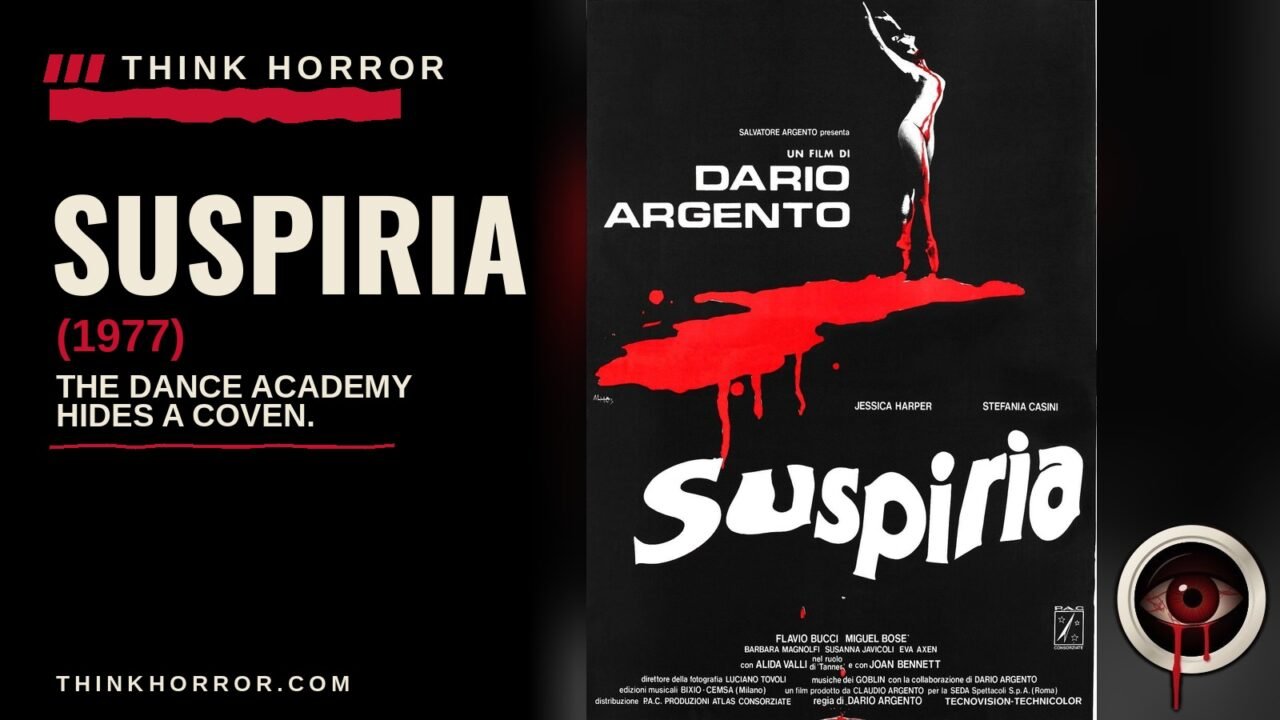
Suspiria (1977) is Dario Argento’s Technicolor nightmare — an American ballet student walks into a German dance academy run by a coven of witches.
Quick Specs
- Director: Dario Argento
- Screenplay: Dario Argento, Daria Nicolodi
- Starring: Jessica Harper, Stefania Casini, Flavio Bucci, Miguel Bosé, Barbara Magnolfi, Susanna Javicoli, Eva Axén, Alida Valli, Joan Bennett
- Music: Goblin (credited as The Goblins), with Dario Argento
- Cinematography: Luciano Tovoli
- Editor: Franco Fraticelli
- Producers: Claudio Argento
- Production Company: Seda Spettacoli
- Distributor: 20th Century Fox
- Premiered: February 1, 1977 (Italy); August 1977 (US theatrical)
- Runtime: 99 minutes (unrated cut; the US R-rated cut ran 92 minutes)
- Rating: R
- Budget: $3,000,000–$4,000,000 (reported figures vary)
- Box Office: 1.43 billion lire (Italy)
- On This Site: Suspiria in the wiki · Dario Argento · Mia Goth
The Review
Any honest Suspiria (1977) review has to begin with the color, because the color is the first thing that hits you and the last thing you forget. This is not a film that looks like other films. It looks like a dream someone had after falling asleep in front of a stained-glass window. The reds are so red they stop being a color and start being a presence. The blues cut like cold water. The greens feel poisoned. Nothing in the frame looks like the real world, and that is the point — Argento and cinematographer Luciano Tovoli built a place that could not exist anywhere except inside a nightmare, and then they locked the doors and left you in there with it.
The story itself is simple, and Argento knows it. Suzy Bannion, an American ballet student played by Jessica Harper, arrives in Freiburg, West Germany, to study at the Tanz Akademie, a prestigious co-ed dance school. On her first night she sees another student, Pat Hingle, flee the school in terror — and by the time Suzy finds a bed for the night, Pat is dead, stabbed again and again and then hanged through a skylight while her friend dies beside her, impaled by falling glass. Suzy walks into the academy the next morning anyway. That is the whole trick of the film: the heroine walks through the front door after watching the warning run past her in the rain, and so do you.
What follows is not really a mystery. It is a haunting. The academy is run by Miss Tanner, the head instructor, played by Alida Valli with the rigid bearing of a woman who has never once doubted herself, and Madame Blanc, the deputy headmistress, played by Joan Bennett with a warmth that never quite reaches her eyes. The other students — Sara, Olga, Sonia, Mark — drift through the corridors like sleepwalkers. The blind pianist Daniel is fired when his dog bites Blanc’s nephew, and that same night the dog turns on him and tears his throat out. Maggots rain from the ceilings because a shipment of spoiled food is rotting in the attic. Sara, the one friend Suzy makes, is chased through the school and falls into a pit of razor wire with her throat cut. None of it makes tidy sense, and none of it needs to. A coven does not run on logic. It runs on appetite.
The secret at the center is the Three Mothers, drawn from Thomas De Quincey’s Suspiria de Profundis — Mater Suspiriorum, the Mother of Sighs; Mater Tenebrarum, the Mother of Darkness; Mater Lacrymarum, the Mother of Tears. The academy was founded by Helena Markos, an alleged witch, and she is still there, in a hidden room behind a door that opens when you turn a blue iris on a mural. Suzy finds her by following the sound of footsteps and by remembering two words Pat spoke before she died: “secret” and “iris.” The old woman sleeps in the dark with the labored breathing Sara recognized from behind a curtain. What happens when Suzy wakes her — and what the school costs everyone inside it — is in the Spoiler Section below.
That is the shape of the story, and if you are waiting for me to tell you it is clever, I will not. It is not clever. It is a fairy tale told by a man who believes in witches, and fairy tales do not need to be clever. They need to be true to their own dread. Argento understands that the way a child understands a dark hallway: the fear is not in what happens, it is in what the place is. The academy is the monster. The witches are its hands.
What makes the film immortal is not the story but the senses. The look comes first. Argento shot the film on ordinary color negative and had it printed using the Technicolor dye-transfer process — the old imbibition method that made The Wizard of Oz and Gone with the Wind glow — on the last dye-transfer machine left in Rome. The color is why the film still looks like nothing else. He told Tovoli to reproduce the color of Walt Disney’s Snow White (1937), and to take the other half of the look from Powell and Pressburger’s The Red Shoes (1948). Production designer Giuseppe Bassan built the academy as a trap: corridors that turn at wrong angles, walls covered in patterns that seem to move if you stare at them, rooms drenched in red. The majority of the film was shot on constructed sets at the De Paoli studios in Rome, with location work in Munich — Daniel’s death in the Königsplatz square, the opening at Munich-Riem Airport, a scene outside the BMW Headquarters — and the mix of real places and built sets is part of the disorientation. You can never quite tell which walls are real.
Then there is the sound. Goblin’s score is not music that sits under the film. It is the film’s second voice, and it never stops talking. The band — credited on screen as The Goblins — worked with Argento on a score that is as strange and relentless as the images, and it plays over the opening murder before you have had time to settle, and it does not let go. The sound is so relentless that the film feels louder than it is; the quiet passages are as frightening as the loud ones. Nearly all the dialogue was dubbed in post-production, standard practice for Italian films of the time, and the slight dislocation between the voices and the faces only adds to the dream. Nobody in this film sounds quite like they belong in the room they are standing in, and that is exactly right for a school run by witches.
Jessica Harper carries the film, and she carries it the way a good final girl should: not by being the strongest person in the room, but by being the one who keeps looking. Suzy is not a detective. She is a dancer, and dancers notice footsteps, and footsteps are what save her. Harper plays her with a wide-eyed steadiness that never tips into hysteria, and the film needs that anchor, because everything around her is spinning. Valli is magnificent as Tanner — clipped, cruel, and utterly certain — and Bennett gives Madame Blanc the terrifying politeness of a woman who has been running a coven so long she no longer sees the evil in it. The two of them together are the film’s real villain: not a monster with a face, but an institution with a smile.
It is worth saying plainly what the film is not. It is not a giallo, though Argento made his name in that form. The giallo is a puzzle with a killer at the end of it, and Suspiria has no puzzle and no killer in any ordinary sense. The deaths are not clues. They are the school feeding. It is also not a film that explains itself. Professor Milius, the occult expert Suzy consults, tells her a coven draws its strength from its leader, and without a leader the coven perishes — and that is the whole of the film’s theology. There is no deeper rule. The witches change the course of events and people’s lives, but only to do harm. That is all you get, and it is enough.
The film’s influence is everywhere once you start looking. It is the first of Argento’s Three Mothers trilogy, followed by Inferno (1980) and The Mother of Tears (2007), and the idea of the three witches — Sighs, Darkness, Tears — has been borrowed by horror ever since. The 2018 remake by Luca Guadagnino, starring Dakota Johnson, Tilda Swinton, Mia Goth and Chloë Grace Moretz, took the same premise and built a much longer, colder film out of it — a $20 million production that made about $7.7 million, which Guadagnino himself called a box-office disaster. The remake is a serious film, and it has its admirers, but it is a different animal. Argento’s version is the one that put the coven in your head and left it there.
If the film has a weakness, it is the one every fever dream has: at some point the logic gives way entirely, and if you need a story to hold together in the daylight, Suspiria will frustrate you. Sara’s notes vanish without explanation. The coven means to make Suzy a human sacrifice, but the film never tells you why her, or why now. The final confrontation happens in a hidden room that the film has not quite earned. But to hold that against Suspiria is to complain that a nightmare does not have a plot. The film’s job is not to make sense. Its job is to make you feel the walls closing in, and it does that job better than almost any horror film ever made.
Come for the color. Stay for the sound. Leave with the feeling that somewhere, in a building far too beautiful to be innocent, the lights are still on and the dancing has not stopped.
Spoiler Section
Spoilers ahead. Do not read past this line unless you have already seen the film.
The ending: Suzy discovers the hidden corridor behind the blue iris in Madame Blanc’s office and finds the academy’s instructors plotting to sacrifice her. She hides in an alcove and finds Sara’s disfigured corpse. Pursued by Pavlos, she retreats into Helena Markos’s bedroom, where the witch — Mater Suspiriorum, the Mother of Sighs — is sleeping. Suzy wakes her by breaking a decorative peacock. Markos turns invisible and taunts her, then reanimates Sara’s corpse to kill her. When lightning flashes, it reveals Markos’s silhouette, and Suzy drives one of the peacock’s broken glass quills through the witch’s neck. Markos’s death makes Sara’s corpse vanish. The academy explodes and burns; Miss Tanner, Pavlos and the rest of the coven die with their leader gone. Suzy escapes into the rainy night as the school is consumed by fire.
The coven’s leader is dead, and the coven dies with her — that is the rule Professor Milius gave Suzy, and the ending honors it. Pat Hingle’s murder is the first of the film’s deaths, and Suzy’s escape is the last of them. Everything in between is the academy feeding on its own students.
Trivia
- The band Goblin is credited on screen as “The Goblins” in the opening credits.
- The 2018 remake was directed by Luca Guadagnino and starred Dakota Johnson, Tilda Swinton, Mia Goth and Chloë Grace Moretz. Made for $20 million, it earned about $7.7 million worldwide; Guadagnino called it a box-office disaster.
- “Suspiria” is Latin for “sighs.”
- The US premiere was in July 1977, through 20th Century Fox’s International Classics shell company, and the wider US theatrical release followed in August 1977.
Where to Watch
As of this writing, the 1977 Suspiria is streaming on the Fandor, Screambox and Midnight Pulp Amazon Channels, and you can watch it free with ads on Tubi, Philo, The Roku Channel and Plex, or free through a library card on Hoopla and Kanopy. If none of those suits you, it is available to rent or buy on Amazon Video. Listings change, so check before you settle in — and make sure you are watching Dario Argento’s 1977 film, not the 2018 remake, because the two are very different nights out. Checked November 10, 2026.
The Verdict
Suspiria is not a film you watch so much as a film you survive. It does not have the cleverest plot or the tidiest logic, and it does not need them. It has the most beautiful images in horror, a score that gets under your skin and stays there, an opening murder that has not lost a drop of its force in nearly fifty years, and a school that feels genuinely haunted in a way no set has felt since. It is the high-water mark of Argento’s career and one of the great horror films, full stop. If you have never seen it, see it loud and in the dark. If you have seen it, you already know why you are going back.
Rating: 4.5 ravens out of 5.
The weekly roundup
One letter a week, from the crypt.
- New reviews, with the ravens
- New wiki entries and news
- Cool stuff worth your night
Weekly. No spam, unsubscribe in one click.