
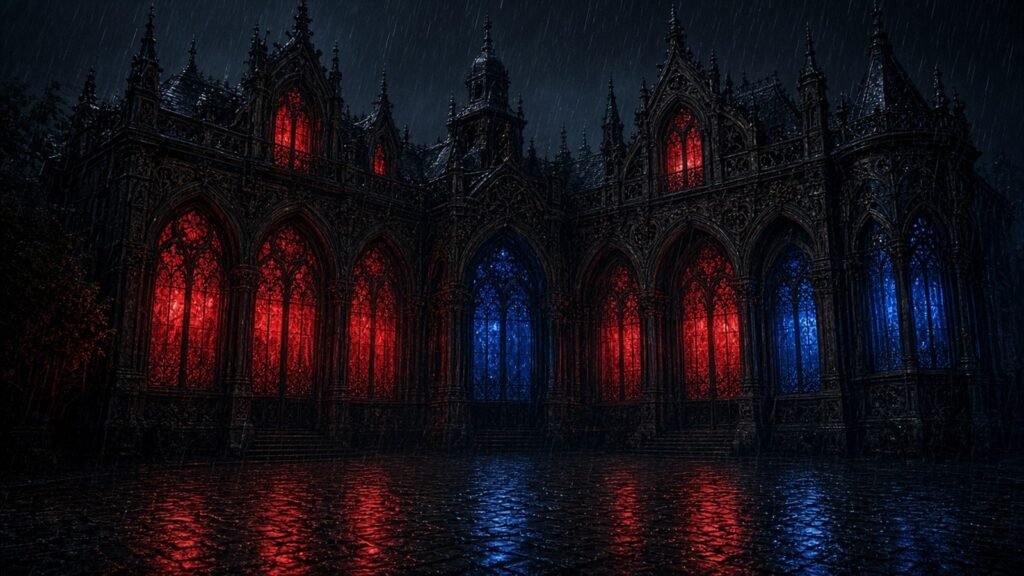
Suspiria (1977) is Dario Argento’s Italian supernatural horror film about an American ballet student who discovers her dance academy is a witches’ coven.
Some horror films scare you with what they show. Suspiria scares you with how everything looks and sounds while it shows you. Argento and his co-writer, Daria Nicolodi, send Suzy Bannion, played by Jessica Harper, through a rainstorm to a dance academy in Freiburg, and from the first minutes the film is drenched in colour so saturated it feels like a fever and a score by the band Goblin that seems to breathe down your neck. It is the first film of Argento’s Three Mothers trilogy, the moment he turned from the giallo murder mystery to outright supernatural horror, and one of the most influential horror films ever made.
At a glance
| Director | Dario Argento |
| Screenplay | Dario Argento and Daria Nicolodi |
| Inspired by | Suspiria de Profundis (1845), the essay collection by Thomas De Quincey |
| Producer | Claudio Argento |
| Starring | Jessica Harper, Stefania Casini, Flavio Bucci, Miguel Bosé, Alida Valli, Joan Bennett, Udo Kier |
| Cinematography | Luciano Tovoli |
| Editing | Franco Fraticelli |
| Music | Goblin, with Dario Argento |
| Production design | Giuseppe Bassan |
| Production company | Seda Spettacoli |
| Distribution | Produzioni Atlas Consorziate (Italy); International Classics, a 20th Century Fox shell company (United States) |
| Release date | 1 February 1977 (Italy); summer 1977 (United States) |
| Running time | 99 minutes, Italian original (also listed at 98); the original US release was cut by eight minutes |
| Country and languages | Italy; performed principally in English, with Italian, German, Russian and Latin |
| Rating | R (US release, after the cuts) |
| Series | first film of the Three Mothers trilogy, followed by Inferno (1980) and The Mother of Tears (2007) |
Plot
Suzy Bannion, an American ballet student, arrives in a storm at the Tanzakademie in Freiburg, Germany. She arrives on the night another student, Pat Hingle, flees the academy in terror. Suzy is turned away at the door. Pat runs to a friend’s apartment for shelter, and that night she is murdered there, the first of the film’s great set-piece killings.
Admitted the next day, Suzy finds a school run with icy discipline by Madame Blanc and the formidable instructor Miss Tanner. Something is wrong with the building and the people in it. Students sicken. Suzy is drugged by the academy’s food and keeps fighting to stay conscious. A rain of maggots falls from the attic, the girls are moved into a makeshift dormitory, and through the dividing curtain Suzy hears the staff’s strange nocturnal routine: the teachers do not leave at night when they say they do.
Her friend Sara has been investigating exactly that: where the staff go every night. Sara is hunted through the academy and killed, trapped and cut down in a room full of coiled wire. The blind pianist, Daniel, is dismissed after his guide dog bites a child; walking home through a deserted monumental square at night, he is mauled to death by his own dog.
Alone now, Suzy puts Sara’s clues together, follows the staff’s footsteps and finds a hidden passage behind Madame Blanc’s office.
The ending
Beyond the passage the coven is at ritual. The academy is a front, and the woman in charge is not Madame Blanc. It is Helena Markos, the academy’s ancient founder, hidden inside the building: Mater Suspiriorum, the Mother of Sighs. Suzy kills Markos with a sharp shard from the room’s ornamental glass peacock, and the academy collapses and burns around her as she escapes into the night.
The mythology under the plot comes from De Quincey. Mater Suspiriorum is the eldest of three sorrowing sisters, with Mater Tenebrarum, the Mother of Darkness, and Mater Lachrymarum, the Mother of Tears, still to come. Argento would give them their own films in Inferno and The Mother of Tears.
Cast
- Jessica Harper as Suzy Bannion
- Stefania Casini as Sara
- Flavio Bucci as Daniel, the blind pianist
- Miguel Bosé as Mark
- Barbara Magnolfi as Olga Ivanova
- Susanna Javicoli as Sonia
- Eva Axén as Pat Hingle
- Alida Valli as Miss Tanner
- Joan Bennett as Madame Blanc
- Udo Kier as Dr. Frank Mandel
- Rudolf Schündler as Professor Milius
- Lela Svasta as Helena Markos, Mater Suspiriorum (uncredited in many listings)
- Dario Argento as the narrator (voice, Italian version)
Production
Argento and Nicolodi built the story from Thomas De Quincey’s Suspiria de Profundis, an 1845 collection of essays rather than a novel, and specifically from its “Levana and Our Ladies of Sorrow” material, which supplies the Three Mothers. Nicolodi brought her fascination with fairy tales and scary children’s stories to the collaboration, and she has said the plot was inspired by a story her grandmother told her.
The students were written younger. In the original screenplay they were children of about twelve, and producer Claudio Argento, the director’s brother, and the studio insisted they be aged up to avoid censorship trouble over violence against children. That is why the dialogue and behaviour of the girls still read as childlike, and why the academy’s doorknobs are mounted conspicuously high, a surviving trace of a set built at a child’s scale.
Argento cast Jessica Harper after seeing her in Brian De Palma’s Phantom of the Paradise (1974). Harper later described the shoot as “very, very focused,” with Argento knowing exactly what he was looking for. Around her he mixed Italian, German, Austrian and American performers, with Udo Kier in the small role of the psychiatrist Dr. Frank Mandel and Joan Bennett as Madame Blanc in her final film role.
Most of the film was shot on constructed sets at De Paolis Studios in Rome, including the academy’s façade, replicated from a real Freiburg building, the Haus zum Walfisch, or Whale House. Location work took the crew to Munich: the opening at Munich-Riem Airport, Daniel’s death in the Königsplatz, and Suzy’s conversation with Dr. Mandel outside the BMW headquarters.
The colour and the sound
The look is the film’s legend, so it is worth getting right. Suspiria was shot on Eastmancolor stock with anamorphic lenses, and its saturated colour comes from imbibition Technicolor prints, the dye-transfer process. It was not photographed in three-strip Technicolor. Argento and his cinematographer, Luciano Tovoli, took Disney’s Snow White (1937) as their explicit reference. “We were trying to reproduce the colour of Walt Disney’s Snow White,” Argento said.
The sound is the other half. Goblin, credited with Argento, wrote the score: pounding drums, synthesisers and whispered voices that make the building feel alive. The band’s credited members on the film are Agostino Marangolo, Massimo Morante, Fabio Pignatelli and Claudio Simonetti. The music is treated across the film’s history as inseparable from its effect, and it has been widely sampled by later musicians.
Release
Suspiria opened in Italy on 1 February 1977. 20th Century Fox acquired the American rights but, nervous about the violence, released the film in the summer of 1977 through a shell company, International Classics, with the Fox branding scrubbed off. The original American prints were cut by eight minutes to win an R rating.
There is no clean box-office number for this film, and anyone who quotes one without a label is guessing. At home it was a major hit, grossing 1.43 billion lire in Italy. In North America it earned $1.8 million in theatrical rentals, the distributor’s share rather than the full gross, and it became Argento’s biggest American success of the era. No verified original worldwide gross survives in the modern box-office databases: their small five-figure totals for the title come from revival screenings from 2017 onward, not from the 1977 run. No verified production budget exists either.
Legacy
Suspiria is recognised as one of the most influential films in the horror genre and is routinely placed at or near the top of Argento’s filmography. It opened the Three Mothers cycle, completed by Inferno in 1980 and The Mother of Tears in 2007.
Most new viewers now meet it through the 4K restoration made from the original camera negative, which toured festivals and revival houses from 2017 for the film’s 40th anniversary and led to new home-video editions, including a Synapse Films release in March 2018.
A 2018 film shares the title. Its director framed it as a homage, a cover version, rather than a straight remake, and its cast, credits and money belong to that film alone.
Trivia
- The heroine’s credited name is Suzy Bannion, and the academy’s founder is Helena Markos.
- Suspiria is an Italian production set in Germany and performed largely in English, not an American film.
- Dario Argento voices the narrator in the Italian version.