The aerialist falls, and the whole circus sees what she lands as: a broken girl in the sawdust, the show ruined, the crowd already turning away. Only one pair of eyes stays. In the dirt at the ring’s edge, a circus clown with a large cyst nobody has ever asked a question — a clown, a freak, property — is reading her injuries like print, naming the fractures, calling for what he needs with the calm of a man who has studied bodies the way other men study scripture. He saves her life in front of everyone. Then a medical student named Victor Frankenstein steps out of the audience, and saves his. Yours is the seat beside them both. Watch what gratitude builds.
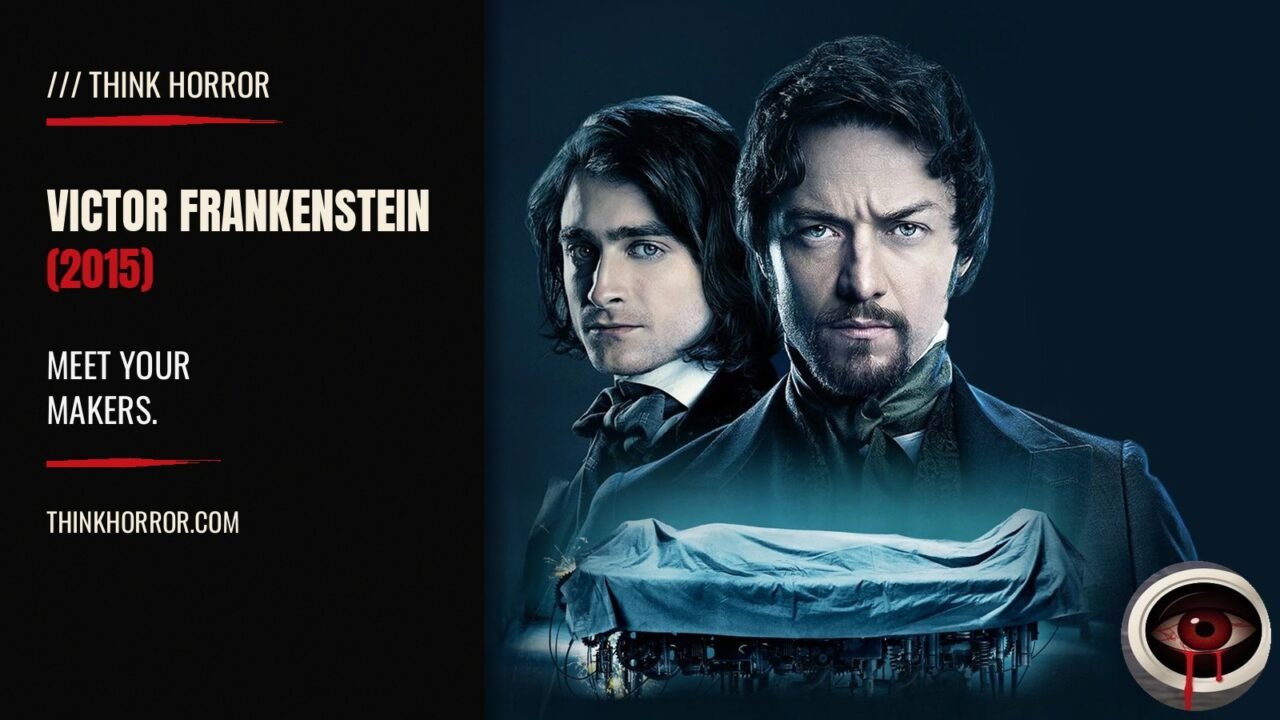
Victor Frankenstein is the 2015 reimagining told by Igor, the assistant Shelley never wrote, as he watches genius become a haunting.

The Review
Start with the lie everybody knows. Mary Shelley’s Victor Frankenstein has no assistant — no hunchback, no lab help, nobody. The sidekick entered the story on a stage in 1823 as a man named Fritz; Whale’s 1931 film gave Fritz the hump and the cruelty; Bela Lugosi’s Ygor, a scheming blacksmith with a broken neck in Son of Frankenstein, donated the name without ever holding the job. The Igor you carry in your head is a century of retellings stitched into one stooping shape. Max Landis, who wrote this film, knew exactly that — his stated ambition was to take the Frankenstein of the public imagination, “Igor, Victor Frankenstein, lightning, the 1800s,” which he cheerfully pointed out never actually existed as a single thing, and build the zeitgeist version as one honest story about friendship instead of antagonism. It is a genuinely clever foundation. The film built on it is a louder, clumsier thing than the idea deserved — but the friendship is real, and it is the reason the picture survives its own noise.
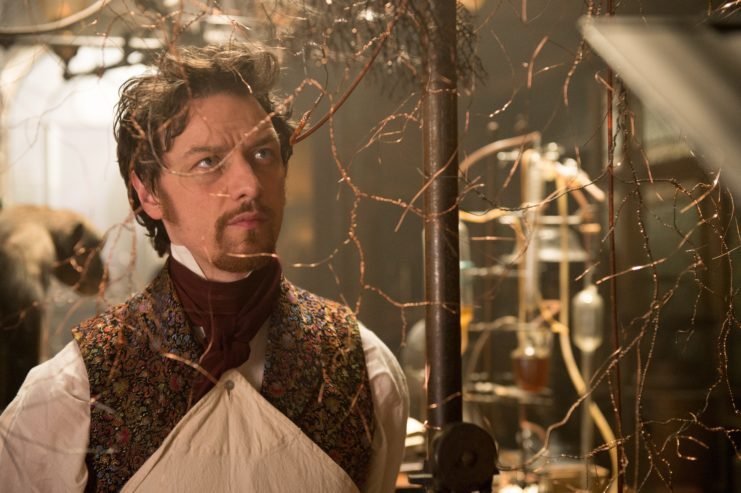
The masterstroke is the casting math. Daniel Radcliffe’s Igor is the narrator and the moral centre: rescued from the circus, cured of the massive cyst that bent him double — Victor quite literally drains the cyst and fits him with a posture harness, gives him a name and a life — and Radcliffe plays the debt beautifully, a man who owes his posture to a genius and spends the film learning the interest rate. His Igor is no grovelling appendage; he is the audience’s surrogate conscience, the one person in the laboratory asking what the work is for. Opposite him, James McAvoy plays Victor as a manic showman — a medical student performing miracles for lecture halls and money men, all velocity and appetite, a rock star of the dissecting theatre. It is a big, sweating, completely committed performance, and the film needs every watt of it: this Victor is not haunted from outside. He is haunted from underneath, by a dead elder brother named Henry — the name Universal gave Frankenstein himself in 1931, reassigned here to the corpse-shaped hole in Victor’s life — and a father, Charles Dance’s Baron Frankenstein, who blames him for it. The experiments are not curiosity. They are an apology Victor intends to deliver to a dead man.
Director Paul McGuigan, who came to this from Sherlock, shoots 1860s London as fog, gaslight and beautiful clutter, and the production design is the film’s most consistent pleasure — every frame is full of brass, wire and wet stone. The first creation, the patchwork chimpanzee Gordon, built from dead animal parts and unveiled at the university, is the film’s best horror sequence by a wide margin: wrong in the right ways, pathetic and dangerous at once, and the moment it turns teaches Victor nothing at all, which is the tragedy in miniature. Andrew Scott, Sherlock‘s Moriarty, plays Inspector Roderick Turpin as the era’s immune response — a policeman whose faith reads the laboratory as heresy, and who pursues Victor with the certainty of a man stamping out blasphemy rather than crime. He is the film’s most interesting pressure, a villain whose objection a modern audience is meant to reject and half understands anyway. Jessica Brown Findlay’s Lorelei, the rescued aerialist, gives Igor a future to lose, which raises the price of every experiment after her.
And then the flaws, which are structural and loud. The film loves its own energy so much it can barely sit still — scenes that should breathe arrive at a sprint and leave at a gallop, and Craig Armstrong’s score, lovely in isolation, is asked to shout over half of them. Worse, the structure keeps its promise too late: the human creation, Prometheus, is withheld until the final act, and when the sheet finally comes off, the film has spent its best ideas on the rehearsal. The monster of the piece is big, silent and strangely weightless — a special effect where the story needed a character. The climactic machinery, for all its lightning and collapsing iron, resolves in minutes what two hours of friendship built. A film about the sin of bringing back the dead gives its dead man almost nothing to say.
The reception wrote the epitaph before the weekend was out. Released into the Thanksgiving frame of 2015 — after sitting finished for some twenty months through four different release dates — it opened with $2,469,341 from 2,797 theatres, reported at the time as the lowest opening ever for a film playing in more than 2,500 of them, and finished with $5,775,076 at home against a $40 million budget. The critics were mostly unkind in interesting ways: Variety’s Andrew Barker called it a patchwork that “never shows enough sparks of life to justify reanimating its nearly 200-year-old source,” and the Hollywood Reporter’s Sheri Linden concluded that “the only real horror in this frenetic spectacle is how unaffecting it is.” Empire, in the standing exception, praised its “playful, postmodern sensibility.” The truth sits between the notices, closer to the pans but not inside them: a handsome, hyperventilating film whose two leads deserved the quieter, stranger movie its first hour keeps promising to become.
So the ledger, plainly. The friendship — Landis’s whole thesis — works: Radcliffe’s gratitude curdling into conscience against McAvoy’s gorgeous, damned charisma is a real engine, and the Igor it builds, out of a folk figure who never existed, is the most humane version of the character the screen has produced. The Gothic craft works: Gordon, the laboratories, the rain-slick London of it all. What doesn’t work is the pacing’s contempt for stillness and a climax that arrives an act late and a soul short. It is a Frankenstein film whose creator and assistant are alive on screen and whose creation never quite is — which is, whatever the filmmakers intended, the most honest accident in the whole Frankenstein tradition.
Spoiler Section
Full spoilers from here. The partnership’s deepest rot is a pair of eyes. Igor learns that Victor used the eyes of the real Igor Straussman — his morphine-addicted roommate, found dead of an overdose — in the work, and the revelation lands as it should: the name Igor wears was a dead man’s first, and parts of the dead man are in the laboratory. The police raid led by Turpin destroys the lab and costs the inspector a hand and an eye. Finnegan, Victor’s wealthy classmate-backer, extracts them both to his Scottish estate — his plan, once Prometheus walks, being to weaponise the creation and dispose of its maker. Igor, increasingly unwilling, is bound and thrown into the Thames by Finnegan’s men to drown; he survives, and Lorelei nurses him back. In the storm-lit climax, Victor animates Prometheus as the electrical apparatus collapses around them, killing Finnegan and many of the workers. The creation rises with no sentience in it — not Henry, not a resurrection, a large and empty refusal — and kills Turpin when the maimed inspector arrives for his reckoning. Victor and Igor destroy Prometheus together, the only way the build allows: the creature was made with two hearts, and both must be stopped. Victor then vanishes into hiding in the Scottish countryside. His letter to Igor apologises, thanks him for his friendship, names Igor his “greatest creation” — and makes no promise whatsoever to stop. The film ends with the monster dead, the assistant free, and the maker at large with his apparatus dreams intact. For a bomb, it leaves the laboratory door unusually, deliberately open.
Trivia
- Shawn Levy was Fox’s director in 2011 and wanted to make the film big — a version reported around $80 million. Fox insisted on economy, Levy departed, and Paul McGuigan made it for $40 million on the small-budget, high-concept model instead.
- The film wrapped in March 2014 and then waited: four release dates (October 2014, January 2015, October 2015, November 2015) passed before it opened, some twenty months after shooting finished.
- Prometheus is played by two performers between them — Spencer Wilding and Guillaume Delaunay.
- It is a quiet Sherlock reunion: director Paul McGuigan had directed episodes of the series, Inspector Turpin is played by its Moriarty, Andrew Scott, and the small role of Dettweiler is played by its co-creator and Mycroft, Mark Gatiss.
- Victor’s dead brother is named Henry — the first name Universal gave Dr. Frankenstein himself in the 1931 film, where Colin Clive’s character is Henry Frankenstein.
- The first trailer, released August 18, 2015, was fronted by a bespoke introduction filmed by McAvoy and Radcliffe themselves.
Where to Watch
Streaming by subscription on Amazon Prime Video; also available to rent or buy on Amazon Video, Apple TV and Fandango At Home (checked November 10, 2026).
The Verdict
Rating: 2.5 ravens out of 5. Meet your makers, by all means — the two of them are worth the introduction. McAvoy burns, Radcliffe aches, and the film between them is a beautiful, breathless machine that builds the most interesting Igor in a century of Frankensteins and then runs its creation onto the table too late to matter. Half a great Gothic friendship, wrapped around a monster who never gets to live. The lightning, at least, is real.
Quick Specs
- Director: Paul McGuigan
- Screenplay: Max Landis
- Starring: Daniel Radcliffe, James McAvoy, Jessica Brown Findlay, Andrew Scott
- Music: Craig Armstrong
- Cinematography: Fabian Wagner
- Editor: Andrew Hulme and Charlie Phillips
- Producers: John Davis
- Production Company: Davis Entertainment
- Distributor: 20th Century Fox
- Premiered: November 11, 2015 (Los Angeles); US release November 25, 2015
- Runtime: 110 minutes
- Rating: PG-13
- Budget: $40 million
- Box Office: $34,227,298 per Box Office Mojo and $31,124,367 per The Numbers
- On This Site: Victor Frankenstein, Frankenstein Must Be Destroyed (1969) review
The weekly roundup
One letter a week, from the crypt.
- New reviews, with the ravens
- New wiki entries and news
- Cool stuff worth your night
Weekly. No spam, unsubscribe in one click.