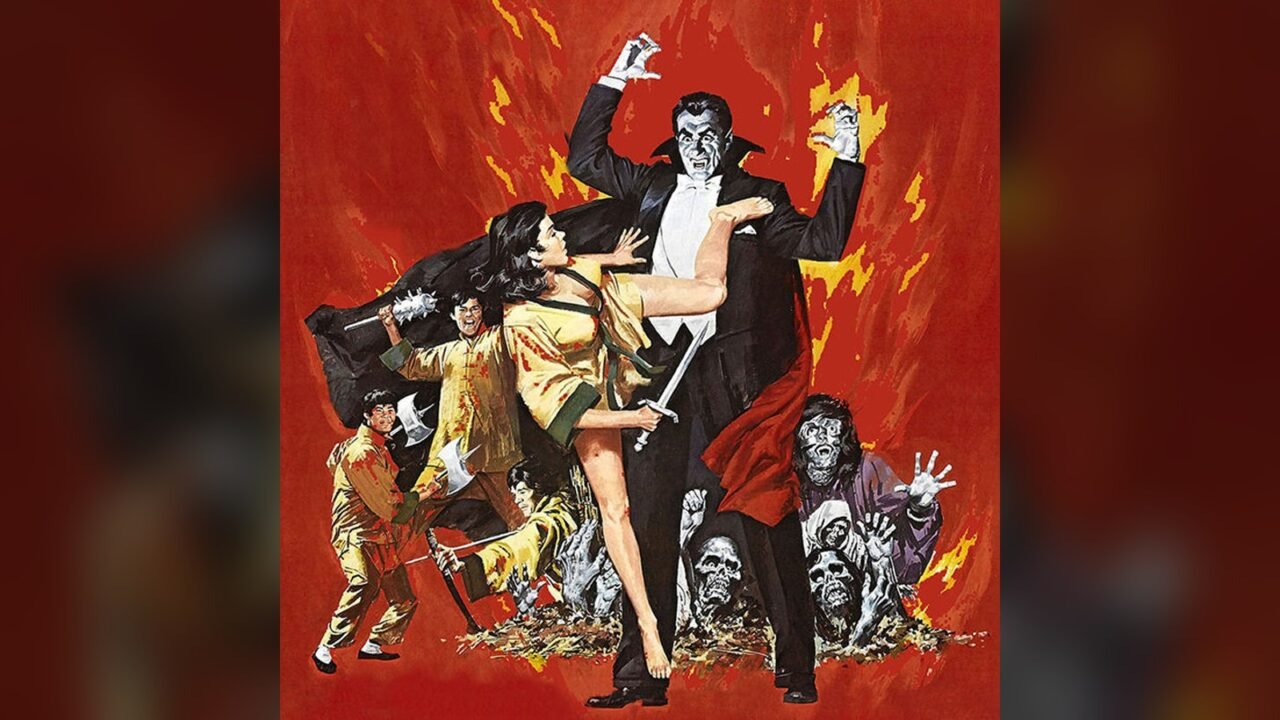
Transylvania, 1804. You have walked for months to reach this castle — a Taoist monk in a land of wolves and winter, your robes frozen, your gods very far away. Your temple in China is dying: the seven golden vampires who were its glory have faded to husks, and their power is draining out of the hills like water out of a cracked bowl. So you kneel on the stone before the tall, pale thing in the black cloak, and you ask the devil himself to restore them. He smiles, fiend. He has been looking for a door out of this castle for a very long time — and you have just volunteered to be it.
The Legend of the 7 Golden Vampires (1974) is Hammer’s Dracula finale, in which Van Helsing aids Hsi Ching and his seven siblings against undead.
Begin with the deal that made it, because no film like this happens by accident. Hammer was dying by inches in 1973, and the kung-fu picture was the loudest new noise in the world — Enter the Dragon had just kicked the door in. Screenwriter Don Houghton’s wife was Pik-Sen Lim; her father knew Run Run Shaw. So Houghton flew to Hong Kong, pitched the Shaw brothers, and came home with half the money for the maddest entry in the Hammer catalogue: Dracula, played for the only time by somebody else, exported to China to fight seven kung-fu siblings and their undead army, co-produced by Hammer and the Shaw Brothers in the Shaws’ own studios. It should not exist. It does. Harper has opinions about both halves of that sentence.
And understand whose farewell this is. Peter Cushing plays Van Helsing for the fifth and last time here — 1958, 1960, 1972, 1973, and now 1974 — and it is his last Hammer Dracula film altogether. Christopher Lee, who had quit the cape after The Satanic Rites of Dracula, declined to return, so the Count is John Forbes-Robertson, a fine, gaunt actor dealt an impossible hand: he speaks with another man’s voice — dubbed, uncredited — and was marketed in a dead legend’s silhouette. Hold those three facts — a dying studio, an absent Dracula, a grieving star working to keep busy — because the film makes sense, all of it, once you do.

Quick Specs
- Director: Roy Ward Baker
- Screenplay: Don Houghton
- Starring: Peter Cushing (Professor Van Helsing), John Forbes-Robertson (Count Dracula), David Chiang (Hsi Ching), Shih Szu (Mai Kwei), Robin Stewart (Leyland Van Helsing), Julie Ege (Vanessa Buren), Chan Shen (Kah)
- Music: James Bernard
- Cinematography: John Wilcox and Roy Ford
- Editor: Chris Barnes
- Producers: Don Houghton and Vee King Shaw
- Production Company: Hammer Film Productions and Shaw Brothers Studio
- Distributor: Columbia-Warner Distributors (UK); Dynamite Entertainment (US, 1979)
- Premiered: July 11, 1974 (Hong Kong); August 29, 1974 (London première)
- Released: October 6, 1974 (UK general release); June 15, 1979 (US, as The 7 Brothers Meet Dracula)
- Runtime: 83 minutes (UK theatrical cut); 89 minutes uncut; about 110 minutes (Hong Kong version); 75 minutes (US recut)
- Rating: X (UK); R (US)
- On This Site: The Legend of the 7 Golden Vampires in the wiki · Hammer Films · Peter Cushing · Christopher Lee · Dracula (1958) · Count Dracula
The Review
The Legend of the 7 Golden Vampires (1974) review has to start with the plot’s beautiful impertinence. A century after Kah’s bargain, Professor Van Helsing is lecturing in Chungking — an ocean and a genre away from home — when a young man named Hsi Ching stands up in his audience with a gold medallion and a family legend: seven vampires, masked in gold, riding out of a temple to bleed a village dry, each one’s life hanging in the medallion at its throat. Ching is the eldest of eight siblings, every one of them trained to fight, and he wants the world’s greatest vampire hunter to walk into the hills and finish what his grandfather started. Van Helsing, being Van Helsing, packs a bag. His son Leyland comes. A wealthy widow, Vanessa Buren, bankrolls the expedition after the young people rescue her from a tong attack. It is a quest picture wearing a Dracula film’s cloak, and the cloak keeps slipping — which is the film’s problem and its charm in a single image.
Cushing first, because Cushing is the reason to watch. He was sixty-one, widowed three years, and working — by every account — to keep the grief at bay, and he plays Van Helsing with the same undimmed, patrician ferocity he brought to the part in 1958: the patrician scholar who turns out to be the most dangerous man in any room. There is no farewell-tour softness in it. When he lectures, the film stands up straight; when he takes up a spear in the last reel, you believe a lifetime in the character’s skin is behind the arm. If the Hammer Dracula series had to end, it ends with its true constant giving full measure one last time. Graeme Clark wrote that Cushing, in his last Hammer Dracula film, is “as commanding as ever” — for once, fiends, the retrospective undersells it.
The Dracula problem is real, and Harper will not pretend otherwise. Forbes-Robertson’s Count is a prologue and a finale with a long absence between: for most of the picture the villain’s work is done by the golden vampires and their hopping, rotting army, while the Count himself waits off-screen wearing another man’s face — a plot point, and also, uncomfortably, the production’s own condition. The voice you hear is not even his: David de Keyser dubbed him, uncredited. Without Lee’s glare the part loses its gravity. What remains is a tall, cadaverous figure in the cape, competently played and oddly weightless — the series’ engine, idling.
But here is what the film has instead, and it is not nothing: the Shaw Brothers’ side of the bargain is delivered with both hands. The kung-fu sequences — staged under Chang Cheh’s second unit for the Eastern version, on top of Roy Ward Baker’s gothic framework — have a muscular joy the late Hammer action scenes had lost. David Chiang, one of Shaw’s great stars, fights like the camera is barely keeping up; the seven siblings each get a weapon and a personality — the archer, the twin swordsman, the spearman — and Mai Kwei, the sister, is nobody’s decoration. The village siege and the temple assault are staged at a scale Hammer could never have afforded at Bray. And when the golden vampires raise their undead army out of the graveyard earth, Peter Dendle’s verdict stands: it is “one of the most visually spectacular” raisings of the dead in zombie cinema — rows of rotting soldiers climbing out of the ground in the green dark, while James Bernard’s score pounds underneath like the Hammer of 1958 remembered itself.
The seams, though. They show, and pretending otherwise would insult you. The film is two pictures shaking hands: Baker’s stately gothic travelogue and Chang Cheh’s kinetic fight film, and the handshake is sometimes a visible jerk as one hands the scene to the other. The journey structure is episodic — walk, fight, walk, fight — and Vanessa’s arc is a pulp subplot that eats minutes the Dracula thread needed. Baker himself, in later years, called it “a terrible picture” and “a failure, an absolute failure”; Michael Carreras allowed only that the idea “wasn’t such a good idea.” The contemporary Monthly Film Bulletin notice, by Verina Glaessner, found the exact two words for it, and this review will not improve on them: a “fascinating failure” — fascinated by its subject, uncertain how hand-to-hand combat is supposed to live inside a Dracula film. The Times’ reviewer was colder, allowing the film would be “tedious” if not for Cushing’s “distinguished presence” and some advanced vampire disintegration. They are all partly right. So is the audience that has kept this oddity alive for fifty years while worthier films mouldered.
So the ledger, plainly. What works: Cushing, undimmed in his fifth and final Van Helsing; the Shaw Brothers’ energy and scale; the golden vampires themselves, gold-masked and medallioned, raising their rotting army out of the earth; and James Bernard’s score, the Hammer sound undiluted over Hong Kong — his last for the studio. What doesn’t: the Count, dubbed and sidelined and absent for the long middle, and the seams where the two pictures alternate instead of blend. Half of it is magnificent, and all of it is like nothing else.
Spoiler Section
Spoilers settle here, fiends — the bargain and the ending are discussed plainly.
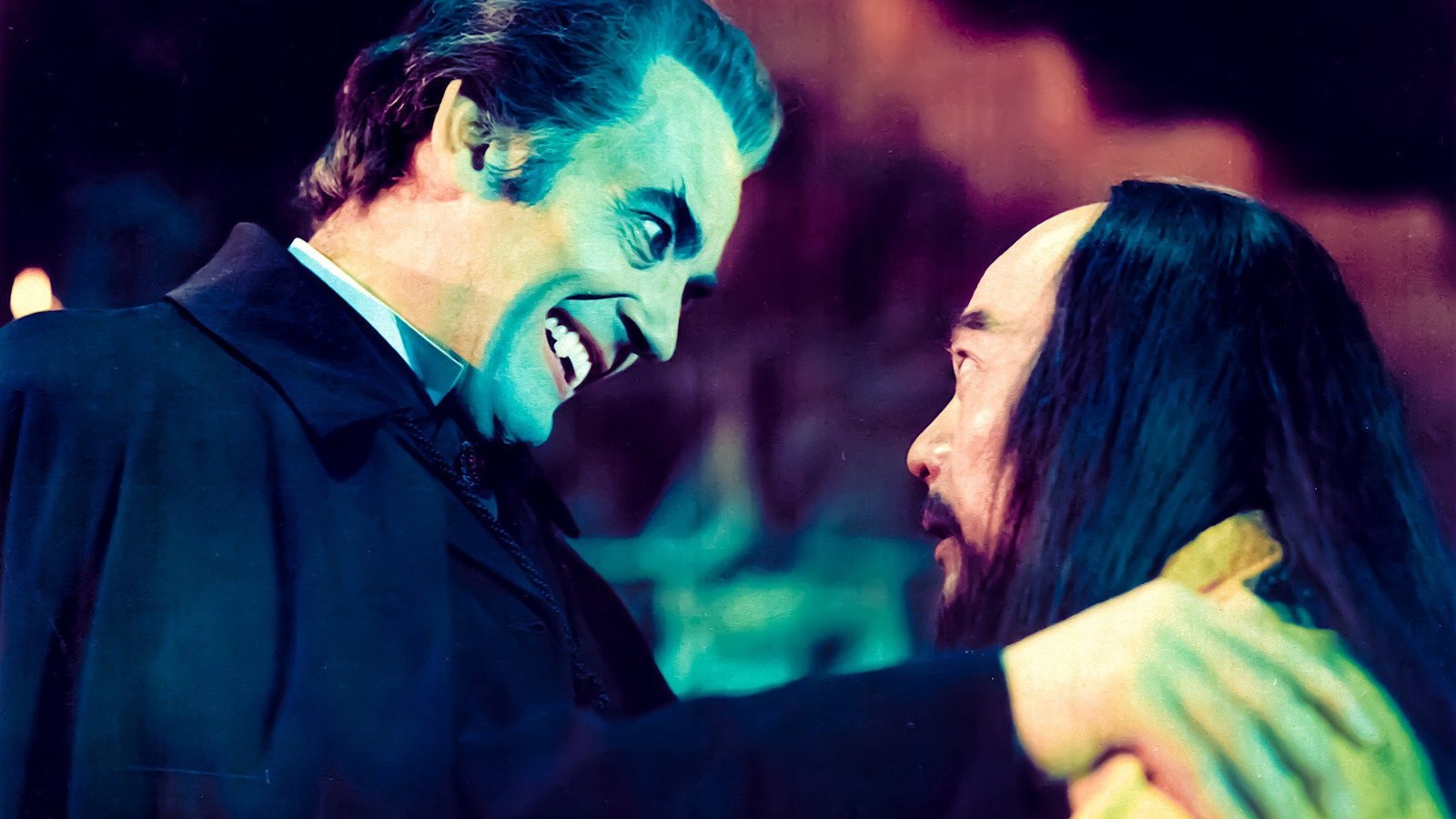
The prologue’s price comes due first: Dracula did not come to China to serve the temple. He took it. In 1804, in his own crypt, he displaced Kah’s spirit and wore the monk’s body out of the castle that had become his prison — so every order the “high priest” gives the golden vampires across the film is the Count’s, spoken through a stolen face. It is, by the production histories, the body-switch device Don Houghton had cut from his Satanic Rites script, rescued and put to work, and it reframes the whole picture: Van Helsing has been hunting his oldest enemy since the first frame without knowing it. The legend inside the lecture is the counterweight — Ching’s grandfather tore a medallion from a golden vampire’s throat and hung it on a jade Buddha, and the vampire that reached for it burst into flames. The medallions are the creatures’ lives, worn outside their bodies.
The village battle costs the expedition its patron: Vanessa is bitten, turns, and bites Hsi Ching — who drives himself and her onto a wooden stake together rather than let either of them rise. Then the last golden vampire carries Mai Kwei to the temple altar, and the film stops shaking hands with itself and simply fights: the siblings and the Van Helsings storm the temple, and the last vampire dies in the melee. Alone with “Kah,” the Professor does the thing only he could do — he looks at the monk and recognises the presence behind the face, calls Dracula a coward, and demands he show himself. The Count resumes his true form and comes at him, and Van Helsing puts a silver spear through his heart. Dracula crumbles to dust in the temple of the seven golden vampires, an ocean from home, killed by the same man for the last time. The series ends not with Lee in the cape but with Cushing on his feet. There are worse symmetries, fiends. There are not many better ones.
Trivia
- It is the ninth and final Hammer Dracula film — but only the eighth to actually feature Dracula, since The Brides of Dracula (1960) has no Count in it. It is also the only entry whose original title does not carry Dracula’s name, and the only one where Lee does not play him.
- The co-production existed because of family: Houghton’s father-in-law knew Run Run Shaw. The Shaws financed half the film, it was shot at Shaw Brothers Studios in Hong Kong from October to December 1973, and a second Hammer–Shaw picture, Shatter (1974), followed under the same arrangement.
- Chang Cheh, one of Shaw’s house masters, ran a second unit adding martial-arts material for the Eastern version, which ran 110 minutes against the UK cut’s 89. Modern databases often bill him as co-director; the film itself credits Baker alone, and Baker said the split suited him — “they would do the kung-fu stuff and I would do the rest of it.”
- Forbes-Robertson had worn Hammer fangs before, in a sense: he played the Man in Black in The Vampire Lovers (1970). His Dracula voice is not his — David de Keyser dubbed the performance, uncredited.
- America’s version, The 7 Brothers Meet Dracula (1979), was cut by roughly twenty minutes and padded by looping surviving scenes. By the oft-told account, one edit prepared under Michael Carreras’s guidance removed Dracula entirely; the film then ran too short, and the Count was put back.
- A sequel was announced in the trade press and never made: Kali, Devil Bride of Dracula, to be shot in India — Hammer’s Dracula, having gone east, was meant to keep going.
- The spin-offs are documented in the Hammer histories: Cushing narrated the film’s story on an LP released in 1974, a recording that survives as an extra on the US home-video editions, and a fifteen-page comics adaptation ran in The House of Hammer magazine in 1977.
- Reception has thawed with the decades: Keith Phipps summed up the modern view — “flawed” but “enjoyable… there’s something inherently entertaining about make-up-splattered vampires, distinguished British actors, and martial artists.”
Where to Watch
As of November 9, 2026, in the US: The Legend of the 7 Golden Vampires is not available on US streaming or digital VOD — this one lives on physical media. The Scream Factory Blu-ray (2019) is the edition to own: a 2K restoration carrying both the uncut film and the American 7 Brothers Meet Dracula cut. Listings rotate — check before you settle in.
The Verdict
Rating: 3 ravens out of 5.
Three ravens — a fascinating failure, and the fascination is genuine. The Dracula is dubbed and mostly absent; the two films inside it never quite become one; its own director disowned it. And yet: Cushing’s last stand is magnificent, the Shaw energy is real, the gold-masked dead rising out of the Chinese earth is an image Hammer never topped for sheer strangeness, and no other studio on Earth would have made it. The Hammer Dracula series did not fade out. It flew to Hong Kong, learned kung fu, and died on its feet with a spear in its hand. Harper would not have it any other way.
The weekly roundup
One letter a week, from the crypt.
- New reviews, with the ravens
- New wiki entries and news
- Cool stuff worth your night
Weekly. No spam, unsubscribe in one click.