The tent is lamplight and canvas, and the case in front of you has not been opened in three and a half thousand years. You are the junior man, the one who reads the old scripts, and the scroll in the box beside the body is covered in words you almost understand — the words that woke Osiris. Your hand is already moving toward it. Everyone in this room is about to learn what you are about to learn: some texts are not read. They are obeyed. Stop, fiend. Put the scroll down.
The Mummy (1932) is Universal’s original mummy film: Boris Karloff’s buried-alive priest Imhotep returns from the tomb to reclaim his reincarnated lost love.
A British Museum expedition opens the wrong casket in 1921, an assistant reads the wrong words aloud, and the thing in the bandages sits up, takes its scroll, and shuffles out into the dark — leaving the reader laughing in a corner, mad as a March hare. A decade later a gaunt Egyptian scholar named Ardath Bey is pointing the same expedition’s heirs toward a lost princess’s tomb, and nobody in Cairo understands what he is really digging for. He is not after gold. He is after the girl.
This is the quiet one, fiends. After Dracula’s drawing-room menace and Frankenstein’s thunder, Universal made a horror film that barely raises its voice — a film built out of lamplight, stillness, and the most patient pair of eyes in horror. It exists because the world had gone Egypt-mad: Howard Carter opened Tutankhamun’s tomb in 1922, the “curse of the pharaohs” filled the newspapers, and Carl Laemmle Jr. wanted an Egyptian horror picture to stand beside his two 1931 giants. There was no novel to buy, so the studio built one from scratch — the first of Universal’s classic monster films made as an original screen story. What they built became the template every mummy movie since has copied, quoted, or run from. Curl up somewhere dusty. We are going back to the beginning.

Quick Specs
- Director: Karl Freund
- Screenplay: John L. Balderston (story by Nina Wilcox Putnam and Richard Schayer)
- Starring: Boris Karloff (Imhotep / Ardath Bey), Zita Johann (Helen Grosvenor), David Manners (Frank Whemple), Arthur Byron (Sir Joseph Whemple), Edward Van Sloan (Dr. Muller)
- Music: James Dietrich
- Cinematography: Charles Stumar
- Editor: Milton Carruth
- Producers: Carl Laemmle Jr.
- Production Company: Universal Pictures
- Distributor: Universal Pictures
- Premiered: December 22, 1932 (United States)
- Released: December 22, 1932 (US theatrical release)
- Runtime: 73 minutes
- Budget: $196,000 (reported)
- Box Office: No verified figure reported
- On This Site: The Mummy in the wiki · Boris Karloff in the wiki · Frankenstein in the wiki · Dracula in the wiki
The Review
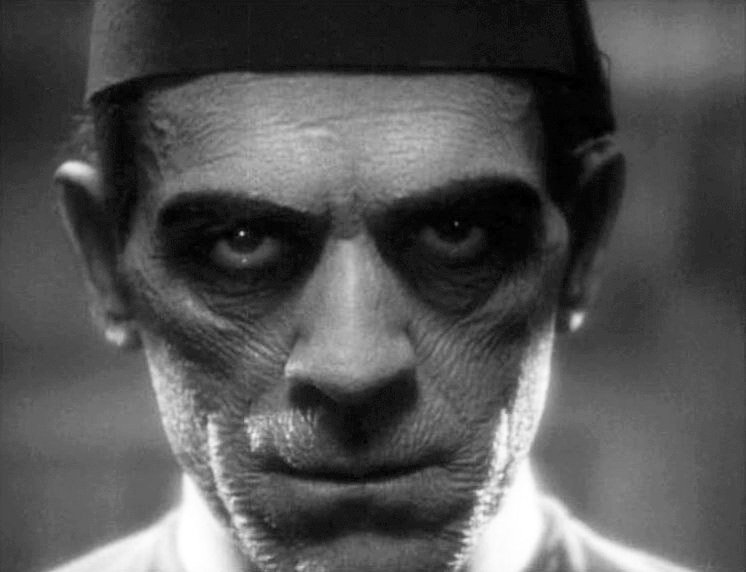
The Mummy (1932) review begins, as the film does, in near-silence: everything you need to know about The Mummy is in its first ten minutes, and almost nothing in those minutes moves. The expedition’s camp is all lamplight and canvas. The mummy case is opened. And Jack Pierce’s masterpiece — a face like cracked riverbed, built from photographs of the mummy of Seti I, wrapped in acid-treated, oven-burned linen — opens its eyes. There is no lunge, no sting of music. A hand lowers. A scroll is gone. Off-screen, a young man starts laughing and cannot stop, because he has understood what he read aloud. Director Karl Freund, the great cinematographer of Metropolis shooting his first film as a director in the United States, understood something his studio’s other horror pictures only reached for: dread is what happens in the pause. He lets shots sit. He lets Karloff sit. The horror accretes like dust.
And here is the film’s great trick, the one its imitators almost always miss: the bandages are a prologue. Karloff wears the famous mummy makeup only for that opening sequence. For the rest of the picture he is Ardath Bey — a fez, a long dark coat, and a second Pierce makeup of impossible wrinkles, a man who looks less undead than over-exposed to centuries. It is one of the finest performances in horror, and it is done almost entirely with voice and eyes. Karloff speaks slowly, as if every word costs him effort across 3,700 years, and those eyes — heavy, wet, bottomless — do the haunting all by themselves. His Imhotep is not a shambling curse with arms outstretched. He is a lovesick high priest who has waited three and a half millennia and has absolutely no intention of being refused. The monster is patience.
The plot, once Ardath Bey surfaces in Cairo, is a gothic romance wearing horror’s coat — consciously so. This was Balderston’s rewrite: the studio’s nine-page treatment, Cagliostro, was about a 3,000-year-old magician in San Francisco taking revenge on women who resembled a lost love. Balderston moved it to Egypt, swapped revenge for resurrection, invented the Scroll of Thoth — the spell by which Isis raised Osiris — and aimed it at a single, terrible idea. Imhotep does not want to kill Helen Grosvenor, the half-Egyptian girl who carries his princess Anck-es-en-Amon’s soul. He wants to kill her so he can raise her — mummified, immortal, his bride forever. The horror is not that a dead man wants her dead. The horror is that he calls it love, means it, and has had 3,700 years to practice meaning it. Zita Johann, otherworldly in a way no other Universal heroine quite is, believed in reincarnation off-screen as well as on, and she plays Helen’s trances like a woman being slowly overwritten. When the film shows us the ancient past reflected in a pool — Imhotep caught at the princess’s tomb, buried alive for the sacrilege, the earth coming down over a living face — it is the one moment the film raises its voice, and it earns the scream.
Not everything holds. The machinery between the great scenes creaks the way 1932 machinery does: David Manners, imported from Dracula along with Edward Van Sloan, is a pleasant blank as Frank, and the love story he is asked to carry matters less than the film pretends. Van Sloan, meanwhile, does his Van Helsing turn a second time as Dr. Muller — occult expert, warner of young men, the man who would burn the scroll — and does it well enough that you forgive the repetition; he is the film’s one-man Greek chorus of doom. The murders, when they come, happen at a distance and by suggestion: a rival drops clutching his chest because Ardath Bey has wished it so from across the city. Modern audiences raised on the 1999 film’s sandstorms should be warned plainly: this Mummy kills the way a held breath kills a conversation. Slowly, and then all at once in your memory afterward.
Film historian William K. Everson called this picture “the closest that Hollywood ever came to creating a poem out of horror,” and the ending is where you feel it. The New York Times, back in January 1933, grumbled that “most of The Mummy is costume melodrama for the children” — while admitting the live burial was “one of decided horror.” The children, it turns out, were right to keep it. Of the founding Universal trio, this is the one that whispers, and the whisper has outlasted a great many screams. Four and a half ravens, fiends — and mind what you read aloud.
Spoiler Section
Spoilers settle here, fiends — outcomes are named plainly.
The ending turns on the film’s deepest idea — that Helen is not a prize to be won but a soul with its own allegiances. Possessed at last by the princess herself, she does the one thing Imhotep never planned for: she prays, to Isis, to be released. The goddess’s statue lifts an arm, the Scroll of Thoth catches fire, and the spell that has kept a dead man walking burns away in his hands. He crumbles — not with a crash, with a sigh, the whole impossible patience of him settling into dust.
Trivia
- The most trying ordeal: Pierce’s full mummy makeup took eight hours to apply — cotton, collodion and spirit gum built up, clay worked into the hair, linen bandages treated with acid and burnt in an oven. On the awakening day Pierce started at 11 a.m., finished at 7 p.m., and Karloff then shot until 2 a.m. Karloff called it “the most trying ordeal I [had] ever endured.”
- Billed as one word: in this film Karloff is billed by surname alone, in capitals — KARLOFF — and advertised as “Karloff the Uncanny.” The famous “?” credit belongs to Frankenstein (1931), where the opening titles credit the Monster to “?” and Karloff’s name appears only in the closing cast.
- It began in San Francisco: Putnam and Schayer’s nine-page treatment Cagliostro concerned a 3,000-year-old magician surviving on nitrate injections and hunting women who resembled his betrayer. Balderston — who had covered the opening of Tutankhamun’s tomb for the New York World as a journalist — moved it to Egypt and rewrote revenge as resurrection.
- Swan Lake again: the opening titles play Tchaikovsky’s Swan Lake theme — the same music Universal had already run over Dracula (1931) and Murders in the Rue Morgue (1932). James Dietrich composed the film’s dramatic score.
- The lost lives of the princess: Freund shot a long montage of Anck-es-en-Amon’s reincarnations across the centuries — Roman, Saxon, and later ages — and it was cut for length. The footage is lost; only stills survive. Henry Victor remains in the credits as “The Saxon Warrior” for a sequence that no longer exists.
- The poster that outlived the vault: Karoly Grosz’s painted one-sheet is among the most valuable film posters in existence — only three originals are known to survive. One set a record at $453,500 in 1997; a 2018 Sotheby’s offering, estimated at $1–1.5 million, famously failed to sell.
- Even the credits have a typo: the film’s own titles misspell James Crane’s role as “The Pharoh.” Nobody at Universal caught it either.
- No sequel — ever: Imhotep dies in this film and never returns, and Karloff never played a mummy again. Universal’s 1940s mummy films follow a different creature entirely, Kharis — and The Mummy’s Hand (1940) still borrows Karloff’s 1932 footage for its flashback, uncredited.
Where to Watch
As of November 9, 2026, in the US: The Mummy (1932) is not currently streaming on any subscription service — it is available to rent or buy digitally on Prime Video, Google Play, Apple TV Store and Fandango At Home. Streaming availability can change.
The Verdict
Rating: 4.5 ravens out of 5.
Four and a half ravens — the quiet masterpiece of the Universal monsters: Karloff turns stillness itself into the scariest thing in the room.
The weekly roundup
One letter a week, from the crypt.
- New reviews, with the ravens
- New wiki entries and news
- Cool stuff worth your night
Weekly. No spam, unsubscribe in one click.