You have always been the girl at the edge of the photograph — the daydreamer, the one who develops other people’s lives in the school darkroom and pastes herself into the margins. Your best friend keeps dragging you into her dreams to stand watch over an empty house, and last night something in the dark stood up and looked back. This morning there is a new weight behind your eyes, fiend, and every mirror in Springwood is about to start lying to you.
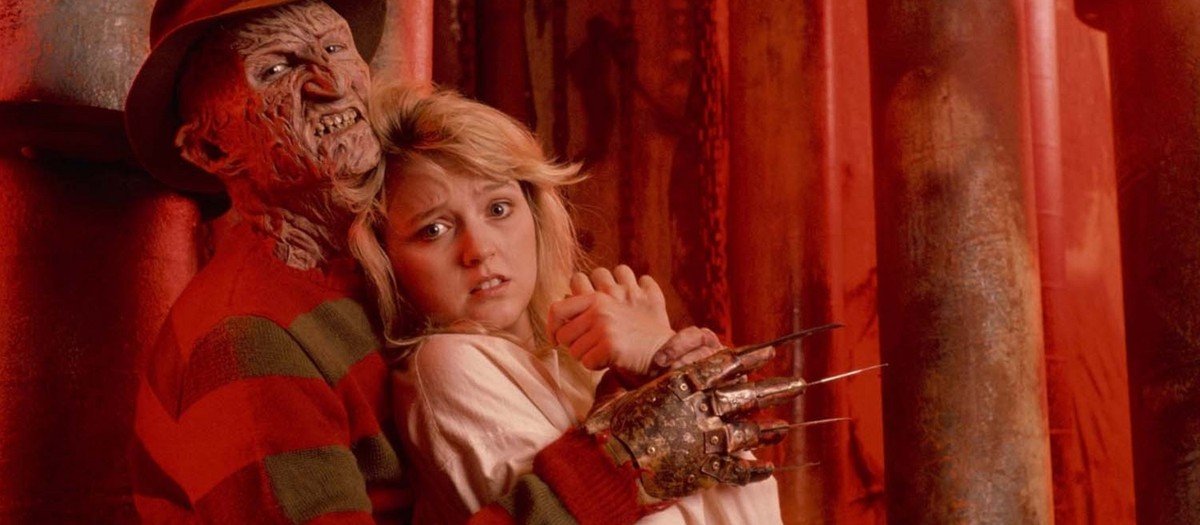
The Dream Master (1988), the fourth Nightmare on Elm Street, hands Freddy a doorway: Alice Johnson, daydreamer who inherits Kristen’s gift and her friends’ powers.
A year after Westin Hills, the surviving Dream Warriors are back at Springwood High and trying to be ordinary — all except Kristen, who keeps pulling her friends into her dreams to stand watch, and who is terrified that the quiet is the lie. She is right. In a junkyard across town, a dog named Jason digs at an unmarked grave and pisses on the bones of Freddy Krueger — and the urine catches fire. By the time the skeleton has finished reassembling itself, the most successful Freddy film of the original run is already doing the two things it does better than any other sequel: spending money beautifully, and killing the previous film’s heroes like it means it.
The production was chaos wearing a schedule. New Line reached Christmas 1987 with no script and no director; Brian Helgeland rewrote William Kotzwinkle’s treatment in nine days at his parents’ house, the Wheat brothers polished under a shared pseudonym just as the Writers Guild strike began, and effects units were already shooting before a director existed. The director they found was a broke Finn named Renny Harlin, who had turned up at New Line’s offices uninvited five times, been thrown out five times, and finally spread a pile of hand-drawn storyboards across Robert Shaye’s desk. Wes Craven, asked first as always, had pitched time travel inside dreams; New Line rejected it, and Craven declined a rewrite. What Harlin built from the wreckage cost a reported $6.5 million by the trade charts of the day and returned $49.4 million — the biggest Elm Street gross in America until Freddy vs. Jason, fifteen years later.

Quick Specs
- Director: Renny Harlin
- Screenplay: Brian Helgeland and Scott Pierce (Jim Wheat and Ken Wheat); story by William Kotzwinkle and Brian Helgeland
- Starring: Lisa Wilcox (Alice Johnson), Danny Hassel (Dan Jordan), Tuesday Knight (Kristen Parker), Ken Sagoes (Roland Kincaid), Rodney Eastman (Joey Crusel), Andras Jones (Rick Johnson), Toy Newkirk (Sheila Kopecky), Brooke Theiss (Debbie Stevens), Robert Englund (Freddy Krueger)
- Music: Craig Safan
- Cinematography: Steven Fierberg
- Editor: Michael N. Knue, Chuck Weiss
- Producers: Robert Shaye, Rachel Talalay
- Production Company: New Line Cinema, Heron Communications, Smart Egg Pictures
- Distributor: New Line Cinema
- Premiered: August 19, 1988
- Runtime: 93 minutes
- Rating: R
- Budget: $6.5 million (trade charts of the day; The Numbers lists $13 million)
- Box Office: $49,369,899
- On This Site: The Dream Master in the wiki · Dream Warriors
The Review
Start with the insult the film plays on everyone who loved Dream Warriors. Kincaid and Joey survived the last film; this one murders them in its first act, almost casually, in the places they feel safest — how each of them goes waits below the gate. Kristen lasts longer, and her end is the engine of everything after: her mother Elaine, impatient with a daughter who will not sleep, spikes her dinner with sleeping pills, and Freddy uses the drugged girl to do the one thing he cannot do himself — summon a brand-new victim. As Kristen dies, her gift passes. It is the series’ cruelest mechanism precisely because a parent’s thoughtlessness loads the weapon. Alice Johnson, the daydreamer at the edge of every frame, is now Freddy’s doorway, and everyone she loves is on the other side of it.
What Alice does with the inheritance is the film’s one great idea, and it is a video game’s idea a decade early: every friend who dies leaves her something. Sheila the science whiz leaves her smarts; Rick, her brother, leaves his martial arts — watch her pick up his nunchucks afterward and simply know them; Debbie the waitress leaves her strength and her defiance. The manner of each taking is pure set-piece — one of them, a transformation by Screaming Mad George, is a masterpiece of cruelty — and the catalogue waits below the gate. Freddy thinks he is farming victims through a conduit. He is actually arming his executioner one funeral at a time, and Lisa Wilcox, in her feature debut, sells the assembly: the mousy girl who photographs herself into other people’s lives ends the film fighting in a derelict church with four dead friends’ worth of borrowed power — and how Freddy dies there is the most operatic kill he ever died. He earned it.
The director is the other half of the story. Harlin shot this film the way he storyboarded it — as a chain of poster images and music-video set pieces, camera swirling, every dream a new stage set: the waterbed, the dojo, the Roach Motel, the diner where Alice and Dan keep driving out of the same loop while Debbie dies somewhere they cannot reach. Englund, in his 2009 memoir, named that looping diner sequence his favourite in the entire franchise — the most hypnotic and accurate depiction of a dream he had ever seen, in a scene Freddy barely appears in. The contemporary ledger noticed the craft. Kevin Thomas in the Los Angeles Times called it “by far the best of the series,” praising exactly its balance of wit, gore and imagination, and singling out Wilcox’s debut. Janet Maslin in The New York Times was cooler — she admired the endless onslaught of grotesque effects, let Harlin off with keeping things moving, and landed the line everyone since has quoted: Freddy, who says he is eternal, seemed to her a self-fulfilling prophecy, immune to directors and scripts.
And a shrug is fair, because the hollowness is real too. This is the film where Freddy completed his transformation from demon to headliner — star billing for Englund for the first time in the series, the producers openly reasoning that he had become, in Harlin’s phrase, the James Bond of the series, the one the audience roots for. Everything follows from that: the wall of licensed songs, the two albums, the music videos, the quips. The era’s chart story tells it perfectly — the official tie-in single, the Fat Boys’ “Are You Ready for Freddy,” with Englund rapping in character, never touched the Hot 100 at all, while the record that actually charted, DJ Jazzy Jeff and the Fresh Prince’s “A Nightmare on My Street,” was an unauthorized cash-in New Line had passed on, which climbed to No. 15 and got its video enjoined in federal court. Freddy in 1988 was so big that the bootleg outsold the brand. Even the censors were gamed as marketing: Robert Shaye had two deliberately disgusting effects built to be sacrificed to the MPAA — the documented one a beach-dream prosthetic gag shot purely to be cut — so that the real set pieces, cockroach included, would survive. They did. The cockroach was never the target, fiends, whatever the legend says.
Spoiler Section
Spoilers settle here, fiends — outcomes are named plainly.
The catalogue, plainly. Kincaid is penned in by hurled cars in the junkyard where he helped bury the bones, and Freddy finishes what the grave started. Joey drowns inside his own waterbed while a poster girl swims in the mattress above him. Kristen, drugged by her mother’s sleeping pills, calls Alice into the dream, apologizes with her eyes, and is thrown into the furnace — Alice and Rick find the bedroom burning in the waking world. Sheila dies of a staged “asthma attack” at her school desk, the air sucked out of her in front of a classroom. Rick falls to an invisible opponent in a dream dojo. Debbie’s arms are snapped backward at the bench press and her body blossoms into a giant cockroach, crushed inside a Roach Motel. Dan — the boyfriend every convention marks for death — survives, wounded, and walks out of the film beside Alice. In the derelict church, Alice holds a shard of mirror to Freddy and recites the guardian’s rhyme — evil will see itself, and shall die — and the souls in his chest tear him open from inside. The fountain ending gives Alice the last word: Freddy’s reflection in the water, and her choice to walk away from it.
Trivia
- The director got the job by refusing to leave. Renny Harlin showed up at New Line’s offices uninvited five times and was thrown out five times. At the fifth, Robert Shaye gave him a meeting; Harlin covered the desk in hand-drawn storyboards of dream sequences he had invented — including a face-filled pizza and a waterbed — and was hired. Effects units were already shooting the film before it had a director.
- The dog is an in-joke with paperwork. Kincaid’s dog, the one whose fiery urine resurrects Freddy, is named Jason — a needle aimed at Friday the 13th, flagged by reviewers in 1988. The animal actor is credited as Jake. Character Jason, performer Jake: two names, one very important dog.
- Kristen was recast by choice — hers. Patricia Arquette was offered a hefty sum to return and declined, saying in 2017 that she was breaking into meatier dramatic roles and was chomping at the bit to try other things. Tuesday Knight stepped in — and also sings the film’s opening-title song, “Nightmare,” which she did not know had been made the title song until she saw the finished film. It is not on the soundtrack album.
- The pseudonym is two brothers. The screenplay is credited to Brian Helgeland and “Scott Pierce” — the shared pen name of Jim and Ken Wheat, who polished Helgeland’s nine-day rewrite of William Kotzwinkle’s treatment. Because the 1988 Writers Guild strike froze all guild writing during the shoot, dialogue and even whole set pieces were finished on the floor by Harlin and the producers, uncredited.
- The teacher is the boss. Alice’s classroom lecture on the two gates of dreams — the film’s whole Dream Master thesis — is delivered by an uncredited Robert Shaye, New Line’s chief, playing the teacher. Englund also appears out of the Freddy make-up, briefly, as the nurse who transforms into Freddy in Alice’s nightmare.
- The decoy gore worked. Shaye ordered two effects built specifically to be cut by the ratings board; the documented one fitted Tuesday Knight with prosthetics for a beach dream that exists only to be censored. It was. The cockroach transformation everyone assumes was trimmed was never targeted and survives whole; the real trim was a longer, bloodier version of Kincaid’s junkyard death.
- The lawsuit outsold the single. The Fat Boys’ official “Are You Ready for Freddy” stalled at No. 93 on the R&B chart and never entered the Hot 100. DJ Jazzy Jeff and the Fresh Prince’s unauthorized “A Nightmare on My Street” reached No. 15 on the Hot 100 in 1988 — and its Freddy-starring video was blocked by a federal injunction that August.
- Harlin’s next stop was the A-list. Within two years of sleeping on a garage floor, the director of The Dream Master was making Die Hard 2. The film also collected three Saturn Award nominations and a Best Special Effects prize at Sitges — and a Razzie nomination for Worst Original Song, which is the most 1988 sentence in this entire file.
Where to Watch
As of November 9, 2026, in the US: A Nightmare on Elm Street 4: The Dream Master streams on AMC+ (also via Philo), and you can rent or buy it digitally on Amazon Video, Apple TV Store or Fandango At Home. Streaming availability can change.
The Verdict
Rating: 3.5 ravens out of 5.
The Dream Master is the MTV Nightmare, the commercial peak of the original run, a film whose set pieces are the series’ most beautiful and whose soul is borrowed — fittingly, from its own dead characters. But it gave the franchise Alice Johnson, the only final girl besides Nancy to headline a second film, and it gave Freddy his biggest stage and his strangest death. When the souls burst out of his chest in that church, the pop era of Elm Street is at its absolute zenith. It was never this big, or this glossy, again.
The weekly roundup
One letter a week, from the crypt.
- New reviews, with the ravens
- New wiki entries and news
- Cool stuff worth your night
Weekly. No spam, unsubscribe in one click.