A Nightmare on Elm Street 4: The Dream Master
The Dream Master is the 1988 Elm Street sequel where Kristen Parker passes her dream power to Alice Johnson, Freddy Krueger’s next target.
One year later
A year after the Westin Hills survivors walked out of Dream Warriors, Kristen Parker, Roland Kincaid and Joey Crusel are back in ordinary teenage life — released, enrolled, trying to be normal. Kristen is the one who cannot let it go. When she dreams her way into Freddy’s boiler room and pulls Joey and Kincaid in with her, they are furious: Freddy is dead, they insist, and dreaming about him is exactly how you bring him back. They are right, and it does not matter. Freddy does not need Kristen’s belief. He needs her gift — the power to pull other sleepers into her dreams — because the children of Elm Street are nearly gone, and through Kristen he can reach fresh victims.
His return is the film’s most famous piece of dream logic, and it comes with a director’s confession attached. Kincaid’s dog, Jason, digs at Freddy’s junkyard grave and urinates fire on the remains — and Freddy Krueger stands back up. That is Renny Harlin’s own account of the resurrection, retold proudly ever since: the great dream demon of the eighties, resurrected by a dog. This is the fourth film’s tone in one image. The fear is still real, but the series has started winking.
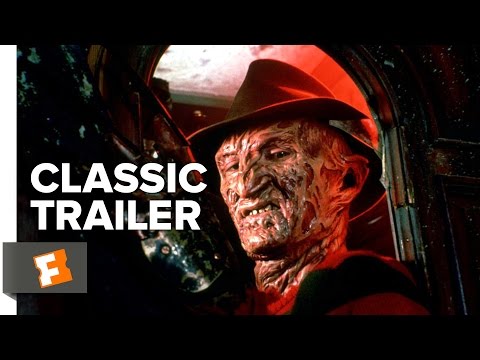
The new blood arrives through Kristen’s circle: her boyfriend Rick Johnson, a martial-arts kid; Rick’s shy younger sister Alice, who daydreams her way through school; Sheila Kopecky, an asthmatic genius; Debbie Stevens, a weightlifter who hates bugs; and Dan Jordan, the handsome football player Alice watches from a distance. Robert Englund, receiving star billing for the first time in the series, plays Freddy now the way Harlin saw him — the James Bond of the franchise, the one the audience comes to see. The film wastes no time proving the point.
The deaths, in order
Kincaid falls first, in the junkyard where Freddy rose — he fights hard, stabbed in the stomach, unable to reach Kristen to pull him out. Joey follows, in the series’ most replayed kill: asleep in front of the television, he wakes to find a model swimming inside his waterbed; she becomes Freddy, and Joey drowns inside his own bed. (That death belongs to this film — Dream Warriors left Joey comatose and rescued alive, whatever the clip compilations imply.)
Kristen is the hinge of the whole film. Her mother, tired of the sleeplessness, slips sleeping pills into her meal. Freddy taunts her — the last of the Elm Street children — into doing the one thing she swore not to: summoning a friend. She pulls Alice in, Freddy throws Kristen into his boiler, and as she burns she pushes her dream power into Alice. Alice and Rick arrive at the house to find Kristen’s bedroom on fire. The last Elm Street child is dead, and the power has a new owner who does not yet know what she is holding.
What follows is the film’s engine: every death makes Alice stronger. Sheila, pulled into Alice’s classroom dream, dies of what the waking world records as an asthma attack — Freddy drains the air from her mouth while Alice sits pinned in her chair, and Alice takes Sheila’s sharpness with her. Rick, believing Alice at last, meets an invisible Freddy in a dream dojo; he knocks the glove loose and thinks he has won, and the glove launches itself into his stomach. Alice takes his fight. Debbie, the bug-hater, gets the cruelest design in the film: her barbell driven down until her arms tear open, cockroach limbs sprouting, her face shearing away as the change completes, and Freddy crushing the roach motel she is trapped in. Alice, looping through a repeating diner dream with Dan, rams her car at Freddy and wakes in a real crash that puts Dan in surgery. Dan survives this film — hospitalized, woken by his surgeons as he bleeds in the dream and in the bed at once. His death belongs to the next film, not this one.
How it ends
Alice goes back in alone, wearing her dead friends like armour — Kristen’s power, Sheila’s mind, Rick’s moves. When Freddy still proves too strong, she remembers the film’s title: a nursery rhyme about the Dream Master, which teaches that evil shown its own reflection cannot stand the sight. She forces Freddy to face himself. The souls packed inside him revolt at what they see, tear him apart from within, and pour free, leaving a hollow husk swaying in the boiler room.
It is not quite an ending, and the film knows it. Months later Alice and Dan — recovered, together at last — toss a coin into a fountain, and for one frame Freddy’s reflection ripples across the water. Alice sees it. She chooses to walk away anyway. One critical reading calls this the first film in the series that declines to tease Freddy’s survival; the reflection is on screen regardless, and the sequel arrived a year later. Draw your own conclusion — Alice drew hers.
The sequel Craven did not make
Wes Craven did not direct this film, did not write it, and was turned down when he tried. The series creator pitched New Line a fourth film built on time travel inside dreams; producer Sara Risher, who said she always went to Craven first, judged that it “broke all the rules of dreams” and chose William Kotzwinkle’s Dream Master idea instead. Craven and Bruce Wagner were later offered rewrite work and declined it. His credit here is characters only — which makes the film’s success a strange milestone: the first Elm Street hit made entirely without its maker.
The script that replaced his came out of desperation and speed. New Line had no script and no director; Brian Helgeland, whose unrelated script had just been passed on, was begged to try a rewrite of Kotzwinkle’s draft and, by his own account in a 2003 interview, finished it in nine days over Christmas at his parents’ house and FedExed it in. The Writers Guild strike of 1988 then swallowed production: with rewrites frozen, Harlin and the cast improvised — Lisa Wilcox and Andras Jones wrote some of their own dialogue after Kristen’s death, and nightmare sequences were invented on the floor from Harlin’s ideas. The director’s chair had nearly gone to Tom McLoughlin, who turned it down because filming had already begun without a director attached and no creative control was on offer; the job went to a Finn with two low-budget features, and as McLoughlin put it, refusing it made Renny Harlin’s career. Harlin, for his part, read the room precisely: “We’ve reached a point where the audience sees Freddy as the hero. They come to these movies to hear his funny lines and see him do those amazing things.”
Kristen, recast
Patricia Arquette does not appear in this film. Kristen is played by Tuesday Knight — who also sings the title song, “Nightmare,” over the opening credits — while Ken Sagoes and Rodney Eastman return as Kincaid and Joey, the only Dream Warriors carried over in their original skin. Why Arquette stayed away has never settled into one story, so here are the three, in the order they deserve. Arquette’s own account, given in 2017: she was breaking into meatier roles and was, in her words, “chomping at the bit to try other things as an actor” — she loved the genre and the franchise, and left anyway. Risher called Arquette an integral part of Dream Warriors and said she was disappointed. Beyond that, the record thins into speculation: a pregnancy at the time of filming in one account, an agent asking too much money in another — reported, theorized, and never confirmed by Arquette herself, which is exactly how this page leaves them. Knight has said she felt out of place stepping into the role; Sagoes and Eastman said they were disappointed by the change.
Alice was the harder casting problem. More than 600 actresses auditioned. Wilcox, who had failed to land a Dream Warriors role a year earlier, was first rejected as too pretty, too cheerleader for a mousy daydreamer — so she came back wearing no makeup and her worst colour, yellow. “Their reaction was, ‘Is that Lisa Wilcox?’ After they got over their shock, they gave me the role.” Harlin’s brief for her was precise: timid and vulnerable at the start, believable by the end as, in his comparison, Sigourney Weaver in Aliens. Watch the film with that sentence in mind and you can see the exact moment the switch flips.
The money
The budget is an argument, not a number, and this page declines to pick a winner: later trade charts (Variety, 1992) put it at $6.5 million, while The Numbers lists $13 million, and figures of $5 million, $6 million and $7 million circulate besides. What is not in dispute is what New Line spent around the film — roughly $1.5 million on advertising and $7 to $8 million on release prints, the company’s most expensive release to that date — or what happened when it opened. Rushed forward from autumn into summer, the first Elm Street film given a summer release, it opened on 19 August 1988 on 1,765 screens at number one. The opening weekend itself survives in two versions differing by a transposed digit — $12,883,403 in one ledger, $12,833,403 in the other — and either way it was the biggest opening an independently distributed film had managed at the time, and the first film launched that late in a summer to clear $10 million. It held number one for a second weekend ($6,989,358), spent two weeks atop the UK chart, and finished with $49,369,899 in North America, a total every tracker agrees on. That made it the highest-grossing film in the franchise — a crown it kept until Freddy vs. Jason in 2003, and it still stands third today — and the highest-grossing horror film of 1988.
The reviews
The notices were better than a third sequel had any right to expect. Kevin Thomas of the Los Angeles Times called it “by far the best of the series, a superior horror picture that balances wit and gore with imagination and intelligence,” and singled out Wilcox’s “exceptionally challenging screen debut.” Variety found Englund “delightful in his frequent incarnations as Freddy, delivering his gag lines with relish.” The Chicago Tribune praised Harlin’s “deft, fluid piece that rushes from one surrealist epiphany to the next.” The dissent ran through the plotting — the Los Angeles Daily News called the story derivative while judging the effects “downright brilliant, matching and even improving on” Dream Warriors. The aggregates have held steady since: Rotten Tomatoes sits at 56% from 34 reviews (checked October 2026), its consensus calling the film “a relative high point in this franchise’s bumpy creative journey, although the original remains far superior”; Metacritic gives it 56 from 10 critics. The honours followed the same split: Saturn Award nominations for Harlin, the film and Englund; Best Special Effects won at Sitges; a Teenage Choice horror win at the Young Artist Awards; and, at the other end of the shelf, a Golden Raspberry nomination for Worst Original Song — sources disagree on whether it was the ninth or tenth Razzie ceremony, so this page leaves the year unclaimed.
The MTV Nightmare
That nickname stuck because it is accurate in both directions. This is the Elm Street film as pop video: a power-ballad soundtrack, a title song sung by its own Kristen, set pieces built like singles — the soul pizza, the roach motel, the waterbed — and a Freddy restyled as the act you bought the ticket for. The marketing bled into the charts: the Fat Boys cut “Are You Ready for Freddy” with Englund in character, while DJ Jazzy Jeff and the Fresh Prince’s unauthorised “A Nightmare on My Street” reached number 15 before a federal injunction kept its video off MTV and New Line’s lawsuit settled quietly. The film is loved for exactly what it is accused of. One ranking calls it the biggest Elm Street film in every key sense and, in the next breath, almost certainly the corniest — the point where the wisecracks tipped over, where Patricia Arquette’s Kristen was recast and then burned in the first act, which “inevitably feels like a betrayal.” Both readings are true. It is the franchise’s commercial summit and its tonal point of no return, in the same 93 minutes.
Start the series from the top at the 1984 original, or browse the whole run on the Elm Street franchise hub.