A Nightmare on Elm Street 5: The Dream Child
The Dream Child is the 1989 Elm Street sequel where Freddy Krueger attacks through Alice Johnson’s unborn son, turning the series gothic and grim.
It’s a boy
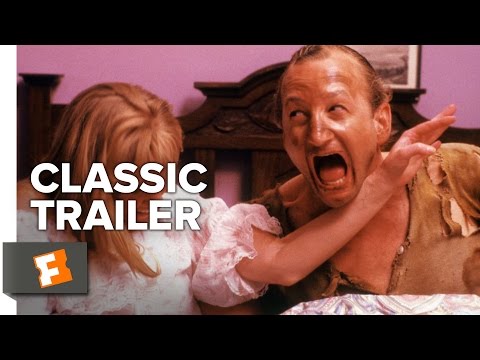
A year after The Dream Master, Alice Johnson and Dan Jordan are a couple, graduating with the class of 1989 alongside new friends: Greta Gibson, an aspiring model starved by her mother’s ambitions; Mark Gray, a comic-book romantic; and Yvonne Miller, a hospital volunteer and competitive swimmer. The peace does not survive the opening minutes. Alice dreams herself into a nun’s habit with a name tag reading Amanda Krueger, in the asylum where Freddy was conceived, and then dreams further — Amanda giving birth to a deformed baby that slips its mother’s hands and escapes. Alice follows it into the church where she destroyed Freddy the year before, and watches the baby find Freddy’s remains and grow, in seconds, into the man himself. He has found the key to coming back, he tells her. He is already using it.
The key is a child who does not exist yet. A little boy named Jacob starts appearing to Alice at night, hinting that she is his mother — though Yvonne, checking the hospital, finds no children on the floor and no children’s ward at all. Jacob is Alice and Dan’s unborn son, and he is nobody’s reincarnation: Freddy’s plan is to be reborn through the boy’s dreams, riding a sleeper who is never fully awake or asleep, and reaching Alice’s friends even while Alice herself is wide awake. An early ultrasound confirms the obscenity of it: Freddy has been feeding Jacob his victims, seasoning the child with murdered souls to make him, in Freddy’s design, like himself. The adults around Alice respond the way this series’ adults always do — Dan’s parents move to take custody of the baby at birth, and Alice refuses, alone with a truth nobody will sign for.
The deaths, in order
Dan Jordan dies first, and his death belongs to this film — he survived The Dream Master in a hospital bed, alive in its fountain finale, whatever the clip reels suggest. Racing to Alice, he falls asleep at the wheel of his motorcycle and Freddy rewires him into it: electrocuted, fused man and machine, the Freddy bike screaming into oncoming traffic. Alice wakes in a hospital to two announcements delivered together — Dan is dead, and she is pregnant.
Greta Gibson dies at her mother’s dinner table, in front of the guests. Asleep upright, she mouths off at her mother in the dream and Freddy answers by force-feeding her — her own organs served back to her while a dream audience laughs — until she chokes. In the waking world she simply falls dead at the table. Mark Gray, who loved Greta and never said so, dies inside his own medium: pulled into a comic-book world, he powers up as a superhero, watches Freddy out-power him as the villain, and is flattened into a paper cutout and slashed to ribbons, the colour draining out of him like ink.
And one death that is not: Yvonne, asleep in the asylum Jacuzzi, is lured down a collapsing diving board into Freddy’s version of the pool — and Alice hauls her out, skimmer jammed into Freddy’s mouth. Yvonne survives this film, and becomes Alice’s one believing ally. Any cast list that buries her is wrong.
How it ends
Alice finally understands the geometry of the haunting: Freddy has been hiding inside her, stepping out of her own sleep. She draws him out of her body and chases him through an asylum rebuilt as an M. C. Escher print — staircases climbing into themselves, gravity on strike. The rescue comes from the other mother. Yvonne finds Amanda Krueger’s remains in the real asylum and frees her spirit from its earthly prison; Amanda crosses into the dream and does not fight Freddy herself. She does something harder: she tells Jacob to use the power Freddy has been feeding him. Jacob turns it on its source. The spirits of Dan, Greta and Mark tear Freddy’s infant form out of him; Jacob, restored to a baby, is absorbed back into Alice — and Freddy is absorbed into Amanda, who closes the church doors and seals her son away inside herself.
Sealed is not destroyed. Detailed accounts of the ending agree the containment is imperfect — Freddy’s clawed hand is seen tearing at Amanda from inside, trying to get out. Months later, at a picnic for the newborn Jacob Daniel Johnson — mother, grandfather Dennis, and Yvonne in attendance — children skipping rope nearby are humming a familiar rhyme about never sleeping again. The next film arrived two years later. Of course it did.
A premise New Line once refused
The pregnancy plot was not new in 1989. Leslie Bohem had developed the idea of Freddy possessing an unborn child years earlier, while being considered to write Freddy’s Revenge — and New Line rejected it, by Bohem’s own account, because executive Sara Risher was pregnant at the time and found the premise disturbing. When The Dream Master‘s receipts made a fifth film inevitable, the studio went back to the rejected pitch — with Risher herself instrumental in reviving it, and in shaping its terms: Alice would make the decision to keep her baby herself, with the alternative presented as real, not as a trap. The script went through John Skipp and Craig Spector (their draft was called The Dream Pool), Bohem’s own pass, and uncredited revisions by William Wisher Jr. and David J. Schow before Bohem took the sole screenplay credit.
Director Stephen Hopkins — an Australian whose thriller Dangerous Game (1987) had been seen at Cannes; this was not his debut — has said he was hired in February to deliver a film to theatres six months later. The tone order from the studio was a reversal: the previous film had aimed Freddy at the MTV audience “almost as a stand-up comedian,” and this one would take him back to the shadows — gothic, expressionistic, blue-filtered, all surreal architecture and asylum dread. Robert Englund took one meeting to be sold on the design: Hopkins, storyboards in hand at a Thai restaurant in Culver City, told him “I want this whole sequence to be like M. C. Escher,” and Englund replied, “Oh, perfect for a dream sequence, I get it.”
Cut by the censors
The gothic turn came with gore the ratings board would not pass. The film was initially rated X for its violence, and the two set pieces the board fought hardest — Dan’s motorcycle transformation and Greta’s force-feeding — were substantially shortened to win the R, cuts the trades reported that November. The longer versions survived on unrated VHS and LaserDisc editions, and in September 2025 Warner Bros.’ seven-film Ultra HD Blu-ray collection restored the removed footage to Dan’s and Greta’s scenes for disc at last. Hopkins, looking back a year after release, did not pretend the released cut was the film he shot: it was, he said, “a rushed schedule without a reasonable budget,” and after the studio and the MPAA “cut the guts out of it completely,” what had started as “an OK film with a few good bits turned into a total embarrassment. I can’t even watch it anymore.” Directors almost never say that about their own studio films. He said it about this one, on the record, while promoting his next job.
The money
The budget is contested in the usual way: $8 million in the figures carried by Wikipedia (citing the AFI) and dvdmg, $6 million at The Numbers — this page prints both and picks neither. What is agreed is the shape of the fall. Released 11 August 1989 on 1,902 screens, the film opened third with $8,115,176 — a figure every tracker matches — behind Parenthood and The Abyss, and its second weekend took $3,584,320. (A $4,084,320 figure circulates for that frame; it is a week total, not the weekend.) The final North American gross was $22,168,359, agreed across the board — against The Dream Master‘s $49,369,899 the year before. Less than half. Wikipedia’s verdict, quoted rather than paraphrased because it is exactly calibrated, is “a steep decline in box office receipts from its two predecessors, though still a box office success.” Both halves of that sentence are true, and the second half is why there was a sixth film at all.
The reviews
The critical weather turned with the receipts. Wikipedia’s summary is “generally negative reviews,” while Metacritic’s count — 54 from 11 critics, three positive, seven mixed, one negative — lands on “mixed or average,” and this page reports both rather than splitting the difference. Rotten Tomatoes stands at 32% from 37 reviews (checked October 2026), its consensus calling the film an exhausted fifth entry “bogged down by a convoluted mythology while showing none of the chilling technique that kicked off the franchise.” Kevin Thomas of the Los Angeles Times stayed loyal, calling it “a dynamic, fully visually realized experience” — a 90 on Metacritic’s scale, the film’s highest major notice. Caryn James in The New York Times allowed that it “doesn’t pretend to be anything more than it is — a genre film that won’t totally insult your intelligence or your eyes.” Variety called it “a poorly constructed special effects showcase” while conceding the set pieces were its saving grace, and Empire’s David Hughes reached for the whip: “old Fred is starting to resemble one of those dead horses that studio execs insist on flogging.” The honours were stranger than the reviews: at Fantasporto, Hopkins won the Critics Award; at the Young Artist Awards, Whit Hertford — the boy Jacob — won for his supporting performance; and at the 10th Golden Raspberry Awards, Bruce Dickinson won Worst Original Song for “Bring Your Daughter… to the Slaughter,” written for this film — a song Iron Maiden’s own version of which topped the UK chart in January 1991. Worst song of the year, number one the next. The eighties were a big tent.
Alice’s story ends here
Together with Dream Warriors and The Dream Master, this film closes a trilogy inside the series — the Nancy-to-Kristen-to-Alice relay, three final girls handing the fight down. It is also where Alice leaves the story. She does not appear as a character in Freddy’s Dead (1991); the original script for that film had her return only to be killed early, making Jacob the lead, and that version was scrapped — the released film mentions neither of them. Wilcox’s own account is that the producers never tried to call her back, though they did ask about using footage of her in the end credits — and archive footage is all she is in that film, a distinction one competing account muddies by claiming she was unavailable; her version is the primary one, and it is the one this page believes. Jacob, too, vanishes from the films entirely. The boy Freddy tried to raise as his second coming grew up, by all the evidence the series offers, somewhere far from Elm Street — which, for a child of this franchise, counts as a happy ending.
Browse the whole run on the Elm Street franchise hub, meet the man himself on the Freddy Krueger page, or start at the 1984 original — and if the mother is the story for you, Wes Craven‘s page is where the asylum’s other ghost is properly introduced.