Your father’s shotgun is cleaned, loaded, and — as of this morning — sabotaged by your own hand, and you are not yet twenty. Upstairs the housekeeper is warming your father’s bed and will shortly warm yours. In six years you will sail through Vienna medical school, ruin the Dean’s daughter, and come home to build a man out of other men, numbering the parts on a chart like a grocer’s list. You are Victor Frankenstein, fiend, and nobody in this film is going to stop you — that is the joke, and the horror.
The Horror of Frankenstein (1970) is Hammer’s sixth Frankenstein film, a remake of The Curse of Frankenstein with a younger Baron and no Peter Cushing.
Sit with that a moment, fiends, because everything strange about this picture flows from it. In 1957, Jimmy Sangster wrote the film that rebuilt British horror — Cushing’s cold, brilliant Baron, stitching a man together out of stolen parts and stolen scenes. Thirteen years later Hammer handed Sangster the same story back and let him produce it, direct it — his first time directing anything — and play it for laughs. The Baron is thirty now, played by Ralph Bates with a smirk instead of a scalpel stare. He murders his father before the credits have finished echoing, seduces the housekeeper, poisons his future father-in-law for his brain, and strolls away at the end entirely unpunished, whistling. It is the series’ black sheep, and it knows it.
Harper has always had a weakness for heresy, and this is the heretical one. 1970 was Hammer’s great reboot year: the American money had fallen away, EMI financed the films in Britain instead, and the studio tried to relaunch both flagship monsters for a younger audience. Dracula at least kept Christopher Lee for Scars of Dracula. Frankenstein lost the most identified-with actor in British horror and gained a joke — or a dare. Whether the joke lands is the argument this film has been having with its audience for fifty years. The contemporary critics mostly walked out of it. Time to open the laboratory door and judge for ourselves.

Quick Specs
- Director: Jimmy Sangster
- Screenplay: Jeremy Burnham and Jimmy Sangster
- Starring: Ralph Bates (Baron Victor Frankenstein), Kate O’Mara (Alys), Veronica Carlson (Elizabeth Heiss), Dennis Price (The Graverobber), Jon Finch (Lieutenant Henry Becker), Bernard Archard (Professor Heiss), Graham James (Wilhelm Kassner), Joan Rice (The Graverobber’s Wife), David Prowse (The Monster)
- Music: Malcolm Williamson
- Cinematography: Moray Grant
- Editor: Chris Barnes
- Producers: Jimmy Sangster
- Production Company: Hammer Film Productions (financed by EMI)
- Distributor: MGM-EMI Distributors (UK); Continental Films (US)
- Premiered: October 1970 (UK trade showing); UK general release November 8, 1970
- Runtime: 95 minutes
- Rating: X (UK); R (US)
- Budget: £200,000
- Box Office: No reliable standalone gross — £55,385 is the combined London double-bill gross with Scars of Dracula, not this film’s earnings
- On This Site: The Horror of Frankenstein in the wiki · The Curse of Frankenstein · Frankenstein Must Be Destroyed · Scars of Dracula · Peter Cushing · Hammer Films
The Review
The Horror of Frankenstein 1970 review has to begin by burying a myth, because it has hardened into folklore: Peter Cushing did not turn this film down. The part was never offered to him. The Cushing cycle had run five films deep, Hammer’s American backing had fallen away, and the studio — newly financed by EMI, shooting at Elstree on recycled sets — decided to reboot its two great series for a younger crowd. Scars of Dracula reset the Count; this reset the Baron, recasting Victor as a man of thirty and building Ralph Bates, fresh from playing the exquisite Lord Courtley in Taste the Blood of Dracula, as a new star. Publicity photographs were even staged of Cushing shaking Bates’s hand, handing over the reins — a managed succession, not a snub. Cushing loyalists have treated the film as an insult ever since. It is better understood as a gamble that Hammer lost and then quietly reversed: four years later Cushing was back for the final entry, and this one was left standing outside the series’ continuity like a relative nobody mentions.
The gamble’s architect is the fascinating part. The project arrived as a straight remake: television writer Jeremy Burnham brought Hammer his own script, The Horrors of Frankenstein, covering the same ground Sangster had covered in 1957. Sangster was asked merely to rewrite it and refused — until the studio let him produce, whereupon he countered that he would do it if he could direct as well. Consider what that means. The man who single-handedly wrote The Curse of Frankenstein — the sole credited screenwriter, replacing an earlier script wholesale — returned thirteen years on to remake his own foundation stone as a black comedy, with himself in charge of everything. Film historian Jonathan Rigby puts the conception precisely: where the earlier Victor had been a sociopath, Sangster deliberately wrote this one as a psychopath — colder, randier, and murdering anyone who inconveniences him without a flicker of anything at all. The jokes are all in that flicker that never comes. Bates plays every atrocity with the same amused, faintly bored courtesy, and the film’s whole tone hangs on whether you find that funny.
For the first hour, Harper mostly does. The schoolboy prologue announces the method at once: young Victor, caught drawing anatomical divisions in felt-tip over a pin-up photograph — the anachronism is the joke, and Sangster signs it like a manifesto. Victor dodges a caning by weaponising his schoolmaster’s hypochondria, sabotages his father’s shotgun and inherits everything, sails through six years of Vienna medical school until he impregnates the Dean’s daughter, and comes home to build his laboratory with the loyal Wilhelm, the housekeeper Alys (Kate O’Mara, who had warmed his father’s bed before him, and treats the promotion as a perquisite), and a chart on the wall numbering the parts he needs — numbers he begins, in the film’s best running gag, to see printed on the foreheads of the living. Variety praised Bates’s “nicely suave and sardonic performance,” and suave and sardonic is exactly the register: this Victor does not rage against God or nature. He simply finds other people an inefficient arrangement, and corrects it.
The supporting company plays the same deadpan game, and the best of them are very good. Dennis Price, billed simply as The Graverobber, delivers corpses with the air of a man discussing the wine list — including a windfall consignment of drowned ferry passengers — and Joan Rice, as his wife, matches him sigh for sigh. Wilhelm’s end, electrocuted at the apparatus for threatening to talk, is staged as a music-hall turn. Professor Heiss’s kidnapped tortoise, revived as an early experiment, is the film in miniature: absurd, a little cruel, and funnier than it has any right to be. And when Victor poisons Heiss himself and the great brain arrives back from the graveyard damaged in its jar — a deliberate rhyme with Curse, where the damaged brain explained the Creature’s violence — the remake tips its hat to the original even as it pickles it.
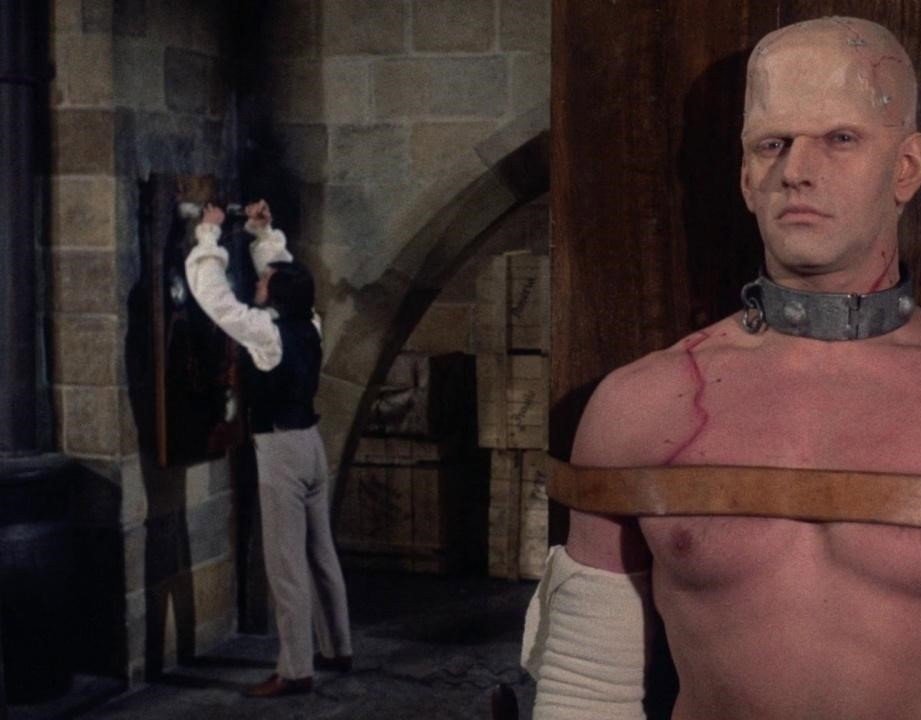
Then the Monster stands up, and the film’s nerve fails. David Prowse — six feet six of him, in a bald pate and a steel collar — is given nothing to be. Cushing’s Creature in 1957 was a murdered innocent with a broken mind; this one is a mute mechanism, an assassin Victor aims at his problems: thrown at the blackmailing Alys, pointed at the Graverobber’s wife in the woods, parked in a vat when company calls. Kevin Thomas, in the Los Angeles Times, called him “simply a robot killer,” and fifty years of defenders have not found the counter-argument, because there isn’t one. The single exception proves the poverty around it: the creature spares a woodsman’s little daughter, who later describes him as a nice monster really — one beat of the old Frankenstein pathos, glowing in a film that has otherwise decided pathos is a mug’s game. Veronica Carlson, as Elizabeth, suffers the same thinning: a fine actress, in her last film for Hammer — she says on camera in the Gallows Humor documentary that she disliked the humorous approach — given a sweetheart’s part with the sweetness ironed out of it.
The notices at the time split along exactly the line the film walks. Howard Thompson in The New York Times found the first hour “not only painless but also fun,” compared the film favourably to Kind Hearts and Coronets, and concluded it was “good fun while it lasted” — before the monster lumbered in and the fun stopped. The Monthly Film Bulletin was savage, accusing Sangster of “annihilating all the power of the original myth” and putting nothing in its place — an unfair verdict, but an understandable one from a critic watching the house style dismantled by its own architect. Kim Newman, looking back for Empire, called it a poor attempt featuring “the usually reliable Bates offering a rather irritating performance,” which is the other honest response available: a little of this Victor’s smirk goes a very long way, and when the murders stop being witty they are merely frequent.
What the record actually shows is a deliberate experiment that its first audience declined: it opened in Britain on a double bill with Scars of Dracula in November 1970, did decent business at home, and in America was handled by a small independent without the clout to open it wide, drifting into New York the following June. No Bates series followed. The reboot was rebooted.
Spoiler Section
Spoilers from here, fiends — the Baron’s escape is discussed plainly.
And so to the ending, which is either the film’s boldest stroke or its final shrug, depending on the seat you’re in. The police, in the person of Jon Finch’s Lieutenant Becker, close in; the creature lies sedated in the laboratory’s great vat; and while the adults interrogate a serenely lying Victor, the woodsman’s little daughter — the one living witness disposed to think well of the monster — wanders to the apparatus and accidentally floods the vat with acid. The evidence dissolves. The film’s last image is the creature’s empty shoes, floating on the surface. Every other Hammer Baron ends condemned, burned, or dragged down with his creation. This one ends free, rich and ready to start again. As a joke about the character — the psychopath the world never catches — it is perfectly constructed. As the climax of a horror film, it is a conjuring trick performed with somebody else’s monster, and the audience of 1970, who had paid for the monster, knew it.
Trivia
- The Monster wore the collar twice. David Prowse is the only actor to play Frankenstein’s Monster in two Hammer films — here, and again under much heavier make-up in Frankenstein and the Monster from Hell (1974), opposite a restored Peter Cushing. Prowse had first walked into Hammer’s offices in the mid-1960s asking to play a monster and been briskly dismissed. He is better known as the body of Darth Vader in the original Star Wars trilogy — the physical performance was his; the voice was James Earl Jones.
- Cushing never refused it. The role of Victor was never offered to Peter Cushing at all: with the Cushing cycle complete, Hammer deliberately recast the Baron younger to reboot the series, and publicity photographs were staged of Cushing shaking Ralph Bates’s hand to hand over the part. Stories of Cushing declining the role are folklore.
- The author remade himself. Jimmy Sangster was the sole credited screenwriter of The Curse of Frankenstein (1957) — he had replaced an earlier script by other hands wholesale. Thirteen years later he rewrote Jeremy Burnham’s straight remake of that same story into this black comedy, and talked Hammer into letting him produce and direct it as well. It was his directorial debut; his second film behind the camera was Lust for a Vampire (1971), where he replaced Terence Fisher at short notice.
- It began as somebody else’s straight remake. Jeremy Burnham — credited as co-screenwriter — originated the project and brought his script to Hammer under the title The Horrors of Frankenstein, plural, with — by the surviving account of his outline — a more conventional final reel of the Monster running amok. The comedy, the floating shoes and the unpunished Baron are Sangster’s rewrite.
- British money, British bill. The film was financed entirely by EMI — one of the first Hammer horrors made without American financing in place — shot at Elstree on sets recycled from Taste the Blood of Dracula and The Vampire Lovers, and released in Britain on a double bill with Scars of Dracula, the Dracula half of the same reboot experiment. Its small American distributor could not open it wide; New York did not see it until June 1971. The budget itself travels with its source attached: The Hammer Story gives £200,000, EMI historian Paul Moody gives £176,000, and the records do not agree.
- A changing-of-the-guard cast. Bates had just played Lord Courtley in Taste the Blood of Dracula; Kate O’Mara and Jon Finch arrived straight from The Vampire Lovers; and for Veronica Carlson it was the end of the line — her last film for Hammer, after Dracula Has Risen from the Grave and Frankenstein Must Be Destroyed. She says on camera in the Gallows Humor documentary (2019) that she disliked Hammer’s humorous approach to this one.
- The Baron who got away. Victor’s clean escape is unique in the series: across five films Cushing’s Baron faced the guillotine, transplanted his own brain to cheat death, and twice went into the fire with his creations. Bates’s incarnation ends the picture free, solvent and unrepentant — the joke the whole film is built to deliver.
- No honest gross exists. The only takings figure in the literature, £55,385, is the combined London gross of this film and Scars of Dracula as a double bill — not this picture’s earnings. Any source quoting it as The Horror of Frankenstein‘s box office is misreporting the package as the film.
Where to Watch
As of November 9, 2026, in the US: The Horror of Frankenstein streams on Shudder, AMC+ and Philo, and free with a library card on Hoopla. Rent or buy it on Amazon Video and Fandango At Home. Collectors: the Scream Factory Blu-ray is the American edition to own. Listings rotate — check before you settle in.
The Verdict
Rating: 2.5 ravens out of 5.
So what is it, fiends, this pickled Baron? Not a good Frankenstein film, exactly — the monster is wasted, the back half sags, and the smirk outstays its welcome. But it is a genuinely singular object: the founding author of Hammer horror returning, at the moment the studio’s old world ended, to take his own masterpiece apart with a grin and see if the pieces still danced. Some of them do. Watch it as a double feature with The Curse of Frankenstein — the straight telling first, then Sangster’s heretical gloss — and you have the complete biography of Hammer’s Frankenstein: the Baron as tragedy, and the Baron as joke, played by the same house. The horror of this Frankenstein was never the creature. It was the suspicion, worn lightly and never quite dispelled, that Victor was enjoying himself — and that his creator was, too.
The weekly roundup
One letter a week, from the crypt.
- New reviews, with the ravens
- New wiki entries and news
- Cool stuff worth your night
Weekly. No spam, unsubscribe in one click.