You wake in a cage in a travelling ventriloquist’s lock-up, and the name your keeper calls you is an insult. All you own is a medallion you cannot read and a recurring nightmare in which you are standing over bodies with a knife in your hand. Then a television in a bar window shows you two dolls — a scarred groom, a bride in leather — and something in your chest says the word you have never been allowed to say: family. So you run, fiend. Hollywood is waiting, and so are Mum and Dad.
Seed of Chucky (2004) is the fifth Child’s Play film: Chucky and Tiffany’s doll child resurrects them in Hollywood — and wants parents, not killers.

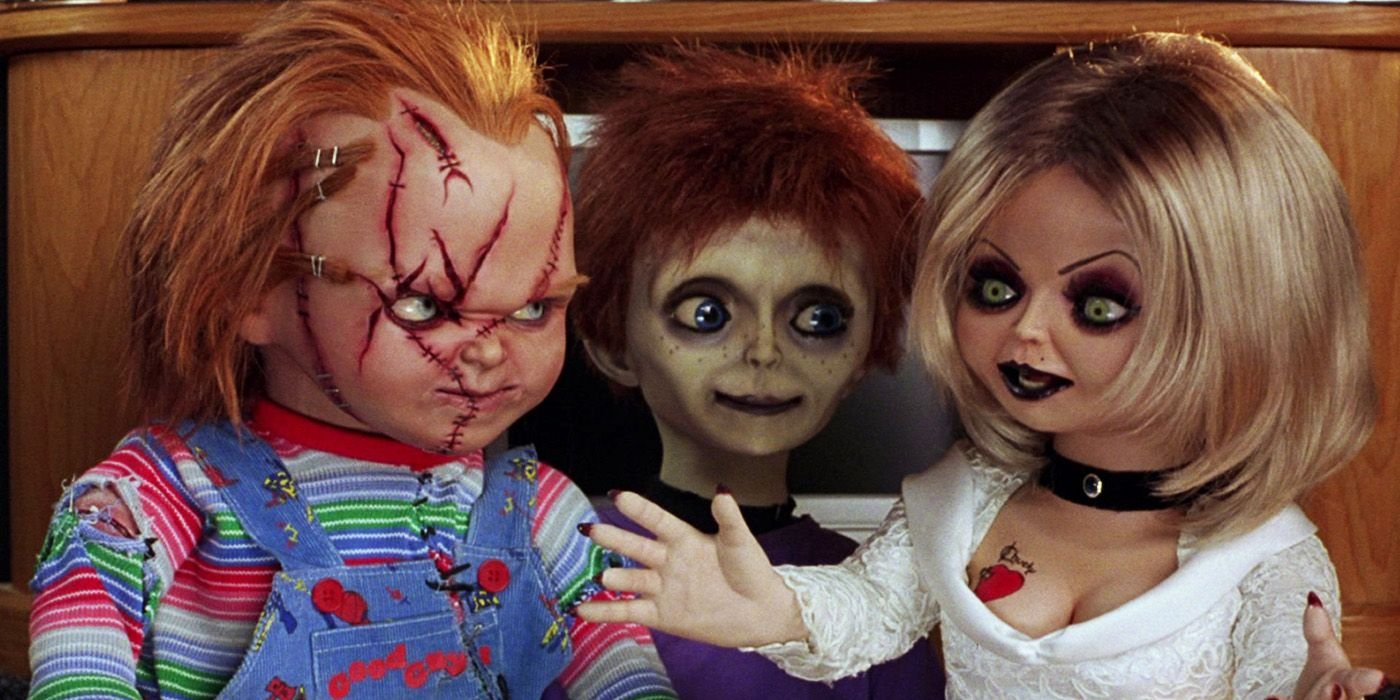
Six years after Bride of Chucky ended in a cemetery with a birth nobody asked about, the baby is grown — or as grown as a doll gets — and living as a ventriloquist’s prisoner in England, tormented by nightmares of murder and answering to the name “Shitface.” Then a television preview shows the child the truth: a Hollywood studio is shooting Chucky Goes Psycho, a film about two killer dolls, and the dolls on the screen are not actors. They are Mum and Dad. What follows is the strangest family reunion in slasher history, staged inside a movie about a movie, with Jennifer Tilly playing the most dangerous role of her career — herself.
This is Don Mancini’s directorial debut, and it nearly never happened. The creator of Chucky had the script ready in 1998, days after Bride of Chucky opened, under the title Son of Chucky — and Universal, expecting a conventional slasher about a murderous boy, rejected it. The note, as Mancini has told it ever since, was three words long: “This is too gay.” The project slept for years before Focus Features revived it and released it through its genre label, Rogue Pictures, in November 2004, for a budget the sources split on — $12 million by Mancini’s own account, the cheapest Chucky film ever made, against $29 million in other production listings. What he shot with that money, at Castel Film Studios in Romania, is not really a horror film with jokes. It is a comedy with corpses, a Hollywood satire wearing a slasher’s skin, and the most argued-over entry in the entire series. Dim the lights, fiends. The family is waiting.
Quick Specs
- Director: Don Mancini
- Screenplay: Don Mancini
- Starring: Jennifer Tilly (Jennifer Tilly; voice of Tiffany), Brad Dourif (voice of Chucky), Billy Boyd (voice of Glen / Glenda), Redman (himself), Hannah Spearritt (Joan), John Waters (Pete Peters)
- Music: Pino Donaggio
- Cinematography: Vernon Layton
- Editor: Chris Dickens
- Producers: David Kirschner, Corey Sienega
- Production Company: La Sienega Productions, David Kirschner Productions
- Distributor: Rogue Pictures
- Premiered: November 12, 2004 (United States)
- Runtime: 86 minutes (theatrical cut); 87 minutes (unrated cut)
- Rating: R
- Budget: $12 million (Mancini’s account); $29 million (other production listings) — the sources conflict
- Box Office: $24,829,644 (worldwide)
- On This Site: Seed of Chucky in the wiki · Bride of Chucky in the wiki · Curse of Chucky in the wiki
The Review
Begin with the child, because the film does. Glen — or Glenda; hold that thought — is the gentlest soul this series ever produced: a pacifist doll with a soft Billy Boyd voice, kept in a cage by a ventriloquist named Psychs and exhibited as a freak. The opening stretch is the film’s most conventionally eerie, and its most pointed. This is a kid who dreams in kills and wakes up horrified, who has been named an insult by the only guardian available, and who escapes to Hollywood on the strength of a single hope — that the monsters on television might be family, and that family might be kinder than the cage. Ed Wood’s Glen or Glenda is the film’s declared ancestor, and Mancini is not joking with the reference: underneath the gags, this is a story about a genderfluid child asking two murderers to simply be parents. That it works at all is Boyd’s doing. His trembling decency gives the farce a heart it has no business possessing.
The resurrection, when it comes, is the film’s thesis in miniature. Glen finds the prop dolls — rebuilt from Chucky and Tiffany’s original remains for the film within the film — and wakes them with the Heart of Damballa. Chucky takes one look at his anatomically unfinished child and names him Glen. Tiffany takes the same look and renames her Glenda. Nobody asks the kid. The parents then do what this series’ parents do: they kill the first person handy, a special-effects technician played, in the film’s neatest inside joke, by Tony Gardner — the man who built them. Jennifer Tilly finds the body. The dolls stow away in her limousine. And the machinery of the plot starts turning: Jennifer, desperate for the Virgin Mary role in rapper Redman’s directing debut, is preparing to seduce her way into the part, while Tiffany — who voices Jennifer’s on-screen doll in Chucky Goes Psycho and considers the human Tilly an embarrassing tenant of her own fame — hatches a plan to take the actress’s body for herself, with Redman’s earmarked for Chucky, and a turkey baster full of voodoo logic reserved for the question of where Glen’s soul will live. It is, deliberately, the most preposterous contraption in the franchise. The film knows. The film is proud.
What carries all of this is Jennifer Tilly, playing the double performance of her life. As Tiffany’s voice she is silk and homicide; as “Jennifer Tilly” — a vain, scheming, oddly touching caricature of her own public image — she is the funniest actor in the film and the only one playing a complete human being. Roger Ebert called it “actually two movies, one wretched, the other funny,” and the funny one is hers. She was nominated for Best Frightened Performance at the MTV Movie Awards for this, and the nomination undersells it: the film’s best scenes are two Tillys regarding each other across the machinery of fame, the doll seething that the woman has wasted her face, the woman unaware the doll exists. When the series is remembered kindly in the future tense, this is the performance people will point to.
The comedy-first bargain has a price, and honesty demands it be entered in the ledger. Seed of Chucky is barely a horror film. The kills are inventive — a paparazzo played by John Waters meets sulfuric acid in the film’s best fatal accident; Redman, having revealed a vasectomy and fired Jennifer in the same breath, is disemboweled by a Tiffany who takes his misogyny personally — but they are staged as punchlines, not dread. The middle sags under its own machinery. The insemination sequence, the film’s most notorious, is a gag the series tells on itself at Jennifer’s expense, and even sympathetic viewers divide on whether it earns its place. And Chucky, for long stretches, is a supporting act in his own franchise: proud father, reluctant abstainer under Tiffany’s no-killing pact, a monster doing stand-up about domestication. If you come to this film wanting the dread of the early entries, you will leave hungry. Mancini had reasoned that familiar villains stop frightening and a series must lean into comedy or die — Seed is that reasoning with the throttle open, and the throttle sticks.
The audience of 2004 did not want it. Seed opened fourth with $8,774,520 and closed with $24,829,644 worldwide — the lowest gross of any theatrical entry — while critics split down the middle and opening-night audiences were colder still. Joe Leydon’s contemporary verdict — that it “simply isn’t funny or frightening enough to expand its appeal beyond core fan base” — was the majority report, and the franchise went silent for nine years. But time has been kind to the outcast. The film’s reputation has grown, as Mancini himself puts it, “in a cult-like way” — critics returning to it now praise the camp, the nerve, and the sincere strangeness of its gender story, which was Mancini’s stated intent from the 1998 draft onward. He defends this film to this day. What he resents is the aftermath: when the series revived with Curse of Chucky, his partners forbade him from referencing Seed at all — which is why Glen and Glenda vanish from the films for fifteen years.
Spoiler Section
Spoilers settle here, fiends — outcomes are named plainly.
The film’s one genuine dark gift is its central reveal: Glen and Glenda are not one child with two names. They are two souls sharing one small body — Glen the pacifist, Glenda the psychopath — and it is Glenda who kills Jennifer’s assistant Joan while Glen sleeps in their shared skin. The voodoo pregnancy Tiffany arranged delivers the solution and the horror in the same package: twins, a boy and a girl, one body for each soul. By then the family has already broken. Chucky, offered the human body of Jennifer’s chauffeur Stan as a replacement vessel, declines the whole enterprise — he has made his peace with being a doll, a killer, a legend, and Stan dies on Chucky’s thrown knife anyway, shielding Jennifer. Tiffany walks out on him. In the hospital climax Chucky axes the Tiffany doll to death and Glen — Glen himself, the gentle one, at last pushed past the end of gentleness — takes the axe and takes his father apart with it, while Chucky dies praising his son. It is the most sincere scene in the film, and it lands like a hammer: the pacifist’s inheritance is the capacity for exactly one act of violence, aimed at the man who wanted him violent all along.
Five years later, the film plays its final card. “Jennifer Tilly” is raising the human twins, and a nanny who quits because little Glenda frightens her is beaten to death by her employer — whose eyes flash green as she does it. Tiffany’s transfer succeeded. She has been living in Jennifer Tilly’s body all along, and the twins are being raised by their mother in a stolen life, while Glen opens a birthday present and finds his father’s severed arm inside, which grabs him. That closing arrangement — Tiffany enthroned in Tilly, the twins in her keeping — is the status quo the series would inherit when it returned, and it is why Seed, for all its farce, cannot be skipped: the two direct-to-video sequels that followed are standing on its floorboards.
Trivia
- This is Don Mancini’s directorial debut. He created Chucky and had written or co-written every previous entry; Seed is the first film he also directed — and he went on to direct Curse and Cult as well.
- The script existed from October 1998 under the title Son of Chucky. Universal rejected it — Mancini has repeatedly quoted the studio’s note as “This is too gay” — and the project revived years later at Focus Features, which released it through its genre label, Rogue Pictures.
- Mancini built the story on Ed Wood’s Glen or Glenda (1953): Chucky’s child as an innocent working out who they are while their parents argue over the answer. The naming fight in the film — Glen versus Glenda — is the homage made literal.
- Hollywood is Romania. The film was shot almost entirely at Castel Film Studios to hold the budget down; the figure itself is disputed — Mancini calls it $12 million, the least expensive Chucky film ever made, while other production listings put it at $29 million.
- The first on-screen victim, the decapitated special-effects technician, is played by Tony Gardner — the film’s actual effects designer, killed by his own puppets.
- Jennifer Tilly’s dual role is the film’s structural joke: she plays the human Jennifer Tilly and voices the doll Tiffany as two separate characters. They only become one person at the climax — the opposite arrangement from Cult of Chucky, where Tiffany starts the film already wearing Tilly.
- Mancini has said he offered Quentin Tarantino a play-himself role before Redman took the part. Tarantino declined.
- The “Unrated and Fully Extended” home-video cut adds roughly 57 seconds — an alternate shot and a slightly longer ending. Mancini’s frugal shoot left almost nothing on the cutting-room floor to restore.
- Seed was the last original-continuity Chucky film released in theaters, and its $24.8 million worldwide gross was the lowest of the theatrical run. The series returned nine years later, direct to video, with Curse of Chucky.
- John Waters — patron saint of cheerful bad taste — appears as Pete Peters, the tabloid photographer whose death by sulfuric acid is the film’s most quoted accident.
Where to Watch
As of November 9, 2026, in the US: Seed of Chucky streams by subscription on AMC+ (via the Roku Premium Channel) and AMC, and free with ads on YouTube Free. It is also available to rent or buy digitally on Amazon Video, Apple TV Store and Fandango At Home. Streaming availability can change.
The Verdict
Rating: 3 ravens out of 5.
Three ravens. Seed of Chucky is a mess with a masterpiece of a Tilly performance inside it, a slasher that traded its scares for satire and mostly got away with it. Fear the second coming? No. But raise a glass to it, fiends. Families are like that.
The weekly roundup
One letter a week, from the crypt.
- New reviews, with the ravens
- New wiki entries and news
- Cool stuff worth your night
Weekly. No spam, unsubscribe in one click.