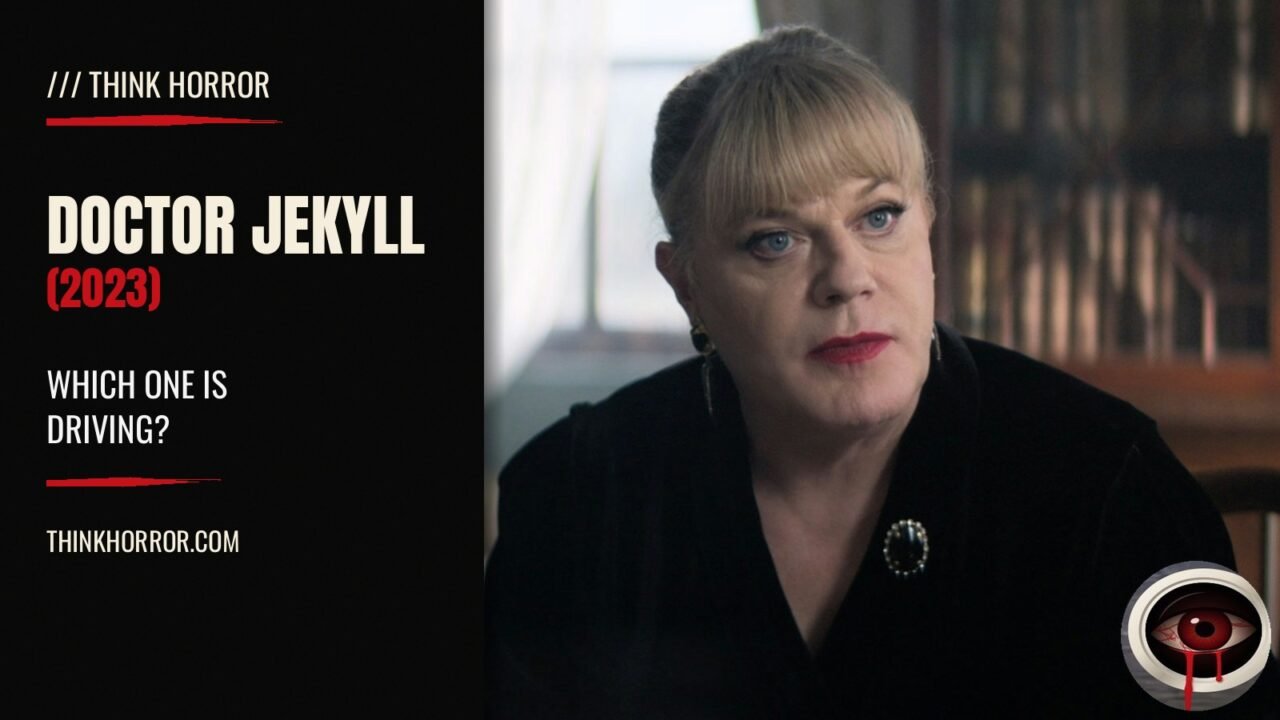
The mansion interview is going well, which is the first strange thing. She is charming. She is funny. The pills on the side table are laid out like a communion — this one, then this one, never late, never missed — and the woman across from you explains her condition the way other people explain a train timetable. You are an ex-con with a record, a temper and a daughter you are not allowed to see, and this job, this live-in job with the billionaire recluse and the locked doors, is the only road back to her. So you smile. You take the work. And somewhere between the charm and the timetable, you understand you will never once be certain which of the two women in this house has been interviewing you.
Doctor Jekyll is an independent B-Good production — Henry Jekyll’s granddaughter Nina keeps her other self on a strict schedule of medication — that became the first release of Hammer’s Gore era, with Hammer taking UK distribution only.

The Review
This Doctor Jekyll (2023) review keeps to the film’s own scale: eighty-nine minutes, two principals, one locked house. Doctor Jekyll was not made by Hammer. It is an independent production that Hammer acquired for distribution. Shot in February–March 2022, the film premiered as a work in progress at FrightFest on 25 August 2023 and reached UK cinemas on 27 October 2023, the first release after John Gore’s acquisition of Hammer, announced 31 August 2023. So the stakes were never really about one small Gothic chamber piece. They were about whether the most famous name in British horror could walk again. The answer the film gives is stranger and more interesting than a triumph or a flop: it walks carefully, in someone else’s shoes, and the shoes belong to Eddie Izzard.
The premise is a continuation, not a remake. Nina Jekyll is Henry Jekyll’s granddaughter — the record is settled on this, whatever a stray review tells you — and she has inherited the whole estate: the mansion, the pharmaceutical company her grandfather’s work became, and the family condition. Henry’s persona-transforming drug runs in the line, and Nina’s other self, Rachel Hyde, is kept down by medication taken on an unforgiving schedule. Nina is a scandal-worn billionaire recluse, recovering from an injury, walking with a cane, when she hires Rob Stevenson — note the surname; the film buries its author in its hero — an ex-convict and recovering addict whose infant daughter, ill and in the care of Social Services, he may only reach by holding exactly this kind of job. Scott Chambers plays Rob with a beaten, hopeful openness that the film leans on heavily: he is our Utterson, the ordinary man walking into the strange case, and his decency is the trap’s bait and the story’s conscience both.
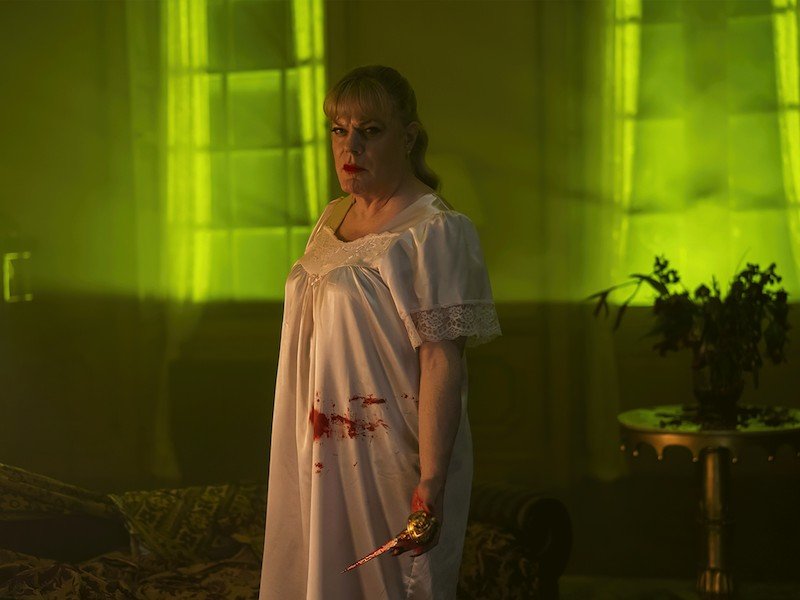
The film’s one genuinely bold decision is what it refuses to show you. There is no transformation — no prosthetics, no second performer, no mirror scene. Nina and Rachel are the same body, the same clothes, the same face, and Izzard plays the difference at the level of weather: a warmth that arrives a half-second late, a smile held one beat too long. Izzard stated the design herself: “in a lot of the scenes you can’t quite tell who is there.” It is the right idea for this story — the film is, at its best, a two-hander where both hands belong to one performer. Hammer itself had already done the visible swap — Dr. Jekyll and Sister Hyde back in 1971, when Ralph Bates physically became Martine Beswick — and Izzard is fully equal to it. The critical picture matches the split. The Telegraph’s Robbie Collin said Izzard “gives a riveting performance” and “isn’t remotely out of place”, while the Guardian’s Peter Bradshaw called the film “bafflingly laborious, leaden and self-conscious” and Variety’s Todd Gilchrist judged it “meandering and empty.” RogerEbert.com praised “her mesmerizingly controlled turn as Dr. Nina Jekyll” and, as Rachel, how “she sneers and purrs her way through each line with divine camp,” over Blair Mowat’s “delightfully outre, baroque” score.
Because the chamber is lovely and the mechanism creaks. Director Joe Stephenson — who directed Chambers in his first feature, Chicken, and shoots a moody film here with cinematographer Birgit Dierken — builds the house well: locked rooms, motion-sensor cameras, an estate manager, Lindsay Duncan’s Sandra Poole, named for the butler in Stevenson’s novella and played as a human locked door. But Dan Kelly-Mulhern’s debut script, having set its elegant premise, services it with television rhythms — conversations that explain, pauses that underline, a middle act that circles the same few rooms and revelations while the tension leaks out of the schedule the film itself established. The meds regime should tick like a bomb; too often it ticks like a timetable. When the violence finally comes, it comes in a rush — a home invasion, a bloody confrontation, a finale the BBFC’s content notes describe with a late supernatural transformation and throats and gunfire the film’s first hour never promised — and the acceleration feels less like a dam breaking than a production remembering its genre in the last reel.
None of which sinks it, because the conception underneath keeps surfacing. This is a Jekyll and Hyde about inheritance — about a woman maintaining, with pharmaceutical discipline, a monster her grandfather bottled and her family monetised; about a working man whose whole life is one missed appointment away from ruin being groomed by someone who understands appetite from the inside. Nina being trans is present in the film the way it should be — an opening newspaper headline identifying Nina as trans, a fact of her history, not the plot’s engine. The film premiered at FrightFest in August 2023 in a work-in-progress cut — the release version adds a beat or two, including that headline — and reached American screens a year later, in August 2024, in a limited run and on demand. No reliable box-office total exists for it, and its budget was never published; it is a small film that travelled on a famous name, and judged as that — rather than as the resurrection it was billed as — it holds together.
So the ledger, plainly. The central performance works — Izzard’s invisible switch is the most intelligent piece of Jekyll-and-Hyde acting since the story stopped needing a second actor, and Chambers gives her a worthy instrument to play against. The premise works: granddaughter, inheritance, suppression by schedule. What doesn’t work is the pacing’s long, talky middle and a finale in a hurry to be a different, louder film. Hammer has returned from the dead before, and on bigger budgets. This time it returned quietly, carrying a good idea and a great performance, and left the door of the mansion open behind it.
Spoiler Section
Spoilers from here — and a warning that this film’s last turn is one its reviewers have deliberately protected, so this section prints only what the record supports. Sandra Poole disappears mid-film and stops answering her phone; the film never accounts for her on screen, and the absence is part of the design. Rob’s ex, Maeve — mother of his daughter — pressures him to help rob the house; his daughter, ill and in the care of Social Services, is the leverage that keeps him from walking away. Meanwhile the film has already prepared the ground for a final twist: Nina’s medication, administered like a ration, has been working less and less reliably, and Rachel’s hold over the house grows stronger by the week, until, in the film’s climax, Rob discovers the truth about the place he has been hired to care for. The film sets out its evidence early: a locked door Rob is told never to open, a second bedroom, always prepared, that he is told is kept for a visitor who never arrives, and the Jekyll family’s own papers, locked in a drawer, that point, unmistakably, to a family history of what the Victorians politely called “dual personality.” From there a final twist establishes that Rob has been manipulated from the very beginning. The film’s own synopsis calls Rob “a catspaw in a murderous game being played between two halves of the same mind.” The film then closes not in the mansion but on television: Simon Callow, billed simply as the Journalist, conducts a closing interview — and it is Rob, groomed and grinning, who comes apart on camera. Whether the game has found its new host, the film leaves for you to decide at 3 a.m.
Trivia
- The actor playing the original Dr. Jekyll in flashback is named Jonathan Hyde. He is no relation to the character — the surname is a coincidence the coverage has delighted in ever since.
- Rob’s full name is Robert Louis Stevenson — the author’s own name, worn whole.
- Sandra Poole’s surname comes straight from the novella: Poole is Henry Jekyll’s butler in Stevenson’s 1886 original.
- The FrightFest audience in August 2023 saw a work-in-progress cut; the release version adds, among small changes, the newspaper headline that establishes Nina is trans.
- Crunchy Nut cornflakes keep surfacing in the film — an odd little running joke, with Jekyll bonding with Rob over a bowl.
Where to Watch
Streaming free with ads on Tubi, Plex and YouTube Free, and free on Fawesome; also available to rent or buy on Amazon Video, Apple TV and Fandango At Home.
The Verdict
Rating: 2.5 ravens out of 5. Which one is driving? For eighty-nine minutes, that question — asked of the finest Jekyll-and-Hyde performance in years — is more than enough to hold a film that sometimes forgets to be a film and remembers only to be a chamber. The premise, the performance and the patience are real, and Doctor Jekyll is a modest, moody chamber piece wearing the most famous coat in British horror, and the coat is heavy. You will watch it for Izzard and remember it for Chambers, and if you are at all like me, you will come back in a week to see whether the locked door was always open. The Gore era opens quietly: a locked room, a whispered name, a monster in the family.
Quick Specs
- Director: Joe Stephenson
- Screenplay: Dan Kelly-Mulhern
- Based on: Strange Case of Dr Jekyll and Mr Hyde (1886) by Robert Louis Stevenson
- Starring: Eddie Izzard, Scott Chambers, Lindsay Duncan, Simon Callow, Robyn Cara as Maeve, Jonathan Hyde as Henry Jekyll, Morgan Watkins as Ewan
- Music: Blair Mowat
- Cinematography: Birgit Dierken
- Editor: Joe Stephenson and Andrew Hulme
- Producers: Liam Coutts, Joe Stephenson, Guy de Beaujeu
- Production Company: B-Good Picture Company
- Distributor: Hammer Films
- Premiered: August 25, 2023 (FrightFest, London)
- Released: October 27, 2023 (UK); August 2, 2024 (US)
- Runtime: 89 minutes
- Rating: 15 (BBFC)
- On This Site: Doctor Jekyll, Hammer Films
The weekly roundup
One letter a week, from the crypt.
- New reviews, with the ravens
- New wiki entries and news
- Cool stuff worth your night
Weekly. No spam, unsubscribe in one click.