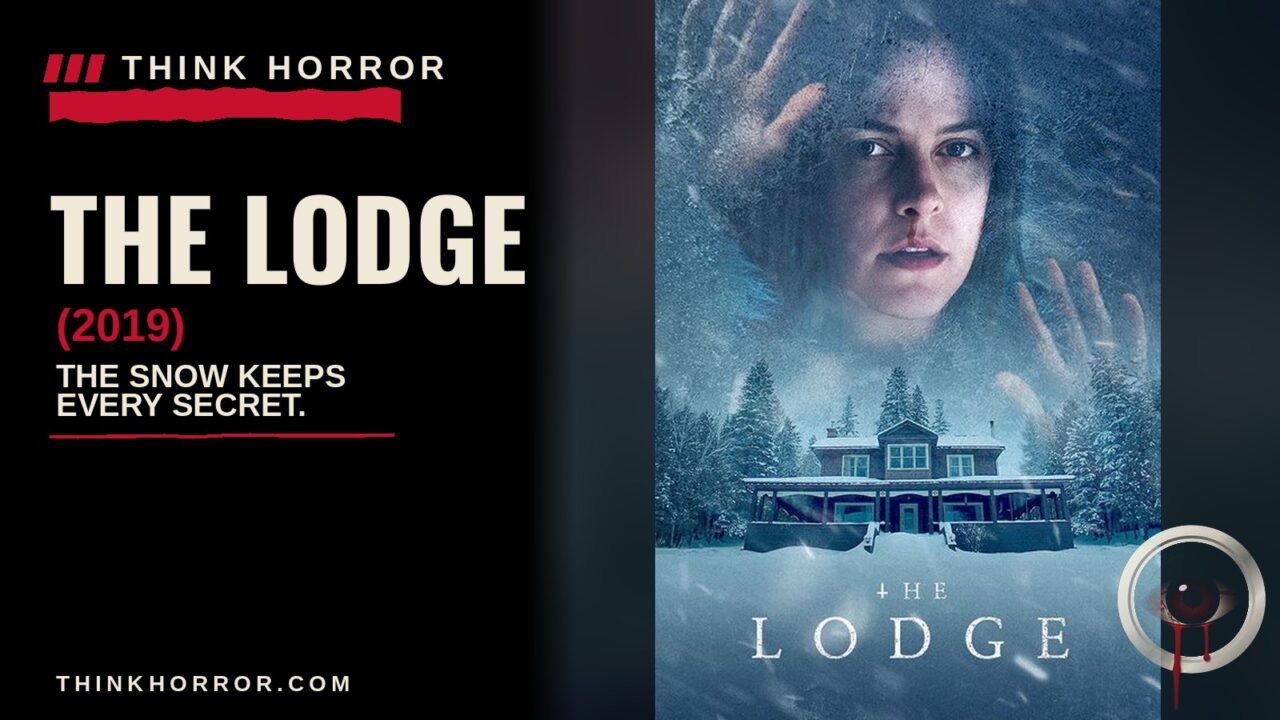
The snow starts before you even reach the house. It comes down in sheets, thick enough to swallow the road behind you, thick enough that the headlights only find the next ten feet of it, and then the next ten, and then nothing at all. You are driving to a lodge in the middle of nowhere in Massachusetts, and the trees on either side of the road stand black and bare and patient, the way trees do when they know you are not going anywhere for a while.
The lodge waits for you at the end of the drive. It is all wood and glass and angles, beautiful in the way rich people’s holiday homes are beautiful, and it is cold in a way that has nothing to do with the thermostat. Somebody has put up Christmas lights. Somebody has built a fire. And standing in the doorway, watching you unpack your bags, are two children who have already decided they hate you.
You smile at them. They do not smile back.
Inside, the house is full of small, careful things. A dollhouse sits on a table, and when you look at it you realise it is this house, in miniature — the same roof, the same windows, the same rooms. You are standing in a dollhouse. Or the dollhouse is standing in you. The film will not tell you which, and that is the first of its many cruelties.
Outside, the snow keeps falling. The generator hums. The clocks tick. And somewhere in the walls of this beautiful, freezing house, something is wrong — not with a ghost, not with a demon, but with the three people trapped inside it together.
A grieving woman, two hostile children, and a snowbound lodge — a slow, merciless study of faith curdling into madness.

Quick Specs
- Director: Veronika Franz and Severin Fiala
- Screenplay: Sergio Casci, Veronika Franz, Severin Fiala
- Starring: Riley Keough, Jaeden Martell, Lia McHugh, Richard Armitage, Alicia Silverstone
- Music: Danny Bensi and Saunder Jurriaans
- Cinematography: Thimios Bakatakis
- Editor: Michael Palm
- Producers: Simon Oakes, Aliza James, Aaron Ryder
- Production Company: FilmNation Entertainment, Hammer Films
- Distributor: Neon (United States)
- Premiered: January 25, 2019 (Sundance, world premiere)
- Runtime: 108 minutes
- Rating: R
- Budget: Not disclosed
- Box Office: $2,138,907 domestic, about $3.2 million worldwide
- On This Site: The Lodge
The Review
Any honest The Lodge (2019) review has to begin with the cold: there is a particular kind of horror film that does not chase you. It waits for you. It lets you walk into the house yourself, sit down by the fire, and only then — slowly, politely — locks the door behind you. The Lodge is that kind of film, and it is one of the coldest, most pitiless things Hammer Films has put its name to in the revival era.
The premise is simple, and the film takes its time making you regret how simple it sounds. Richard Hall, a writer researching a book about an extremist Christian cult, is leaving his wife for Grace Marshall — a woman he met through that research, the sole survivor of the cult’s mass suicide, led by her own father. His estranged wife Laura, played by Alicia Silverstone, does not survive the news: she takes her own life in the opening, and her death is the wound the whole film runs on. Six months later, Richard takes Grace and his two children — teenage Aiden and young Mia — to the family’s remote Massachusetts lodge for Christmas, and then work calls him back to the city, leaving the three of them alone in the snow.
What follows is a slow, controlled descent into a house where nobody trusts anybody, and where the cold gets inside everything: the food, the generator, the medicine cabinet, the marriage that has not happened yet.
Riley Keough is the film, and the film knows it. Her Grace is a woman held together by routine — medication taken on schedule, prayers said the right way, a smile kept in place — and Keough lets you watch that routine fray thread by thread. She does the quiet work here, the recessive work: a glance held a beat too long, a hand that will not stop shaking, a woman trying to be kind to children who have every reason to hate her and knowing it is not working. Justin Chang called her the movie’s strongest asset, “no less powerful in her quieter, more recessive moments,” and he was right; Michael Roffman went further and called it career-best work. Both notices are earned. Keough does not play Grace as a victim or a saint. She plays her as a woman who survived one horror by building a life on top of it, and who is about to find out how shallow the foundation was.
The children are the film’s other engine, played without a trace of sentimentality. Jaeden Martell is Aiden, old enough to be cruel on purpose and young enough to believe cruelty is the same as justice. Lia McHugh is Mia, younger, quieter, the one who still plays with the dollhouse that mirrors the lodge room for room. The directors kept Keough apart from the two young actors before filming, they have said, so that the distance between Grace and the children on screen would be real. It is. Every scene the three of them share has the texture of a negotiation that has already failed.
Franz and Fiala are working here in English for the first time — their previous feature, Goodnight Mommy, was Austrian and German-language — and the move suits them. They are patient filmmakers, and The Lodge is patient in the way a trap is patient. The camera, shot by Thimios Bakatakis, frames the lodge’s interiors from above or below eye level, never at it, so you are always looking down on Grace or up at her, never standing beside her. The dollhouse is the film’s master image: the directors had one built to look like the lodge, and shot the real lodge as if it were a dollhouse, cutting between the two without signalling the jumps, so you are never quite sure which space you are in. It is a beautiful idea, and a frightening one: everyone in this house is small, and someone is moving them around.
The dread the film builds is, as Dennis Harvey wrote, at its best “in fostering a sense of stylish dread and orchestrating some harrowing individual sequences,” and he was right to reach for the language of the old Italian gialli to describe it. This is a film that understands atmosphere as an argument: the snow, the Catholic iconography on the walls, the purple silk and the duct tape in the cult footage the children have dug up, the sermons that seem to come from nowhere. Brian Tallerico called it “a truly unsettling movie, the kind of horror film that rattles you on an almost subconscious level,” and that is the right register — the fear here is not the jump scare, it is the slow realisation that the house has rules you do not know and that someone else wrote them.
It is not a perfect film, and the flaws are the ones that come with the virtues. The middle stretch, as the days blur into each other and Grace’s medication routine falls apart, tests your patience the way the snow tests the characters: deliberately, and a little longer than is comfortable. Jeannette Catsoulis found the atmosphere “so wintry in tone and setting that no movie-theater thermostat will banish its chill,” but felt the unease outran the narrative, and she has a point — there are stretches where the film is holding a mood rather than advancing a story. And the final act asks you to accept a collapse of a human mind that is total and fast, and if you stop to interrogate the mechanics of it, the spell thins. Benjamin Lee called the film “an accomplished beast… taking the film to a place that’s both staggeringly grim and hopelessly sad,” and the grimness is the point — but grimness, held for two hours, can start to feel like the film is punishing you for staying.
And yet. When the ending comes — and I will not spoil it here, only say that it is one of the most devastating final images in modern horror — it retroactively justifies every slow minute that came before it. The film has been telling you all along what it is about: not ghosts, not cults, not the cold. It is about what happens when a person who was taught that suffering is holy is handed suffering and told it is love. Grace believes because belief is the one thing her upbringing built to last. That is the horror of The Lodge: a human horror, and the only kind that follows you home.
Spoiler Section
Everything below gives away the ending. Do not read on if you have not seen the film.
The purgatory is a hoax. All of it. The children staged every moment of it: they drugged Grace, hid her clothing and medication and food and the Christmas decorations — and their own belongings — in a crawlspace, killed the generator, advanced the clocks to January 9, and played recordings of her father’s sermons through a wireless speaker. Aiden’s hanging in the attic was faked. The memorial photo Grace finds buried in the snow, and the newspaper report of all three of them dying of carbon-monoxide poisoning on 22 December 2019, were planted. The dog was not killed by the children — the plot never says that — but Grace finds it frozen to death outside, and that is the blow that breaks her completely.
Only then do the children confess, and the confession comes too late. Grace now believes she is dead, and belief — as the film has been telling us for two hours — is the one thing her upbringing built to last. She self-flagellates at the hearth. She burns Mia’s doll as an idol. And when Richard returns, she tries to prove they are dead by firing his revolver at herself. The chamber is empty, and she reads that as proof she cannot die.
So she shoots Richard dead.
The children flee, get the car stuck in the snow, and are marched back inside. The final tableau is the film’s coldest image: Grace seats Aiden and Mia at the dinner table beside their father’s corpse, sings “Nearer, My God, to Thee,” and tapes the word “sin” over their mouths, a loaded gun sitting on the table. It is the cult’s ritual, repeated by its last survivor, on the only congregation she has left.
Trivia
- Shot outside Montreal in the winter of 2018, with the lodge standing on a golf resort closed for the season. The story is set in rural Massachusetts; it was never shot in New England.
- The dollhouse was built for the film to look like the lodge, and the directors shot the real lodge “as if a dollhouse,” cutting between the two without signalling the jumps so the audience is never sure which space they are in. The device is the directors’ own account, given in interviews with /Film and Filmmaker Magazine.
- The score is by Danny Bensi and Saunder Jurriaans. Danny Keough plays Grace’s father, the cult leader Aaron Marshall, and is Riley Keough’s real-life father.
- Jaeden Martell plays Aiden, the older of the two children, opposite Lia McHugh as Mia.
- The film premiered in the Midnight section of the 2019 Sundance Film Festival on 25 January 2019. Neon acquired the US rights at the festival shortly after, and the film did not reach American cinemas until 7 February 2020 — thirteen months later — after an original November 2019 date was abandoned.
- The US opening weekend took $76,251 from six theatres. The run expanded to 322 theatres on 21 February 2020 and peaked at 395 the following weekend.
- The first run was cut off by the COVID cinema closures in mid-March 2020 at $1,666,564 domestic. A July 2020 drive-in weekend in eight theatres completed the final domestic total of $2,138,907.
- The film runs 108 minutes.
- The screenplay began as Sergio Casci’s original script, sold to Hammer, and Franz and Fiala rewrote a significant portion of it — including the ending, which Franz has said “didn’t work” in its original form.
- Keough was cast in October 2017; Martell, Armitage, and McHugh joined in February 2018. The directors have said they took Martell and McHugh on outings — rock climbing, ice skating — before filming, to build the sibling bond.
- The cult footage the children uncover shows the dead followers draped in purple silk, with duct tape reading “sin” across their mouths — the same image Grace recreates in the final tableau.
- Hammer Films and FilmNation Entertainment made the film.
Where to Watch
Checked November 10, 2026: in the United States the film streams free with ads on Tubi, and free with a library card through Kanopy, while Amazon Video, Apple TV, and Fandango at Home carry it to rent for $3.99 or buy for $14.99. There is no subscription streaming home for it on Hulu, Netflix, or Max in the US at the moment, so if you want it without a rental fee, Tubi or your library card is the way in.
The Verdict
The Lodge is a film that earns its bleakness. It is slow, cold, and at times punishingly patient, and it asks more of its audience than most horror films dare to: sit in a freezing house with three people who cannot stand each other and watch faith curdle into something monstrous. The reward is a film of rare formal control, a lead performance from Riley Keough carrying the whole terrible weight of it, and an ending that lands like a door slamming in a snowstorm. It is not a film you enjoy. It is a film you survive. And like the best horror, it leaves something behind in you when the snow finally stops.
Rating: 4 ravens out of 5.
The weekly roundup
One letter a week, from the crypt.
- New reviews, with the ravens
- New wiki entries and news
- Cool stuff worth your night
Weekly. No spam, unsubscribe in one click.