
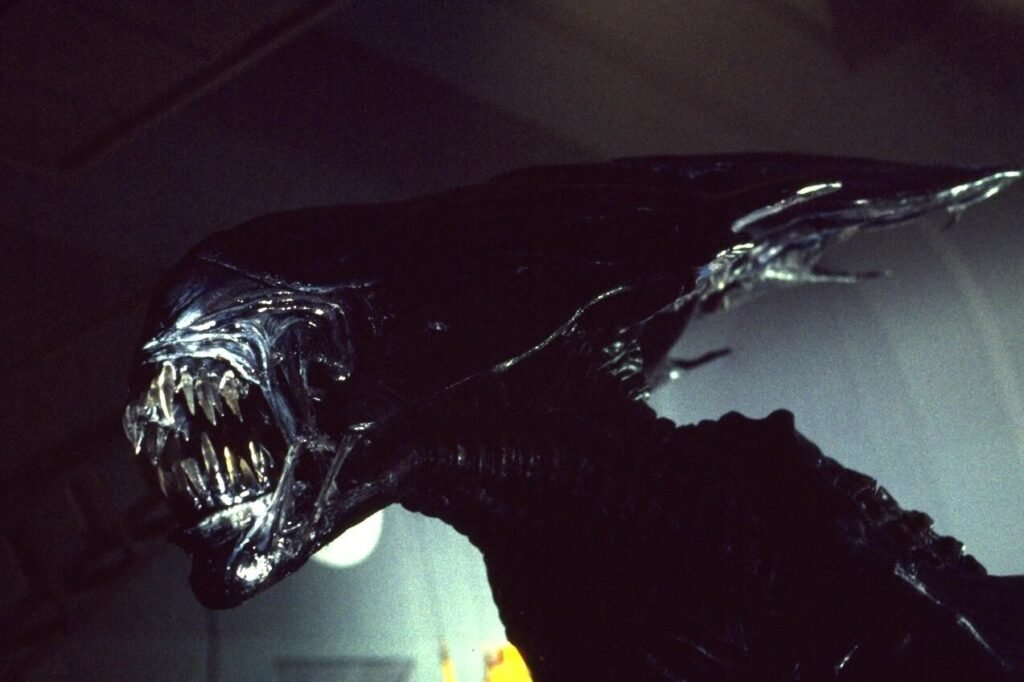
The Xenomorph, often simply called “the Alien,” is the eyeless, acid-blooded creature of Ridley Scott’s Alien (1979) and the franchise that followed. Unlike most screen aliens, it builds nothing and wants nothing beyond survival and reproduction. It plants its young inside living hosts, and each one bursts from its host’s chest and grows into a killer within hours. Swiss artist H. R. Giger’s “biomechanical” design made it one of the most influential monsters in film, and the creature or its forerunners appear in all seven Alien films, plus two Alien vs. Predator crossovers and FX’s Alien: Earth.
At a glance
| Franchise | Alien (also Alien vs. Predator) |
| First appearance | Alien (1979) |
| Creators | Dan O’Bannon and Ronald Shusett (story); creature designed by H. R. Giger, with the head mechanics built by Carlo Rambaldi |
| Portrayed by | Suit performers: Bolaji Badejo (Alien, 1979; stuntman Eddie Powell in some scenes) Tom Woodruff Jr. (Alien 3, 1992; Alien Resurrection, 1997; Alien vs. Predator, 2004; Aliens vs. Predator: Requiem, 2007) Andrew Crawford (Alien: Covenant, 2017) Trevor Newlin (Alien: Romulus, 2024) The Alien Queen in Aliens (1986) was a hydraulic puppet built by Stan Winston’s studio. |
| Weapon of choice | A second, inner jaw that shoots out from its mouth, a bladed tail, claws, and highly corrosive acid for blood; it reproduces by implanting embryos in living hosts |
Origin story and backstory
In Alien, the crew of the commercial towing ship Nostromo answers a signal from the planetoid LV-426 and finds a derelict alien ship full of leathery eggs. One egg releases a “facehugger” that clamps onto Executive Officer Kane’s face. It soon drops off dead, and Kane seems fine until dinner, when a creature bursts from his chest. The “chestburster” grows within hours into a towering adult that hunts the crew through the ship’s corridors until Warrant Officer Ellen Ripley (Sigourney Weaver) blows it into space.
The creature’s life cycle became the core of the franchise: egg, facehugger, chestburster, adult. James Cameron’s Aliens (1986) added the egg-laying Queen and a hive organized like a colony of ants or termites. Alien 3 (1992) showed that a Xenomorph takes on traits of its host: one born from an animal runs on all fours. The term “xenomorph” itself comes from Aliens, where a Marine officer uses it as a general term for alien life. It became the creature’s name thanks to fans and merchandise.
Where did the Xenomorph come from?
The franchise has offered several answers, and they don’t fully agree. Ridley Scott has said since the first film that a creature this deadly must have been engineered as a biological weapon. His prequels, Prometheus (2012) and Alien: Covenant (2017), tie it to the Engineers’ mutagenic “black goo,” and Covenant shows the android David (Michael Fassbender) experimenting to breed new creatures. Many viewers read that as David creating the Xenomorph. Later entries pull back from that. Alien: Romulus (2024), set between Alien and Aliens, goes back to the original design. Noah Hawley has said Alien: Earth (2025), set two years before the 1979 film, is “its own thing” and deliberately leaves out some ideas from the prequels. In short, there is no single official origin, and the Xenomorph is most frightening as an unexplained force.
Iconic moments
- The chestburster (1979): The cast knew a creature would burst from John Hurt’s chest but hadn’t been told how much blood would come with it. Veronica Cartwright’s shock on camera is real.
- The air shafts (1979): Captain Dallas crawls through the ventilation ducts with a flamethrower while the crew tracks the creature’s blip, which keeps getting closer.
- The shuttle (1979): Ripley thinks she has escaped, until she sees the Alien folded into the shuttle’s machinery.
- The motion trackers (1986): In Aliens, the Marines watch the signals close in from every side, then realize the creatures are in the ceiling.
- “Get away from her, you—” (1986): Ripley climbs into a power loader to fight the Alien Queen.
- The newborn (1997): Alien Resurrection ends with a human-Xenomorph hybrid that sees a cloned Ripley as its mother.
Appearances
Films and TV in release order
- Alien (1979), directed by Ridley Scott
- Aliens (1986), directed by James Cameron
- Alien 3 (1992), directed by David Fincher
- Alien Resurrection (1997), directed by Jean-Pierre Jeunet
- Alien vs. Predator (2004), a crossover
- Aliens vs. Predator: Requiem (2007), a crossover
- Prometheus (2012), a prequel featuring a forerunner creature, the “Deacon,” rather than the classic Xenomorph
- Alien: Covenant (2017)
- Alien: Romulus (2024), directed by Fede Ãlvarez
- Alien: Earth (FX, 2025–), created by Noah Hawley
The Xenomorph also cameos in the Predator films: an Alien skull appears in a Predator trophy case in Predator 2 (1990). FX renewed Alien: Earth for a second season in November 2025.
Trivia and behind-the-scenes facts
- Screenwriter Dan O’Bannon met Giger while working on Alejandro Jodorowsky’s failed Dune project. Scott based the creature on Giger’s 1976 painting Necronom IV.
- Giger built his model of the creature partly from old Rolls-Royce parts, rib bones and snake vertebrae. Rambaldi’s mechanical head had 900 moving parts.
- Giger, Rambaldi and the effects team won the 1980 Academy Award for Best Visual Effects for Alien.
- Bolaji Badejo, a 6-foot-10 Nigerian design student, was discovered in a London pub. He took tai chi and mime classes to learn to move slowly, and Alien is his only screen credit.
- Giger insisted the creature have no eyes, because it is more frightening when you can’t tell where it’s looking.
- The Alien Queen grew out of an idea Cameron had for an unproduced script called Mother. Stan Winston’s studio built her as a full-size hydraulic puppet, operated by puppeteers both inside and outside it.
- For Alien: Romulus, the creature was redesigned to look more like Giger’s 1979 original, with one new touch: serrated, sharkskin-like skin that looks as if it could cut you.
- Ron Cobb suggested the acid blood as a way to make the creature practically unkillable: shoot it, and it eats through the hull.
- O’Bannon said he settled on the title when the word “alien” “just came out of the typewriter at me.” The script had been called Star Beast.
- Alien was promoted with the tagline “In space no one can hear you scream.”