
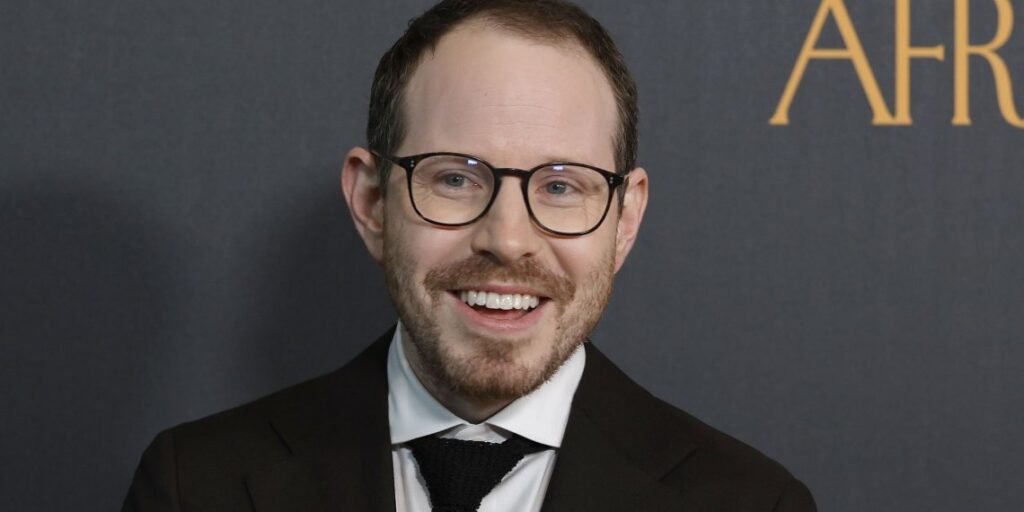
Ari Aster is the American filmmaker whose debut Hereditary turned family grief into the defining horror film of its decade.
Quick Specs
- Born: 15 July 1986 — birthplace disputed (see below; this page states no flat birthplace)
- Formation: College of Santa Fe, then an MFA in directing from the AFI Conservatory
- Known for: Hereditary, Midsommar, and the thesis short The Strange Thing About the Johnsons
- The house: Square Peg, co-founded 2019 with Lars Knudsen
- The method: The complete shot list first — weeks of dry-erase-board sessions before anyone builds anything
- The material: Grief, family, and the discovery that nobody in the room ever had any agency
Overview
Two films in two years, and an entire era of horror had a house style. Ari Aster arrived with a first feature about a family being fed, member by member, to a demon — that played, minute to minute, like the most honest film ever made about grief. Then he made a breakup movie inside a Swedish folk ritual, in blazing daylight, and folk horror was never allowed to hide in the dark again. His characters don’t lose control of their lives; his films reveal, with terrible patience, that they never had it. He has spent the years since testing how far that sensibility travels — into surreal comedy, into a pandemic Western — and building a production company to shelter other directors’ difficult films. But it is the dollhouse that defines him: a family arranged in miniature rooms, moved by hands they cannot see.
The Life
Ari Aster was born on 15 July 1986 — the date is solid everywhere, and almost nothing else about the birthplace is. Aster himself told Filmmaker Magazine: “I was born in New York,” and the older press agrees; some current listings instead give Princeton, New Jersey, with the family moving to New York when he was about a week old. The sources conflict, so this page prints the conflict and no winner: beware any bio that states either city flat. His mother was a poet, his father a jazz musician; he has a younger brother. The family spent part of his early childhood in Chester, England, where his father planned a jazz club, and returned to the United States when Aster was ten, settling in Santa Fe, New Mexico, where he spent the rest of his childhood. His own founding memory, told as recollection: seeing Dick Tracy at about age four, and at the machine-gun scene jumping up and running six New York City blocks with his mother in pursuit.
The formation was a video store’s horror section, exhausted shelf by shelf — his words — and six feature-length screenplays written during high school because a shy teenager who couldn’t assemble collaborators could still write. He studied film at the College of Santa Fe from 2004, wrote for the local Weekly Alibi, graduated in 2008 with the short Tale of Two Tims, and took it to the AFI Conservatory, entering the 2010 class and earning an MFA in directing. There he formed the partnership that carries into the features: producer Alejandro de Leon and cinematographer Pawel Pogorzelski, an AFI classmate who has shot his defining work.
The Work
The shorts were a taboo laboratory. The thesis film, The Strange Thing About the Johnsons (2011), is a 29-minute psychological horror short about a suburban family in which a father is trapped in a one-sided incestuous relationship with his abusive son — the son is the abuser; careless summaries invert it, and this page states it once, factually, and moves on. It premiered at Slamdance on 22 January 2011, leaked online that November, went viral, and drew everything from acclaim to disgusted vitriol — the modern short-to-feature pipeline in a single case study. Beau (2011) shares its protagonist’s name and premise with the later feature; Munchausen (2013), featuring Bonnie Bedelia, Basically and The Turtle’s Head (2014) and C’est la vie (2016) complete the verified short run — their existence and his writer-director credit are what the record supports, so no plots are invented for them here.
Hereditary (2018), his feature directorial debut for A24, premiered in Sundance’s Midnight section on 21 January 2018: after a secretive grandmother’s death, the Graham family is haunted — and dismantled — by what she left behind. Toni Collette, Alex Wolff, Milly Shapiro and Gabriel Byrne head the cast, with Ann Dowd as the cult’s emissary. What Aster did is the craft story of the decade: he shot-listed the entire film before speaking to any collaborator, then walked Pogorzelski and production designer Grace Yun through it shot by shot across roughly three weeks of dry-erase-board sessions; when no real house fit the list, the Graham house — both floors, attic, treehouse — was built entire on a stage, with custom Panavision primes made for the lived-in dollhouse effect. The dollhouse is the thesis, in his own words to NPR: the family are “like dolls in a dollhouse, being manipulated by these outside forces.” Budget $10 million; the gross ran over $80 million in contemporary reporting and stands over $90 million in current listings, and it was A24’s highest-grossing film worldwide at the time of its release — say it with the qualifier, because the record has since been passed. Now the awards, exactly: Hereditary received zero Academy Award nominations — Collette’s towering performance was widely tipped, and its omission became the defining horror-snub story of the era; a snub is not a nomination, and this page will not print one. Aster won Chicago Film Critics’ Most Promising Filmmaker and the Chainsaw Awards for Best Director and Best Screenplay, and was nominated — nominated — for the Gotham Breakthrough Director award and the Independent Spirit Award for Best First Feature.
Midsommar (2019) began as a pitch for a straightforward slasher among Swedish cultists; Aster rebuilt it around a deteriorating relationship drawn from a difficult breakup of his own, with Florence Pugh and Jack Reynor travelling to the Hårga commune’s once-in-ninety-years festival. It is set in Hälsingland, Sweden — and filmed in the Budapest area of Hungary, July to October 2018; drafts that put the cameras in Sweden are repeating the classic error. Budget $9 million; about $48 million at the box office; Aster was nominated for Best Screenplay at the Gotham Awards. His original 171-minute cut, trimmed for wide release at A24’s request, premiered at Lincoln Center’s Scary Movies XII in August 2019. In June 2019 he and Danish producer Lars Knudsen founded Square Peg, and Aster the producer emerged alongside Aster the director — producer on Kristoffer Borgli’s Dream Scenario (2023) and Yorgos Lanthimos’s Bugonia (2025). His third feature, Beau Is Afraid (2023) — a surrealist comedy-drama, not a horror film flat — sent Joaquin Phoenix’s anxiety-ridden Beau on an odyssey home to his mother: $35 million budget, roughly $12 million back, mixed-to-positive reviews, a Golden Globe nomination for Phoenix, and Aster’s own later verdict, from 2025, that he was “pretty sad that it was so maligned… it lost money.” The fourth, Eddington (2025), a neo-Western political satire set in May 2020 around a contested mayoral election between Phoenix’s sheriff and Pedro Pascal’s mayor, premiered in competition at Cannes on 16 May 2025, nominated for the Palme d’Or; its reported budget is $25 million and its record, as of this writing, is mixed. Browse the wider horror movies index for where these films sit in the wiki.
The Aster Touch
The shot-list-first method is the signature underneath everything: the film exists completely in his head before a collaborator is consulted, and the design serves the list — never the reverse. The documented through-line of the work is unresolved grief, familial trauma, loss of identity and psychological deterioration, staged with vividly bright imagery and childhood symbols set against graphic violence. He resists the “horror director” label in interview after interview, even while acknowledging the childhood obsession that built him — attribute the position to him rather than inflating it; he does not hate horror, he declines the box. And the tonal mix is his, not an accident: an unsettling combination of dark humour, horror and graphic violence, present from the shorts onward, which is why Beau and Eddington read as changes of genre, not of sensibility. More of his generation’s directors live in the horror directors index.
Why He Matters
For horror: Aster is one of the two or three directors who defined what 2010s prestige horror felt like. Hereditary put a first feature into the lineage contemporary critics drew straight back to The Exorcist and Rosemary’s Baby; Midsommar proved folk horror could play at multiplex scale in full daylight. The Collette non-nomination became the era’s Exhibit A in the argument about the Academy and horror — his film matters to that debate because of what did not happen. For film overall: Hereditary was the commercial proof that A24’s director-first model could beat the studio genre system at its own game, and Square Peg makes him a patron of other filmmakers’ risks as well as his own. The viral-thesis-short-to-A24-debut route he walked is now the standard map for how a horror director gets made.
Trivia & Facts
- Toni Collette was not Oscar-nominated for Hereditary. Nobody on the film was. The film’s awards story is the snub.
- Midsommar’s sunlit Swedish commune was built and shot around Budapest, Hungary. The daylight is real; the geography is a set.
- He wrote six feature screenplays in high school because he couldn’t find collaborators. The features are what happened when he finally did.
- The Graham house in Hereditary was built entire on a stage — because no real house matched the shot list he had already finished.
- His birthplace is genuinely disputed between his own statement and current listings. Any bio that gives you one city with total confidence is guessing.
FAQ
Where was Ari Aster born?
It is genuinely disputed. Aster himself has said “I was born in New York,” and older press agrees; some current listings give Princeton, New Jersey, with a move to New York in his first week of life. His birth date — 15 July 1986 — is certain; the city is not, and this page does not pretend otherwise.
Was Toni Collette nominated for an Oscar for Hereditary?
No. Hereditary received no Academy Award nominations at all. Collette’s performance was widely tipped and its omission became the famous horror snub of that awards season.
Did Ari Aster win the Gotham Breakthrough Director award?
No — he was nominated for it, and nominated for the Independent Spirit Award for Best First Feature. His verified wins for Hereditary are the Chicago Film Critics’ Most Promising Filmmaker prize and the Chainsaw Awards for Best Director and Best Screenplay.
Was Midsommar filmed in Sweden?
No. It is set in Hälsingland, Sweden, and was filmed predominantly in the Budapest metropolitan area of Hungary in the summer and autumn of 2018.