
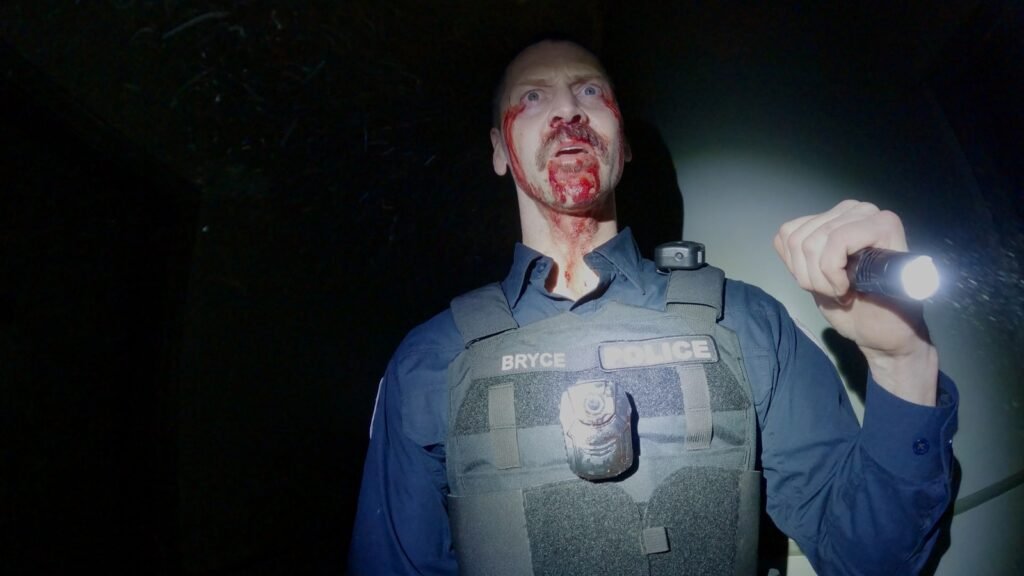
Bodycam (2026) is Brandon Christensen’s found-footage horror film, told through two police officers’ own body cameras as a covered-up shooting unravels. Every found-footage film has to survive one rude question: why is the camera still running? Most of them dodge it, or hope you won’t ask. This one builds the whole nightmare out of the answer. The camera is running because the law requires it to run. It records everything, it uploads everything, and it cannot be switched off, wiped, or talked out of what it saw. Two officers spend one long night learning that the most frightening witness to what they did is the one pinned to their own chests — and that it may not be the only witness they have.
Quick Specs
- Director: Brandon Christensen
- Screenplay: Brandon Christensen and Ryan Christensen
- Producers: Chris Ball, Kurtis David Harder, Brandon Christensen
- Executive producers: Kerry Cooper, Ty Sivertsen, Andy Thompson, James Norrie, Nina Kolokouri
- Starring: Jaime M. Callica, Sean Rogerson, Catherine Lough Haggquist, Angel Prater, Keegan Connor Tracy, Chris Casson, Elizabeth Longshaw, Colette Nwachi
- Cinematography: Clayton Moore
- Production company: Superchill
- Distributor: Shudder
- Country: Canada
- Language: English
- World premiere: 7 August 2025, Popcorn Frights Film Festival
- Shudder release: 13 March 2026
- Running time: 75 minutes
- Rating: Unrated
One night in Henderson
The story plays out in the early hours of 13 October 2025. Officers Jerome Jackson (Jaime M. Callica) and Bryce Anderson (Sean Rogerson) are patrol partners, dispatched to a domestic dispute in the rough patrol area the reviews call Henderson. It is Jackson’s ground more than Bryce’s: Jackson comes from these streets, and his mother still lives on them. Before the pair even reach the house, the night is wrong in small, deniable ways. Locals the officers brush off as tweakers are standing motionless around the area, watching. And the radios — the ordinary lifeline back to the department — stop reaching anyone.
The house itself is worse. Rats move through it. Occult symbols mark the walls. An injured dog lies in a crib. In the basement floor there is a hole, with the word “Rise” written in red above it. The woman of the house — credited only as the Mother (Keegan Connor Tracy) — is bloody and erratic. Her husband, the Father (Chris Casson), stands by that hole holding a newborn wrapped in his arms.
What happens next takes seconds. The Father advances on Bryce. Bryce panics, and fires. The man was holding a baby, not a weapon. Two people die in that house: the Father, and the child in his arms. Everything about the rest of the film — every bad decision, every mile of the long night that follows — grows out of those seconds, and out of the fact that both officers’ cameras were rolling through all of it.
The cover-up that couldn’t be deleted
Jackson’s instinct is the honest one: call it in. Bryce’s terror is the louder one. He is convinced — his word for it, in Shudder’s own synopsis, is “crucified” — that the footage will end them both in public, and he starts building a cover story on the spot. Jackson goes along with it against his own judgment, which is the film’s first real horror: not a monster, but a decent man choosing the wrong loyalty in a doorway, with the red light blinking.
Because the footage is the problem that refuses to be solved. These are not tapes that can be lost or files that can be quietly deleted. The bodycams record and upload to a cloud server as they go. Bryce has one hope — Esposito (Angel Prater), an underground tech contact in his pocket — and she refuses to touch the footage the moment she learns whose house the officers entered. The place is a local taboo, the kind of address the neighbourhood understands and outsiders learn about too late. Whatever the pair walked into, the people of Henderson already knew its rules.
The neighbourhood, it turns out, is in the grip of something. The festival programme that premiered the film called it a terrifying cult; the reviews reach for an entity that works through the area’s people, taking hold of bodies and minds and meaning to take the officers the same way. No name is ever put to it, by the film or by anyone who has written about it — and the absence is the point. What the locals do have is a rule, repeated like a chant through the night, transcribed slightly differently by different reviewers but always with the same sense: a taking is answered by a taking. Something was taken in that house. Something will be taken back.
The one person who can read the night is Jackson’s mother, Ally (Catherine Lough Haggquist), a neighbourhood fixture who works with recovering addicts and takes people in off the street. She knows the rules her son never learned, and she tells him the truth the uniform kept him from hearing: “You don’t mix well with the people you’re supposed to be helping.” She coaches the pair on how to survive until morning — even as the people she shelters are found chanting in a circle inside a home, and the night closes in.
The reach of it
The haunting does not stay at the house. The locals appear across the city, hunting the pair. Loved ones begin acting out of character. And the threat reaches toward Bryce’s own home, where his pregnant wife Michelle (Elizabeth Longshaw) waits, not knowing what her husband has done or what it may cost her.
The sequence reviewers single out is Jackson’s solo drive through the city streets, talking to his mother on the phone while reality bends around the car — a long, wrong glide through a city that no longer obeys its own map. Late in the night there is also a tearful, close-up address Jackson delivers straight into his own camera, a moment that openly recalls the confession at the heart of The Blair Witch Project: a man apologising to a lens because there is nobody else left to apologise to. The cover-up collapses, as cover-ups do. What the cameras finally witness is theirs to hold.
Twelve days, two cameras
Brandon Christensen started writing Bodycam in 2022, from an idea he says came to him about four years before the film reached audiences. His pitch for it is his own: there had been bodycam sequences in movies, he says, but there had “never been a bodycam movie” — a whole feature carried on the cameras themselves. Whether or not the superlative survives every footnote, the narrower claim is the one the reviews keep making for him: this is a feature told entirely through police bodycams, with dashcam angles when the officers are in their cruiser.
The shoot was as stripped-down as the format promises. Principal photography took twelve days in Alberta, Christensen’s home province, in 2023 — a real derelict house supplied the main location, and by the director’s account the crew walked in, saw how genuinely grim it already was, and knew they had their set. Then came the long part: post-production, which stretched the road from that 2023 wrap to a 2025 premiere and a 2026 release.
The method is the movie. The actors wore and operated the cameras themselves — GoPros in 3D-printed housings, one live camera at a time with a dummy camera riding on the other actor’s chest. Each scene was played twice, once for each officer’s angle, instead of being shot in conventional coverage. The original plan had cinematographer Clayton Moore wearing the camera; it was dropped because the actors doing it themselves, Christensen found, “feels so real.” The one sequence that broke the method was Jackson’s drive: shot in the original production, judged wrong, and reshot a year later on a volume stage in Calgary, with the VFX house RCS Studios projecting a 3D city around the patrol car while Callica reacted live. Christensen calls it the most challenging sequence of his career — and his favourite scene in the film.
Bodycam is Christensen’s sixth feature with Shudder, a relationship that runs through Still/Born, Z, Superhost, The Puppetman and Night of the Reaper — all released through the service, all made with the same economy of means. If you know the form’s family tree, Bodycam sits on the branch that Paranormal Activity grew: proof that a locked-off camera and a room people are afraid of can out-scare a budget a hundred times the size.
Two years on the poster
Ask what year Bodycam is from and you will get two correct answers, which is why this site dates it by its wide release. The film world-premiered on 7 August 2025, opening the Popcorn Frights Film Festival in Fort Lauderdale as half of a world-premiere double bill with Night of the Reaper — two Christensen films, one night, the director in person. On 3 November 2025, Shudder announced it had picked the film up among three festival titles for undated 2026 debuts, and Calgary got a hometown look first: by local report, an Off the CUFF screening at the Globe Cinema on 4 March 2026, ahead of the launch.
The general audience met it in 2026. Brazilian cinemas played it from 12 March 2026 under the title POV: Presença Oculta — the film’s one theatrical run of record. And on Friday, 13 March 2026, Bodycam began streaming on Shudder, in Australia the same day. Shudder sold it with a pitchman’s flourish — End of Watch meets Event Horizon — which is the distributor’s marketing line. The 2025 premiere and the 2026 release are both real; the film simply lived at festivals before it lived on your television, and its catalogue year depends on which of those lives you count.
What the critics made of it
The response was genuinely split, and lands positive in aggregate. On Rotten Tomatoes the film holds 85% from 33 reviews, after 83% in release week and 88% by May. The consensus there credits its smart, low-budget ingenuity and visceral atmosphere. Metacritic, for the record, carries no Metascore for the film at all — its page lists the score as still to be determined, with two critic reviews indexed — so any Metacritic number you see quoted for Bodycam was invented by whoever quoted it.
The champions were loud. Kristy Puchko called it “a wickedly smart horror film” and a gnarly romp. One review gave it three stars out of five, praising its energy and spookiness and its intelligently modest use of digital effects. Another scored it three and a half stars for breathing new life into the found-footage formula; a third called it a relentless horror thrill ride; a fourth declared it another win for the Christensens.
The sceptics were not quiet either. Simon Abrams gave it two and a half out of four — a gross, dynamic haunted chase film, he found, that coasts on carnival-ride energy before crashing into a goofy anticlimax in its last stretch. Another review panned it outright, arguing the social commentary curdles. One C+ review likened it to a lost anthology segment — meant, in fairness, as both compliment and ceiling — and another found the back half hollow, its antagonist left deliberately vague.
Read across the spectrum, the arguments settle into four. The format: near-consensus that the bodycam solves found footage’s oldest problem, because officers are required to record — the camera keeps running because it must. The theme: a real split over whether the film’s use of bodycam footage as accountability evidence — and its threads of addiction and community — cut sharp or land muddled. The ending: the third act’s effects-forward turn is the most criticised stretch of the film almost everywhere, praised almost nowhere. And the performances: Callica and Rogerson are praised even by several of the film’s detractors, with Haggquist singled out as its sharpest supporting turn — the still centre of a film about men who cannot stop moving.
Follow the money
There is very little of it to report. No budget figure for Bodycam has ever been published — reviewers describe it as a low-budget film. For the gross: its worldwide theatrical gross was $124,154 by May 2026. That is a streaming-first film’s theatrical residue — essentially the Brazilian cinema run — not a measure of how the film performed where it actually lives, on Shudder.