
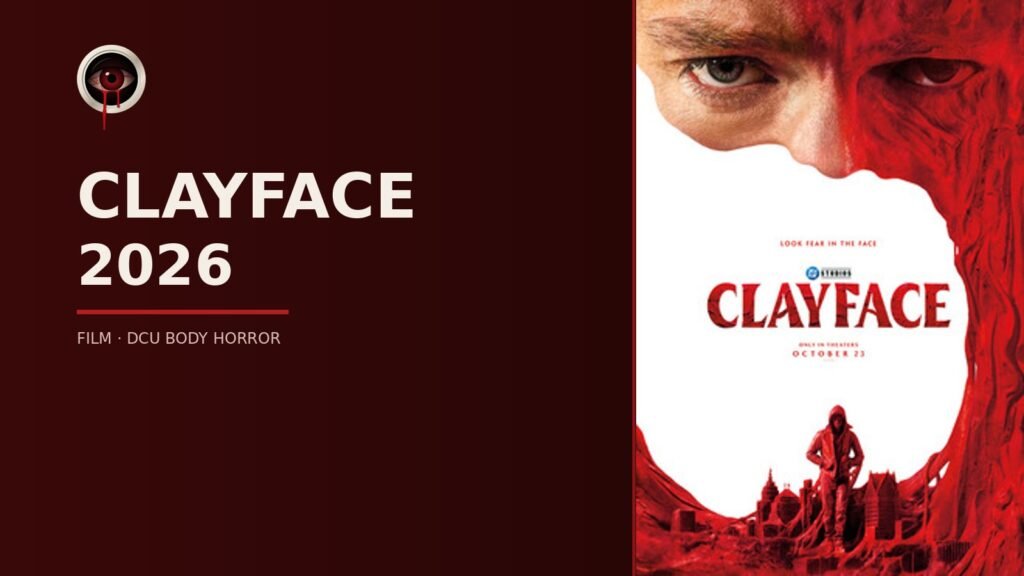
Clayface (2026) is DC Studios’ R-rated body-horror thriller — disfigured actor Matt Hagen takes an experimental treatment and melts into a revenge-driven monster.
Clayface is out: it premiered in Los Angeles on 13 October 2026 and opened in U.S. theatres on 23 October 2026. It is the third film in the DC Universe (DCU), part of Chapter One: Gods and Monsters, and the DCU’s first R-rated film and first straight-up horror film: a body-horror psychological thriller built as a crime-and-revenge story, not a conventional superhero film. It is not part of Matt Reeves’s The Batman universe, even though Reeves produces it. Its Clayface is Matt Hagen — the second Clayface of the comics, not Basil Karlo, the 1940s original — reinvented here as a rising Gotham actor rather than given any comics backstory. Mike Flanagan originated the project and wrote its story; he did not direct it — scheduling conflicts kept him from the chair, and James Watkins directed. And despite the Gotham setting, Batman does not appear in the film and is never mentioned by name: DC Studios co-CEO Peter Safran has said the DCU’s Batman is active during these events but unseen, the film serving as an introduction to live-action Gotham rather than a Batman appearance.
Quick Specs
Director: James Watkins
Screenplay: Mike Flanagan and Hossein Amini; story by Mike Flanagan
Producers: Matt Reeves, Lynn Harris, James Gunn and Peter Safran
Starring: Tom Rhys Harries, Naomi Ackie, David Dencik, Max Minghella and Eddie Marsan
Music: Volker Bertelmann
Production: DC Studios, 6th & Idaho, Troll Court Entertainment and The Safran Company; distributed by Warner Bros. Pictures
Premiere: 13 October 2026, Los Angeles
Release: 23 October 2026 (US)
Runtime: 108 minutes
Rating: R (strong bloody violence, gore, language, some nudity and brief drug use)
Budget: $30–44 million
How a Batman Villain Got a Horror Film
The comics background: Clayface is a shape-shifting Batman villain; Basil Karlo was the original, Matt Hagen the second incarnation, and Flanagan’s pitch drew on Hagen’s depiction in the 1992 animated two-parter “Feat of Clay,” where Ron Perlman voiced him. That episode inspired the pitch; the film does not adapt it, Perlman is not in this film, and the film’s origin — an experimental nanite treatment — is its own invention, not the comics’ protoplasm pool or any television version. Flanagan had wanted a standalone Clayface film since at least January 2021, when he said a horror-leaning version he had discussed for the earlier DC regime “kind of went nowhere.” In March 2023 he and Trevor Macy pitched Gunn and Safran at the newly formed DC Studios, with the character pointedly not written as a villain; Flanagan then publicly called the report “entirely speculative,” and the project was nonetheless reported in development by that August. DC Studios greenlit it in December 2024 as a DCU film — Gunn has said he had not planned a Clayface film but was won over by the pitch and drafts — initially as a “stripped down” production of around $40 million, first dated for September 2026. The director search ran wide: J. A. Bayona was eyed, Demián Rugna was approached and declined, and Jeff Wadlow, named in one report, was never in the mix. Watkins entered negotiations in February 2025 after a final presentation to Gunn. Hossein Amini joined in May 2025 to rewrite; Watkins has said Flanagan’s drafts carried “mythic things within the shape-shifting world” and questions of losing humanity, and that the script “significantly evolved” once Amini joined — Flanagan, by then committed elsewhere, confirmed he was no longer involved and expected Watkins to make it his own. The title role search was, in Gunn’s words, “a long and incredibly exhaustive search,” hundreds considered, with Tom Blyth, George MacKay, Jack O’Connell and Leo Woodall reported in the running before the relatively unknown Tom Rhys Harries was cast in June 2025 — the producers saying they had not intended to cast a star. (One February 2025 report named Daniel Radcliffe as eyed for the role; Gunn publicly stated Radcliffe was not being considered, and he was never cast.) Naomi Ackie emerged from July 2025 reading sessions as the top choice for Dr. Caitlyn Corr and was confirmed that August; David Dencik’s role as crime lord Markos Szabo was revealed in February 2026, and Eddie Marsan’s casting as Hagen’s manager surfaced during filming. Photography ran in Liverpool — standing in for Gotham, from Derby Square’s Law Courts as Gotham Hospital to the Pier Head and the old Birkenhead Tunnel — and at Warner Bros. Studios Leavesden from 31 August to 1 November 2025, under the working title Corinthians. Watkins’s cited visual references for the transformation were The Fly (1986) for its evolution, The Invisible Man (1933) and House of Wax (1953) for Hagen’s facial coverings, and Frankenstein (1931) for the initial scarring; for Gotham itself he and Gunn wanted “certain impressiveness and corruption to it and dirt to it” while staying colourful rather than murky. The production leaned practical — real prosthetics over green screen, with Ackie describing acting opposite a realistic clay puppet. Production accounts credit cinematography to Rob Hardy, production design to James Price, costume design to Keith Madden, editing to Jon Harris and visual effects to Framestore under Angus Bickerton; they also report that Harries shot all of his scenes with a torn ACL. In February 2026 Warner Bros. moved the release from 11 September to 23 October 2026, repositioning it as a Halloween event film; a teaser followed in April 2026, and Volker Bertelmann’s score album arrived on 16 October 2026.
The Plot
Matt Hagen rises from a Gotham street kid to a Hollywood leading man; a local crime boss’s actions leave him horribly disfigured, his career over, abandoned back to his former life. Desperate to reclaim his face, he turns to an experimental treatment from scientist Dr. Caitlyn Corr that miraculously restores his appearance — and warps his body into clay and his grip on reality with it: unable to recognise himself, he spirals into an all-consuming path of revenge against those who ruined him. The makers frame it as a standalone origin needing no prior DC knowledge — Reeves calls it “a tragic character journey wrapped in terrifying body horror” — and Harries gives its central question: “How far would you go to reclaim your life that you’ve built?” After an Academy Award nomination, Hagen spends a night with actress Mia Torrez — the girlfriend of crime lord Markos Szabo — and Szabo’s men slash his face the next morning; with no prosecution and his reputation poisoned, he ends up broke in his childhood home. Corr’s nanites, developed to heal damaged tissue, restore him — with her fiancé, detective John Borrelli, encouraging the treatment — until his face melts at a red-carpet event and a larger, unauthorised dose leaves him able to heal from anything and to reshape his face and voice into anyone’s. Learning his manager Frank Fitzpatrick betrayed him to hide embezzlement, and that his friend Corey destroyed his reputation from jealousy, he murders both. When Szabo threatens Corr and Borrelli, Hagen massacres Szabo’s club, suffocates Mia, and kills Szabo by letting his own chemically altered blood dissolve the crime lord’s face. Corr discovers the “Borrelli” she has been speaking to is Hagen wearing his face; when she rejects him, she triggers the nanites’ kill switch and he melts into the sewers, officially missing, her account dismissed and her research abandoned. The account’s ending: Corr, later, unknowingly gives a dollar to a homeless man who is Hagen, alive underground, moulding a clay replica of her and imagining their reconciliation before rising, hulking, to roar. One casting footnote: Aaron Paul reportedly makes an uncredited cameo as Hagen’s abusive father in a climactic club sequence, with more extensive flashbacks mostly cut — he is not a principal cast member, and the cut material is not in the film.
Release, Money and Reception
International release began 21 October 2026 in some territories, ahead of the U.S. opening on 23 October, in 3,458 theatres; no streaming date has been announced. After its U.S. opening day, the film stood at $18.2 million worldwide — $10.4 million in the U.S. and Canada and $7.8 million elsewhere — a partial, not a weekend final. Opening day itself is a live conflict in the reporting: early figures put Friday at $9.5 million including $3.5 million in Thursday previews, while later tallies put the same day at $10.4 million on the same previews. Weekend estimates after opening day ran to $23–25 million domestic, against pre-release projections that had ranged from $25–35 million domestic (with the studio’s own projection at $25–30 million and early tracking as low as $15 million). The budget is a labelled range — $30–44 million, from an initial roughly $40 million framing through a later roughly $30 million report to a $44 million net production cost before marketing — and no profit verdict is available or claimed on weekend estimates; analysts put breakeven around $80–100 million worldwide. The reception, snapshots dated: at the 21 October embargo lift, debut tallies conflicted by counting hour — 77% from the first 44 reviews in one count, 73% from 74 reviews in another. In its opening weekend it held 75% of 155 critics positive on Rotten Tomatoes, average 6.6 out of 10, Certified Fresh, consensus: “Carving out a unique identity for itself in the DCU while closely resembling a litany of body horror classics, Clayface takes time to get going until it eventually morphs into an icky and satisfying revenge thriller.” Another count around the same time read 76%. Metacritic stands at 59 out of 100 from 44 critics. The CinemaScore was A-, a rare grade for a body-horror film and joint-highest for a DCU release alongside Superman (2025), and verified ticket buyers scored it 93–94% after a 96% debut. Praise in the reviews concentrates on Harries’s performance and the practical-effects body horror, including a much-discussed airplane-bathroom sequence; division concentrates on the script and pacing. No sequel is confirmed: asked at the London junket, Watkins said a sequel is “a question for James Gunn,” and the ending’s leaving Hagen alive in the sewers is narrative permission, not an announcement.