
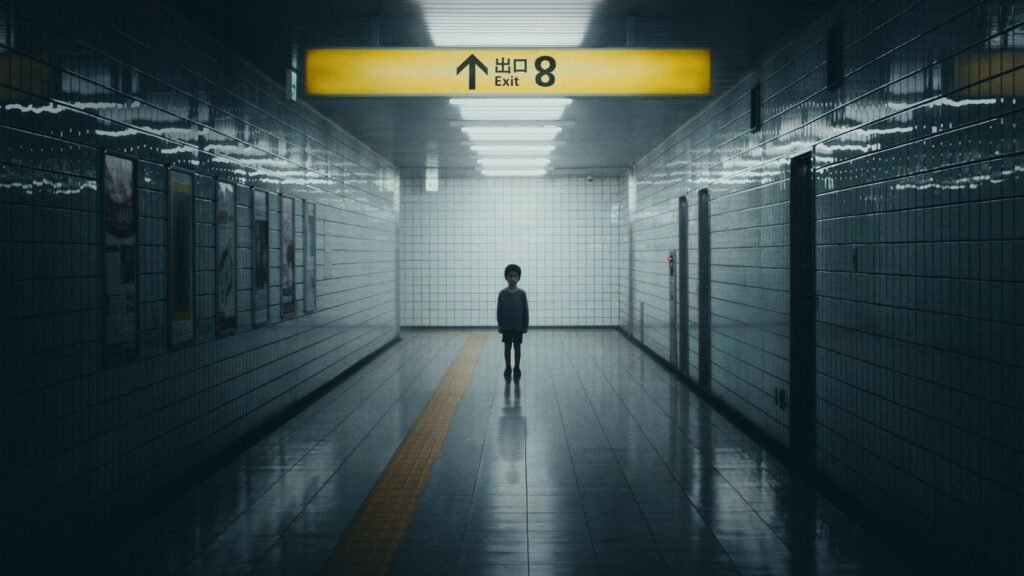
Exit 8 is Genki Kawamura’s Japanese liminal-space horror film, trapping a commuter in a looping subway corridor governed by one merciless rule. Here is the dating, stated whole, because this film refuses to sit in a single year: it is a 2025 Japanese film, premiered at Cannes in May 2025 and released in Japan that August; North America did not get it until April 2026. Think Horror files it under 2026 — but it was made and first released in 2025. What Kawamura built from a fifteen-minute indie game with no story at all is a corridor, a counter, and a man who has spent his life looking away. Watch everything. One oversight sends you back to the beginning.
Quick Specs
- Title: Exit 8 (Japanese: 8番出口, Hachiban Deguchi)
- Director: Genki Kawamura
- Screenplay: Kentaro Hirase and Genki Kawamura
- Based on: The Exit 8 (2023), the video game by Kotake Create
- Starring: Kazunari Ninomiya, Yamato Kochi, Naru Asanuma, Kotone Hanase, Nana Komatsu
- Cinematography: Keisuke Imamura
- Music: Yasutaka Nakata and Shohei Amimori
- Editing: Sakura Seya
- Production companies: Story inc. and AOI Pro.
- Distributors: Toho (Japan); Neon (North America)
- Premiere: 19 May 2025, Cannes Film Festival, Midnight Screenings (out of competition)
- Japan release: 29 August 2025
- US release: 10 April 2026 (theatres); 8 May 2026 (digital/VOD, Neon)
- Running time: 95 minutes
- Certificate: PG-13 — for some bloody images and terror
- Budget: Not disclosed
The game and its rules
The Exit 8 arrived on Steam on 29 November 2023, developed and published by Kotake Create, a solo Japanese indie developer making his debut. It is a short first-person walking simulator set in one endlessly looping underground station passageway in Japan, modelled on real station corridors — and that is nearly the whole of it. There is essentially no story and no dialogue. The whole game is the rule set, posted where the player cannot miss it: do not overlook any anomalies; if you find an anomaly, turn back immediately; if you find none, do not turn back; exit at Exit 8. A single oversight resets the counter to 0, so escape means eight consecutive correct calls. A full run takes minutes — coverage routinely puts a playthrough at roughly a quarter of an hour. Its horror is liminal-space horror by observation rather than jump scares: white tile, fluorescent light, and one recurring figure, a middle-aged man who walks toward you on every loop — the game’s sole non-player character, and the seed of the film’s Walking Man.
Players found it fast. The game sold over 30,000 copies within a day of its Steam release, a figure reported from the developer directly at launch. By April 2024 it had sold 500,000 copies on Steam; by August 2024 it passed one million downloads across Steam and Nintendo Switch; by the film’s Japanese release campaign, downloads stood at over 1.4 million. Ports followed: Switch in April 2024, PlayStation 4 and 5 that August, VR, Xbox Series X/S in January 2025 and mobile that March (PLAYISM). Kotake Create also made a sequel game, Platform 8 (31 May 2024), which traps its player on an endlessly looping train and demands they confront anomalies rather than turn back. It is a game, not a film, with no announced adaptation, and Kotake Create has declared the two titles the complete “Number 8” series. No source reports an Exit 8 film sequel in production, either.
Eight correct calls: the plot
On a crowded subway train, an unnamed commuter — credited only as the Lost Man — watches another passenger berating a young mother whose baby will not stop crying. He does nothing. Ravel’s Boléro is playing in his earbuds: one unchanging rhythm, repeated — reviewers have noted it mirrors the loop he is about to enter. Off the train, his phone rings. The caller is his ex-girlfriend — not his wife — and she is pregnant, at a hospital, asking him what she should do. He cannot answer. The call drops as he heads for Exit 8, an asthma attack takes him, and he comes out of it in a deserted corridor that loops back on itself.
A posted set of rules tells him how to escape, and the film keeps the game’s mechanic exact: walk the corridor; if anything is out of the ordinary — an anomaly — turn back immediately; if there is no anomaly, carry on. The exit counter starts at 0. Each correct call advances it toward Exit 8. A single mistake resets the counter to Exit 0. The anomalies run from the subtle to the surreal: poster faces that track his movement, blood raining from the ceiling. At Exit 5, his ex-girlfriend’s call reconnects. He tells her about the man on the train nobody defended, and confesses, in tears, that his own failure to stand up makes him feel unfit to be a father. Then she appears in the corridor in front of him — an anomaly — and the counter resets to Exit 0.
He meets the Boy, a small child who has been following the Walking Man. The Walking Man was once a lost man himself; he abandoned the Boy for a false Exit 8 and became part of the loop. The Boy, at first mute, proves sharply perceptive, and together they make steady progress. The verified ending: the Lost Man reaches the real Exit 8 and returns to the real world, calls his ex-girlfriend and promises to meet her at the hospital, then boards the same crowded train — and this time, when the man starts berating the mother and her crying baby, the Lost Man turns and confronts him. The deeper beats inside the final loops are unconfirmed.
The people in the corridor
Kazunari Ninomiya plays the Lost Man, credited only under that role name — the character has no personal name. Born on 17 June 1983 in Katsushika, Tokyo, a member of the idol group Arashi, Ninomiya is known to film audiences as Private Saigo in Clint Eastwood’s Letters from Iwo Jima (2006). He was 41 at Cannes, and 42 at both the Japanese and US releases. He is also part of the film’s making: credited with script cooperation, and, as a gamer who knew the game first-hand, a source of practical tips for adapting a game with no story. Yamato Kochi plays the Walking Man; his name, from the characters 河内大和, is also romanised Yamato Kawachi — one actor, two spellings. Naru Asanuma plays the Boy, Kotone Hanase the High School Girl, and Nana Komatsu — credited as The Woman — plays the ex-girlfriend; her casting was announced on 1 May 2025 with the role deliberately undisclosed.
Making a story out of no story
Toho announced the live-action film on 27 December 2024, with Kawamura set to write, produce and direct, and Ninomiya and Kochi cast as the Lost Man and the Walking Man. Filming ran from late 2024 to early 2025 in Tokyo, mainly on a purpose-built set replicating the game’s underground passage. The adaptation problem was the whole assignment: the game has no story, no characters and no dialogue, so the screenplay Kawamura wrote with Kentaro Hirase had to invent all three while keeping the game’s exact rules as the plot engine. The crew was deliberately cross-disciplinary — a production feature names Yuto Sakata, from the game industry, on the production side alongside Hirase and cinematographer Keisuke Imamura, though Sakata’s formal producer credit is not settled across listings. Kawamura also wrote a novelization, announced in May 2025 to publish alongside the film.
Kawamura came to the corridor from the producer’s side of Japanese cinema. His producer credits run from Confessions (2010) through Makoto Shinkai’s Your Name (2016), Mamoru Hosoda’s Mirai (2018) — Hosoda’s film, not Shinkai’s — Belle (2021), Suzume (2022) and Hirokazu Kore-eda’s Monster (2023). As a director he had exactly one feature before this: A Hundred Flowers (2022), which won Best Director at San Sebastián. Exit 8 is his second feature as director — not his debut, and nothing to do with Don’t Call It Mystery, directed by Hiroaki Matsuyama. He is also the novelist of the 2012 bestseller If Cats Disappeared from the World.
Two years, two release dates
The world premiere came at Cannes on 19 May 2025, in Midnight Screenings, out of competition — the film did not compete for the Palme d’Or, whatever loose coverage implies. The screening began at 00:30 in the Grand Théâtre Lumière, sold out at 2,300 seats, and ended in a standing ovation reported at eight minutes — a coincidence with the title the Japanese reporting itself noted. Japan opened the film on 29 August 2025 through Toho — a day after Russia and the CIS — with France following on 3 September and South Korea on 22 October 2025. The festival road ran through Toronto (Centrepiece, its North American premiere that September), Sitges, Busan, Melbourne and Rotterdam. Neon acquired the North American rights in a deal announced on 6 August 2025 — not at Cannes — and dated the US theatrical release for 10 April 2026; a US festival stop at Overlook was scheduled for 9 April 2026. The UK opened on 24 April 2026, and Neon’s US digital/VOD release followed on 8 May 2026 — the verified American home release; no streaming window beyond it is confirmed.
Hence the two years. Some catalogues list the film as 2025, anchored to the premiere and the Japanese opening. The Irish Film Classification Office catalogues it as 2026, anchored to the markets that received it then. Both are correct in the wild, each tied to a real release. The money, though, belongs mostly to 2025: in Japan the film took ¥953,919,000 from 671,840 admissions in its first three days — the biggest three-day opening of any live-action film released in Japan in 2025 — while debuting at number two for the weekend, behind the Demon Slayer: Infinity Castle phenomenon. Its Japanese total reached ¥5.17 billion, eighth for the Japanese year. In the United States it opened to $1,435,789 across 495 theatres and finished at $3,735,090; the worldwide total stands at $43,892,680 — about $44 million. No reliable budget figure has been published.
What the critics made of it
The critical consensus on Rotten Tomatoes calls it “an unsettling maze navigated with finesse by director Genki Kawamura,” and “a video game adaptation rendered with existential dread and stylistic sophistication.” The film holds 91–92% on Rotten Tomatoes from about 176 reviews. The 97% figure in Neon’s February 2026 announcement was the festival-era pool, not the current score. On Metacritic the film holds 71 from 31 critics — 25 positive, six mixed, none negative. One review from Cannes judged it “a rare game-based movie that actually has the feel of a game” that “should achieve solid cult status beyond Japan”; another scored it three of five, crediting Kawamura with turning a simple premise into “a psychological thriller exploring a man’s guilt and redemption”; a third graded it B+, praising the fatherhood material and the finale. The shape of the response is consistent: critics credit the film with making the audience play along, scanning each loop for anomalies, and with building a guilt-and-responsibility story inside a game that had none — while dissenters find the fatherhood metaphor heavy-handed and the loop repetitive. On release, the film stood as the highest-rated video-game adaptation on both Rotten Tomatoes and Metacritic, overtaking Werewolves Within; it was later surpassed. For this site’s own verdict, read Harper’s review of Exit 8 — the corridor walked at review length, skulls and all.
The honours
One honour is verified clean. At the 58th Sitges Film Festival in October 2025, the film won Best Music for Yasutaka Nakata and Shohei Amimori. A Best Feature Film nomination at the same festival rests on a single listing. A single accolades listing credits the film with a Cannes poster-design prize dated 24 May 2025; no second source confirms it, and the festival’s official awards list carries no headline prize of that name. The same single listing gives the film a TikTok Awards Japan win and Japan Academy honours — an editing nomination naming Sakura Seya, and a Newcomer of the Year win for Yamato Kochi — while another awards summary records two Japanese Academy nominations without a win. Two more reported items: Kawamura has said, in the novelization and in interview, that he cut a scene before Cannes as too frightening, involving the photo-booth images and how a lost man becomes a walking man; and a production profile reports foreign remake offers arriving, with no named buyer and no deal — colour about interest, never a remake in development.
That is the honest shape of Exit 8: a game of eight correct calls, a film that needed two calendar years to walk out of its corridor. The Lost Man’s lesson is the player’s lesson — pay attention, and do not walk past the thing that is wrong because walking past is easier. When you are ready for the next hallway, the rest of the crypt is filed in our horror movie wiki. Mind the counter. It is watching what you overlook.