
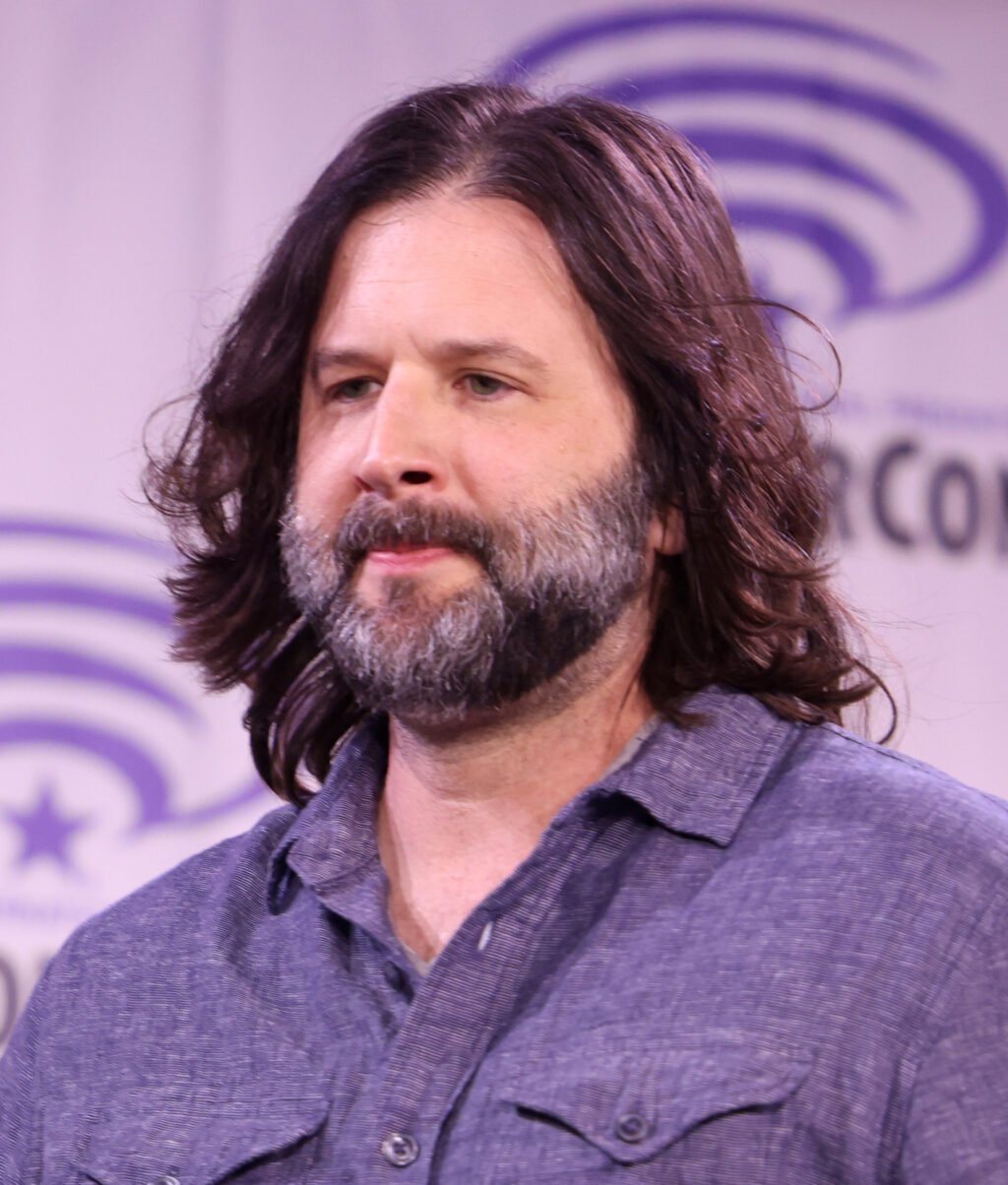
Gary Dauberman is the screenwriter who built the Conjuring Universe’s spin-off wing — the Annabelle films, The Nun — out of TV creature features and a decade of patience, and then became one of Stephen King’s defining modern adapters almost in the same breath. James Wan created the Conjuring Universe; Dauberman wrote its branches. And he did much of it with a stated method almost nobody else in modern horror would put on the record: he builds his scripts around what the characters believe, because he is a believer himself. Let’s get his credits exactly right — because with Dauberman, the credits are where everyone else gets sloppy.
Glen Mills to Los Angeles
Dauberman grew up in Glen Mills, Pennsylvania, and graduated from Penncrest High School in 1995. His education ran through Delaware County Community College — two years, majoring in communications — and then Temple University, where he graduated with a degree in Film and Media Studies. Read that college name carefully: it is Delaware County Community College, a community college, not the University of Delaware, and the confusion between the two has corrupted half the biographies of him on the internet.
One more piece of housekeeping, stated plainly because his page should be the one place that states it: Dauberman’s birth date is not publicly documented. No reliable source gives one, and the dates circulating on aggregator sites contradict each other outright — treat any age, birth year or birthplace of record you see attached to his name as invention, because that is what it is. This page prints no age for him, anywhere, on purpose.
After Temple he moved to Los Angeles to start a career in show business, and began by working as an extra through Central Casting — not, as some versions of his story claim, as anyone’s assistant. By his own oft-told account in his studio biography, he first realised his love of film watching It’s a Wonderful Life (1946) at age thirteen, and aimed first at Disney animation or comic-book art before settling on writing. The animation and comic art lost. Horror won.
The Apprenticeship and the Breakthrough
His first produced credits were Syfy creature features: In the Spider’s Web (2007), Blood Monkey (2007) and Swamp Devil (2008) — low-budget television horror, written a full decade before the Conjuring fame. A real apprenticeship, served in the trenches. In 2009 his original body-horror script Burst was optioned by Sam Raimi and Neil Marshall — an option, not a produced film, but the break his studio biography credits with putting him on the map.
The breakthrough came with Annabelle (2014), the spin-off built around the possessed doll glimpsed in The Conjuring. Dauberman was the film’s sole screenwriter — his first Conjuring Universe credit, and the foundation of everything after. The film grossed over $256 million worldwide on the production reporting of record. He followed it with Within (2016) and Wolves at the Door (2016), and then the franchise came calling again.
Inside the Conjuring Universe
Annabelle: Creation (2017), the origin-story prequel directed by David F. Sandberg, was again Dauberman’s alone as screenwriter — and it is the film where his method comes into focus. Building the film explicitly around belief, he has said that what the characters believe is “really the first thing we’re talking about when writing the script.” Hold that quote; it explains his whole wing of this franchise.
The Nun (2018) is where credit discipline matters most, so here it is in its exact two lines: screenplay by Gary Dauberman; story by Dauberman & James Wan. Wan’s name sits on the story line, not the screenplay line, on this film and on Annabelle Comes Home — any source telling you Wan “co-wrote” those screenplays is compressing two different credits into one. Dauberman also served as executive producer on The Nun, the fifth instalment of the Conjuring Universe, spun off from Valak‘s appearance in The Conjuring 2. (One honest footnote: an earlier draft by David Leslie Johnson-McGoldrick preceded the Wan/Dauberman version. Dauberman’s was not the only script ever written for the project, and this page won’t pretend otherwise.)
His name on a Conjuring-adjacent title does not automatically mean he wrote it. On The Curse of La Llorona (2019) he was producer only. On The Nun II (2023), executive producer only. The writing credits are his crown; the producing credits are his business. Keep them separate and you understand his career better than most coverage does.
Then, Annabelle Comes Home (2019): his directorial debut. Screenplay by Dauberman, story by Dauberman and Wan — and this time Dauberman behind the camera too, moving the doll into the Warrens’ artifact room and building the film around Judy Warren and two teenage babysitters across one night in the house. His stated aim was a fun, youthful, “comfort food” adventure energy inside a single location. His preparation was unusual: he had been on set through prep, production and post on the earlier films, with directors who let him into the process. And there is a family footnote hiding in the cast — his son Oliver appears in the film, the schoolboy who first says “Happy Birthday, Judy.” Dauberman confirmed it himself: “That is my son.”
The King Years
Running parallel to the Conjuring work, Dauberman became a principal Stephen King adapter of the modern era — and the two It films are where his credits run in opposite directions, so both flat versions you have read elsewhere are wrong.
It (2017), directed by Andy Muschietti, carries a three-way screenplay credit: Chase Palmer & Cary Joji Fukunaga and Gary Dauberman. Dauberman was the last writer in — the one who carried the adaptation of Stephen King‘s thousand-page novel to its shooting form — not the author of the whole script. Print all three names, always.
It Chapter Two (2019) is the mirror image: screenplay by Gary Dauberman alone, with Dauberman also executive producing. His own description of the job was an editor’s, not an inventor’s: “you know you’re not going to get all the fucking great scenes in there… I tried to preserve as much as I can of the book, in the spirit of the book.” Preservation under pressure — that is his King doctrine, and it is the opposite of a hired gun’s shrug.
Then ‘Salem’s Lot (2024), which he wrote, directed and executive produced, with Lewis Pullman as Ben Mears. Its release history is part of the fact, so here it is straight: shot in 2021, additional photography in 2022, announced theatrical dates — including 21 April 2023 — announced and then lost, until the film finally premiered at Beyond Fest on 25 September 2024 and was released on Max on 3 October 2024. It is a streaming film that sat on the shelf, not a theatrical release. It is also the first feature-film adaptation of King’s 1975 novel — the 1979 and 2004 versions were television miniseries, which makes his the third screen version but the first film. Dauberman has said his original cut ran around three hours before being trimmed to the released 113 minutes; that is his stated account, printed as such.
Swamp Thing, Until Dawn and Coin Operated
His one major television credit is horror too: Swamp Thing (2019), the DC Universe series he developed with Mark Verheiden, co-writing the first episode and executive producing alongside Wan and Michael Clear. It was cancelled on 6 June 2019 — one week after its premiere. A Southern Gothic swamp series, gone almost on arrival.
Most recently, Until Dawn (2025), released 25 April 2025: co-writer and producer, directed by David F. Sandberg — his Annabelle: Creation director, which makes the film a reunion rather than a new pairing. The credit, precisely: the screenplay is by Dauberman and Blair Butler, and Dauberman’s script built on and rewrote an earlier draft by Butler. The film is an original standalone story set in the game’s universe — a time-loop story about a group searching for a missing sister — not a beat-for-beat adaptation of the 2015 game, and Peter Stormare reprises his game role as Dr. Hill. Dauberman produced it through Coin Operated, the horror-focused production company he founded, with Mia Maniscalco as its president, under his Screen Gems first-look arrangement.
How He Writes
Dauberman’s signature is stated, on the record, across years of interviews — his own testimony, attributed to him, and the most distinctive true thing about his writing. On Annabelle: Creation: “In many ways, these are faith-based films for me. I’m a believer, so I believe evil and demonic entities are out there — but so is God, and so is good. Even as dark and scary as these movies can get, there’s always that safety net. If evil is true, the opposite must also be true.” Note the “for me” — that is his description of his own relationship to the work, and this page prints it as his, not as a classification of the films. A decade of movies later, the same structure closes Annabelle Comes Home: “ultimately, it’s the faith in God that dispels the demon at the end when Judy picks up the crucifix.”
His other stated habit is contrast. “I like watching moments of levity before a moment of horror. I like that contrast. It makes you feel like you’re on a ride.” Comes Home was framed by him as “babysitters versus demons,” with a ’70s-and-’80s throwback feel — levity first, then the drop. He has also said the unproduced spec that got his foot in the door was written as “a love letter to Big Trouble in Little China and the Carpenter movies I loved in the ’80s” — his account, and a telling one for a writer whose career runs on tonal range. And on adaptation generally, his doctrine in his own words: “the faith I have there is in the source material… That isn’t to say you can’t make departures from the source material because I think that’s necessary too. But it needs to be rooted there.”
Why Dauberman Matters to Horror
He is the principal screenwriter of the Conjuring Universe’s spin-off wing: Annabelle, Annabelle: Creation, The Nun and Annabelle Comes Home — four films, three as sole screenwriter, the fourth written and directed by him — are most of the writing spine of the highest-grossing horror franchise’s expansion beyond the Warrens’ mainline films. No other single writer holds that position. Simultaneously, he is a principal King adapter of the era: co-writer of It, sole writer of It Chapter Two, writer-director of ‘Salem’s Lot. And the ladder itself is the lesson — TV creature features in 2007, sole writer of a spin-off hit in 2014, directorial debut inside the same universe in 2019, a King feature as writer-director in 2024, his own horror banner producing for Screen Gems by 2025. Every step credit-verified. That is not a lucky break. That is a career built one exact credit at a time.
Trivia
- His son Oliver Dauberman has a cameo in Annabelle Comes Home — the first schoolboy to say “Happy Birthday, Judy.” Dauberman identified him on the record himself.
- Before the breaks, he worked as an extra through Central Casting in Los Angeles. The “he was James Wan’s assistant” version of his story has no reliable source behind it.
- His 2009 body-horror script Burst was optioned by Sam Raimi and Neil Marshall — optioned, never produced, but the break that put him on the map.
- Swamp Thing, the series he developed with Mark Verheiden, was cancelled one week after its premiere in June 2019.
FAQ
Did Gary Dauberman write It (2017) by himself?
No. The screenplay credit is three-way: Chase Palmer & Cary Joji Fukunaga and Gary Dauberman. He was the last writer in. The solo credit belongs to the sequel — It Chapter Two is his alone.
Did Dauberman write The Nun II or The Curse of La Llorona?
Neither. He was executive producer on The Nun II and producer on La Llorona — producing credits, not writing credits. His Conjuring writing credits are the Annabelle films and The Nun.
Was ‘Salem’s Lot (2024) released in cinemas?
No. After announced theatrical dates were lost, it premiered at Beyond Fest on 25 September 2024 and streamed on Max from 3 October 2024. It is the first feature-film adaptation of King’s novel; the 1979 and 2004 versions were miniseries.
How old is Gary Dauberman?
His birth date is not publicly documented in reliable sources, and the dates circulating online contradict each other. This page states no age for him — deliberately.