
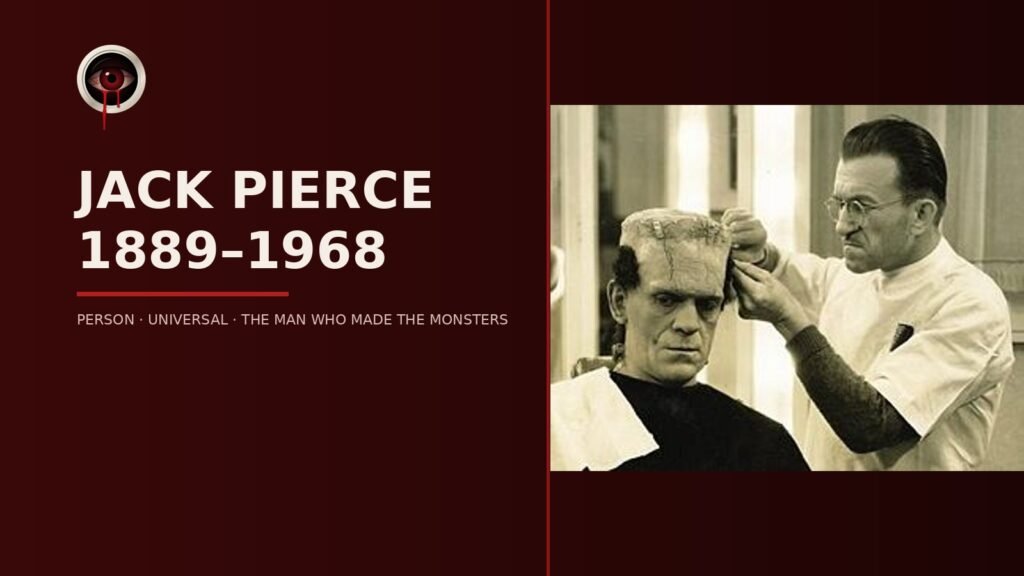
Jack Pierce (1889–1968) was Universal’s makeup chief who built the Frankenstein Monster, the Mummy, the Bride and the Wolf Man.
Even his name is complicated. The record gives his birth name in three spellings — Yiannis Pikoulas, Janus Piccoula, Janus Piccoulas — and his early professional life under two more, Jack Pearce and Jack Piccolo; the name used here is Jack P. Pierce, the name on the Universal years. His birthplace is likewise disputed: most sources say Greece, one reference-work entry says New York City. What is solid is the arc: born 5 May 1889, died 19 July 1968 in Hollywood, aged 79, largely uncredited on screen while he worked and in virtual obscurity when he died — the maker of the most reproduced monster faces in cinema, attached to almost none of them by name. One warning for anyone searching him: a modern British actor shares the name. He is a different man.
Quick Specs
Born: 5 May 1889
Died: 19 July 1968, Hollywood, California, aged 79
Occupation: Makeup artist; head of Universal Pictures’ makeup department
Known for: The Frankenstein Monster, the Mummy, the Bride of Frankenstein and the Wolf Man makeups
Resting place: Forest Lawn Memorial Park, Glendale
Actor, Stuntman, Makeup Man
Pierce came to the United States from Greece as a teenager and worked his way through the young industry in nearly every job it had: nickelodeon manager, projectionist, cameraman, stuntman, assistant director — and actor. Between 1915 and 1925 he acted in about a dozen films, usually as a villain, applying his own makeup as he went; those credits are his, and any filmography that deletes them on the assumption that “actor” means the namesake has it backwards. The early makeup chronology will not merge into one tidy line: one reference chronology has him doing makeup work around 1910 for independent companies, then Vitagraph and Fox, while the broader account is vaguer, placing him on crews from 1915. The breakthrough jobs, though, are clear. For Fox’s The Monkey Talks (1926 — one filmography dates it 1927) he built the ape makeup for Jacques Lernier, and Carl Laemmle was won over. For The Man Who Laughs (1928) he gave Conrad Veidt the permanent rictus grin. When Lon Chaney Sr. died in 1930, the niche he had owned — the actor-transforming makeup artist — stood open at Universal, and Pierce filled it. He was at Universal from the late 1920s; one chronology dates his head-of-department appointment to 1928.
Dracula: A Greasepaint, Not a Creation
Pierce’s part in Dracula (1931) is a trap. He designed a special colour greasepaint for Bela Lugosi’s Count Dracula — and Lugosi insisted on applying his own makeup, as stage actors of his generation commonly did. The 1931 Dracula look is substantially Lugosi’s own work, and crediting Pierce with “creating Dracula” the way he created the Monster is simply wrong. (A further claim that Pierce recast Dracula with greying hair and a moustache for later appearances is unconfirmed.)
Frankenstein: The Monster
Frankenstein (1931) is the creation, and even it is a collaboration with a contested pre-production. Lugosi was originally attached as the Monster and left the role; why he left is part of a disputed story. The preliminary design itself is disputed: contemporary newspaper accounts and Edward Van Sloan’s recollection of a screen test describe something resembling Paul Wegener’s Golem, while director Robert Florey and cameraman Paul Ivano remembered a test makeup not very different from what Boris Karloff eventually wore — and the surviving sketch evidence comes with its own warning that it may not date from the test. How much input director James Whale had in the initial concept remains, in the reference account’s own word, controversial. The settled design logic is Pierce’s: a flat, square head, because a scientist who was not a practising surgeon would cut the skull straight across, hinge it, set the brain in and clamp it shut — hence the forehead scar and clamps (Pierce’s fuller “pot lid” explanation survives in a 1967 interview). The famous neck bolts are not bolts but electrodes, carriers for the current that revives the corpse. Karloff contributed to his own transformation — wax on the eyelids for the drooping look, and a dental plate removed to sink one cheek. The technique was “out of the kit”: cotton, collodion and spirit gum built directly on the face, green greasepaint chosen because it photographed as dead grey. How long it took is a genuine conflict in the sources — four hours to apply in two accounts, around three and a half in a third, with about two hours to remove. The opening credits listed the Monster as “?” and did not name Karloff at all. And none of it comes from Mary Shelley’s novel, which describes no flat head and no electrodes: the face the world now draws from memory is a 1931 film invention — Pierce’s, Whale’s and Karloff’s between them.
The Mummy
For Karl Freund’s The Mummy (1932), Pierce built two makeups: the bandaged ancient of the opening, and the desiccated, parchment Ardath Bey face Karloff wears for most of the film. The full mummy took eight hours — cotton and collodion, spirit gum, beauty clay and Fuller’s earth for the desiccated finish, bandages treated to look ancient. Even the bandage length is disputed (150 feet in one account, 150 yards in another). Two claims about this creation rest on one reference source: that it was Pierce’s favourite of his own work, and the story that he based it on Cairo museum photographs of royal remains. And the image’s fame outruns the film — Karloff is in the full bandages for roughly the first ten minutes only; the shambling bandaged mummy of popular memory comes mainly from the sequels, where the creature is Kharis, played by another actor under a different makeup regime entirely. Karloff’s own verdict on the eight hours survives as a widely repeated joke — Pierce did a great job, “except that he forgot to put in a fly.” It is an anecdote, told with affection.
The Bride
Bride of Frankenstein (1935) is a co-creation, not a Pierce solo. Pierce and Whale developed the Bride’s look together, Whale’s input strongest on the hair: a Marcel wave built over a wire cage, inspired by the bust of Nefertiti, with white lightning streaks. Elsa Lanchester played both Mary Shelley and the Bride, the Bride credited — like Karloff’s Monster before her — only as “?”. The famous gown, white and embroidered with stars, moons and butterflies, is costume-department work (the designer named in other summaries is Vera West) and is not Pierce’s to be credited with. Lanchester’s own account of working with him is her characterisation: she said he “really did feel that he made these people, like he was a god,” and remembered him in the mornings “dressed in white as if he were in hospital to perform an operation.” For the Monster in the same film, Pierce revised his own design to tell the story — scars and burned-shortened hair from the mill fire, adjusted through filming so the injuries visibly heal — and from 1935 the Monster’s head was a rubber headpiece rather than the 1931 built-up construction, a fact worth holding for the dismissal story below: Pierce was never the latex refusenik of legend.
Two Werewolves
The Wolf Man’s face was not designed in 1941. Pierce had built a fuller werewolf makeup for Werewolf of London (1935) — Universal’s first werewolf film, with Henry Hull as Wilfred Glendon — and Hull did not wear it. Why is a three-way dispute: the long-repeated version says Hull refused over chair time and vanity; the best-sourced correction, from Hull’s great-nephew Cortlandt Hull, says Hull — himself an accomplished makeup artist — argued the full design would make Glendon unrecognisable in scenes where the script required others to recognise him, and that studio head Carl Laemmle sided with Hull over Pierce’s objections; and one reference account reverses the aesthetic verdict entirely, calling Chaney’s later creature the less ferocious of the two. Six years later Pierce used a design closely resembling the original for Lon Chaney Jr. in The Wolf Man (1941): yak hair laid and singed into place, the transformation itself achieved by John P. Fulton’s lap dissolves. No verified application time for the Wolf Man survives.
Also on His Table — and Not His
The rest of the Universal workload was mostly not monsters at all: the same hands did glamour makeup for leading ladies and standard makeup for leading men, year in, year out (the department statistics sometimes quoted for this rest on a single passage and are not leaned on here). The character work that did come: Karloff’s Morgan in The Old Dark House (1932); The Invisible Man (1933), where Pierce’s contribution is the bandaged head, goggles and ragged wrappings — the invisibility itself is Fulton’s effects work; Karloff’s sculpted widow’s-peak hairline in The Black Cat (1934); Son of Frankenstein (1939); and the crossover cycle of the 1940s. Phantom of the Opera (1943), with Claude Rains, was his only monster film in colour, its original, more hideous concept toned down at the producers’ request. And one negative credit, stated plainly because it is the most common error in his filmography: Pierce did not create the Creature from the Black Lagoon. That 1954 film belongs to the next regime entirely.
The Method
What made Pierce distinctive was process. The out-of-the-kit method built features directly on the actor’s face — cotton, collodion, spirit gum, mortician’s wax, greasepaint — rather than applying pre-made appliances. His laid hair work went on strand-row by strand-row: a line of spirit gum, a row of human, yak or crepe hair, dried, overlapped, trimmed. One reference account credits Pierce with a repeated widow’s-peak hairline — on Lugosi in both 1931 Dracula productions and White Zombie, on Karloff in The Black Cat, on Chaney Jr. in the Inner Sanctum films — and with flattening Vincent Price’s natural peak for his debut. His relationship with latex was specific, not phobic: rubber headpieces and appliances from 1935 onward, fabricated with crafts help (reportedly Ellis Berman), and a resistance that applied to foam latex for old-age makeups, where he trusted spirit gum and crinkled tissue paper instead. That distinction is the whole of the next section.
The Dismissal
Even the year is contested: the broader account says Pierce was fired in 1946 after twenty years; other summaries say he was let go in 1947. A detailed 1947 account dates a dismissal meeting to 28 February of that year and quotes the executive’s words; both rest on a single biographical source. He was dismissed in 1946 or early 1947; sources disagree. Why has three strands, and the popular one-strand version — he refused foam latex, so he was fired — is incomplete to the point of misleading. First, the materials strand, narrowed to the truth: foam latex, developed in the late 1930s, promised faster, cheaper monsters, and Pierce resisted it for old-age work specifically, not across the board. Second, the strand the reference account itself calls “more to the point”: new Universal-International management was rebranding away from B-pictures toward prestige, and the Westmore name carried a cachet the studio wanted — Bud Westmore, youngest of the dynasty, took the department, headed it from the mid-1940s to about 1970, and accumulated 450-plus credits. Third, personality, which is contested: Pierce “was not especially liked around Universal” in one account; stuntman Gil Perkins is quoted calling him “a miserable old bastard.” Against that stand the men who wore his work — and their judgements belong to the legacy section below. Westmore’s tenure carries its own credit lesson: the head of department took sole screen credit for a team’s work as a matter of custom, so when Westmore recreated Pierce’s classic looks for Abbott and Costello Meet Frankenstein (1948) — a film Pierce did not work on — or took the credit for the Gill Man that Millicent Patrick designed, with Jack Kevan moulding and Chris Mueller Jr. sculpting the head, the credit line is evidence of the custom, not of sole authorship. Patrick was dismissed after a publicity tour on which she was told to say Westmore designed it. A credit, for Pierce or against him, is not the same thing as a pair of hands.
The Feud That Wasn’t
The Pierce–Chaney Jr. conflict is usually told as a villain story, and the sources do not sustain it. Chaney claimed Pierce compounded the process, singed the yak hair with a hot iron and purposely burned him, and that he reacted badly to a rubber headpiece — claims from a single account. The same account adds that genre fans “seem to have exaggerated the Pierce-Chaney conflict to huge proportions,” notes that Chaney knew transformation from his father’s example and did elaborate makeups of his own elsewhere, and records Pierce, asked a year before his death whether Chaney was difficult, answering only: “Yes and no, that’s all I can say.” Chaney, for his part, later called Pierce a makeup genius second only to his own father. They worked together across the Wolf Man and Mummy sequel cycles. Whatever friction the chair produced, both men’s settled public verdict on each other was respect.
After Universal
Pierce worked steadily for two more decades — freelance, mostly at the industry’s lower-budget end, which is not the same as disappearing. There were occasional major productions, among them Joan of Arc (1948) and The Secret Life of Walter Mitty (1947), for which he made Karloff up as the Monster for a daydream sequence — a sequence reportedly cut. There were television anthologies: Screen Directors Playhouse, You Are There, Telephone Time, Fireside Theatre. A list of later creations — the halfwit of Teenage Monster, the mutants of Beyond the Time Barrier (1959), the bald cyborgs of Creation of the Humanoids (1962), a Wolf Man reprise for Beauty and the Beast (1962) — is reported but not established. His last steady employment was television’s gentlest credit: Mister Ed, 1961 to 1964, hired by Arthur Lubin, an associate from the Universal years — Pierce was 72 when it began and 75 when it ended. He died in Hollywood on 19 July 1968. The obscurity was virtual, almost total. The additions that sometimes follow — that he died with little to his name, that Universal took huge royalties from toys and masks of his Monster “of which Pierce saw none” — are claims, not established facts. His death was reported, in one source, as uremia.
Legacy
The legacy line needs no embroidery, because the contrast does the work: the Frankenstein Monster, the Mummy, the Bride and the Wolf Man as Pierce built them remain the default visual shorthand for those characters nearly a century on — the faces on the lunchboxes, the masks, the tattoos — while their maker was largely uncredited in his working life and forgotten by the public at his death. The men in his chair knew. On This Is Your Life, 20 November 1957, with Karloff as the subject and Pierce appearing, Karloff called him “the greatest make-up man in the business.” The honours that followed are reported: influence on the next generations of makeup artists, Rick Baker and Tom Savini among them; a posthumous lifetime achievement award from the Hollywood Make-up Artist and Hair Stylist Guild in 2003; a petition begun in 2008 for a star on Hollywood Boulevard; a memorial gallery dedicated by the Cinema Makeup School in 2013. What is beyond dispute is standing in the Universal Monsters gallery itself: four of the most famous faces in film history, built out of cotton, collodion, spirit gum and patience, by a Greek immigrant who signed almost none of them.