
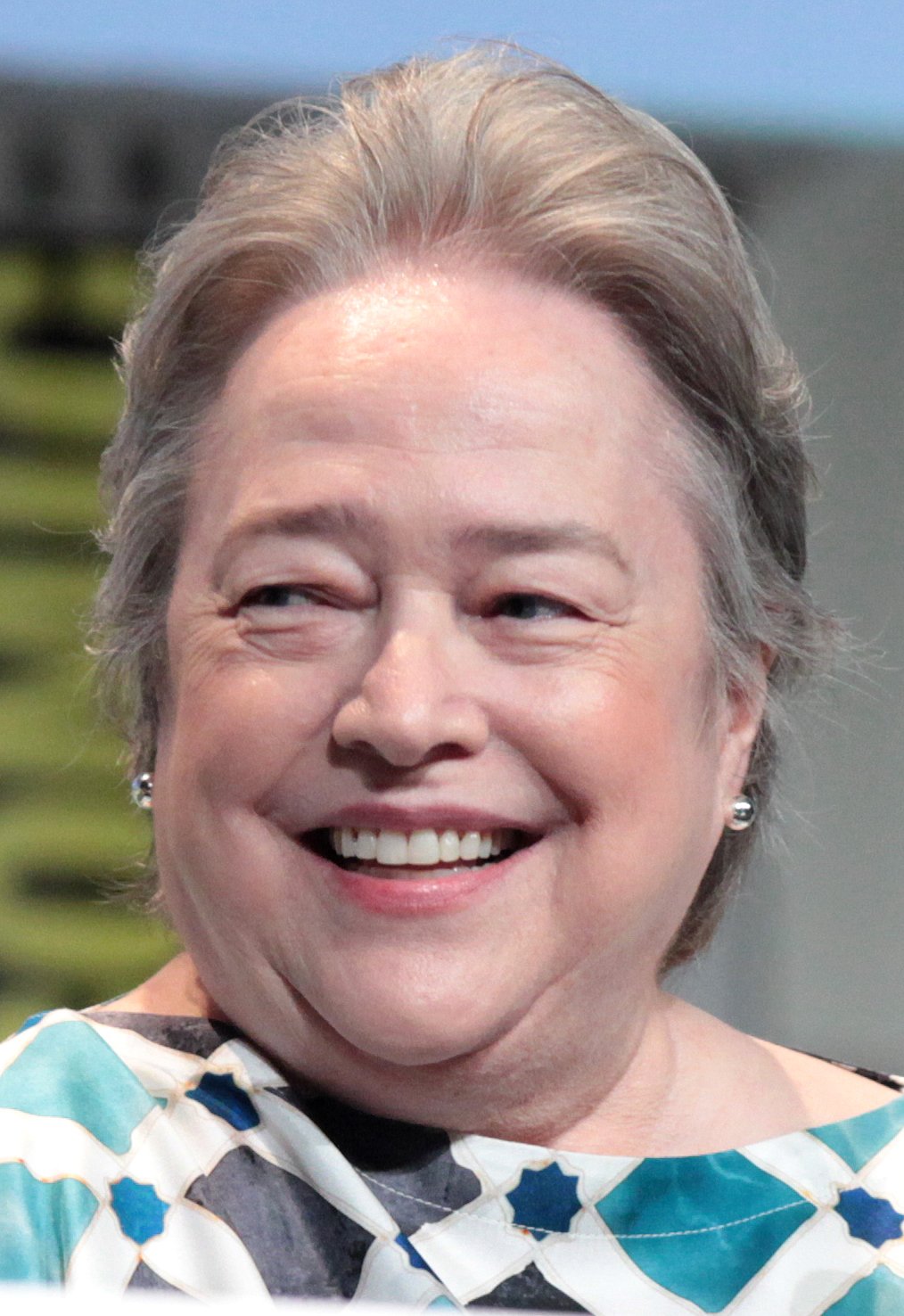
Kathy Bates (born 1948) is the stage-trained powerhouse who won an Oscar as Annie Wilkes — horror’s most decorated actress, still headlining at seventy-eight.
There is a short list of performances that changed what horror acting was allowed to be, and Kathy Bates owns the top of it. In 1990 a decorated New York stage actress whom Hollywood had mostly ignored for a decade played a lonely former nurse with a sledgehammer and a scrapbook, and walked away with the Academy Award for Best Actress — still the benchmark every genre performance is measured against. Twenty-three years later she did it again on television, rising from a New Orleans grave as Delphine LaLaurie to anchor American Horror Story. In between and since: a second Stephen King masterpiece the Oscars famously snubbed, the “Unsinkable” Molly Brown, a directing career, two cancer fights conducted in public on her own terms, and a network title role at seventy-seven that made her the oldest lead-actress Emmy nominee in history. This is that career.
Quick Specs
Full name: Kathleen Doyle Bates
Born: 28 June 1948, Memphis, Tennessee, USA
Family: Married actor Tony Campisi (1991–1997); no children
Known for: Annie Wilkes in Misery (1990), Dolores Claiborne (1995), Evelyn Couch in Fried Green Tomatoes (1991), Molly Brown in Titanic (1997), Delphine LaLaurie and four other roles across five American Horror Story seasons, Madeline “Matty” Matlock in Matlock (2024– )
Honours: Academy Award winner — Best Actress, Misery; two-time Primetime Emmy winner; two-time Golden Globe winner; Hollywood Walk of Fame star (2016)
Memphis, SMU, and the Decade Hollywood Wasted
Kathleen Doyle Bates was born on 28 June 1948 in Memphis, Tennessee, the youngest of three daughters of Langdon Doyle Bates, a mechanical engineer, and Bertye Kathleen Bates, a homemaker; her grandfather was the author Finis L. Bates. She went from White Station High School to Southern Methodist University in Dallas, majoring in theatre and taking her B.F.A. in 1969, then moved to New York City in 1970 and worked odd jobs while landing minor stage roles. Her earliest screen credit is an audition singer in Miloš Forman’s Taking Off (1971) — credited, genuinely, as “Bobo Bates.” It is not a typo and not another person; it is her first footprint in film, nineteen years before the breakthrough.
The stage record is the point the filmographies flatten. First Off-Broadway role: Joanne in Vanities (1976). A Tony Award nomination for Best Lead Actress in a Play as Jessie Cates in Marsha Norman’s ‘night, Mother (1983) — a daughter calmly telling her mother she intends to die by morning. An Obie Award for Terrence McNally’s Frankie and Johnny in the Clair de Lune (1988). Meanwhile film gave her a decade of small parts in other people’s movies — Straight Time (1978), Come Back to the Five and Dime, Jimmy Dean, Jimmy Dean (1982), The Morning After (1986), the horror-adjacent My Best Friend Is a Vampire (1987). So when Misery arrived, director Rob Reiner was not discovering an unknown. He was casting one of the most decorated stage actresses of her generation, whom the film industry had simply failed to use. Remember that when the “overnight sensation” version gets told.
Misery: Annie Wilkes and the Oscar
Misery (1990) — Reiner directing William Goldman’s adaptation of Stephen King’s novel, James Caan as novelist Paul Sheldon — gave Bates the role of her life: Annie Wilkes, the former nurse who pulls Paul from a car wreck, nurses him in her isolated house, and, discovering he has killed off her beloved Misery Chastain in his new manuscript, forces him to burn it and write a resurrection novel for an audience of one. The performance swings between maternal tenderness, fannish delight and sudden violence — “I’m your number one fan” delivered as both devotion and death sentence — and culminates in the hobbling. Keep the versions straight, because the internet doesn’t: in King’s novel, Annie cuts off Paul’s foot and cauterises it; in Reiner’s film, she breaks both his ankles with a sledgehammer over a wooden block. Two works, two hobblings, never to be merged. The scene ranked No. 12 on Bravo’s 100 Scariest Movie Moments, and AFI placed Annie Wilkes at No. 17 on its 100 Heroes & Villains list.
The honour, stated with the precision the record deserves: Bates won the Academy Award for Best Actress — lead, not supporting — at the 63rd Academy Awards on 25 March 1991, for the 1990 film, at the age of 42; she also won the Golden Globe for Best Actress in a Drama. Film year and ceremony year are separate facts, and the blogs that merge them are wrong in both directions. One coda, verified and better than fiction: for thirty-three years Bates believed she had forgotten to thank her mother in that acceptance speech — her mother had been lukewarm about the win afterwards (“You didn’t discover the cure for cancer”) — until a 2024 CBS Sunday Morning conversation, in which TCM’s Ben Mankiewicz played her the tape. She had thanked her: “I would like to thank my family, my friends, my mom at home, and my dad, who I hope is watching somewhere.” She had remembered it wrong for three decades. Even her regrets turned out to be performances she was too hard on.
The Second King, the Towanda Year, and Molly Brown
The decade after the Oscar is a masterclass in range. In Fried Green Tomatoes (1991) she played Evelyn Couch, the frame story’s lead — a timid, unhappy housewife rebuilt by Jessica Tandy’s storytelling into the woman who rams a car-park bully’s car repeatedly, shouting “Towanda!” (BAFTA nominated her for it in the supporting category, exactly as the record stands — for a performance most listings call the lead.) Then came the second King centrepiece: Dolores Claiborne (1995), Taylor Hackford directing, Bates as a Maine housekeeper accused of murdering her employer, interrogated while her estranged daughter returns home and the film unfolds a lifetime of protecting that daughter. It is, by wide critical consent, one of the great un-nominated performances — there was no Oscar nomination, and the absence is itself the famous fact. In Titanic (1997) she was Margaret “Molly” Brown for James Cameron — the new-money socialite who lends Jack evening clothes and, in the lifeboat, argues the rowers back toward the wreck to search for survivors — in what became, at that point, the highest-grossing film ever released. Primary Colors (1998) brought her second Oscar nomination (Best Supporting Actress, ceremony 1999) and the SAG Award as the campaign’s “dustbuster” Libby Holden; the same year she played Helen “Mama” Boucher in The Waterboy. And her television awards record had already started: as Jay Leno’s manager Helen Kushnick in The Late Shift (1996) she won both a Golden Globe and a SAG Award.
Director, Guest Star, Series Lead
Bates built a parallel career behind the camera from the late 1990s, directing episodes of Homicide: Life on the Street, NYPD Blue, Oz, Everwood and Six Feet Under — on which she also recurred as Bettina, actor and director on the same series — plus the TV movies Dash and Lilly (1999, Emmy directing nomination) and Ambulance Girl (2005, which she directed and starred in). About Schmidt (2002) brought her third Oscar nomination, for Roberta Hertzel and a hot-tub scene that remains the performance’s signature beat. Her first series-lead role, Harriet “Harry” Korn in Harry’s Law (2011–2012), brought two Primetime Emmy nominations as Outstanding Lead Actress in a Drama Series. And then, in 2012, after nine nominations, the first Emmy win arrived from the unlikeliest door in her filmography: a guest spot on Two and a Half Men, playing the ghost of Charlie Harper returned to haunt his brother. Outstanding Guest Actress in a Comedy Series. Horror’s greatest dramatic actress won her first Emmy as a sitcom ghost — playing a dead man. The genre was about to reclaim her properly.
The Third Act: American Horror Story
“Ryan Murphy resurrected my career,” Bates told Vanity Fair in 2016. “This is the third act, and I never dreamed any of this stuff would happen.” Murphy’s pitch for her first season’s role, as he described it, was a character “five times worse than her Misery character.” Five seasons followed — Coven, Freak Show, Hotel, Roanoke, Apocalypse; she is not in Cult or 1984 — and the roles escalated like a dare. Coven (2013): Madame Delphine LaLaurie, the real 1830s New Orleans socialite who tortured and murdered enslaved people, dug up into the present day to reckon with what she’d done — the performance won her second Emmy, Outstanding Supporting Actress in a Limited Series or Movie (ceremony 2014). Freak Show (2014): Ethel Darling, the bearded lady, mother-figure of the troupe — nomination. Hotel (2015): Iris, the Cortez’s desk manager — nomination. Roanoke (2016) is the one listings flatten: she plays Agnes Mary Winstead, the unstable actress consumed by playing Thomasin “the Butcher” White in the in-show documentary — a double role, actress and role devouring each other. Apocalypse (2018): a new character, Ms. Miriam Mead, the Satanist guardian of Michael Langdon, with a brief LaLaurie reprise folded in. Her own summary of the run, in interview, is a joke with truth in it: “Ryan Murphy is obsessed with cutting my head off, I don’t know why.” Her character gallery belongs with the rest of our Horror Characters.
Cancer, Advocacy, and Matlock
The public record of her health, in the shape she has herself stated it: diagnosed with ovarian cancer in 2003, she underwent surgery and chemotherapy and said nothing publicly at the time. In 2012 came a stage II breast-cancer diagnosis and a double mastectomy; she has spoken openly about living with lymphedema since, and turned the experience outward — national spokesperson for the Lymphatic Education & Research Network, an address at the first DC/VA Walk to Fight Lymphedema at the Lincoln Memorial in 2018, a WebMD Health Heroes “Game Changer” Award the same year. A Walk of Fame star (2016) and the 2025 Television Critics Association Career Achievement Award mark the industry’s side of the same years. Then Richard Jewell (2019) brought her fourth Oscar nomination, as Bobi Jewell, mother of the wrongly suspected guard — one win from four nominations across three decades.
And then the capstone nobody predicted: Matlock (2024– ), with Bates also executive producing. The character device is the show’s engine, so state it exactly: she plays Madeline Kingston, a wealthy retired lawyer who talks her way back into a prestige firm under the alias Madeline “Matty” Matlock — the folksy widow persona is a cover for an investigation connected to her daughter’s death. She won the Critics’ Choice Television Award for Best Actress in a Drama Series for it, and at the 2025 Emmy nominations she became, at 77, the oldest person ever nominated for Outstanding Lead Actress in a Drama Series, passing Angela Lansbury’s record. A 2024 newspaper framing of the show as her farewell produced retirement headlines; Bates subsequently said she had no plans to quit acting — she had had “one foot out the door” before the show, and hoped to play the role for years. Not retired. Expanding.
Why Kathy Bates Matters
For horror, she owns two of the genre’s defining female performances twenty-three years apart: Annie Wilkes, who took horror acting to the Academy’s top prize and remains the standard against which genre performances are measured, and Delphine LaLaurie, who anchored American Horror Story‘s reinvention of horror television and won its first great monster an Emmy. Between them sits Dolores Claiborne — two of Stephen King’s most substantial women, both Bates performances, in adaptations five years apart; no other actor is so bound to King’s women (start with Rob Reiner’s Misery and James Caan’s Paul Sheldon for the full picture). For acting generally, she is the proof of concept for the character actress as headliner: ignored by film for a decade, an Oscar at 42, Emmys in her sixties, a title role at seventy-eight. The totals, exactly: four Academy Award nominations, one win; two Primetime Emmy wins from fourteen nominations; two Golden Globe wins; one Tony nomination. No rounding, no inflation — the record doesn’t need it. You’ll find her in our Horror Actors index and across our Horror Movies pages.