
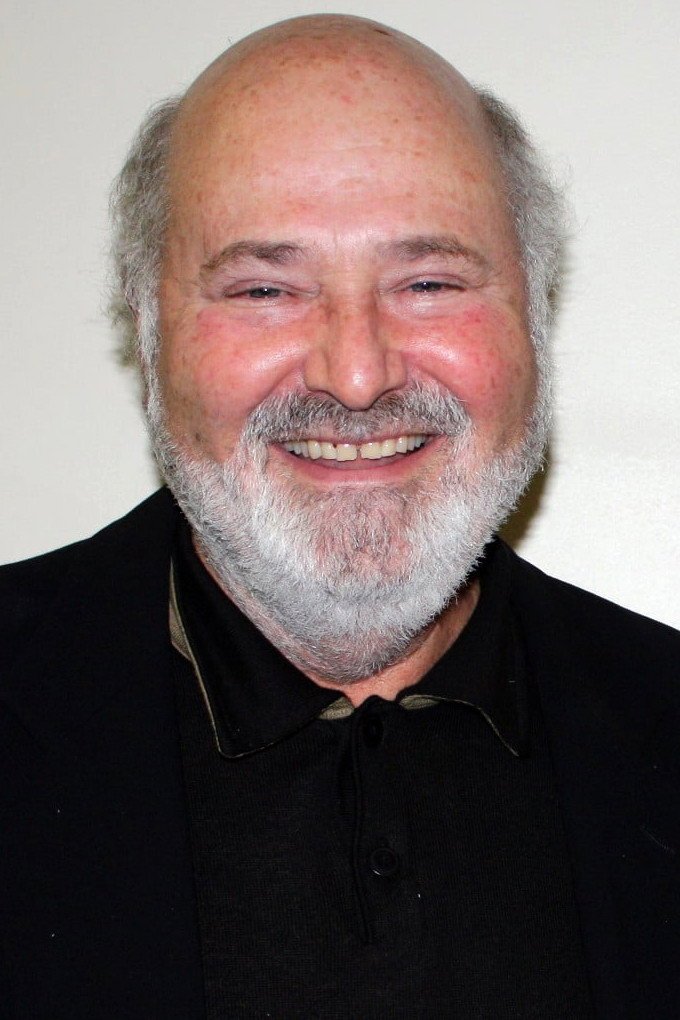
Rob Reiner is the Meathead who directed seven straight classics — including the only Stephen King film ever to win an Oscar.
Quick Specs
- Born: March 6, 1947, the Bronx, New York City
- Died: December 14, 2025, Los Angeles, California (aged 78)
- Known for: This Is Spinal Tap, Stand by Me, Misery, A Few Good Men
- Occupations: Director, actor, producer, screenwriter, activist
- Spouses: Penny Marshall (1971–1981); Michele Singer (1989–2025)
- Children: 4
Overview
Rob Reiner spent five seasons as the most famous liberal son-in-law in America, then walked away and directed one of the great runs in Hollywood history. From This Is Spinal Tap (1984) to A Few Good Men (1992), he made seven films in seven different genres without a flop among them. The horror anchor is Misery (1990), which won Kathy Bates the Academy Award — the only Oscar any Stephen King adaptation has ever won. He co-founded Castle Rock Entertainment, the company behind Seinfeld and The Shawshank Redemption, and spent decades as a political activist whose work outlived the films.
The Life
Robert Reiner — no middle name, in his own words: his mother didn’t have one, his father didn’t have one, so they didn’t give him one — was born March 6, 1947, in the Bronx, the eldest child of comedian and writer Carl Reiner and actress and jazz singer Estelle Reiner. The family moved from the Grand Concourse to New Rochelle, then to Los Angeles in 1959. He attended Beverly Hills High School alongside Albert Brooks and Richard Dreyfuss, then UCLA for two years, 1964–66, without graduating. He made his television acting debut at 14 and trained at the Bucks County Playhouse in Pennsylvania.
He married actress and director Penny Marshall in 1971, adopted her daughter Tracy, and divorced in 1981. He met photographer Michele Singer while directing When Harry Met Sally… and they married in 1989. They had three children: Jake, Nick, and Romy.
Rob Reiner, aged 78, and his wife Michele Singer Reiner were found dead on December 14, 2025, at their home in the Brentwood neighborhood of Los Angeles. The deaths were investigated as a homicide; the medical examiner’s finding was multiple sharp force injuries. Their son Nick Reiner, 32, was arrested the same day and charged with two counts of first-degree murder; he pleaded not guilty on February 23, 2026. As of this writing, he had not been convicted of anything.
The Work
Reiner’s route in was improv and writing. Tommy Smothers saw him perform with the San Francisco improv group The Committee and hired him as a writer on The Smothers Brothers Comedy Hour (1968–69), where his writing partner was Steve Martin.
All in the Family made him famous. As Michael Stivic — Archie Bunker’s liberal son-in-law, saddled with Archie’s nickname “Meathead” — Reiner won two Primetime Emmys for Outstanding Supporting Actor in a Comedy, in 1974 and 1978. The series was the most-watched program in America for five straight seasons. He left as a regular in 1978, after season 8; the series itself ran to 1979. During the run he directed for the first time: the television movie Sonny Boy (1974).
This Is Spinal Tap (1984) is his feature directorial debut: director, co-writer with Christopher Guest, Michael McKean, and Harry Shearer, and actor as Marty Di Bergi, the documentarian following a fictional English metal band on a disastrous American tour. Most of the dialogue was improvised and the film was built in the edit, with Reiner posing unscripted questions in character. Financing came via Norman Lear, his All in the Family mentor. A cult phenomenon on video, National Film Registry 2002. The Sure Thing (1985) proved range: a Cusack romantic-comedy road film, about $18.1 million on about $4.5 million.
Stand by Me (1986) was the first King film and the personal one. Adapted from Stephen King’s 1982 novella “The Body,” it follows four boys hiking to find a missing boy’s body in Castle Rock, Oregon, in 1959. Reiner shifted the film’s center from the novella’s shared story to Gordie, the grieving, overlooked younger son who becomes a writer — the kid Reiner himself had been as Carl Reiner’s son. He called it the film of his that “meant the most to me,” and proposed the title, from Ben E. King’s 1961 song, after Columbia balked at The Body. The film grossed about $52–54 million on about $8 million. King told Reiner after his first screening: “That’s the best film ever made out of anything I’ve written.”
In 1987 he co-founded Castle Rock Entertainment with Alan Horn, Andrew Scheinman, Martin Shafer, and Glenn Padnick; it produced most of his subsequent films and, beyond him, Seinfeld and The Shawshank Redemption — which he did not create or direct.
The Princess Bride (1987), director and co-producer, was adapted by William Goldman from his own 1973 novel: Westley (Cary Elwes) must rescue Buttercup (Robin Wright) from Prince Humperdinck, framed as a grandfather reading to his grandson. His father gave him the novel; after a decade of failed attempts by other directors, he got it made with financing from Norman Lear. It won the 1988 Hugo Award and entered the National Film Registry in 2016.
When Harry Met Sally… (1989), director and producer, was written by Nora Ephron, who interviewed Reiner about how men and women connect. The original conception ended with Harry and Sally parting; Reiner met Michele Singer during production, fell in love, and changed the ending so the couple end up together. The deli scene ends with an older customer — played by Estelle Reiner, the director’s mother — delivering “I’ll have what she’s having.” It entered the National Film Registry in 2022.
Misery (1990) is the centerpiece. Director and producer, screenplay by Goldman from King’s 1987 novel: James Caan is novelist Paul Sheldon, and Kathy Bates is Annie Wilkes, the former nurse and self-described “number one fan” who rescues him from a car crash and holds him captive.
The hobbling is the film’s defining creative decision, stated exactly. In King’s novel, Annie cuts off Paul’s left foot with an axe and cauterizes the stump, and later cuts off his thumb. Goldman wanted the amputation in the film. It cost the film its first director: George Roy Hill withdrew because he could not face shooting the scene. Reiner and Scheinman rewrote the sequence: Annie places a wooden block between Paul’s ankles and breaks them with a sledgehammer. His reasoning: without a foot, Paul would have paid too high a price for victory. He told the Los Angeles Times he toned down the gore so the film would play as an intellectual “chess match” rather than a horror show. Goldman conceded in print: “I was wrong.”
The role was refused by ten leading men — Hurt, Kline, Douglas, Ford, Hoffman, De Niro, Pacino, Dreyfuss, Hackman, Redford — before Beatty dropped out over Dick Tracy. Caan took the part precisely because it was passive: “being a totally reactionary character is really much tougher.” Anjelica Huston and Bette Midler were both offered Annie and both turned it down; Goldman suggested Bates, a respected stage actress effectively unknown to film audiences. Bates won the Academy Award for Best Actress — the only Oscar ever won by a film based on a Stephen King novel, and the only Oscar won by any Reiner film. Misery grossed $61.3 million worldwide on about $18–20 million.
A Few Good Men (1992), director and producer, was Sorkin adapting his own play: Kaffee (Tom Cruise) confronts Jessup (Jack Nicholson) over a Marine’s death at Guantanamo. It grossed $243.2 million worldwide — his most commercially successful film as director — and took four Oscar nominations including Best Picture. The nomination was Reiner’s as a producer; he was never nominated for the Academy Award for Best Director.
North (1994) ended the run: a family fable with Elijah Wood as a boy shopping for new parents, a box-office bomb and critical disaster. Reiner never disowned it — “a little fable.” The American President (1995) and Ghosts of Mississippi (1996) recovered ground; The Bucket List (2007) was his biggest later success. Later: Being Charlie (2015), co-written by his son Nick; LBJ (2016); Shock and Awe (2017); the documentary Albert Brooks: Defending My Life (2023); and his final completed film, Spinal Tap II (2025) — director, co-writer, again Marty Di Bergi. A concert film, Spinal Tap at Stonehenge, was filmed and unreleased, its release on hold.
He never stopped acting for other directors — Sleepless in Seattle (1993) as Jay, The Wolf of Wall Street (2013) as Max Belfort, directed by Scorsese — and played Albert Schnur on The Bear (2025), winning a posthumous guest-actor Emmy, his third overall.
The Reiner Touch
Reiner was an actor’s director because he had been the actor nobody would stop typecasting. His method was casting people who already were the part, then playing games. For Stand by Me he and the producers interviewed more than 70 boys and cast four who substantially were their characters — Wheaton sensitive, Phoenix passionate, O’Connell funny, Feldman in pain — then ran them through two weeks of Viola Spolin improvisation games before filming. Wheaton: “When you saw the four of us being comrades, that was real life, not acting.”
Improvisation was house style from first feature to last. Spinal Tap was built from unscripted questions and improvised dialogue; four decades later, for Spinal Tap II, he fell straight back into it — “like jazz musicians, you just fall in and do what you do.” And his one stated horror method is the chess-match doctrine: two actors, one room, a typewriter as a weapon, violence rationed to a single unforgettable sequence.
Why He Matters
For Think Horror, the anchor is precise: he directed the only Stephen King film ever to win an Academy Award, and he got it by removing the novel’s most famous atrocity and trusting two performances in one room. He is the only director with two era-defining King adaptations in two different registers — Stand by Me, the author’s own declared favorite adaptation of his work, and Misery, psychological horror with no supernatural element at all.
The seven-film run is the argument: from 1984 to 1992, seven films in seven genres, each now canonical in its genre, three in the National Film Registry. “Meathead” was supposed to be a life sentence; instead the All in the Family years gave him Lear’s mentorship and the standing to finance two unmakeable films. And the activism was not a hobby appended to the career: First 5 California still operates on the 1998 initiative he chaired, and the Proposition 8 challenge his foundation brought helped end California’s same-sex-marriage ban.
Trivia & Facts
- On the nickname that never left him: “I could win the Nobel Prize and they’d write ‘Meathead wins the Nobel Prize.’”
- As a boy, worried about his father’s shadow, he considered changing his name — and when Carl asked what to, he said “Carl.” “I just wanted to be like him.”
- Directing the deli scene: Meg Ryan’s first attempts at the fake orgasm were not full-out, so Reiner sat across from Billy Crystal and acted it out for her himself — pounding the table, “Yes! Yes! Yes!” — then realized he was performing an orgasm in front of his mother, who was playing the customer.
FAQ
Who is Rob Reiner?
An American director, actor, and producer — Meathead on All in the Family, director of This Is Spinal Tap, Stand by Me, The Princess Bride, When Harry Met Sally…, Misery, and A Few Good Men, and co-founder of Castle Rock Entertainment.
Was This Is Spinal Tap Rob Reiner’s directorial debut?
His feature directorial debut, yes. He had already directed the television movie Sonny Boy in 1974, during All in the Family.
What did Misery change from Stephen King’s novel?
In the novel, Annie cuts off Paul’s foot with an axe. In Reiner’s film, she breaks both his ankles with a sledgehammer against a wooden block — a change Reiner made so Paul could emerge victorious at the end. He also cut the novel’s lawnmower killing, judging audiences would find it funny rather than horrifying.
What is Rob Reiner’s best film?
Misery for horror, Stand by Me for the film that meant the most to him, Spinal Tap for comedy. Start with Misery.