
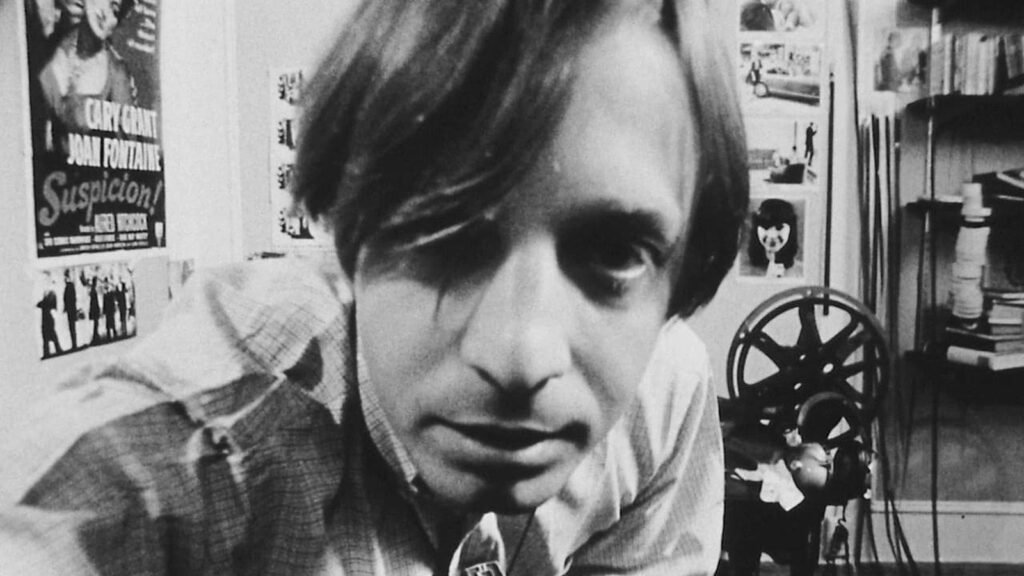
Some names in the credits make you stop the scroll. Run the opening of The Texas Chainsaw Massacre 2 — Cannon Films, Tobe Hooper directing, Dennis Hopper facing down Leatherface — and the screenplay credit belongs to a man whose other famous credit that decade was helping shape Paris, Texas, the quietest road movie ever made. Sit with that a second. Then come meet him properly.
L. M. Kit Carson was the American actor and screenwriter who wrote The Texas Chainsaw Massacre 2 and adapted Paris, Texas. Born Lewis Minor Carson in Texas on 12 August 1941, he straddled two cinemas that rarely shake hands: the arthouse, where he started as a fake diarist and finished other men’s masterpieces, and the exploitation trenches, where his name sits alone on a Chainsaw sequel. He died in Dallas on 20 October 2014, aged 73 — and the obituaries couldn’t agree on which of him to lead with either.
Quick Specs
- Born: 12 August 1941, Texas
- Died: 20 October 2014, Dallas, Texas (aged 73)
- Occupations: Actor, screenwriter, director, producer
- Known for: Sole screenplay credit on The Texas Chainsaw Massacre 2 (1986); the “Adaptation by” credit on Paris, Texas (1984); the title role in David Holzman’s Diary (1967)
- Years active: 1967–2014
The name on the Chainsaw sequel
Start where this site starts: 1986, and Tobe Hooper deep in his three-picture deal with Cannon Films — Lifeforce behind him, Invaders from Mars alongside. For the Chainsaw sequel, Hooper approached Carson to write it, and Carson began writing in January 1986. What came back was his and his alone: the film is credited “Written by L. M. Kit Carson” with no second name beside it. One writer. Hooper directed — Carson never did — and no, it was not co-written.
And what a script to sign alone. The sequel’s concept came from Carson watching the crowds at Dallas shopping malls: in his version, the cannibal family would pursue yuppies. That’s the whole film in one pitch — the Paris, Texas man looked at Dallas mall culture and saw a menu. Dennis Hopper played Lt. “Lefty” Enright, Caroline Williams played Stretch, Bill Johnson wore the mask as Leatherface, and Jim Siedow returned as Drayton Sawyer. The sequel’s breakout monster has a Carson fingerprint too: Chop-Top began as “Platehead” in the initial treatment by original Chain Saw co-writer Kim Henkel, and Carson — brought aboard to write the screenplay — is credited with reworking and renaming him into the Chop-Top Bill Moseley played.
Two credit warnings before you quote any of this at a convention. Carson also produced on the film, but the form of that credit conflicts in the record: some listings name him a producer, others associate producer. And the film itself was released on 22 August 1986 unrated. The reason was blunt: the R rating the producers wanted wasn’t available (it would have been rated X), Cannon was not an MPAA signatory, and so Cannon put it out unrated with a warning that under-17s be accompanied. Rated R is the one thing it never was.
The 1986 film doesn’t have its own page on this site yet — a gap we intend to close — so for now it lives inside our Texas Chainsaw Massacre franchise hub, twelve years on from the 1974 original.
Horror on television, and one more franchise
The episode guide for HBO’s horror anthology The Hitchhiker credits Carson with teleplays on two season-four episodes in 1987 — “Why Are You Here?” (teleplay by Christopher Leitch and Carson, aired 10 March 1987) and “The Legendary Billy B.” (teleplay by Carson, story by Marjorie David, aired 31 March 1987). A horror-genre yearbook’s obituary independently remembered him as the man who “scripted The Texas Chainsaw Massacre 2 and two episodes of TV’s The Hitchhiker” — the count and the series match. One warning, because it’s a genuine trap: the series is The Hitchhiker. Deadly Nightmares is its British title, and any source billing his episodes under that name as an American show is selling you a phantom.
Nearly two decades later came a second, smaller horror-franchise touch, strictly behind the camera: co-producer on The Crow: Wicked Prayer (2005), the fourth Crow film, directed by Lance Mungia with Edward Furlong as Jimmy Cuervo. He is credited as “L.M. Kit Carson — Co-Producer”. A producing credit only — he neither wrote nor directed it — but on a horror filmography this eclectic, it earns its line.
The adaptation: Paris, Texas
Now the credit the world keeps getting wrong. Paris, Texas (1984), directed by Wim Wenders, won the Palme d’Or at Cannes — and its credit split is “Screenplay by Sam Shepard, adapted by L. M. Kit Carson.” That is the form. Obituaries that call Carson the film’s “co-writer” are speaking loosely: Shepard wrote the screenplay, Carson adapted it, and the on-screen credit says so.
There is, though, a true story underneath the loose phrasing, and it’s Carson’s own. In his account, given in a 2011 interview, Shepard’s script was unfinished when Shepard was called away to act in another production, and Carson, brought onto the film, completed it in his absence, writing toward the ending himself. That’s how a writer becomes the invisible hand on a Palme d’Or winner: no shared screenplay credit, just the ending.
And there’s a family face in the film. The boy Hunter is played by Hunter Carson — Kit Carson’s son with actress Karen Black — in his film debut; he was eight, born in 1975. Hold that fact — it pays off two summers later.
The diary that wasn’t
Before any of it, there was the hoax. David Holzman’s Diary (1967), directed by Jim McBride, stars Carson as David Holzman, a young man so obsessed with filming his own life that the camera eats his relationships whole. It presents itself as a documentary. It is not one. It is McBride and Carson’s freewheeling mock-documentary — a staged fiction shot in cinema-vérité style, decades before “found footage” was a phrase anyone used. Anyone filing it as a real diary, or as found footage, is falling for a trick the film announces in its own end credits.
The making of it, in Carson’s own telling — a 2011 guest post for the film’s re-release — is the best shoestring story in American independent film. He and McBride held a $2,500 advance to write a cinema-vérité book for the Museum of Modern Art, a book to be called “The Truth on Film”. They never wrote it. Instead they took the money and shot the film over the 10-day Easter break, on a $2,500 budget. Credit hygiene, though: the writing credit is McBride’s alone. Carson’s accurate titles here are star and co-conceiver, and they’re enough.
The afterlife was slow and strange. The film was not shown theatrically until 1973, six years after it was made. It was later named to the National Film Registry — the year is given as both 1991 and 1992. Carson even returned to the role decades later, reprising Holzman in Lisa Picard Is Famous (2000) — the fake diarist, checking back in on the century he accidentally predicted.
McBride again, and Hopper in the desert
The McBride partnership produced one more headline credit: Breathless (1983), the American remake of Jean-Luc Godard’s 1960 original, starring Richard Gere and Valérie Kaprisky. The credit reads “Written by Jim McBride, L. M. Kit Carson” — a true joint screenplay this time, released 13 May 1983 — and McBride obtained permission from Godard and François Truffaut before remaking it.
And earlier still, the directing credit. The American Dreamer (1971), co-directed by Carson with Lawrence Schiller, is a documentary portrait of Dennis Hopper in the aftermath of Easy Rider, made around Hopper’s The Last Movie. It remains his one directing credit of note — a real camera pointed at a real man coming apart interestingly, two years after he’d played a fictional one.
The mentor: Bottle Rocket
One credit has to be corrected before it can be told, because the wrong version is everywhere: Carson did not act in Bottle Rocket. There is no character named “Mr. Lawson” in the film — James Caan plays the ex-con, and his name is Mr. Abe Henry. The full credit listings, from the official Sony production notes on, contain no Carson acting credit at all. If you came here with that credit in your notes, cross it out.
The true version is better anyway. Carson was a friend of Owen Wilson’s father, and he championed the short film Wes Anderson and Owen Wilson had made. He executive produced that 1994 Bottle Rocket short with Michael Lang, with Carson getting Stones manager Lang to fund a post-Sundance reshoot. Then the official Sony production notes for the 1996 feature state it plainly: the film “is co-produced by Ray Zimmerman and L. M. Kit Carson”. His wife, producer Cynthia Hargrave, was among the feature’s producers too. The real Wes Anderson connection isn’t an acting role that never existed — it’s that independent film’s old guard reached down and pulled the next generation up by the collar.
Dallas, magazines, and the rest of the work
Underneath everything, Carson was a magazine writer first. The young Carson wrote for Esquire, Rolling Stone and other magazines in the 1960s and ’70s, and Bruce Weber’s obituary called him “an early advocate of young American directors like Martin Scorsese and Brian De Palma”. The advocacy never stopped; it just changed form. In Dallas, he co-founded the USA Film Festival in 1970.
Which brings back the Cannon summer, and the adjacency that is not a credit. Invaders from Mars (1986) — Hooper’s remake, released 6 June 1986, weeks before the Chainsaw sequel — starred Hunter Carson, Kit’s son, as the boy lead, and Karen Black, Kit’s former wife, as the school nurse. Carson himself has no writing, directing or producing credit on it whatsoever; the credit record is clear. It belongs in his story for one sentence only: while Carson wrote the Chainsaw sequel for Hooper, Hooper was shooting a film led by Carson’s son and former wife — family adjacency, filed as exactly that.
The rest of the record, in credit form, the way the databases carry it:
- The Last Word (1979) — writer
- Chinese Boxes (1984) — writer, and a small acting role
- Running on Empty (1988) — actor
- Hurricane Streets (1997) — actor; executive producer
- Bullfighter (2000) — writer and producer
- CQ (2001) — actor
- Perfume (2001) — writer and producer
- Tempo (2003) — writer
Family
The load-bearing family fact is solid: Hunter Carson, the actor, is Kit Carson’s son with actress Karen Black. The marriage dates differ: 1975–1983 in one account, 1977–83 in a horror-genre yearbook obituary. The divorce year agrees everywhere; the wedding year doesn’t. After Black, the record gives Cynthia Hargrave, married in 1990 — and at his death Hargrave called him “my beloved husband”, which settles what matters: she was his wife when he died, and she survived him.
What he left
Carson died in Dallas on 20 October 2014. The obituaries said 73; compute it rather than copy it — born 12 August 1941, he’d passed his birthday that October, so 73 is right. Accounts of the cause vary: one, citing those same obituaries, says he died in his sleep of pneumonia; another says complications from pneumonia; a third describes a fight with osteoporosis and other illnesses. In short: aged 73, after a long illness, reported cause pneumonia.
So file him properly. A magazine writer who championed Scorsese before it was safe. A fake diarist whose $2,500 hoax now sits in the National Film Registry. The adapter who finished Paris, Texas and took half a credit for a whole ending. The mentor who executive-produced a 13-minute short and thereby midwifed Wes Anderson. And for this site’s purposes, above all of it: the man whose name stands alone — no partner, no committee — on the screenplay of The Texas Chainsaw Massacre 2. Plenty of writers touch horror once and spend a career apologising for it. Carson touched it with yuppies, a renamed monster and an unrated release, and signed it. That’s not a detour in his filmography. Around here, it’s the headline.