
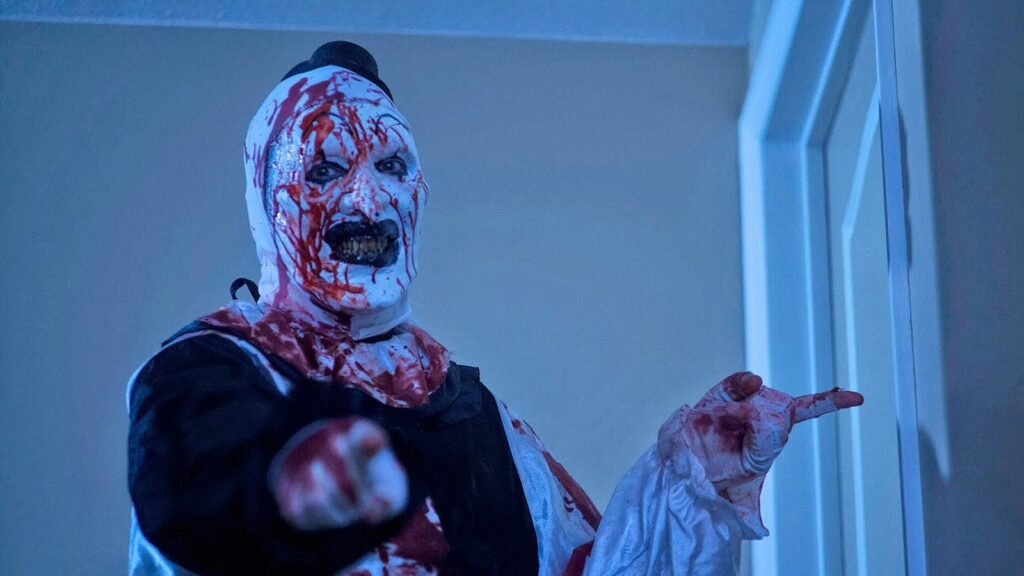
Before Art the Clown was a franchise, a Halloween institution and a face on a thousand t-shirts, he was a favour one friend did for another, in a short film almost nobody saw. The man under the makeup wasn’t an actor, never wanted to be one, and walked away before the whole thing exploded — which is exactly why his three credits matter more than most filmographies ten times their size.
Mike Giannelli is the first actor to play Art the Clown, Damien Leone’s silent black-and-white killer, in the shorts and All Hallows’ Eve (2013). Everything the character became started with a face Leone built on his friend. The record on Giannelli is short, strange and easy to get wrong: no solid source gives his birth date or birthplace, he had no acting career before Art and has none after, and his entire filmography is three titles long. What follows is all of it — and only what can actually be carried.
Quick Specs
- Known for: Art the Clown (2008–2013)
- Occupation: Not a professional actor — Damien Leone’s friend, who played the role as a favour
- Credits: The 9th Circle (2008), Terrifier (short, 2011), All Hallows’ Eve (2013) — three, total
- Character: Art the Clown, created by Damien Leone
- Succeeded by: David Howard Thornton, from Terrifier (2016) onward
A sketch, a friend, a favour
By Giannelli’s own account, in a podcast interview, he met Leone in 2002. Leone was always sketching, and one day he sketched a black-and-white clown and asked his friend whether he wanted to play it. There was no casting call and no audition circuit, because there was no actor to cast. Leone has put it plainly more than once: “not an actor at all, he just did me a favor” — the first couple of short films were simply his buddy Mike in the makeup.
That point matters, because coverage of Giannelli tends to inflate him into a working performer who stepped away from a career. There is no pre-Art career on the record to step away from — no theatre background, no training, no trail of earlier roles, whatever a few explainer pages have invented for him. He has no standalone biography in any encyclopedia; everything solid about the man runs through the Art record and the interviews gathered here. The thinness of that record isn’t a gap. It’s the story.
Three credits, one clown
The 9th Circle (short). Leone’s first film was shot in 2006, on 35mm, and premiered in 2008 at the Backseat Film Festival; it is catalogued as a 2008 short. Art began there as a minor character, one monster among several in a film testing out different horror ideas. What audiences responded to, Leone has said, was the clown — Art was the element people kept telling him to build on. Giannelli’s credit on the anthology that later absorbed the short reads “Art the Clown / Demon,” the Demon belonging to this segment; it is one credit line, not two roles, and it is the whole of his debut.
Terrifier (short, 2011). This time the clown got a short of his own — roughly twenty minutes, by Leone’s account — with Art promoted from background menace to lead. Producer Jesse Baget found it on YouTube, where it had drawn around 120,000 views at the time by Leone’s telling, and that viewing is the direct path to everything after. One warning that will save you confusion forever: this Terrifier is the 2011 short. The feature of the same name from 2016 is a separate production, and Giannelli is not in it.
All Hallows’ Eve (2013). Baget proposed building an anthology feature out of the two shorts he had found, and the result was released on DVD and digital on 29 October 2013 by Image Entertainment, with Giannelli again credited as Art the Clown / Demon. It is his only feature film — and it made him, retroactively and somewhat accidentally, the original face of one of the biggest horror franchises of the modern era.
Inside the anthology
All Hallows’ Eve is worth taking apart, because Giannelli’s place inside it is widely misunderstood. The first segment is The 9th Circle, with additional footage. The third is the 2011 Terrifier short, carried over whole. Between them sits “Something in the Dark,” a new alien home-invasion segment written for the anthology — and Art appears in that one only as a painting on a wall. Giannelli does not perform in the middle segment at all. His anthology, structurally, is two old shorts, somebody else’s new story, and a frame he shot fresh.
The frame is where his new work lives. Baget had proposed the anthology; Leone agreed on condition that he could also devise the new middle segment and the wraparound story. In that wraparound, babysitter Sarah (Katie Maguire) watches the tape with two children on Halloween night, and Giannelli shot brand-new Art footage for it — not recycled scares, but the clown stepping out of the fiction and into the house. It gives his Art its defining moment: at the end, Art is outside the children’s room, covered in blood, laughing at her.
Hold onto that laugh, because it corrects a lazy claim you will see repeated everywhere. Art never speaks — not in Giannelli’s films, not in anyone’s; the character has had no dialogue in any incarnation, and that was the design from the start. But “never speaks” is not “completely silent,” and it never has been. The first Art ever put on screen is heard, clearly, laughing. The sound was there before the franchise was.
A face built on a friend
Leone is an effects artist before he is anything else, and Giannelli was his practice dummy long before he was his clown. Leone had been practising prosthetics and life-casting on him — actually moulding his friend’s face — when the pitch arrived, and the pitch was basically: you don’t have to act. The casting logic was endurance. Leone has said he knew he needed someone who would be comfortable sitting in the makeup chair for at least three hours a day, and then sitting in the makeup itself for another ten. Most actors would call that a warning. Giannelli, not being an actor, apparently heard it as a favour.
You can watch the face evolve across the three credits in Leone’s own contemporary account, given in 2013. For The 9th Circle, he took a life cast of Giannelli and sculpted “gaunt facial features, a pointy nose and chin,” then painted his teeth yellow. For the Terrifier short, he sculpted a whole new face — even more zombie-like — and added rotten dentures. Giannelli’s own telling of the early days starts smaller and more homemade: mostly face paint and a small nose prosthetic at first, contact lenses meant to give him white-and-red eyes that kept popping out and were eventually dropped, and only later the mould of his face. The two accounts differ in detail and agree on the essential thing: this face was built on this specific man, not fitted to him afterward. Art’s look is, quite literally, Giannelli-shaped.
And the rules of the character were set before there was a franchise to protect. Leone knew from the start that the colour scheme would be black and white, and that Art was “never going to mutter a sound.” His later summary of the design is still the cleanest one anyone has produced: “Pennywise speaks, Art doesn’t.”
The handover
Here is where most coverage gets Giannelli wrong, so let’s be exact. He was not fired. He was not dropped in favour of a better performer, and he was not recast on performance grounds. He was offered the Terrifier feature and he turned it down — his words, from that same podcast interview: “I was offered the role to do ‘Terrifier’ and I turned it down.” His reasoning was the process itself: filming meant long hours, the makeup took a long time to go on, and “it just wasn’t my thing.” On the makeup days themselves he is blunter: “I hated every second of it. Love the outcome, love Damien.”
The colour from his telling is vivid, and it is entirely his — Leone shot in winter and the clown suit was thin; the corn-syrup blood was sticky; for one scene Leone kept real pig organs in a cooler for Art to use; and during the short-film period Giannelli was working as a mall security guard, and got talked into calling in sick so a makeup test could be done. That’s period detail from the man’s own mouth, from the one interview he has given on any scale. It is not a claim about his life now, which is not publicly documented.
Leone’s side of the story agrees with Giannelli’s in every particular, which is precisely why the “recast” framing collapses. “I didn’t want to replace Mike,” Leone has said — his friend had simply told him he didn’t think it was in him anymore, that he couldn’t go through hours and hours in the makeup chair again. Leone has also framed the difference in demand: the shorts asked hours of Giannelli; the feature would have asked months. And in 2017, with the feature made and a new Art in place, he was still saying the quiet part out loud: “Finding a new actor to play Art was by far the most crucial and nerve-wracking aspect of this film” — because everything people loved about Art up to that point was a testament to how Giannelli had portrayed him.
The role passed to David Howard Thornton, and the two Arts are genuinely different instruments. In a 2022 newspaper interview, Leone contrasted them this way: Mike may as well have been “a guy dressed as a clown,” whereas David is a clown outright, “Roger Rabbit in real life.” There was never a feud underneath any of it; in that same 2022 coverage, Leone was still calling Giannelli his “buddy.” One more Leone line belongs in this section, filed exactly under what it is — a stated wish, not casting news: “I’d like to get him in the movie somehow, at least get him a cameo.” No return has ever been announced. If that changes, it will change on the record, not on rumour.
Where he stands
Somewhere along the way, coverage settled on saying Giannelli “retired from acting,” and it’s worth retiring that phrase instead. He never built an acting career to retire from. He did a friend a favour three times, discovered he hated the chair it required, and declined the fourth — politely, on good terms, with the friendship intact. That’s the whole arc, and honestly it’s a cleaner one than most.
His filmography stands at exactly three credits, and there is no verified sign of a fourth coming. But look at what those three credits contain: the first appearance of Art the Clown, the short that promoted a background monster into a leading man, and the anthology that carried him to the world. Thornton made Art an icon. Giannelli made Art exist. Every version of the clown since — every silent tilt of the head, every grin, every laugh — is built on a face that was life-cast, once, on a friend who couldn’t sit still.