
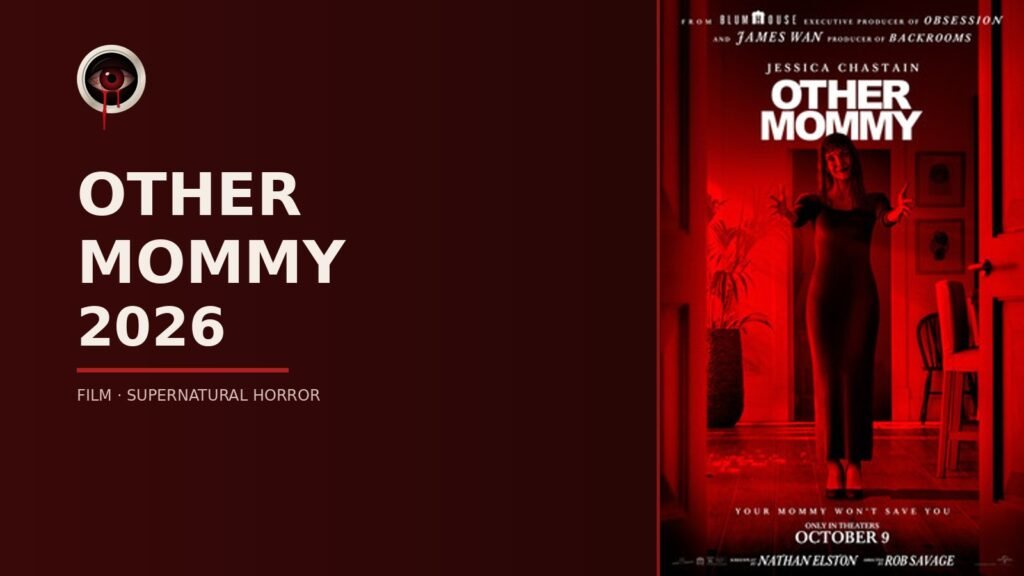
Other Mommy (2026) is a supernatural psychological horror film: a mother-shaped entity asks young Bela Martin to let it into her heart.
It is already out — and that correction matters, because early paperwork on this film still described it as upcoming. Other Mommy opened in U.S. theaters on 9 October 2026 through Universal Pictures, topped the box office on its first weekend, and did it while critics were panning it: both halves of that sentence are the story, and this page keeps both. Jessica Chastain plays a dual role — Ursula Martin, Bela’s mother, and Other Mommy, the entity wearing her face. The title is Bela’s word, deliberately: as Chastain explained in an Associated Press interview, a child calls her mother “Mommy,” not “Mother” — and the name traces to author Josh Malerman’s brother’s niece, who once said “Goodnight, Other Mommy” to an empty room. The film adapts Malerman’s 2024 novel Incidents Around the House — the title it was developed and shot under before being retitled Other Mommy in July 2025 — and it is not connected to Bird Box, Malerman’s other famous book, in any way beyond the shared author.
Quick Specs
Director: Rob Savage
Written by: Nathan Elston, from Josh Malerman’s novel Incidents Around the House (2024)
Producer: James Wan; executive producers include Michael Clear, Judson Scott, Rob Savage, Josh Malerman and Ryan Lewis
Starring: Jessica Chastain as Ursula Martin and as Other Mommy; Arabella Olivia Clark as Isabela “Bela” Martin; Jay Duplass as Russell “Russ” Martin (called Daddo); Dichen Lachman as Lois Anthony; Arian Moayed as Frank; Karen Allen as Grandma Ruth Martin; Sean Kaufman as Kelvin
Production: Blumhouse–Atomic Monster; distributed by Universal Pictures
Release: 9 October 2026 (U.S. theatrical)
Runtime: 93 minutes
Rating: R
Budget: A reported $18–19 million
The Story (Spoilers)
Bela Martin lives with her mother Ursula, consumed by her corporate career, and her father Russ, an unemployed househusband caring for her, while the marriage strains — Bela’s age is reported as seven in some sources and eight in others, including the novel’s premise, so this page prints neither flatly. Bela begins encountering a supernatural entity that resembles her mother, which she calls Other Mommy, and which repeatedly asks to be let into her heart. Two passages of the plot rest on a single plot summary in the record and are fenced as such: that the entity is first confined largely to Bela’s room and closet before breaking that boundary — appearing as Ursula at home, asking over lunch to enter Bela’s heart, and driving Russ to flee the house with Bela after he sees it contorted under a counter; and the anniversary-party sequence, in which the entity takes the form of Kelvin (described in that same single source as Bela’s babysitter), seemingly makes guests disappear, lifts Bela to the ceiling and tries to force its way into her before she fights it off. What follows is corroborated more widely. The family stays with Frank; that night Other Mommy manipulates Bela into wishing Frank out of their lives, then kills him in front of the family despite his gunshots. The family flees, is attacked again, and travels to Ruth’s home, where Ruth hires paranormal investigators — Lois Anthony among them; her exact label conflicts between sources, exorcist in one listing, paranormal scientist in another, so this page calls her one of the investigators — who identify Other Mommy as a trickster demon seeking to incarnate into Bela and take over her life, which it cannot do without her permission. A séance summons the entity; the investigators are killed. Determined to stop running, the family returns home, barricades in the basement, and Ursula confesses two things: she never wanted to be a mother, and Bela’s biological father is not Russ but her first husband, whom she left for Russ (one ending explainer attaches a first name to that husband that appears in no other source; it is an error in that piece and is not repeated here). The confession appears to weaken Other Mommy but devastates Bela, who runs to her bedroom and begs the entity to enter her heart. Remembering Ruth’s lesson — that pain is an unavoidable part of life — she fights back, repeatedly denying permission until the entity is defeated; post-release coverage also describes her as tricking the entity by pretending to offer her heart. Months later, Bela, Ursula and Russ hang Christmas lights together, though Bela notices Ursula looks unhappy, leaving the family’s future uncertain. A post-credits scene shows Other Mommy facing the camera and whispering “Shhhhhhhh” — a stinger suggesting the entity lingers, not a reversal of the ending and not a sequel announcement; no sequel has been reported. And the contrast every recap should print: in Malerman’s novel, Bela ultimately lets Other Mommy in and is displaced. The film pointedly refuses that ending — any summary in which Bela says yes, Russ dies, or Ursula is consumed is describing the book, or a recap that has mixed the two, not this film.
Production
The adaptation was announced in April 2025 with Savage directing, Elston writing and Chastain starring. Casting filled out across the summer of 2025: Duplass in May, Lachman in June, and in July the trio of announcements that landed Clark in the lead, added Kaufman, Silver and Allen, and retitled the film Other Mommy. Principal photography ran in Dublin, Ireland, from 12 May to 9 July 2025. Craft credits are printed fenced where the record is single-sourced: cinematography by Lowell A. Meyer and music by Patrick Jonsson rest on credit listings alone in this pass, and the editing credit conflicts — one source gives John Cutler alone, a review’s credit block gives Peter Gvozdas and John Cutler jointly. Savage, asked how many jump scares to expect, told Entertainment Weekly “Oh, like 50” — his own joke estimate, offered with the caveat that it depends on what counts as one, and printed here as a quote, not a count. Universal first dated the film 8 May 2026, then moved it to October, into the Halloween run-up.
Release and Box Office
The film opened at No. 1 domestically on the weekend of 9–11 October 2026, ahead of pre-release tracking that had run from about $20 million to the high twenties. The opening figure itself carries a small conflict this page prints rather than resolves: most reporting gives about $27.5 million domestic from 3,365 theaters, while Wikipedia’s box-office section gives $27.8 million; with about $17.6 million international, the worldwide opening was about $45.2 million — more than double the reported $18–19 million production budget on the first weekend, stated as a gross-versus-budget comparison, not a profitability claim. Later totals, each dated: about $78.8 million worldwide circa 18 October, and, in the sanctioned late-October form, about $86–87 million worldwide (Wikipedia / The Numbers, late October 2026) against that reported budget. Australia and Singapore opened a day earlier, on 8 October; those are not the U.S. date.
Reception
Critics were harsh and audiences who showed up anyway were lukewarm — the dated snapshots tell it. Rotten Tomatoes stood at about 20% from 20 reviews on release day, at 18–19% with a 46–48% audience score across opening weekend reporting, and at 19% of 96 critics’ reviews, average 4.4 out of 10, in the tally retrieved in late October 2026, with the consensus: “Despite a valiant turn from Jessica Chastain as the spectral embodiment of a smothering parent, Other Mommy proves too silly for its intermittently effective jump scares to add up to a spooky whole.” Metacritic scored it 38 out of 100 from 15 critics. Opening-night audiences gave it a D+ CinemaScore — reported as the lowest grade for a wide release since Megalopolis in September 2024 — and PostTrak measured 47% overall positive with 33% who would definitely recommend it. The recurring critical shape, attributed rather than averaged: Chastain’s dual performance drew consistent praise inside otherwise negative reviews — The New York Times’s Beatrice Loayza called the film a “sometimes-creepy, sometimes-hilarious schlockfest,” The Guardian’s Benjamin Lee gave it 2 out of 5, and Variety’s review found the tone limp. Think Horror’s own coverage is separate from this record: the site’s opening-weekend verdict and its release-day news post.