
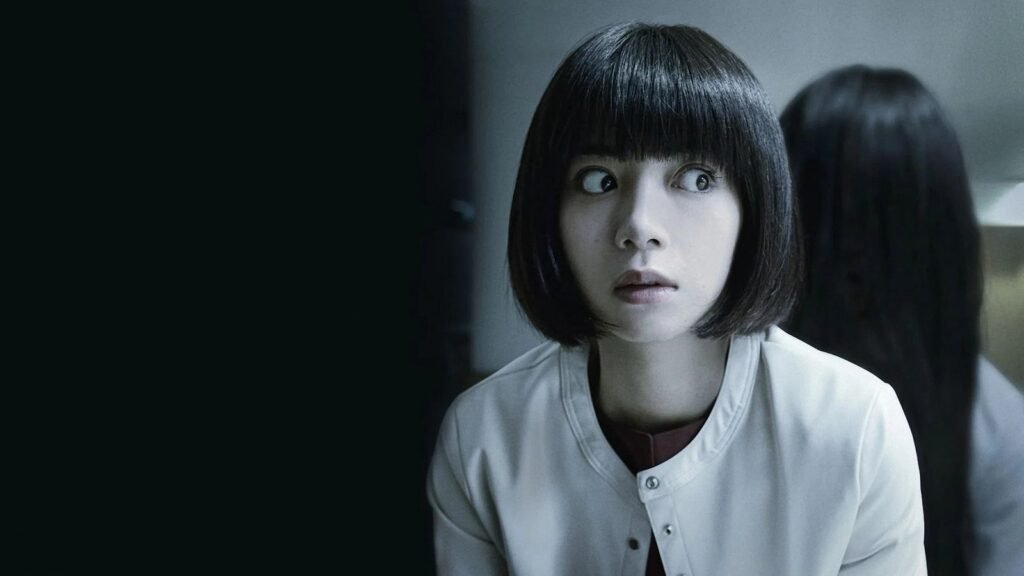
The tape is dead, and everybody under thirty knows it. Nobody owns a VCR, nobody rents anything, and a curse that needs a specific piece of plastic to travel is a curse with nowhere to go. So Sadako did what every other predator of the modern world did. She moved online.
Sadako (2019) is Hideo Nakata’s return to the Ring series — a sequel to Ring 2 where the curse leaves videotape for uploaded video.
Twenty years after he last directed Sadako in Japan, Hideo Nakata came home to the ghost he made famous — and found her waiting in a hospital ward and a dead boy’s video channel. There is no cursed videotape driving this film and no seven-day countdown ticking over anybody’s head; those belong to the 1998 original, and Nakata leaves them there as backstory and iconography — a television manifestation, a glimpse of the well. What spreads the curse now is an upload: a struggling YouTuber’s final video, with Sadako’s image hidden inside it, bleeding out into other people’s videos. It opened in Japan on 24 May 2019, and that summer it opened the Fantasia festival in Montreal. In some territories it was released as Sadako KOL — KOL being “Key Opinion Leader,” the industry term for a social-media influencer, which tells you exactly where this film’s head is at.
Quick Specs
Title: Sadako (Japanese: 貞子); released in some territories as Sadako KOL
Year: 2019
Country / Language: Japan / Japanese
Director: Hideo Nakata
Screenplay: Noriaki Sugihara
Based on: Tide (2013) by Koji Suzuki — the credited source; the film’s story is original
Starring: Elaiza Ikeda, Hiroya Shimizu, Himeka Himejima, Ayaka Minami, Takashi Tsukamoto, Renn Kiriyama, Rie Tomosaka, Hitomi Satō
Music: Shōgo Kaida
Theme song: “Seisen” by Queen Bee (Ziyoou-vachi)
Cinematography: Takahiro Imai
Editor: Naoko Aono
Producers: Reiko Imayasu, Kimio Hara
Executive producer: Shinichirō Inoue
Production: Kadokawa Daiei Studio, Twins Japan
Distributor: Kadokawa
Release date (Japan): 24 May 2019
Running time: 99 minutes
Series position: Eighth Japanese theatrical Ring feature; a direct sequel to Ring 2 (1999)
Rotten Tomatoes: 24%
The girl in the closet
Before the hospital, before the video, there is a closet. Hatsuko Sofue, a clairvoyant, has kept her daughter locked inside one for nearly ten years — a child born in secret, never registered, never named — because Hatsuko believes the girl is Sadako Yamamura reborn. When she tries to burn the child alive, Sadako manifests. The apartment burns. Five people die, Hatsuko among them. The girl walks out of the fire.
A month later she is a patient at Kurokawa Memorial General Hospital, under police guard, amnesiac, with no name anybody can find. The staff call her “Sadako,” because there is nothing else to call her. She says almost nothing. She does not eat. And when she is threatened, things move that should not move — the girl carries telekinetic power, and the hospital is about to learn it. Her case goes to Mayu Akikawa, a psychological counsellor at the hospital (some English coverage styles her a clinical psychologist). Among Mayu’s other patients is Masami Kurahashi — a name the series remembers, even if the ward does not. Masami survived Sadako as a schoolgirl in Ring and was institutionalised in Ring 2; twenty years on she is still inside the system, and she has fixed on Mayu with an intensity that is not quite worship and not quite warning.
Mayu’s younger brother Kazuma is chasing the opposite kind of attention. He is a would-be YouTube star watching his follower count slide, and his web-marketing consultant, Yusuke Ishida, steers him toward the one commodity the internet always buys: somewhere genuinely frightening, filmed up close. Kazuma breaks into the burned Sofue apartment. He captures Sadako on camera. Then he disappears.
His final video does not disappear with him. It circulates — and subliminal images from inside it, skulls underwater, a cave, a drowning woman, begin appearing inside unrelated videos his followers watch. The curse no longer needs a tape, a rental store, or a week. It needs a view count. Back at the hospital, the girl slips into a coma after Sadako manifests through a ward television, and Masami — who knows this curse from the inside, the only living person who does — tells Mayu the truth nobody wants: Kazuma cannot be saved. Sadako kills Masami that night, twenty years after letting her go the first time.
Tracing the drowned imagery, Mayu and Ishida travel to Izu Ōshima, Sadako’s birthplace, and to a sea cave with a shrine — a place where, in the era of the priests who kept it, unwanted children were left to be taken by the rising tide. The infant Sadako was meant to be one of them. She survived, and she draws her power from the souls of the drowned children; the girl in the hospital is her latest intended vessel. In the cave pool, Mayu pulls the girl’s spirit back from the drowned. Kazuma, who has been hiding in the cave, gives himself to Sadako in his sister’s place, and is taken. The girl recovers. She is discharged, and she thanks Mayu. It reads like an ending. It is not one. Hospitalised and barricading herself behind privacy curtains, Mayu is found anyway — Sadako draws the curtains back, and kills her.
Nakata comes home
The project began with producer Reiko Imayasu, who wanted a film that returned to Sadako’s origins now that the character had become a universally recognised icon, and who took the idea to novelist Koji Suzuki and to Nakata himself. Her stated aim was a completely new story — one that puts the dread of today’s casual social-media and video-posting culture in front of Sadako’s curse. On paper, it is the most honest pitch the series ever had. The tape was always a delivery system. Delivery systems change.
Two numbers follow this film around, and both are true — against different baselines. Sadako is Nakata’s first Japanese Ring film in twenty years, measured from Ring 2 (1999). It is also his first film in the wider series in fourteen years, measured from Hollywood’s The Ring Two (2005) — the framing the Japanese press used at announcement. Nakata, born 19 July 1961, was 57 when the film opened. He said he wanted Sadako frightening again, in pointed contrast to the two Sadako 3D films, and that he aimed the film both at the generation that saw Ring in 1998 and at teenagers who know Sadako only as an image. Screenwriter Noriaki Sugihara, meanwhile, came to this film from the other branch of the family: he had previously co-written Sadako 3D 2 (2013) with Daisuke Hosaka.
The film is credited as based on Suzuki’s novel Tide, published in 2013 — the sixth and final Ring novel. But its characters differ from the novel’s, and its YouTube-centred story is an original story, not an adaptation of the book’s plot: loosely based is the honest label. Nor is the Tide credit unique to this film — Sadako 3D 2 carries the same credit — so “the film of Tide” is a coat two films wear.
Kadokawa released the film nationwide in Japan on 24 May 2019; Singapore followed on 30 May. Its North American premiere came on 11 July 2019, as the opening film of the 23rd Fantasia International Film Festival in Montreal — a genuine honour, and no North American theatrical release followed it. A tie-in comedy manga, Sadako-san and Sadako-chan, in which Sadako becomes a video creator, was published in February 2019 ahead of the film.
The cast
Elaiza Ikeda leads as Mayu Akikawa, the counsellor who takes the girl’s case and follows her brother into the cave. Ikeda was born on 16 April 1996 in the Philippines and raised in Fukuoka; she was 23 years old on the film’s release date. Hiroya Shimizu plays Kazuma, the younger brother whose subscriber chase starts the fire this time — born 9 June 1999 in Tokyo, he was 19 at release and turned 20 just 16 days after opening day.
Two performers carry the name Sadako, and the film keeps them separate even when its characters cannot. The amnesiac girl — Hatsuko’s daughter, held under police guard, her real name unknown — is played by Himeka Himejima. The adult Sadako Yamamura, and her mother Shizuko Yamamura besides, are played by Ayaka Minami in a dual role; Minami inherited Shizuko from the actress Masako, who died in 2015. Around them: Takashi Tsukamoto as Yusuke Ishida, the web-marketing consultant who points Kazuma at haunted places; Renn Kiriyama as Minoru Fujii, Mayu’s colleague at the hospital; Rie Tomosaka as Hatsuko Sofue, the clairvoyant mother; and the real-life YouTuber duo Mizutamari Bond — Kanta and Tommi — in a guest appearance as YouTubers, because by 2019 that was simply who you cast.
And then there is Hitomi Satō, back as Masami Kurahashi — not a new character written to sound familiar, but the schoolgirl who survived Sadako in 1998, carried through Ring 2, and now returned twenty years on as Mayu’s fixated patient. It is the film’s quietest piece of casting and its most devastating: the one person who got away, still in a ward, still waiting for the curse to finish its paperwork.
What the critics made of it
The consensus was negative, and not by a little. Rotten Tomatoes lists the film at 24%, and its critics’ consensus reads the film as a rote final chapter, rehashing the earlier ones to diminishing returns. James Marsh gave it two and a half stars of five, finding the old-world/new-media “balance is awkward and only intermittently successful” — while allowing that the film “drags this lurching, wayward franchise back in the right direction.”
The most sympathetic major notice came from Alexandra Heller-Nicholas, who praised the film’s exploration of “the deeper, richer psychological terrain which was always in the series,” and its broad disinterest in rehashing the cursed video yet again. Nick Allen was cooler: “sporadic lukewarm scares” and story pieces that “drag viewers to an underwhelming climax,” though he singled out Himejima’s “creepy young lead” performance. Joelle Monique found that the film “loses several of the key elements that made the original films terrifying,” and noted it carries the lowest body count in the franchise’s history — a statistic that is either the film’s failure or its whole point, depending on how you like your dread served.
The money
No budget figure for this film has been verified. The Japanese final gross is reported as ¥720 million. The film’s Japanese run had reached ¥562,557,700 by 9 June 2019, mid-run; no final total or worldwide figure has been published. Set against the family, the finish is stark even in its own currency: ¥720 million stands far below Ring 2’s ¥3.57 billion and below Sadako 3D’s ¥1.35 billion. The series’ quietest Japanese theatrical performer since its revival — that is as far as the verified numbers go, and it is far enough.
Where it sits in the Ring series
Sadako is the eighth Japanese theatrical feature in the Ring franchise: Ring and Spiral — released the same day, 31 January 1998, as a double bill — then Ring 2 (1999), Ring 0: Birthday (2000), Sadako 3D (2012), Sadako 3D 2 (2013), Sadako vs. Kayako (2016), this film, and finally Sadako DX (2022), which makes nine.
Continuity is where the series forks, and this film’s placement is precise: it is a sequel to Ring 2, continuing the line that runs Ring 0: Birthday → Ring → Ring 2 → Sadako. (That branch is named for its story order, not its director — Ring 0 was directed by Norio Tsuruta, not Nakata.) The 3D films run down a separate Spiral branch, both directed by Tsutomu Hanabusa; Sadako vs. Kayako, directed by Kōji Shiraishi in 2016, is a standalone crossover canon to neither series; and Sadako DX, directed by Hisashi Kimura, opens its own branch with a noticeably lighter, comedy-leaning flavour that this film does not share. Some English reviewers framed Sadako as a reboot of sorts; the continuity placement above is the fact of it.
Count Nakata’s own Ring films and there are exactly four, across two countries and twenty-one years: Ring (1998), Ring 2 (1999), Hollywood’s The Ring Two (2005) and this one. The American line otherwise runs its own continuity — The Ring (2002), the Rings short, The Ring Two and Rings (2017) — and its ghost is Samara Morgan, not Sadako; the two should never be merged. Behind all of it stands the novel line: Ring (1991), Spiral (1995), Loop (1998), Birthday (1999), S (2012) and Tide (2013).
So where does that leave her? Sadako is Nakata’s last word in the series he started — a film that understood the tape had to die, even if it could not quite decide what should haunt the upload in its place. The well is still down there. The water is still rising. And somewhere on a server nobody will ever clean out, a video is still collecting views.