
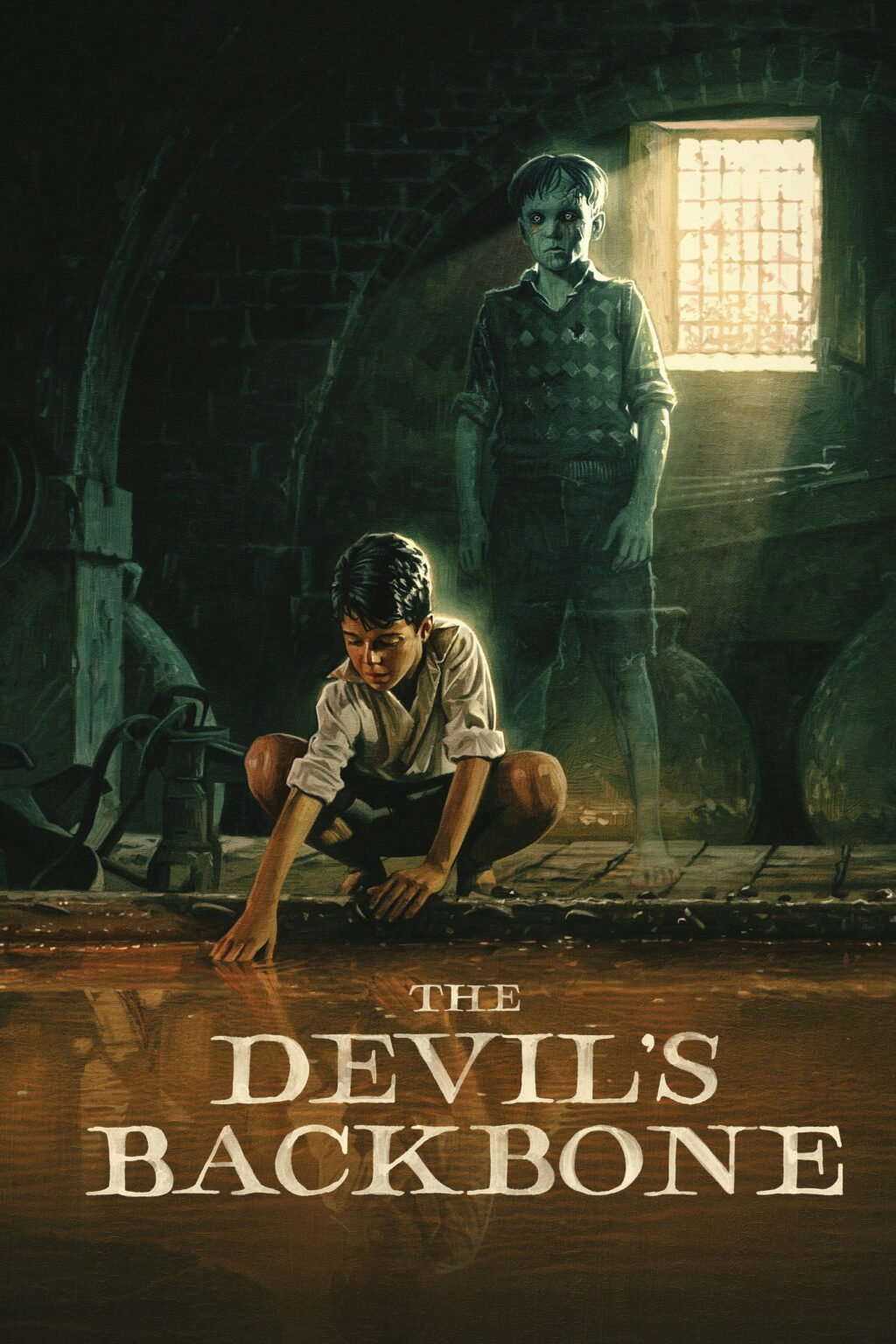
The Devil’s Backbone is a 2001 gothic ghost story by Guillermo del Toro, set in a remote orphanage during the Spanish Civil War.
At a Glance
| Release | April 20, 2001 (Spain) |
| Director | Guillermo del Toro |
| Writers | Guillermo del Toro, Antonio Trashorras and David Muñoz |
| Stars | Marisa Paredes, Eduardo Noriega, Federico Luppi, Fernando Tielve, Íñigo Garcés, Irene Visedo |
| Runtime | 108 minutes |
| Rating | R |
| Budget | About $4.5 million |
| Box office | About $6.5 million |
Overview
During the Spanish Civil War, a young boy named Carlos is left at a remote orphanage on the Spanish plain. He does not know that his father has been killed. The orphanage is run by Carmen, a widow, and her late husband’s friend Dr. Casares. Both support the Republican side and are hiding a cache of gold meant to back the Republican treasury. In the courtyard stands an unexploded bomb, dropped during an air raid and still lodged in the ground as a constant reminder of the war.
Carlos is soon tormented by the bully Jaime, but the two become friends after Carlos refuses to give him away to Casares. At night, Carlos hears whispers that “many of you will die,” and glimpses a pale boy with a bleeding crack in his head. The other boys call him Santi, a child who disappeared the night the bomb fell. The real danger, though, is the living: Jacinto, the groundskeeper and a former orphan of the house, who is having an affair with Carmen so he can find the gold.
Guillermo del Toro treats the ghost as a victim rather than a monster, and the film became the companion piece to his later Pan’s Labyrinth, which also sets a child’s encounter with the supernatural against the brutality of the Spanish Civil War and its aftermath.
Production
Del Toro wrote the first draft before his debut feature, Cronos (1993). That early version was set during the Mexican Revolution and was very different. The title first came from a mountain range in Mexico, and when the story moved to Spain it was reworked into the doctor’s jars of “limbo water,” rum preserving fetuses with spina bifida, which he sells as a supposed cure for impotence to fund the school. The film was produced by Agustín Almodóvar through El Deseo as a Spanish and Mexican co-production, and shot in and around Madrid, with orphanage scenes at Talamanca de Jarama. Guillermo Navarro was the cinematographer and Javier Navarrete composed the score. DDT Studios in Barcelona created Santi’s final look, with a cracked temple resembling aged porcelain.
Cast
- Fernando Tielve as Carlos
- Íñigo Garcés as Jaime
- Eduardo Noriega as Jacinto
- Marisa Paredes as Carmen
- Federico Luppi as Dr. Casares
- Irene Visedo as Conchita
Reception
Rotten Tomatoes lists 93 percent approval from 120 reviews, describing it as “both a potent ghost story and an intelligent political allegory,” and Metacritic’s score is 78 out of 100. Roger Ebert gave it three stars out of four and compared it favorably with The Others, released later the same year. A. O. Scott wrote in The New York Times that del Toro “balances dread with tenderness.” Cinefantastique’s Steve Biodrowski called it “quite probably… the saddest horror movie ever made.” Bloody Disgusting ranked it 18th among the top horror films of the decade. Its standing has only grown with time, and it is now widely regarded as one of del Toro’s finest films and a cornerstone of modern Spanish-language horror.
Spoiler: The Ending
When Casares learns a loyalist friend has been captured, he plans to evacuate the children. Jacinto confronts Carmen and is thrown out at gunpoint, but he returns and sets a fire, and the explosion kills Carmen, teacher Alma and several boys. Jaime finally tells Carlos the truth: Jacinto attacked Santi while trying to open the safe, fatally injured him and sank his body in the cistern. Jacinto later stabs Conchita, his fiancée, to death on the road. Casares dies of his wounds, but his ghost unlocks the door where the children have been imprisoned. Armed with sharpened sticks and broken glass, the boys attack Jacinto in the cellar and push him into the cistern. Weighed down by the stolen gold, he sinks, and Santi’s ghost drags him under. The surviving children walk away toward town while Casares’s ghost watches from the doorway.
Trivia & Facts
- Del Toro wrote the first draft before making Cronos (1993).
- The early version was set during the Mexican Revolution.
- It was produced by Agustín Almodóvar through the company El Deseo.
- Fernando Tielve originally auditioned as an extra and made his film debut as Carlos.
- Tielve and Íñigo Garcés later made cameos as guerrilla soldiers in Pan’s Labyrinth (2006).
- Bravo ranked the film’s ghost scenes at number 61 on its 100 Scariest Movie Moments.