
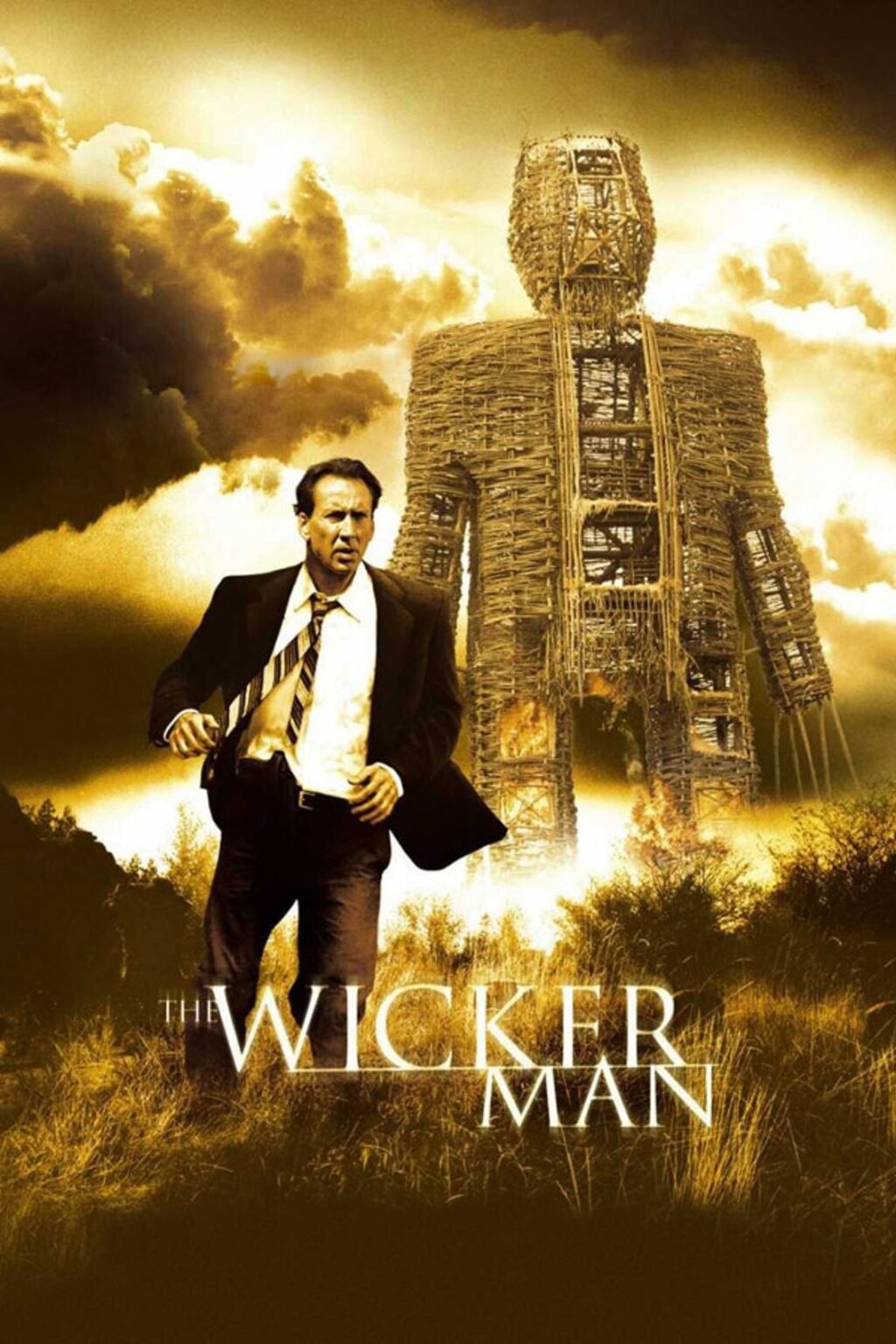
The Wicker Man (2006) is an American folk horror film written and directed by Neil LaBute, starring Nicolas Cage, and it is a remake of Robin Hardy’s 1973 British classic of the same name — a film routinely counted among the greatest horror movies ever made. This is the remake: the one with the bear suit, the bees and the forty-million-dollar bonfire. LaBute kept the skeleton of Anthony Shaffer’s original story — a police officer lured to a remote pagan island to search for a missing girl — and moved it from Scotland to an island off the Washington coast, flipping the original’s pagan patriarchy into a matriarchy ruled by women. What audiences got was a dead-serious thriller that detonated, scene by scene, into the most beloved unintentional comedy in horror history. To be clear about which film this page covers: the 1973 original is a masterpiece of slow-burn dread. This is the other one.
At a glance
| Release date | September 1, 2006 (US) |
| Director | Neil LaBute |
| Writers | Neil LaBute, based on Anthony Shaffer’s 1973 screenplay |
| Starring | Nicolas Cage, Ellen Burstyn, Kate Beahan, Frances Conroy, Molly Parker, Leelee Sobieski |
| Runtime | 102 minutes |
| Rating | PG-13 (US) |
| Budget | $40 million |
| Box office | $38.8 million worldwide |
| Studio | Saturn Films / Millennium Films, released by Warner Bros. Pictures |
Plot summary
Edward Malus (Nicolas Cage) is a California highway patrolman carrying the kind of guilt that doesn’t wash off: he was there for a roadside tragedy — a car, a truck, a little girl he couldn’t save — and it follows him into his sleep. Then a letter arrives from Willow Woodward (Kate Beahan), the fiancée he lost years ago. Her young daughter, Rowan, has vanished from Summersisle, a private island in Puget Sound that doesn’t court visitors. Willow is begging him to come and find her. So Malus does what haunted ex-cops do: he bribes his way onto a seaplane and goes.
The island is wrong from the first step. Summersisle is a neo-pagan matriarchy led by Sister Summersisle (Ellen Burstyn), who speaks for the goddess and answers questions with serene, smiling nothing. The men are near-silent labor. The economy is honey — it’s in the shops, on the altars, in the island’s whole theology — and the honey harvest is failing, which nobody wants to discuss. Malus asks about Rowan and gets a masterclass in evasion: two men carrying a large, dripping bag; a fresh grave in the churchyard containing nothing but a burned doll; Rowan’s sweater found nearby; a school register with the girl’s name crossed out. The teacher, Sister Rose (Molly Parker), lets slip that Rowan will burn to death — future tense — before correcting herself. And then Willow delivers the revelation the island has been holding: Rowan is Malus’s daughter too. The day of the great fertility festival arrives, and Malus, frantic, takes the only route left to him. He puts on a bear costume and joins the parade.
Spoiler section: the ending
The rescue is the trap. Malus finds Rowan tied to a tree, about to be burned, cuts her loose and runs — and the girl leads him straight back into the arms of Sister Summersisle and the whole smiling congregation. There was never a missing child to save. Willow is Sister Summersisle’s daughter, and the letter was bait: the island’s failing honey demanded a sacrifice, and Malus was chosen for the part — a man who would come of his own free will, tied to the island by blood, and, not incidentally, a man who had smashed the island’s beehives during his investigation. His legs are broken so he can’t run. He is hauled up into an enormous wicker man, and Rowan herself sets the fire. His last line, screamed as the flames take hold, is the whole tragedy in one sentence: “Killing me won’t bring back your goddamn honey!” In the theatrical cut, the film then jumps six months ahead: Willow and Sister Honey sit in a Seattle bar, chatting up two young policemen — one of them played, uncredited, by James Franco — and volunteering to go home with them. The harvest needs feeding again. The unrated cut tells it differently: before the burning, the islanders strap a wire helmet over Malus’s head and pour in live bees, playing on his allergy — the legendary “No! Not the bees! NOT THE BEES!” scene — and that version drops the bar epilogue entirely, ending on the wicker man’s burning head toppling into the fire.
Production and behind the scenes
Hollywood had been circling the remake for over a decade. Universal Pictures held plans for a new Wicker Man from the 1990s, and in March 2002 it was announced that Neil LaBute — a playwright-filmmaker with a reputation as a provocateur — would write and direct it, with Nicolas Cage starring and producing through his Saturn Films. At almost the same moment, Robin Hardy and Christopher Lee were preparing their own follow-up to the 1973 film; Hardy’s project eventually became The Wicker Tree (2011), and the remake rights drifted from Universal to Millennium Films. LaBute’s boldest change was structural: he inverted the original’s world, making Summersisle a matriarchy where women hold every scrap of power and men are kept voiceless — a gender-flip meant to put Malus’s macho bluster on trial.
The film was shot in the summer of 2005 in British Columbia, largely on Bowen Island, standing in for the misty Pacific Northwest, with additional filming on the mainland in Merritt. The budget was $40 million — an enormous sum for a remake of a film that was made for a fraction of it and built on patience rather than spectacle. Angelo Badalamenti, David Lynch’s composer, wrote the score, one of the few elements of the finished film that nobody has ever made fun of. The cinematography was by Paul Sarossy. And above everything hung the shadow of 1973: Hardy publicly distanced himself from the production, had his name removed from the remake’s promotional material, and went off to make his own spiritual sequel. Christopher Lee, the original’s Lord Summerisle, was blunter: “I don’t believe in remakes.”
Release and reception
The Wicker Man opened in US theaters on September 1, 2006, released by Warner Bros. Pictures. It opened in third place with $9.6 million and closed with $38.8 million worldwide — less than its $40 million production budget, before a dollar of marketing was counted. A certified box office bomb. Critics were merciless: it holds a 15% score on Rotten Tomatoes, whose consensus calls it “puzzlingly misguided” and struggling “against unintentional comedy,” a 36 on Metacritic, and paying audiences gave it a CinemaScore of F — a grade the service almost never hands out. The Golden Raspberry Awards nominated it five times: Worst Picture, Worst Actor for Cage, Worst Screenplay for LaBute, Worst Remake, and Worst Screen Couple, for Cage and his bear suit. It lost all five. Think Horror’s review of The Wicker Man (2006) scored it 1.5 out of 5 skulls — “NOT THE SKULLS!” — calling it a spectacular failure that is never, ever boring, and essential viewing for exactly the reasons its makers never intended.
The unrated cut arrived on DVD on December 19, 2006, restoring the bee-torture scene that would go on to outlive the film itself. As of October 2026, the film streams free with ads on YouTube Free in the US, and is available to rent or buy on Amazon Video, Apple TV and Fandango at Home — ideally, per long Think Horror tradition, with friends in the room and the famous lines practiced in advance.
Legacy and influence
No remake has ever failed more successfully. Within a few years of release, the film’s most volcanic moments — “How’d it get burned?!” “Step away from the bike!,” a full-body bear suit used to punch a woman in the face, and above all “Not the bees!” — had escaped the movie entirely and become internet folklore, quoted by millions of people who have never seen the film they come from. The Alamo Drafthouse runs quote-along screenings; audiences recite it the way other audiences recite The Rocky Horror Picture Show. Cage himself came around to the joke: in 2010 he admitted the film was “absurd,” allowing that “a mischievous mind” may have been at work all along, and in 2012 he cheerfully pitched a sequel in which Malus returns in Japan — as a ghost. The remake also stands as the permanent cautionary tale of its genre: a beloved, singular classic, remade at forty times the cost, with an Oscar winner in the lead, by a talented director playing it completely straight — and every single choice landing wrong in the most entertaining way possible. The 1973 film is the one in the history books. The 2006 film is the one at the party. Both, in their way, are immortal.
Trivia
- The most famous scene isn’t in the movie: the “Not the bees!” bee-torture sequence was cut from the theatrical release entirely. It exists only in the unrated cut, restored for DVD in December 2006 — which means no theater audience ever heard the scream that built the legend.
- Two endings for the price of one: the theatrical cut closes with a “six months later” epilogue — Willow and Sister Honey picking up two young cops in a Seattle bar, one played by an uncredited James Franco. The unrated cut removes the epilogue and ends on the wicker man’s burning head instead.
- Five Razzies, zero wins: the film was nominated for Worst Picture, Worst Actor, Worst Screenplay, Worst Remake and Worst Screen Couple — and still lost them all, mostly to Basic Instinct 2 and Little Man. Even the Razzies found worse.
- The worst screen couple in the world (almost): the Razzie nomination for Worst Screen Couple went to Nicolas Cage — paired, officially, with his bear suit.
- The grade audiences almost never give: opening-night crowds handed the film a CinemaScore of F, one of the rarest grades in the service’s history.
- The original director took his name off it: Robin Hardy had his lawyers make Warner Bros. remove his name from the remake’s promotional material, then directed his own spiritual sequel, The Wicker Tree, in 2011.
- A dedication, of all things: the film is dedicated to Cage’s friend Johnny Ramone, the Ramones guitarist who died in 2004. Cage has said Ramone was the one who introduced him to the 1973 original.
- The one trophy on the shelf: cinematographer Paul Sarossy won Best Cinematography from the Canadian Society of Cinematographers for this film — proof that even a legendary disaster can be beautifully shot.
Related links
- The Wicker Man (2006) review — Think Horror’s full review (1.5 out of 5 skulls)
- Ellen Burstyn — Sister Summersisle herself, a legend who deserved a better script than this one
- Christopher Lee — the original Lord Summerisle, who wanted nothing to do with the remake
- Midsommar — folk horror done right: the sunlit pagan nightmare LaBute’s film was reaching for
- The Witch — slow-burn pagan dread that understands the scariest rituals are the ones that feel real
- Mandy — the good Cage freakout, where every wild choice actually serves the movie