To the Devil a Daughter
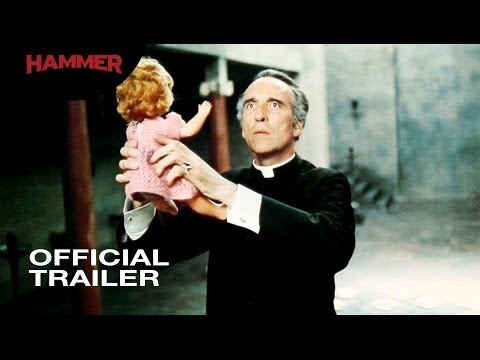
To the Devil a Daughter (1976) is Hammer’s last horror film of the classic era, Christopher Lee’s Satanist priest claiming a girl for Astaroth. Get the billing the right way round before anything else, because this is the picture that turns the studio’s own furniture upside down. For two decades Lee was the monster other men hunted. Here he is still the monster — an excommunicated Catholic priest running a Satanic order out of Bavaria — but the man hunting him is no Van Helsing. He is John Verney, an American occult novelist played by Richard Widmark, a writer who knows the black-magic world from his books and gets dragged into the real one at London Airport. Lee is the villain. Widmark is the hero. Everything else about this strange, troubled, fascinating film follows from that reversal.
Scope the famous claim properly, too, because it is usually printed wrong. This was Hammer‘s last horror film of the classic era — the studio’s final feature of that run was actually a thriller, The Lady Vanishes, three years later — and it was the last Hammer production to feature Christopher Lee until The Resident in 2011. It was also the second time Hammer filmed one of Dennis Wheatley’s “black magic” novels, after The Devil Rides Out in 1968. Thanks to what Wheatley thought of the result, it was also the last. This is not a fond farewell to the Gothic years. It is Hammer in 1976, contemporary, location-shot and chasing the post-Exorcist devil cycle — and if its reach exceeds its grasp, what it reaches for is still worth your evening.
The priest, the writer and the girl
Father Michael Rayner was once a Catholic priest; the Church excommunicated him for heresy. Twenty years on he leads the Children of the Lord, a religious order on a small island in Bavaria that is, in truth, a Satanic cult serving the demon Astaroth. Catherine Beddows was raised inside that order at her late mother’s urging. Days before her eighteenth birthday she is released from its convent — and her father Henry, a devoted, terrified member of the order who wants her out, begs Verney to collect her at Heathrow and keep her safe. Verney, in London for a book launch, intercepts her from her escort and installs her at his home. Henry, trying to reach her, shoots the escort dead.
Be precise about the machinery, because garbled versions of this plot travel. Catherine is not a demon child, and nobody swaps any babies. She is Henry Beddows’ daughter, promised to the order by her upbringing. The demon child is a separate birth: Margaret, a member of the order, is impregnated in the cult’s sex-magic rituals and bears a demonic infant, and Rayner has her killed once she has delivered. What the order intends for Catherine is worse than a haunting — on her eighteenth birthday, which falls on Halloween, Rayner means to sacrifice that demon child and baptize Catherine in its blood, making her the avatar of Astaroth on Earth.
From the bishop who excommunicated Rayner, Verney learns exactly what is planned. The cult’s magic reaches into his own house: Catherine, under Rayner’s influence, murders Verney’s literary agent and friend Anna Fountain. Verney and Anna’s partner David hunt down the metal pact Henry signed with Rayner, hidden at a church altar — and David, touching the pact’s pendant, bursts into flames. In the yard of an abandoned mausoleum, Rayner lays Catherine on an altar inside a circle of human blood and sacrifices the demon child. Verney clubs Rayner’s henchman George de Grass down with a rock, refuses the temptation Rayner offers him, and turns that same rock — covered in George’s blood — into the talisman that breaks the circle’s protection. He hurls it at Rayner, who vanishes into nothingness. But several drops of the demon child’s blood reached Catherine first. She was partially baptized. The film carries her out of that yard and pointedly refuses to tell you what she is now.
The cast, billed correctly
Richard Widmark was 61 when the film opened in Britain, and he plays Verney as a man whose expertise is entirely second-hand until it suddenly is not — a famous writer on the occult, asked for help because of what he writes, not because he is any kind of detective or hired investigator. Christopher Lee, 53 at the release, gets the other half of the bargain: Rayner is played with a stillness the Dracula years rarely asked of him, a true believer whose evil is administrative. This is the man who had been Hammer’s Dracula since 1958, and the studio would not see him again for thirty-five years.
Honor Blackman plays Anna Fountain, Verney’s literary agent — his friend, and the cult’s most personal strike against him. Denholm Elliott plays Henry Beddows, Catherine’s weak, pact-bound father, not any kind of doctor or sceptic: a man who signed, repented, and set the plot moving by asking a novelist to do a rescuer’s job. Michael Goodliffe plays George de Grass, Rayner’s henchman — the man Verney brings down with the rock in the climax. It was Goodliffe’s last film.
And Nastassja Kinski plays Catherine. The facts here deserve to be stated plainly and without colour. Kinski was born on 24 January 1961; production began in September 1975, which means she was fourteen when filming began, and fifteen by the UK release. In the story, Catherine is days short of eighteen. The film includes a nude scene played by her; she later said she regretted it, and in a 1997 account spoke of feeling unprotected on the set. That is the record, and this page leaves it there.
The film Lee pushed for
Of all people, this film exists because Christopher Lee wanted it. Lee championed Wheatley’s novel as a feature and pressed Hammer to make it — no small irony, given where it ended. The financing took years to assemble: EMI’s Nat Cohen agreed to put up half the budget after a March 1974 preview of The Exorcist showed him where the market was heading, the West German Terra Filmkunst provided the other half, and the picture sat in Cohen’s July 1975 £6 million EMI programme. Peter Sykes was hired to direct after several bigger names had turned it down. Principal photography finally began in September 1975, having originally been scheduled for June 1974.
Where it was shot is a genuine disagreement in the record, so here it is carried as one. One account, following BFI Screenonline, stresses that the film was shot entirely on location — Bavaria and London, Heathrow and St Katharine Docks among the real places used — a deliberate break from studio-bound Hammer. Another account puts stages at EMI’s Elstree Studios into the schedule alongside the locations. What both agree on is the climax: the Dashwood Mausoleum and the Hellfire Caves at West Wycombe, standing in for a rite the production had first hoped to stage in the crypt of St Martin-in-the-Fields.
It was not a happy shoot, by the accounts of the men who ran it. Sykes recalled that Widmark repeatedly threatened to walk back to the United States, clashed with cast and crew, and called Hammer “Mickey Mouse Productions.” Wicking, looking back, called the finished film “an awful mess. There was no real focus to it,” and said EMI had vetoed his wish to build DNA into the story as too science-fictional. The ending drew the sharpest verdict of all, and it came from inside the house: Michael Carreras judged that the film “simply didn’t work… the people who made it forgot about the ending” — and when he asked Cohen for the money to shoot a new one, Cohen refused.
Wheatley’s ban
Dennis Wheatley had given Hammer one of its defining films in The Devil Rides Out. This time the transaction ended the relationship. The screenplay deviated notably from his 1953 novel, and Wheatley disliked the finished film, found it obscene, and told Hammer they were never to make another film from his novels. Hammer never did. Hold the two complaints apart, because history keeps gluing them together: Wheatley’s documented objection was to what the adaptation did to his book; the famous complaint about the ending belongs to Carreras, above. The second Hammer Wheatley was therefore also the last — a door the author himself closed.
The money argument
Ask how this film did and you start a fight this page will not settle for you. One widely read account calls it one of Hammer’s most profitable films of the 1970s, a financial success. Against that stand several others recording the opposite: that it was not a great success, that it did poor business, that it was a financial and creative disappointment, filed among the Cohen-slate pictures that were not particularly successful. No verified gross figure exists in any of it, so this page prints none. What is solid is the cost: £360,000, the figure in the Hammer histories, reached after Cohen required the original £430,000 budget to be cut down. Even the running time refuses to sit still — listings give everything from 92 to 95 minutes. A film this argued over in its own paperwork was never going to get a tidy legend.
What the critics made of it
The first notices were mostly rough, with one honourable exception. Variety found a “lacklustre occult melodrama” that “seems padded and tentative,” its shock value “remarkably subdued.” Gary Arnold in The Washington Post thought it scripted, directed and edited “with extreme haste and negligence.” Roger Ebert gave it one star, calling it “the most over-directed exploitation movie I’ve seen in a long time.” Linda Gross in the Los Angeles Times found the story a “confusing vacillation” but the film “distinguished by engrossing performances,” with “superior photography” and “eerie music.” Time Out judged it “a good deal more interesting than the rest of the possession cycle, but still a disappointment.”
The dissent in the film’s favour came from Tony Rayns in The Monthly Film Bulletin, who praised its “expert special effects” and “no-nonsense script” and Lee playing “with a gusto absent from his performances for many years.” Later guides kept the split. Leonard Maltin’s gave it two and a half stars — “well made but lacks punch.” BFI Screenonline’s retrospective conceded that the film jettisons much of the novel yet thought it “feels like a ‘classic’ Hammer horror film,” and noted that its gory childbirth scene foreshadowed the chestburster from Alien. On Rotten Tomatoes the film stands at 45% from 11 reviews, as live-checked on 25 October 2026 — a small, divided jury for a small, divided film.
The last word of the classic era
Hammer’s Dracula line had already sung its swan songs in The Satanic Rites of Dracula and The Legend of the 7 Golden Vampires; this was the other door closing. After it, one thriller, then silence, then a revival a generation later that eventually brought even Lee home. The film’s own afterlife has been louder than its release: Lee’s defiance — “It is not heresy… and I will not recant!” — was sampled by White Zombie in “Super-Charger Heaven,” and the title turns up again in “Black Sunshine.” Anchor Bay’s DVD carried it to North America in 2002; Scream Factory’s Blu-ray followed in December 2019.
Endings matter, and this one has two. On screen, a girl carried out of a mausoleum yard, partially baptized in a demon’s blood, her state left deliberately unresolved — a studio famous for tidy Gothic closures going out on a question mark. Off screen, the last horror film of Hammer’s classic era: flawed, fought over by nearly everyone who made it, banned by its own author from ever having a sequel in kind — and anchored by the spectacle of Christopher Lee, in his final Hammer performance for thirty-five years, playing the devil’s priest with absolute conviction. It is not heresy. He did not recant. Neither, in the end, did the film.