
The Mummy (1959) is Hammer’s first mummy film, directed by Terence Fisher, with Christopher Lee as Kharis and Peter Cushing as John Banning.
The best performance in The Mummy is given almost entirely through two eyeholes. Christopher Lee spends most of the film wrapped head to foot, with no lines to speak, and plays a three-thousand-year-old priest’s broken heart with nothing but his eyes and the way he walks. Hammer had already given the world a new Frankenstein and a new Dracula. Here it took the shambling bandaged monster of Universal’s B-movie sequels and made him tragic.
Three things to settle first. Kharis is not Imhotep: Boris Karloff’s mummy in The Mummy (1932) is a different character in a different story. Despite the title, this film borrows far more from Universal’s 1940s sequels than from the 1932 original. And it has nothing to do with the 2026 film of the same name, which has its own page.
Quick Specs
- Directed by: Terence Fisher
- Screenplay by: Jimmy Sangster
- Produced by: Michael Carreras and Anthony Nelson Keys
- Production company: Hammer Film Productions
- Starring: Peter Cushing, Christopher Lee, Yvonne Furneaux, Eddie Byrne
- Cinematography: Jack Asher, in Technicolor
- Music: Franz Reizenstein
- Makeup: Roy Ashton
- Released: September 25, 1959 (United Kingdom); December 16, 1959 (United States)
- Runtime: 88 minutes
- Budget: 100,000–125,000 pounds
- Country: United Kingdom
The Cast
Peter Cushing, top-billed, plays John Banning, an archaeologist who misses the great discovery of his career because he is laid up in camp with a broken leg. It is a very Cushing part: a man of reason, a scholar, who has to accept that the legend he studies is walking across his lawn. Christopher Lee plays Kharis, the high priest of Karnak, both as the living man in the film’s long Egyptian flashback and as the mummy he becomes.
Yvonne Furneaux plays two roles: Isobel, John’s wife, and Princess Ananka, the woman Kharis died for. Eddie Byrne is Inspector Mulrooney, the local policeman who does not believe a word of it. Felix Aylmer plays John’s father, Stephen Banning, and Raymond Huntley his uncle, Joseph Whemple. George Pastell is Mehemet Bey, the worshipper of Karnak who brings Kharis to England, and Hammer regular Michael Ripper turns up as a poacher.
The Plot
Egypt, 1895. Stephen Banning and Joseph Whemple are about to open the tomb of Princess Ananka, high priestess of the god Karnak. John, with his broken leg, has to stay behind. Before they go in, an Egyptian named Mehemet Bey warns them that anyone who violates the tomb will be cursed. They go in anyway. Joseph leaves to tell John the news, and Stephen, alone with the sarcophagus, finds the Scroll of Life and reads it aloud. His screams bring the others running. They find him catatonic.
Three years later, in England, Stephen comes out of it at a nursing home and tells his son what happened in the tomb. Reading the scroll woke Kharis. Long ago, the story goes, Kharis loved Ananka in secret, and when she died he tried to use the scroll to bring her back. For that he was sentenced to be entombed alive as the eternal guardian of her tomb. Now he is awake, and he will kill everyone who broke into it.
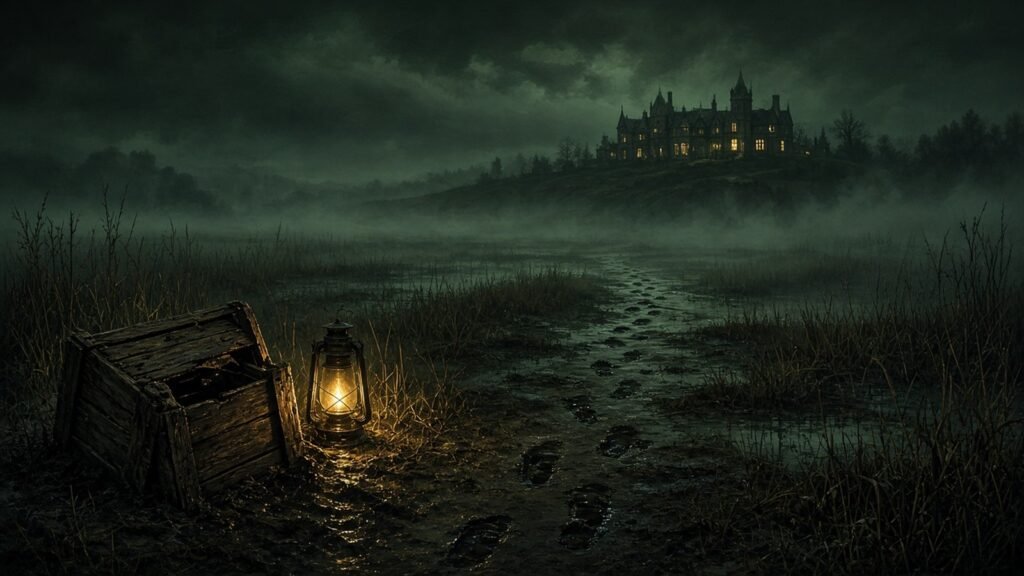
Mehemet has come to England too, with Kharis in a crate. On the way to his rented house, the men he hired to move it lose the crate, and it sinks into a bog. It does not matter. Mehemet reads from the scroll, and the mummy rises out of the mud. He sends Kharis first to kill Stephen, then Joseph.
Inspector Mulrooney takes the case and wants nothing to do with John’s talk of a living mummy. Meanwhile John notices something stranger: his wife Isobel looks uncannily like the princess in the old pictures of Ananka.
When Kharis comes for John, the last of the three, it is that resemblance that saves him. At the sight of Isobel, the mummy lets go. Mehemet orders it to kill her instead. Kharis refuses, and when Mehemet tries to do it himself, Kharis kills him.
The mummy carries the unconscious Isobel into the swamp, with John, Mulrooney and the police behind. She comes to and tells Kharis to put her down, and he obeys. Once she is clear, the police open fire, and Kharis sinks into the bog, taking the Scroll of Life down with him. Isobel survives. Kharis is not shot dead. He goes back into the mud he came out of, and this time he takes the means of waking him along.
Not Quite a Remake
The Mummy exists because of a deal. After The Curse of Frankenstein (1957) and Dracula (1958) were hits, Universal signed an agreement with Hammer in 1958 that gave the British studio remake rights to its classic monsters, and The Mummy was the first film made under it. The Phantom of the Opera followed in 1962. A Hammer version of The Invisible Man was planned and never made.
Remake is the official word, but it is the wrong one. The character name Joseph Whemple and a scroll that can wake the dead are about all that comes from Karl Freund’s 1932 film with Boris Karloff. The rest, from the mummy named Kharis to the princess Ananka, comes from Universal’s 1940s cycle: The Mummy’s Hand (1940), The Mummy’s Tomb (1942) and The Mummy’s Ghost (1944). Even the swamp finale has a Universal ancestor, with one change: this time the woman survives.
Sangster, asked about it decades later, could not remember watching the Universal films. “I must, at some point, have been shown these earlier Universal films,” he said. “How else could one explain the same character names and plot elements? But I honestly don’t recall doing so.”
What Hammer changed was the monster. In the 1940s films Kharis is a slow, one-eyed thing in a rubber mask. Lee’s Kharis is fast, strong and, above all, sad. Roy Ashton’s makeup leaves the actor his eyes and little else, and Lee uses them to play a man who has been punished for love for three thousand years and is still being used by someone else. He speaks only in the flashback, as the living priest. As the mummy he is silent.
Making It
The Mummy was Hammer’s third film pairing Cushing and Lee, after The Curse of Frankenstein and Dracula, and it brought back the team behind both: Fisher directing, Sangster writing, Jack Asher shooting in Technicolor and Bernard Robinson designing. Michael Carreras and Anthony Nelson Keys produced. The budget was small even by Hammer’s standards; accounts put it at 125,000 pounds or 100,000 pounds.
Fisher made a point of keeping the nastiest moments off screen. “I have always strenuously tried to avoid being blatant in my pictures,” he told the trade press. “Instead, whenever possible, I have used the camera to show things – especially nasty things – happening by implication.” It suits a film that is, in the end, more mournful than gory.
Release and Reception
The Mummy opened in Britain on September 25, 1959, and in the United States on December 16, 1959. One history of the film calls it “prodigiously successful in Britain and abroad,” and “one of the most crisply crafted and memorable shockers to emerge from Hammer’s heyday.”
Its reputation has held. One review called it the most interesting of the films Hammer made under the Universal deal and “a handsome, polished production with, for the time, some real scares,” and singled out Lee’s Kharis as “breathtakingly transformed.” Rotten Tomatoes lists the film at 93 percent from 15 reviews.
What Came After
The Mummy launched Hammer’s mummy cycle, but not a series in the Dracula sense. The three later films, The Curse of the Mummy’s Tomb (1964), The Mummy’s Shroud (1967) and Blood from the Mummy’s Tomb (1971), share no story with this one or with each other. Christopher Lee never played a mummy for Hammer again; Dickie Owen played the mummy in the 1964 film. Peter Cushing is not in any of the finished sequels. George Pastell came back in The Curse of the Mummy’s Tomb in a different role. Blood from the Mummy’s Tomb had the hardest road of the four: its director, Seth Holt, died during production, and Michael Carreras finished it.
None of them matched the first. The Mummy is the one where Hammer looked at a monster that had been reduced to a shuffling punchline and found the love story inside it. Next to The Curse of Frankenstein and Dracula, it is the quiet third piece of Hammer’s great early run, and the one that ends not with a stake or a fire but with a creature letting go of the woman it loves and sinking out of sight. For the rest of Hammer’s story, see the Hammer Films page; for the Universal originals, Universal Monsters.