
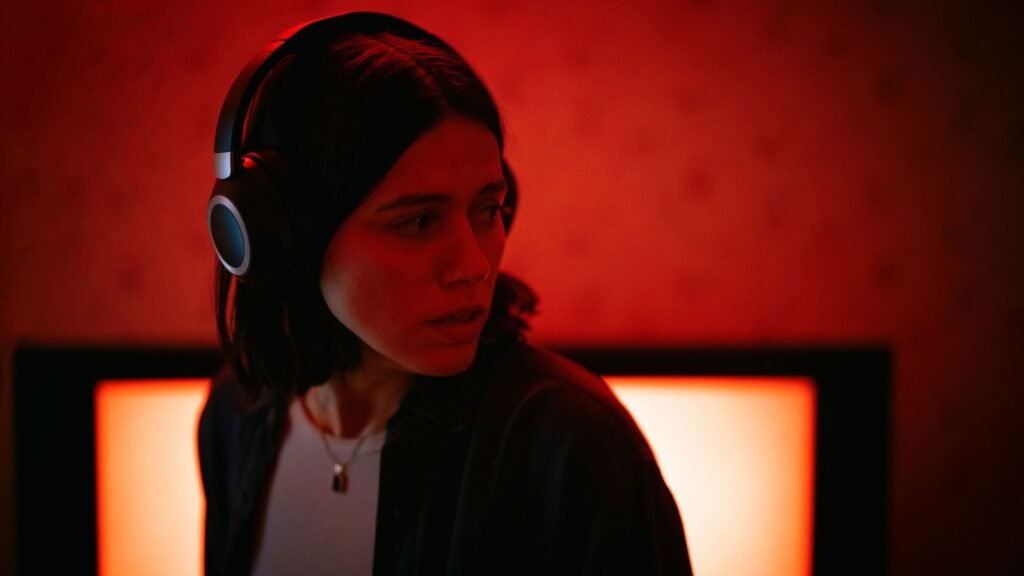
Put the headphones on. No — really, that is not a figure of speech with this one. This is a film that happens almost entirely between your ears: ten anonymous audio files, a woman alone in a house with her dying mother, and sounds that were never meant to be listened to twice. Most horror asks you to watch. This one asks you to lean in closer, turn it up, and keep listening long after every instinct says stop.
Undertone (2026) is Ian Tuason’s feature debut — a Canadian sonic horror film where a podcast host’s ten anonymous recordings start answering back. A24 styles the title all lower case, undertone, and the smallness is the point: this is a half-million-dollar, one-house, one-woman chamber piece that a bidding war turned into one of 2026’s unlikeliest box-office stories. Harper has already reviewed it on this site — Harper’s review carries the verdict.
Quick Specs
- Director: Ian Tuason
- Screenplay: Ian Tuason
- Producers: Dan Slater, Cody Calahan
- Starring: Nina Kiri, Adam DiMarco (voice), Michèle Duquet, Keana Lyn Bastidas (voice), Jeff Yung (voice)
- Cinematography: Graham Beasley
- Editor: Sonny Atkins
- Music: Shanika Lewis-Waddell
- Production design: Mercedes Coyle
- Production companies: Black Fawn Films, Slaterverse Pictures, KINO Studios
- Distributor: A24 (worldwide rights, acquired August 2025)
- World premiere: 27 July 2025, Fantasia International Film Festival
- US release: 13 March 2026
- Running time: 94 minutes
- Certificate: R — for language
- Country / language: Canada / English
- Budget: $500,000
Ten files, one house
Evangeline “Evy” Babic is a full-time carer and a part-time debunker. She lives alone with her mother — comatose, unresponsive, dying by slow degrees in an upstairs room — and co-hosts a paranormal podcast called The Undertone with her friend Justin. The act is a double act: Justin believes, Evy dismantles. Then Justin receives an anonymous email — a random string of letters and ten audio files — and the two of them do what podcasters do. They press play, on air, one file at a time.
The recordings belong to a couple, Mike and Jessa. Mike has been taping the pregnant Jessa’s sleep-talking, hoping to catch evidence of something in their house. In the first file she sings “London Bridge” in her sleep; played backwards, Justin hears “Mike, kill all.” Evy, digging into hidden messages in children’s songs, finds her own childhood favourite, “Baa, Baa, Black Sheep,” reversing into something she cannot unhear either. More files bring more reversed speech, and one phrase surfaces clearly enough to be named: “come in, Abyzou.” In the film’s folklore, Abyzou is a demon of Mediterranean and European tradition — herself infertile, said to cause miscarriages and to drive mothers to kill their own children out of envy. The mythology is the film’s own mixture, part tradition and part invention.
Here is the hinge the whole film swings on: Evy discovers she is six weeks pregnant. She tells her unresponsive mother. She confesses she feels unfit to be a mother, and she books an appointment at a women’s clinic. Understand what Tuason has built — the demon in the recordings hunts mothers and children, the woman in the recordings is pregnant, and the woman listening is pregnant, caring for a mother who cannot answer her, in a house that has started answering instead. Around Evy, the phenomena step out of the headphones: her still-unconscious mother moves on her own; the lights flicker; a Virgin Mary statue she shut away in a closet turns up somewhere else in the house.
The final movement belongs to the callers. In the last recording, Jessa insists she has to “warn” someone who is “listening” — and she seems to mean Evy. Justin’s reply to the anonymous sender bounces back undeliverable. Then the phones open up: a neighbour reports Mike and Jessa found dead at home, plastic bags over their heads, crayon drawings of babies covering their walls — and Jessa’s autopsy showed she had been pregnant. Another caller demands to speak to “Mary,” the name Evy once said she would give a child of her own. Another warns they should never have named Abyzou, never have listened to all ten. A last caller, Abby, begs for help calming her crying baby — and what happens on that call happens live, with Evy and Justin pleading down the line.
What follows for Evy herself, the film doesn’t settle: Tuason has said the ending is deliberately ambiguous. She confesses that her mother has died and that she blames herself for refusing to pray for her; she runs upstairs to walls covered in crayon drawings; she finds her mother standing in the bathroom. The rest is the film’s to show you.
Two faces, and a house full of voices
The film’s strangest and most important fact: only two characters are ever seen on screen — Evy, and her mother, Mama, bedridden throughout. And of those two, only Evy ever speaks on screen. Her mother never speaks on camera; she is comatose for the whole film. Everyone else — Justin, Jessa, Mike, every caller — exists purely as a voice. Any account that tells you Nina Kiri is the only person in this film is erasing the woman in the bed, and the erasure matters: the mother is the film’s silent centre.
Nina Kiri is Evy, and the film is hers in a way few films belong to anyone: the skeptic’s armour, the carer’s exhaustion, the dawning understanding that the story she is narrating for content is narrating her back. Michèle Duquet is Mama — credited simply as “Mama” — present in nearly every sense except speech, a performance made of stillness. Keana Lyn Bastidas voices Jessa, whose sleep-talking fills the recordings, and Jeff Yung voices Mike, the husband who recorded her. Sarah Beaudin voices Abby, the final caller, and Brian Quintero voices Dr. Ram.
Justin’s voice carries a genuine credit conflict. In the film as released, Justin Morales is voiced by Adam DiMarco — the credit in the 2026 Sundance Film Festival programme, which screened the release cut, and the name release-era reviews carry. But every Fantasia-era source — the production announcement, reviews written off the July 2025 premiere screenings, and several database cast tables still in their current listings — credits Kris Holden-Ried as Justin. No source states what happened between the two records. DiMarco is credited on the film you can watch today; Holden-Ried’s festival credit remains an open question.
Born in a childhood home
The film began as a radio play — Tuason dates the first version to 2018 — and you can feel that origin in every scene: a story built to be heard first and seen second. What reshaped it was his own life. In the early 2020s both of Tuason’s parents were diagnosed with terminal cancer, and he cared for them through it; his mother died first, his father about two years later. “This film was born from the grief and love I carried for my mom in her final days,” Tuason said at the production’s announcement, and the closing credits carry his written tribute to them both.
He shot it, in February 2025, in Rexdale, a neighbourhood of Toronto — in his own childhood home, the house where he had cared for his parents. Production designer Mercedes Coyle transformed the space, and the method inside it was subtraction. Tuason has taken The Babadook as a model for what negative space can do, and his own account of the approach is the film in miniature: “I’m relying entirely on the audience to make that up in their own head… I just saw a jacket hanging on an old rack, and I said, ‘That’s enough. I won’t do anything. I’ll just hang a jacket on a chair.'” The horror is withheld on purpose, left in the corners of the frame and the bottom of the mix, where your imagination does the unpaid overtime. Tuason arrived as an established science-fiction author who had directed VR and point-of-view horror shorts; this is unanimously his feature debut.
One credit note: listings disagree on the full company roster. The announcement and the financing tables agree on the three-way collaboration printed in the specs above.
Fantasia to Friday the 13th
The film world-premiered at the Fantasia International Film Festival on 27 July 2025 — a homecoming of sorts, since Tuason was born in Montreal, the festival’s city — and left with the Gold Audience Award for Best Canadian Feature. What happened next made the trades pay attention: in August 2025, A24 acquired worldwide distribution rights after a competitive bidding war, with six buyers in the mix and the price reported as mid-seven figures. No more precise figure has been published.
In January 2026 it screened in Sundance’s Midnight section as its U.S. Premiere — a premiere of geography only; Fantasia had shown it to the world five months earlier. A24 opened it wide in the United States on Friday, 13 March 2026 — yes, a Friday the 13th, and no, that cannot have hurt — in 2,570 theatres, with VVS Films handling Canada. The rollout continued through the spring: Australia and New Zealand on 9 April 2026 through Rialto Distribution, the UK and Ireland on 10 April through Vertigo Releasing. Premium VOD followed on 14 April 2026, and on 26 June 2026 the film arrived on HBO Max, where it hit number one on the US chart within days.
What the critics made of it
The reception split cleanly in two, and the split is the story. Critics, in aggregate, admired it: Rotten Tomatoes stands at 74% across 196 reviews, with a consensus praising a film “masterfully using negative space and unsettling audio to build its creeping dread” before it “erupts as a diabolically immersive aural nightmare.” Metacritic gives it 64 out of 100 from 32 critics — generally favourable, twenty positive, twelve mixed, none negative. Audiences walking out of opening weekend were colder: a CinemaScore of C and a PostTrak “definitely recommend” of just 41%. Critics heard a craft object; general audiences, by those measures, heard something slower and stranger than the marketing promised.
The praise, where it landed, landed on the sound and the space. Brian Tallerico gave it three and a half stars out of four for its “expert use of space” and “simply incredible sound design.” John Nugent, awarding four stars out of five, called it “a deeply unsettling sensory experience” whose “form and function feel fresh, fluent and flippin’ frightening.” Tara Brady praised the sound team and Kiri’s “layered performance,” while finding the coda veering toward weaker, later Paranormal Activity territory. Katie Rife called it “the perfect horror film for our era.”
Benjamin Lee gave it two stars out of five and heard “enough sighs of familiarity to give horror fans a scary case of deja vu,” name-checking a half-dozen ancestors from Paranormal Activity to The Exorcist. Richard Lawson concluded that the film “makes one yearn for an official moratorium on its many reappropriated tropes.” Siddhant Adlakha, in the middle, judged that Tuason “proves himself a deft enough tonal tinkerer at times, marking a notable arrival in the world of independent tech horror.” A24, for its part, sold the film with a campaign line — “the scariest movie you’ll ever hear”.
The box office
The budget was $500,000, as reported. The opening was the shock: about $9.3 million across the first weekend including $1.05 million in Thursday previews (the Friday-to-Sunday figure alone, $9,069,849, is the other number you will see quoted; the difference is the previews, not a disagreement). The domestic run closed at $20,001,151 in the US and Canada — $20.0 million; the worldwide total is sometimes misreported as the domestic one. It isn’t.
Worldwide, the film took about $21.6 million ($21,555,603), built from that $20.0 million domestic and an international total reported as both $1,554,452 and $1,536,016. One widely repeated headline form, “$22 million,” is a rounding-up of the same worldwide total, not a separate figure. That worldwide gross is 43 times the reported budget. No profit figure exists, because the budget is as-reported, the grosses are theatrical only, and nobody has published the marketing spend. What can be said plainly is enough — a one-house debut, made for the price of a house, outgrossed most of the studio horror released around it.
Where it stands
So where does that leave her — Evy, and the film around her? undertone stands as the year’s defining example of a particular modern path: festival discovery, a bidding war, a major indie distributor, a Friday-the-13th wide release and a second life at the top of a streaming chart, all for a film in which two people appear on screen and one of them never says a word. It sits naturally beside this site’s pages on Paranormal Activity, the found-footage ancestor its sound-first method reinvents, on The Babadook, whose negative space Tuason studied, and on Hereditary, the A24 stablemate the dissenters kept reaching for.
Two futures are on the record. Tuason has stated a plan for a trilogy — “the next one is the story of Mike and Jessa,” he has said. “I am talking to A24 about it. It looks like it’s going to happen.” That is a director’s stated intention; no sequel has been announced, titled or dated. And trade reports across December 2025 and January 2026 named Tuason as the director of the next Paranormal Activity film — a remarkable sentence to write about a man whose feature debut cost half a million dollars and was shot in his parents’ house. The recordings, meanwhile, are still out there in the film’s world. Press play at your own risk. Evy would tell you not to. Evy also pressed play.