
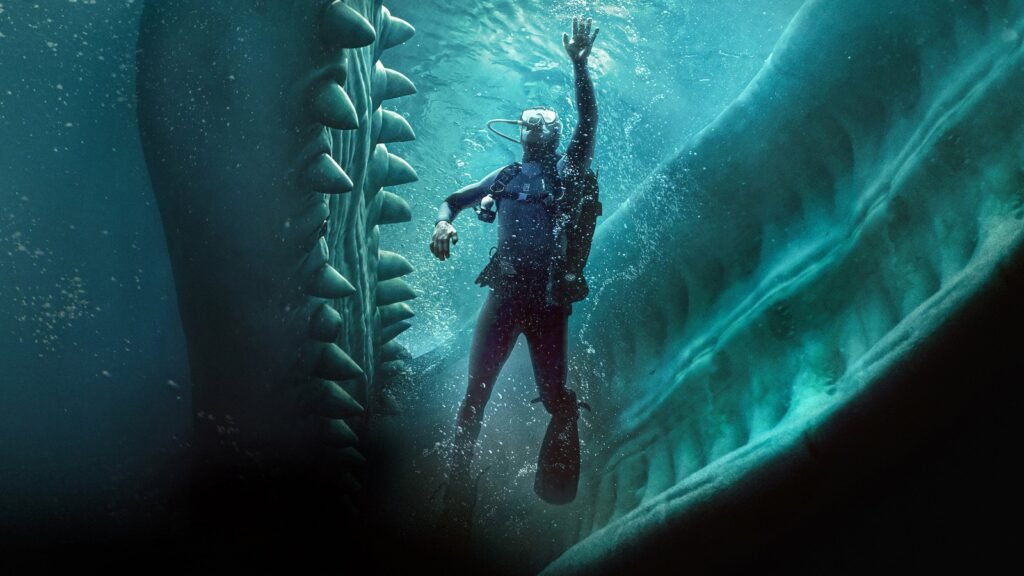
Some premises you have to say out loud twice. A diver goes down off the California coast to recover his father’s remains, and a feeding sperm whale swallows him — whole, alive, with exactly one hour of oxygen in his tank. Say it again and it gets no less absurd — just more interesting, because the film built on that premise plays the whole thing dead straight.
Whalefall (2026) is Brian Duffield’s survival thriller in which diver Jay Gardiner is swallowed whole by a sperm whale. It premiered at Cineworld Leicester Square in London on 5 October 2026 and opened wide in the United States on 16 October, in 3,065 theatres, day-and-date with the UK — the film is out, its opening weekend is behind it, and the numbers are in. It arrived with a strange pedigree: a bestselling novel its director chased before publication, a largely practical whale built across a Studio City stage, and a leading man who carries nearly the whole film alone, inside the animal, close to real time.
Quick Specs
- Director: Brian Duffield
- Screenplay: Brian Duffield and Daniel Kraus
- Based on: Whalefall (2023), the novel by Daniel Kraus
- Producers: Brian Grazer, Brian Duffield, Jeb Brody, Allan Mandelbaum
- Starring: Austin Abrams, Josh Brolin, Elisabeth Shue, John Ortiz, Jane Levy, Emily Rudd
- Cinematography: Aaron Morton
- Edited by: Pietro Scalia
- Music: Joseph Trapanese
- Production design: Ramsey Avery
- Production companies: Imagine Entertainment, 20th Century Studios
- Distributor: 20th Century Studios
- World premiere: 5 October 2026, Cineworld Leicester Square, London
- US release: 16 October 2026 (wide, 3,065 theatres)
- Running time: 106 minutes
- Certificate: PG-13 — some strong language, peril, bloody images, thematic content, violent content (UK: 15)
- Tagline: “Hold your breath.”
One hour of air
Start with the father, because the film does. Mitt Gardiner was a dive-boat captain off Monastery Beach, on California’s Central Coast. Diagnosed with terminal mesothelioma, he wrote sealed farewell letters for his wife and three children, weighted himself, and went into the water. His body was never recovered; the family buried an empty casket. Mitt’s dive was a suicide, not an accident, and everything that follows grows out of that fact.
A year later, his son Jay — a college student who refused to speak to his father through the illness and has never opened the letter Mitt left him — makes an unauthorised solo dive to bring home something his mother and sisters can actually bury. He has one hour of air. What he finds down there is a giant squid, and then, arriving to feed on it, a sperm whale. Jay is caught up in the feeding and swallowed whole.
He wakes in the first of the whale’s four stomach chambers, alive, with the clock running. The fullest beat-by-beat account of the inside runs like this: the swallowed squid dies crushed by the stomach walls, and its beak becomes Jay’s tool. A second chamber’s acids burn him and mark his point of no return. He tries the esophagus during a surface breath and fails to flag a passing tour boat. Then an orca attack leaves the whale mortally wounded and rising, and Jay — hallucinating his father, the lessons of a hard childhood surfacing under pressure — builds an ignition charge from the chamber’s methane, his remaining oxygen and steel wool, and blows his way out through the whale’s side. A tour boat pulls him from the water. The coda is quiet: aboard Mitt’s old boat, Jay finally reads the letter.
Roughly ninety-five percent Austin Abrams
That figure is the director’s own: Duffield has described the film as “roughly 95% Austin Abrams,” and the casting bears him out: this is a near-solo performance, not a two-hander. Austin Abrams was the first name attached, cast in March 2025, and he was 28 years old during the June-to-August 2025 shoot; he had just turned 30 by the US release. It was also his second leading role in a month, after headlining Zach Cregger’s Resident Evil, which opened on 18 September 2026 — and his third film with Josh Brolin, after a small role in Gangster Squad (2013) and their pairing in Weapons (2025).
Brolin’s placement needs care, because the posters blur it. Mitt Gardiner is dead a year before Jay ever gets in the water. Brolin appears in flashbacks, and once more in Jay’s late-film hallucination — he does not share the whale, the dive, or the film’s present tense. He entered talks in March 2025 and was confirmed by June; he was 57 during production and 58 at release, and the film asks the harder trick of him: be the voice in a young man’s head, rough enough to leave scars and right enough, often enough, to save his life. Around the two of them sits the family Jay is diving for — Elisabeth Shue as his mother Zara, Jane Levy as eldest daughter Eva, Emily Rudd as youngest daughter Nan, and John Ortiz as Hewey, Mitt’s friend — all four added in the June 2025 casting wave.
The book came first
Film and novel share the title exactly — Whalefall, one word, both of them. Daniel Kraus’s novel was published on 8 August 2023 by MTV Books / Atria Books (Simon & Schuster), at 336 pages, with a pitch line that followed the property to the screen: The Martian meets 127 Hours. The whale’s famous dimensions come from the same marketing — “an eighty-foot, sixty-ton sperm whale” is the synopsis’s line, repeated by studio materials and trade coverage — the pitch, not a measurement. The book was also sold on its researched accuracy, and the honours were real: a front-cover review in The New York Times Book Review (“A crazy, and crazily enjoyable, beat-the-clock adventure story about fathers, sons, guilt and the mysteries of the sea”), the Alex Award, a finalist slot for the Los Angeles Times Book Prize in its Ray Bradbury Prize category, Best Book of 2023 listings, and cover blurbs from Gillian Flynn (“astoundingly great”) and Owen King (“powerfully humane”).
Kraus is worth a paragraph of his own. He co-wrote the film with Duffield — he was attached as co-writer from the first announcement onward, and any account of this adaptation that hands the screenplay to Duffield alone is wrong. He co-authored The Shape of Water and Trollhunters with Guillermo del Toro, completed George A. Romero’s unfinished novels The Living Dead and Pay the Piper, and holds a Bram Stoker Award and two Odyssey Awards. And in 2026 he won the Pulitzer Prize for Fiction — for Angel Down, his one-sentence First World War novel. Not for this book. Whalefall’s own honours are the ones listed above, and they need no borrowed medal. For the record: neither del Toro nor Romero had any involvement in this film; they belong in Kraus’s biography, not in its credits.
The adaptation’s changes are three. The film ages Jay up — the novel’s Jay is a teenager; the film’s is a college student. Many of the novel’s smaller flashbacks were dropped, in Kraus’s own account, while its present-and-past alternation survives. And the book’s one-hour clock survives intact, played nearly in real time.
A whale built in Studio City
The deal history has two chapters, and the order matters. Duffield, by his own account, contacted Kraus about the novel ahead of publication. In August 2023 — before the book was even on shelves — Imagine Entertainment struck a pre-emptive deal for the film rights. Only in March 2024 did 20th Century Studios enter the picture, winning a competitive bidding war for distribution and setting Duffield to direct, co-write and produce. So 20th Century did not originate the project — Imagine bet on it pre-publication; the studio won the right to release it. The credits need the same care: announcement-era coverage listed Brian Grazer, Ron Howard and Allan Mandelbaum as producers for Imagine, but the finished film’s producer credits are Grazer, Duffield, Jeb Brody and Allan Mandelbaum. Howard — Imagine’s co-founder — is not a credited producer on the film you can watch.
Principal photography began in Los Angeles on 9 June 2025 and ran 62 days, with a Monterey Peninsula unit shooting on 17 June. The county film commission’s locations read like the story’s own map: Monastery Beach, Pacific Grove, Monterey High School and Jacks Peak County Park. The production stayed in California by choice — Louisiana’s slightly richer incentives were passed over so cast and crew could sleep at home; the state awarded $10.4 million in tax credits against $48.7 million of qualified in-state spend. Neither figure is the film’s budget, whatever you may see elsewhere; the budget lives in the money section below, labelled as reported.
The whale itself was substantially practical — a build some twelve feet tall and eighteen feet wide anchored the shoot. Wētā Workshop designed and fabricated the whale’s interior elements, including the squid, working with Duffield and production designer Ramsey Avery from endoscopy and autopsy references. The stomach was a 360-degree set that could roll, mounted on a gimbal at Radford Studio Center in Studio City, with underwater work in a purpose-built tank; Abrams spent roughly two months performing inside it. Behind the camera: Aaron Morton, Duffield’s cinematographer on both previous features, editor Pietro Scalia, and composer Joseph Trapanese. And a credit note, because an error is in circulation: this is Duffield’s third feature as director, after Spontaneous (2020) and No One Will Save You (2023). He wrote Love and Monsters and Underwater; other men directed them.
It opened
The 16 October date was set by August 2025. The teaser and poster landed on 9 June 2026, the full trailer on 19 August, under the poster tagline “Hold your breath.” and a second teaser line worth keeping: “The odds of being swallowed alive by a whale are not zero.” The world premiere followed on 5 October 2026 at Cineworld Leicester Square, where Abrams told the press the fake whale stomach was “the wildest thing I’ve ever done.” Festival stops bracketed the opening — Sitges, in its Sitges Collection strand, on 14 October, and Rome’s Grand Public section in October — and the film opened wide in the US on 16 October in 3,065 theatres, day-and-date with the UK; Australia had opened a day earlier, on 15 October. Certificates ran PG-13 in the US, 15 in the UK and M in Australia. No streaming or home-release date has been announced for the film anywhere. Anyone who gives you one is guessing.
What the critics made of it
The aggregate picture, dated the way scores should be: Rotten Tomatoes has it at 73% from 175 reviews, with a critics’ consensus that sums it up — “Unforgettably visceral whenever it isn’t getting mired in flashbacks,” it reads, rewarding the suspension of disbelief with “some of the most unusual set pieces the survival thriller genre has to offer.” Audiences ran warmer, at 81–82% in opening week. Metacritic scored it 59 out of 100 from 37 critics — twenty positive, fifteen mixed, two negative, squarely “mixed or average” — with a 6.7 user score, labelled as exactly that. Opening-night audiences polled by CinemaScore gave it a B.
The admirers praised the same things. Zachary Lee gave it three and a half stars of four for its “claustrophobic suspense, imaginative visual spectacle, and exploration of grief and spirituality,” calling it a “mind-bending joyride.” Nikki Baughan found that Abrams “carries much of the film” and that its “emotional core elevates it beyond its high-concept premise”; Phil de Semlyen gave four stars of five to “a fast-paced and effective underwater thriller.” The top score was a 90, praising a film “terrifying, awe-inspiring, moving, a little sappy, unbelievably earnest, and wholly memorable,” with another major notice at 80 calling it “frightening, thrilling, bold and brutal… a genuine one-off.”
The dissent ran on rails the consensus already laid down. One British review praised the effects and Abrams and found the father–son storyline “overly sentimental”; two trade reviews were harsh and dismissive; Johnny Oleksinski found it unable to engage but praised Abrams anyway; Peter Travers, at two and a half of four, enjoyed “slimy-scary good times… until a soap opera plot drowns everything in tearjerking.” Read the whole spread and the shape is consistent: the set pieces inside the whale land, the flashback machinery and the sentiment divide the room — and almost nobody, on either side, blames the man in the stomach.
The money, honestly
Label first, figures second. The budget is a reported $60 million, not an audited number. The California figures above ($48.7 million qualified spend, $10.4 million in credits) are separate facts, and no profit-or-loss arithmetic is built on any of it here.
The film was projected at $10–12 million domestic and missed. The actuals: $7,837,153 from 3,065 theatres, fourth place for the weekend — $900,000 of it from Thursday previews — behind a frame that Street Fighter took at $31 million. The “$8 million debut” in the headlines was the rounded estimate line, not the counted figure. Internationally the opening added an estimated $9.5 million, for a worldwide opening of roughly $17.5 million, estimates labelled as such. By Friday 23 October, its eighth day, the domestic cumulative stood at $11,748,434 and the worldwide at $21.4 million. The film is mid-run: there is no final gross to print. One warning: a “$7.8M” gross figure in circulation is that opening weekend wearing a total’s clothes. Opening-weekend coverage reached for the words “belly flop,” and against a reported $60 million cost that verdict is not an unfair one.
Where it stands
Whalefall is a standalone film — not a remake, not a sequel, no franchise waiting in the wings. What survives its soft opening is the thing itself: a Pulitzer-winning novelist’s grief story, co-written by its author, directed by a filmmaker who bet on it before it existed in print, and carried for two months inside a rolling practical stomach by a 28-year-old actor giving the performance of his career so far. The premise is a punchline until the lights go down. Then it is a clock, a beak, a letter nobody wanted to open, and an hour of air. Hold your breath.