
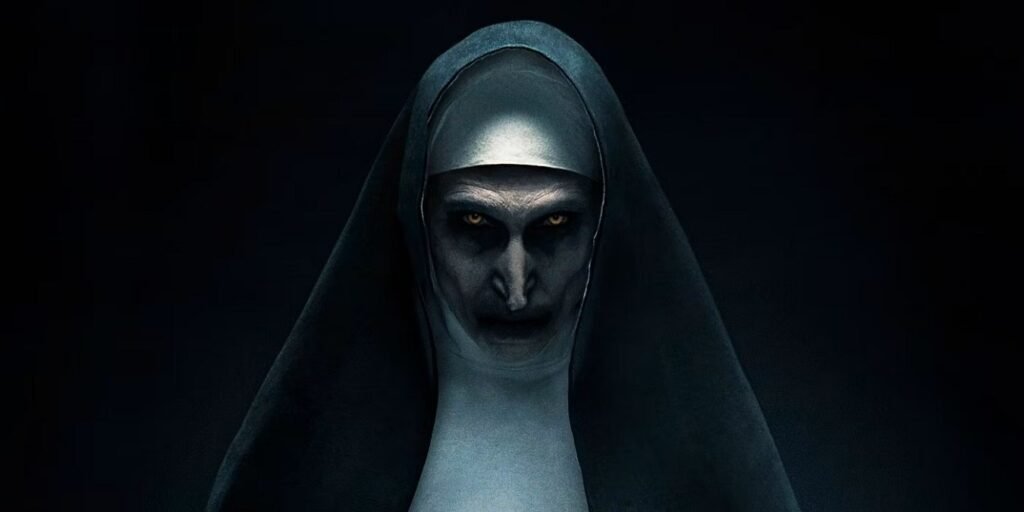
Valak is the demon of the Conjuring films, best known as the nun played by Bonnie Aarons, its name borrowed from a grimoire demon.
Quick Specs
| Film name | Valak, “the Defiler, the Profane, the Marquis of Snakes” |
| Created for | The Conjuring 2 (2016), directed by James Wan |
| Name source | Valac, or Volac, a President of Hell in the early modern grimoires |
| Grimoire form | A boy with angel’s wings riding a two-headed dragon |
| Film form | A demonic nun, played by Bonnie Aarons |
| Films | The Conjuring 2 (2016), Annabelle: Creation (2017), The Nun (2018), The Nun II (2023) |
| Related form | The Crooked Man (Javier Botet), in The Conjuring 2 |
| Weakness (films) | Its true name spoken against it; the Blood of Christ |
| In the real Enfield case | Absent; the 1977 record names no demon and no nun |
| Not in | The Conjuring: Last Rites (2025), as villain or verified appearance |
What Valak Is
There are three layers to this name, and they never meet. The first is the historical demonology of the early modern grimoires, where the spelling is Valac or Volac. The second is the film character, Valak, invented for The Conjuring 2. The third is the real-world case the film dramatised, the Enfield poltergeist of 1977, which contains no Valak at all. The grimoire demon is not a nun, the nun is not folklore, and neither was part of Enfield. This page keeps the three apart.
The Grimoire Demon
In the demonology texts, Valac is a mighty and great President of Hell. The Lesser Key of Solomon, the Munich Manual of Demonic Magic, Thomas Rudd’s version of the Goetia and Johann Weyer’s Pseudomonarchia Daemonum (1563) all agree on that rank. He is the 62nd of the 72 spirits in the Lesser Key and the 50th in Weyer. The Liber Officiorum Spirituum tradition is the exception, ranking its versions of him, Coolor and Doolas, as princes.
His name comes in many spellings: Valac, Ualac and Valak in versions of the Lesser Key; Valu in Rudd; Volac in Weyer; Volach in the Munich Manual. The 1904 Mathers edition of the Goetia heads its entry “Volac, or Valak, or Valu,” so Valak is an old variant spelling, but it is the films that made it standard.
The entry in the Mathers Goetia gives his whole description: “The Sixty-second Spirit is Volac, or Valak, or Valu. He is a President Mighty and Great, and appeareth like a Child with Angel’s Wings, riding on a Two-headed Dragon.” Weyer, in the period spelling, says Valac “is a great president, and commeth abroad with angels wings like a boie, riding on a twoheaded dragon.” The figure is a boy, winged and mounted. The texts give no other form.
His office is just as specific: “His Office is to give True Answers of Hidden Treasures, and to tell where Serpents may be seen. The which he will bring unto the Exorciser without any Force or Strength being by him employed.” Weyer agrees that he “perfectlie answereth of treasure hidden, and where serpents may be seene.” That is the whole of his portfolio, treasure and serpents. There is no possession, no haunting, no testing of faith and no nun.
The texts disagree on how many legions of spirits he commands, so this page gives the split rather than a number:
- Weyer: 30, “dominion over thirtie legions of divels”
- The Lesser Key manuscript tradition: 30, though some manuscripts say 38
- The Mathers Goetia as printed (1904): 38, “He governeth 38 Legions of Spirits”
- The Munich Manual: 27
- The Liber Officiorum Spirituum: 13 as Coolor, 20 as Doolas
The Goetia entry closes “and his Seal is thus”: Valac has a sigil, reproduced in the Mathers and Peterson editions, though the films never use it. Collin de Plancy’s Dictionnaire Infernal (1818) carries the figure into the 19th century as a high president of Hell who appears “in the form of a child with the wings of an angel, mounted on a two-headed dragon,” who “knows the position of the planets and the lurking places of serpents,” with thirty legions under him. The 1863 illustrated edition adds an engraving by Louis Le Breton of the winged child on his dragon. From the 15th century to the 19th, the record holds steady: a boy, wings, a two-headed dragon, treasure, serpents, a President.
The Film Character
In the films Valak is a demon, a fallen angel in the lore of The Nun II, called in dialogue “the Defiler, the Profane, the Marquis of Snakes.” Its signature form is the demonic nun, played by Bonnie Aarons, a shape the films present as deliberate mockery and infiltration; in The Nun it lets the demon move among the sisters of an abbey. The films treat it as the most dangerous thing the Warrens face, partly because it hides, working through other spirits while Lorraine Warren fails to sense it.
The Conjuring 2 (2016). During the Amityville séance that opens the film, set in 1974, Lorraine (Vera Farmiga) meets the nun, who shows her Ed (Patrick Wilson) impaled on a jagged stump. The vision is why she wants to stop investigating, and it hangs over everything after. At home, Ed, who says the figure came to him in a dream, paints its portrait. Valak uses the painting in the film’s study set piece, its shadow crossing the room to the canvas before the figure confronts Lorraine in her own house. The name is hidden in the house’s decor, letters spelling V-A-L-A-K, for the audience to find before Lorraine does.
The Enfield haunting presents as the ghost of Bill Wilkins, the old man who died in the house, speaking through Janet Hodgson. The film’s reveal is that Wilkins is not behind it. Valak has been using his spirit as a puppet and a shield, so that the investigators fight the ghost and never see the demon. In Lorraine’s vision Wilkins himself exposes this.
The Crooked Man, played by Javier Botet, is a separate figure on screen: a tall, jointed nursery-rhyme figure who steps out of young Billy Hodgson’s zoetrope, at one point unfolding out of the family dog, and terrorises the children. He is a zoetrope-born form Valak uses in the film. He is not simply Valak, and he is not a grimoire demon either; he is built on the traditional rhyme “There Was a Crooked Man.”
In the climax Lorraine realises she already has the name, written in her Bible during a vision, and that knowing it is the weapon: “Your name gives me dominion over you, demon, and I do know your name! You are Valak, the defiler, the profane, the Marquis of Snakes! In the name of the Father, and of the Son, and of the Holy Spirit, I condemn you back to Hell!” Valak is driven back, Janet is freed, and Ed survives the impalement the visions promised.
Annabelle: Creation (2017). Two brief beats, both teasers for The Nun. Sister Charlotte shows Samuel Mullins a photograph of herself with nuns at an abbey in Romania, and among the sisters, unnoticed at first, stands Valak. A post-credits scene follows Valak down a candlelit abbey corridor, the candles going out as it passes. Aarons is uncredited, and Valak has no part in the Annabelle story itself.
The Nun (2018). Set in 1952 at the cloistered Abbey of St. Carta in Romania, the film invents a history for the demon. In the Dark Ages the abbey was the castle of a duke obsessed with the occult, who opened a rift in the catacombs and summoned it. Christian knights killed him and sealed the rift with a relic containing the Blood of Christ. Bombing in the Second World War reopened it, and the nuns held the demon back with perpetual prayer in shifts until they were killed. After Sister Victoria hangs herself rather than be taken, the Vatican sends Father Burke (Demián Bichir) and a novice, Sister Irene (Taissa Farmiga), guided by a villager called Frenchie, or Maurice (Jonas Bloquet). Burke identifies the demon as Valak from a book in the abbey. Irene takes her vows mid-film and, in the climax, reseals the rift with the relic, but Valak escapes by possessing Frenchie, marked with an inverted cross. That ties the film to The Conjuring (2013): the possessed man in the Warrens’ lecture footage in that film is Maurice. The 2013 film never names his demon; The Nun made it Valak after the fact. The duke, the relic and the rift exist only in the 2018 film.
The Nun II (2023). Set in France in 1956, four years later. Maurice, still possessed without knowing it, works at a boarding school in Tarascon, and by night Valak works through him, killing clergy and hunting a relic, the Eyes of St. Lucy. Irene, revealed as a descendant of St. Lucy, which is why she does not burn when Valak sets her alight, recovers the relic with Sister Debra (Storm Reid). In the climax they pray the Words of Institution over the school’s old wine barrels, the wine becomes the Blood of Christ, Valak is banished and Maurice is freed, though Irene’s last look leaves his cure in doubt. Michael Chaves directed. Patrick Wilson and Vera Farmiga appear in a mid-credits scene only in archive footage from The Devil Made Me Do It.
The Conjuring: Last Rites (2025). Valak is not in it as the villain. The film’s case is the Smurl haunting, driven by a demon in an antique mirror, and Valak has no verified appearance in it.
In the films, Valak can be beaten two ways: by its true name spoken against it, in The Conjuring 2, and by the Blood of Christ, as the sealed relic in The Nun and as consecrated wine in The Nun II. Neither comes from the grimoires.
The Real-world Layer
The nun was a late idea. James Wan told io9 in 2016 that the demon’s design was the one element he was “still discovering,” and that he had always planned additional photography to find it. The starting point, in Wan’s telling, was something the real Lorraine Warren mentioned to him in passing: “she mentioned a spectral entity that has haunted her in her house. And it’s this swirling tornado vortex with this hooded figure in there.” He did not want a CGI creature. The vision “only attacks her,” he said; “I wanted something that would attack her faith. Something that would threaten the safety of her husband. And so that was eventually how the idea of this very iconographic image of a holy icon cemented in my head.” That story is Warren’s account, as Wan relays it: it explains where the design came from, not that any entity exists. Wan also glossed the opening vision as a premonition inside the fiction: “she’s seeing what’s going to happen at the end of the movie… The demonic entity that takes on the form of a nun has got nothing to do with Amityville. At all.”
The design it replaced. In a later Instagram post Wan revealed that “the original VALAK in The Conjuring 2 was going to be this winged demon,” an animatronic head and practical body suit built by Justin Raleigh’s Fractured FX and worn by Joseph Bishara, the films’ composer. “I think I have only one fully finished shot with CGI wings in place. It was really grand and epic. But as cool as it was, it felt out of place within the Conjuring world we had built. And so during post-production, I reconceived the villain, feeling it needed to be something more grounded, more personal, and creepier. And thus the demonic Nun was born.” All the nun material, he added, was shot during additional photography, including new set pieces like “the painting on the wall.” Peter Safran, the producer, compresses it further: “in a one-day reshoot against blue screen, James shot Bonnie Aarons doing a whole bunch of different things that we then inserted into the movie.”
Bonnie Aarons plays the nun in The Conjuring 2, Annabelle: Creation, The Nun and The Nun II. Safran’s line on casting her: “with the unique geography of her face, everybody said: ’This is exactly who we want; this is who it has to be.'” The face is hers under makeup, which matters for the lawsuit below. Three performers stand behind three different things: Aarons is the nun, Botet is the Crooked Man, and Bishara wore the unused original suit.
The Aarons lawsuit. On August 15, 2023, Aarons sued Warner Bros., New Line Cinema and Scope Productions in Los Angeles Superior Court for breach of contract, breach of the covenant of good faith and fair dealing, and an accounting. The case was first reported by The Guardian, and The Hollywood Reporter obtained the complaint. She alleges the studios obscured the merchandising revenue earned from her likeness. According to the complaint, she was paid $71,500 for The Nun plus a $175,000 box office bonus, and her contract entitled her to a “pro-rata share of 5% of 50% of the gross receipts” from merchandise using her likeness, from toys and dolls to T-shirts, bedding and costumes. She alleges that Warner Bros.’ statements from 2019 to 2022 were “inconsistent with the extensive merchandising activities,” and that a spreadsheet supplied on request “contained line items corresponding to only a fraction of the known licenses.” These are allegations. Warner Bros. had made no statement in the reporting, and no verdict, settlement or dismissal has been reported.
The Crooked Man spin-off. A Crooked Man film was announced in 2017. In 2022 Wan posted that “unfortunately the spin-off movie with this character isn’t happening. Outside of my control. But maybe one day.” Safran has said the production expected the Crooked Man to be the sequel’s breakout, but “test screenings proved people were latching onto the nun… When the audiences saw the movie, they wanted to know more about the nun. That’s what they gravitated toward.”
Box office. Worldwide, unadjusted: The Conjuring 2 about $322 million (budget $40 million); Annabelle: Creation about $307 million ($15 million); The Nun about $366 million ($22 million); The Nun II about $270 million ($38.5 million); The Conjuring: Last Rites about $499 million ($55 million). The Nun was the Conjuring universe’s highest-grossing film from 2018 until Last Rites overtook it in 2025.
The real Enfield case. The case behind The Conjuring 2 began in August 1977 at 284 Green Street, Enfield, London, where Peggy Hodgson, a single mother, and her children, with 11-year-old Janet at the centre, reported moving furniture, thrown objects, knocking and a gruff voice. It ran for about 18 months and was investigated mainly by Maurice Grosse and Guy Lyon Playfair of the Society for Psychical Research, not by the Warrens. One of Janet’s voices called itself Bill Wilkins; a man of that name had lived in the house and died there in 1963, which his son later confirmed to investigators. The record also holds the counter-evidence: Janet was caught on camera bending spoons and trying to bend an iron bar, the girls admitted pranks to journalists, and the SPR investigator Anita Gregory and others concluded that incidents had been staged. The Warrens’ visit was short; by Playfair’s account they showed up uninvited. Lorraine Warren later spoke of sensing a demonic presence there, and that is her account. Nothing in the Enfield record mentions a nun, a demon called Valak, or any demon by name.
Signatures and Iconography
The silhouette. The icon is a silhouette first: black habit, white wimple and coif framing the face, readable at the end of a dark corridor before any detail registers. In Wan’s words it is “a very iconographic image of a holy icon,” inverted, and the blasphemy is the design. None of it comes from the grimoires, whose Valac rides a dragon.
The face. Aarons’ own features under the makeup: chalk-white skin, yellow eyes, darkened sockets, cracked skin and a mouth of sharp teeth. Her lawsuit rests on that fact, that the face on the merchandise is hers.
The portrait. Ed’s painting of the nun, made from his dream, hangs in the Warrens’ study, and the film’s signature home-invasion scare plays off it, the shadow moving to the canvas and the figure coming out of its darkness. Wan names “the painting on the wall” as a set piece created for the reshoots. The name hidden in the same rooms’ decor is part of the same trick.
The name as weakness. Valak works by hiding, behind Wilkins, in a photograph, inside a possessed friend, and it is beaten by being identified. The Nun films swap the weapon for the Blood of Christ but keep the shape: the heroes win only when they find the right sacred counter.
The serpents. Of the grimoire Valac’s whole job, treasure and serpents, the films keep only the serpents, and only as a title, “Marquis of Snakes,” which contradicts the grimoire rank of President. The treasure is never used.
The zoetrope. The spinning toy, the rhyme and Botet’s unfolding, jointed movement, performed for real rather than in CGI, belong to The Conjuring 2’s imagery, filed under the Crooked Man, not as Valak’s true form.
Why It Matters
Valak is a breakout icon made almost entirely by design and one performance. By Safran’s account the character began as an unresolved design, replaced in a one-day blue-screen reshoot during post-production, and test audiences gravitated to the nun over the creature the production had built its plans around. What they latched onto was a silhouette and Aarons’ face, and it carried a $366 million spin-off, a sequel, and merchandise extensive enough to ground a lawsuit over her likeness. There is no folklore underneath any of it. The icon is about a decade old and wholly cinematic, which makes it the clearest case of a modern horror icon being manufactured.
The films borrow a grimoire name and almost nothing else. Writers comparing the two layers have been blunt that no lore portrays Valak as a nun, that the grimoire figure is a boy who finds treasure, and that the Enfield investigators found no demonic activity to attach a name to. The same method, a real demonology or case-file label wrapped around an invented screen entity, runs through the franchise. The evidence is plain on this page: the name and the word “snakes” cross over from the grimoires, and nothing else does.
And the gap between the layers is the story. A minor President of Hell whose job was finding hidden treasure became, by borrowing, the face of the highest-grossing horror universe of its era, and the borrowing then flowed backwards, with paranormal content now presenting the nun as “the real Valak” and writing her into the Enfield case. Holding the three layers apart is the point of a page like this one.