
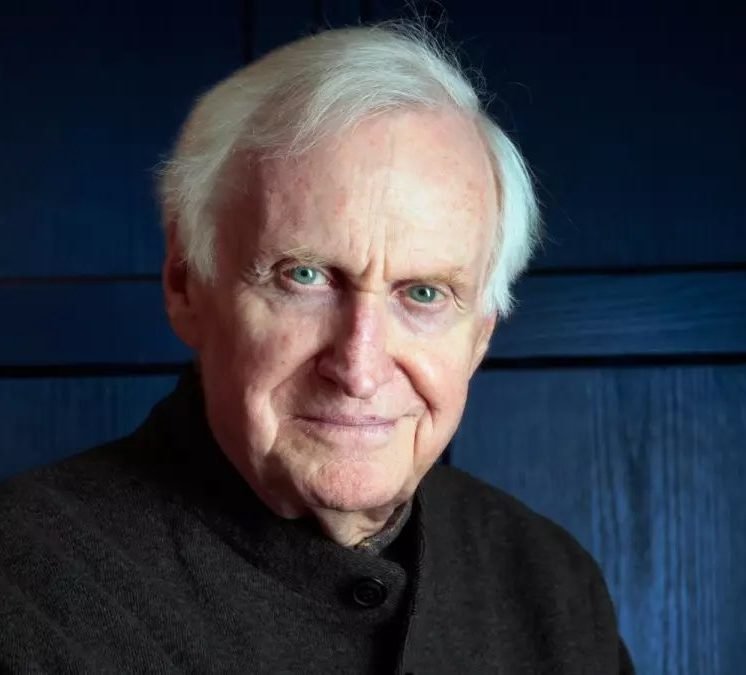
Sir John Boorman (born 1933) is a British director who made Deliverance, Point Blank, Excalibur and the famously divisive Exorcist II: The Heretic.
Quick Specs
| Born | January 18, 1933, Shepperton, Middlesex, England |
| Started in | BBC documentaries; head of the BBC Documentary Unit in Bristol by 1962 |
| First feature | Catch Us If You Can (1965) |
| Horror and thriller | Point Blank (1967), Deliverance (1972), Zardoz (1974), Exorcist II: The Heretic (1977) |
| Other key films | Excalibur (1981), The Emerald Forest (1985), Hope and Glory (1987), The General (1998) |
| Honors | five Academy Award nominations; Best Director at Cannes for Leo the Last (1970) and The General (1998); knighted in 2022 |
| Books | Money Into Light (1985), Adventures of a Suburban Boy (2003), Conclusions (2020) |
Who He Is
John Boorman was born in Shepperton, Middlesex, on January 18, 1933, the son of pub landlord George Boorman and Ivy Chapman. He grew up through the London Blitz, the childhood he later put on screen in Hope and Glory. He wasn’t Catholic, but after failing the eleven-plus he was educated at the Salesian School in Chertsey.
Conscripted into the British Army, he became a clerical instructor in England. He never served in Korea. He did face a court-martial for “seducing a soldier from the course of his duty” after criticizing the Korean War to his trainees, and the case collapsed when he showed that everything he had said came from The Times.
After the army he worked as a dry cleaner, then as a journalist and film reviewer. He moved into television, ran newsrooms at Southern Television, and by 1962, at 29, was head of the BBC’s Documentary Unit in Bristol. His series Citizen 63 (1963) and The Newcomers (1964) made his name. He also shot Six Days to Saturday (1963), a week in the life of Swindon Town football club.
The Work, and What He Did in It
Catch Us If You Can (1965): producer David Deutsch hired him, still a BBC man, to direct a Dave Clark Five vehicle in the mold of A Hard Day’s Night. Even inside the pop formula he went looking for strange, fantastical English landscapes.
Point Blank (1967): Lee Marvin plays Walker, shot and left for dead by his wife and his partner, cutting through the syndicate for his $93,000. The key act came before shooting. Marvin, at the height of his clout, told MGM he deferred all of his script and casting approvals to Boorman, an unknown from British TV. Boorman and Alex Jacobs rewrote the script, and Boorman shot it with jump cuts, fractured memory and Alcatraz as a bookend fortress. It was selected for the National Film Registry in 2016.
Hell in the Pacific (1968): Marvin and Toshiro Mifune are the only two people on screen, an American pilot and a Japanese naval captain marooned together, shot in the Rock Islands of Palau. Boorman’s decision: Mifune’s Japanese is neither dubbed nor subtitled, so the audience shares Marvin’s incomprehension. In his memoir he describes directing Mifune through an interpreter who admitted softening the notes so the star wouldn’t lose face. The producers replaced Boorman’s ending on some releases without telling him, and he said he hated it.
Leo the Last (1970), starring Marcello Mastroianni, won him Best Director at Cannes. He took it to Ireland for post-production and stayed, settling at Annamoe in County Wicklow.
Deliverance (1972) is the centerpiece. Boorman directed and produced; James Dickey adapted his own novel, and Boorman’s heavy uncredited rewriting ended in an arbitration Dickey won. Jon Voight, Burt Reynolds, Ned Beatty and Ronny Cox (Beatty’s and Cox’s feature debuts) play four Atlanta businessmen canoeing a river before it is dammed. It was shot in Rabun County, Georgia, with the canoe sequences on the Chattooga River. The studio cut the budget over the film’s content, and the four leads did their own stunts without insurance cover. Voight climbed the cliff himself. Beatty nearly drowned. Reynolds insisted on redoing a waterfall shot first done with a dummy and cracked his tailbone. When he asked how it looked, Boorman told him it looked like a dummy falling over a waterfall.
By the standard account, Dickey, furious about the rewrites, got into a fight with Boorman that left the director with a broken nose and four shattered teeth. The two reconciled, became friends, and Boorman gave Dickey the cameo of Sheriff Bullard.
The film made $46.1 million on a $2 million budget and earned three Oscar nominations, including Best Picture and Best Director. It entered the National Film Registry in 2008. It also drew lasting criticism from Rabun County residents, journalists and historians for its portrait of Appalachia, and that criticism is part of its legacy.
Zardoz (1974): the blank cheque Deliverance bought him. Boorman wrote, produced and directed an original fable set in 2293, with Sean Connery as Zed, a killer who stows away inside a giant flying stone head and infiltrates a commune of bored immortals. The title comes from The Wizard of Oz, the book Zed finds that exposes the god as a fake. It was shot in 1973 in Ireland, at Ardmore Studios and around Wicklow. It failed commercially and has since built a cult following.
Exorcist II: The Heretic (1977): the surprise is that Boorman disliked the original. He said he had told Warner Bros. head John Calley he would be happy if Calley didn’t produce it either. What drew him was William Goodhart’s script, built on Pierre Teilhard de Chardin’s idea of evolution as the first step of a divine plan. So instead of an exorcism, Boorman made a film about a brainwave “synchronizer,” Merrin’s African past and the demon Pazuzu, with Linda Blair’s Regan recast as a healer. Richard Burton replaced Jon Voight as Father Lamont, with Louise Fletcher and Max von Sydow, and Ennio Morricone scored it.
The production was cursed. Boorman caught valley fever and shooting shut down for over a month. Imported locusts died at about 100 a day. The first editor quit. Preview audiences laughed and jeered, and Boorman recut the film after release.
The money is not what most people think. It set a Warner opening-weekend record and grossed $30,749,142 in the U.S. on a budget of about $14 million, so it turned a profit. It was a critical catastrophe and a crushing disappointment next to the original. Boorman’s own verdict, quoted by Bob McCabe: “I created this arena and I just didn’t throw enough Christians into it.” William Friedkin compared watching it to seeing a traffic accident. Martin Scorsese and Pauline Kael both rated it above the original.
Excalibur (1981): his long-held Arthur project, which absorbed ideas from his abandoned Lord of the Rings adaptation. He had corresponded with Tolkien about that film before its cost killed it. Boorman co-wrote Excalibur with Rospo Pallenberg from Malory’s Le Morte d’Arthur and shot it in Ireland, using all of his children as actors and crew. Katrine Boorman played Igrayne and Charley Boorman the young Mordred. He cast Nicol Williamson and Helen Mirren as Merlin and Morgana knowing they disliked each other after a disastrous stage Macbeth, betting the antagonism would play. The film pairs Trevor Jones’s score with Wagner and Carl Orff’s “O Fortuna,” which it helped turn into a screen cue. It made about $35 million on about $11 million and won Best Artistic Contribution at Cannes.
The Emerald Forest (1985): Charley Boorman stars as a boy raised by an Amazonian tribe, found by his engineer father (Powers Boothe) after ten years. The distributor was in trouble and couldn’t mount an awards campaign, so Boorman split the cost of putting free VHS copies in Los Angeles video stores for Academy members. “I was aware that it hadn’t been done before,” he said. The film got no nominations, but he had effectively invented the Oscar screener.
Hope and Glory (1987) filmed his Blitz childhood and earned five Oscar nominations, including Best Picture, Best Director and Best Original Screenplay. Where the Heart Is (1990), co-written with his daughter Telsche, was a major flop. The General (1998), starring Brendan Gleeson as Dublin robber Martin Cahill, won him Best Director at Cannes again, 28 years after the first. Cahill’s gang had once burgled Boorman’s own house and stolen his gold record for the Deliverance soundtrack, and the film stages the theft.
He went on to The Tailor of Panama (2001), with Pierce Brosnan as a corrupt anti-Bond and Daniel Radcliffe in his film debut, then In My Country (2004) and The Tiger’s Tail (2006). Queen and Country (2014), the sequel to Hope and Glory drawn from his National Service, was billed as his final film.
Cool Verified Facts
- “Dueling Banjos” is not what it looks like. Billy Redden couldn’t play the banjo; local musician Mike Addis hid behind him with an arm through his sleeve. The recording is by Eric Weissberg and Steve Mandell, and the tune is Arthur Smith’s “Feudin’ Banjos.” Smith sued and won credit and royalties.
- Nobody agrees who came up with “squeal like a pig.” Ned Beatty, a crew member in Christopher Dickey’s memoir, county liaison Frank Rickman by Boorman himself, and Rospo Pallenberg have all been credited.
- Charley Boorman, then about five, appears in Deliverance’s final scene as Ed’s son.
- Lee Marvin was Charley’s godfather, and Boorman made the documentary Lee Marvin: A Personal Portrait by John Boorman (1998).
- His papers, 277 boxes covering 1940 to 2014, are at the Lilly Library at Indiana University.
Signatures, Habits and Behind the Scenes
- The outsider walks into someone else’s world. MGM’s Los Angeles, Dickey’s Georgia, Malory’s Britain, Cahill’s Dublin: he films each one as myth.
- Nature is the subject, a career-long interest alongside traditional heroism, and his jungles and rivers are magnetic and indifferent at once.
- He casts his family, systematically, from Deliverance and Excalibur to The Emerald Forest and Where the Heart Is.
- He shoots in real places at real risk: an uninsured river in Georgia, Palau, the Xingu River in Brazil, and Wicklow standing in for both the 23rd century and Camelot.
- He is his own chronicler. Money Into Light is his diary of The Emerald Forest, and he co-edited Faber’s filmmakers’ journal Projections with Walter Donohue.
- His own summary of the method: “Sometimes it works, and comes together, and sometimes it doesn’t.”
Why He Matters
Boorman made the American wilderness itself the monster in Deliverance, and backwoods horror still answers to it. Then he walked into the genre’s biggest franchise and, on metaphysical principle, refused to make the film the audience wanted. Both films are still argued about. Point Blank and Deliverance are both in the National Film Registry, Excalibur is still the benchmark Arthur film, and a desperate VHS gambit gave Hollywood the screener. Add five Oscar nominations, two Cannes Best Director prizes, BAFTA and BFI Fellowships and a 2022 knighthood, and you have a restlessly experimental director who still got his particular visions made inside the studio system.