
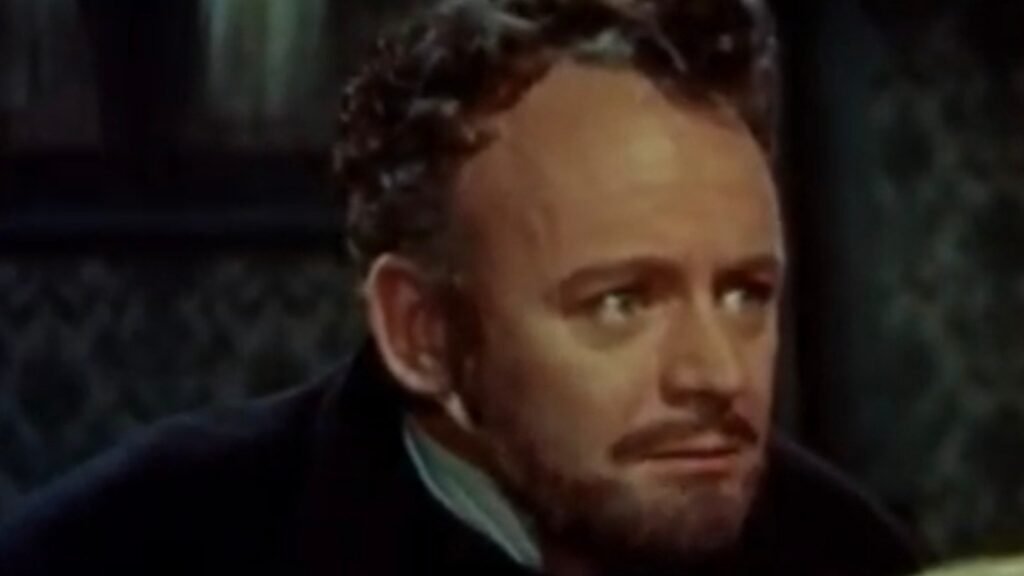
Somebody in a Frankenstein film has to be the adult in the room. In The Curse of Frankenstein, that job falls to the tutor — the man hired to teach the young Baron his science, who ends up teaching the audience how to judge him instead. Robert Urquhart was the Scottish actor who played Paul Krempe, the tutor who became Frankenstein’s conscience in Hammer’s The Curse of Frankenstein. It was his breakthrough role, and it came a decade into a stage career and five years into a film career. He was no discovery — he was a seasoned professional who walked into Hammer’s first colour horror film and quietly became the measure of everyone else in it.
Quick Specs
- Born: 16 October 1921 or 1922, Ullapool, Scotland
- Died: 21 March 1995, Edinburgh, Scotland (aged 72 or 73)
- Occupation: Actor (stage, film and television); hotelier in later life
- Known for: Paul Krempe in The Curse of Frankenstein (1957)
- Years active: 1947–1994 on stage and screen; screen work 1952–1994
His birth year is given as both 1921 and 1922. The rest is settled: he was born on 16 October in Ullapool, and he died in Edinburgh on 21 March 1995.
From the sea to RADA
Urquhart was the son of a Merchant Navy sailor, educated at George Heriot’s School in Edinburgh, and he followed his father to sea. After school he entered the Merchant Navy as an apprentice, sailing to Australia, New Zealand, South America and South Africa before earning his third mate’s papers, and he stayed in service into the early years of the Second World War. The most dramatic detail of that chapter comes from Hayward’s obituary account: that he left the Merchant Navy in 1942 after his ship had been torpedoed three times, and worked in Glasgow’s docklands. What is carried more broadly is the turn that followed — an ex-serviceman’s scholarship took him to train at the Royal Academy of Dramatic Art. Nothing in his later screen presence — the steadiness, the authority, the refusal to be rattled — comes from nowhere.
A stage actor first
He made his stage debut in 1947 at the Park Theatre, Glasgow. With no birth month on record for the debut itself, that makes him 24 or 25 at the time. The same year, he was cast in Tyrone Guthrie’s production of The Thrie Estaitis for the first Edinburgh Festival. A season with the Royal Shakespeare Company followed in 1948, playing across Hamlet, King John, Othello, The Taming of the Shrew, Troilus and Cressida and The Winter’s Tale, then repertory work in Edinburgh and Glasgow.
His West End debut came in 1950 as Captain Hugh Ardale in The Second Mrs Tanqueray at the Theatre Royal Haymarket, and he played Horatio in Hamlet at the New Theatre opposite Alec Guinness. The 1950s brought The Merchant of Venice at the Old Vic, Restless Heart, a six-month run of Speaking of Murder, and Agatha Christie’s Go Back for Murder. In the mid-1960s he crossed the Atlantic as Chitterlow in Half a Sixpence on Broadway. And the stage bookended the career: in 1982 he played Friedrich Wilhelm in The Prince of Homburg for the National Theatre and returned to The Thrie Estaitis — the same play that had launched him at the first Edinburgh Festival thirty-five years earlier — this time as Divine Correction, before playing Father Dolan in The Shaughraun at the Olivier from 1988 into 1990. Curse sits in the middle of all that. It was never the whole story.
Film before Frankenstein
His film debut came in 1952 — at 29 or 30, on the same fork — as Sheltie in You’re Only Young Twice, and he was busy from the start: Paul Temple Returns, Tread Softly and Isn’t Life Wonderful! all followed the same year. He secured a contract with Associated British Picture Corporation, and the ABPC years gave him The House of the Arrow (Jim Frobisher), Knights of the Round Table — Sir Gawain, spelled “Gawaine” in some listings — Happy Ever After as Dr Michael Flynn, The Dark Avenger, Yangtse Incident as Flight Lieutenant Fearnley, and later The Bulldog Breed. These were leads and strong supporting parts in mainstream British pictures, not bit-part scrabbling. By the time Hammer came calling, Urquhart was an established film actor with a contract, a stage reputation and a decade’s experience of holding an audience. That is the man who was cast as Krempe — and one production history has suggested the casting followed from ABPC’s co-financing involvement in the Hammer picture. The contract itself is solid; that causal step is one history’s suggestion.
Paul Krempe: tutor, partner, conscience
The Curse of Frankenstein (1957) was Hammer’s first colour horror film and the first of its Frankenstein series, directed by Terence Fisher from Jimmy Sangster’s script, opening in London on 2 May 1957 ahead of its UK release on 20 May. Peter Cushing stars as Baron Victor Frankenstein and Christopher Lee plays the Creature, with Hazel Court as Elizabeth and Urquhart in support — third-billed, as Paul Krempe. Not the Baron. Not the Creature. Not a professor. The tutor.
And the distinction from the book matters. Mary Shelley’s M. Krempe is a professor of natural philosophy at Ingolstadt who lectures the student Victor and dismisses his alchemy reading. Sangster kept the surname and rebuilt the man. Hammer’s Paul Krempe is engaged by the orphaned fifteen-year-old Victor, sole master of the Frankenstein estate after his mother’s death, to tutor him privately. After two years of intense study the two begin collaborating as equals. Their joint triumph — bringing a dead puppy back to life — is the hinge of the film: it turns Victor toward building a perfect human from scavenged parts. Paul assists at first. Then he withdraws, unable to tolerate the continued scavenging of human remains, a break hastened by the grown Elizabeth’s arrival in the house. He confronts Victor as Victor steals Professor Bernstein’s brain from the vault, and the brain is damaged in their struggle. Again and again he tries to persuade Elizabeth to leave the house. Tutor, then partner, then the man who walks away — that three-step shape is the performance, and it is why Krempe endures as the film’s moral counterweight. Urquhart plays him without pleading for sympathy: a working scientist who shared the early wonder, drew a line, and held it while the man he had taught crossed every line there was.
The sequel that never called
Here is a piece of Frankenstein history that is often told wrong, so let it be told exactly. Krempe does not appear in The Revenge of Frankenstein (1958). The character was dropped, not recast. The sequel’s collaborator is a new character entirely — Hans Kleve, a junior doctor who recognises the Baron and negotiates his way into the apprentice’s place. No other actor played Krempe, Urquhart was not replaced, and no source says he was offered a return and refused it. There was no return offer. The sequel was simply written without the character, and no Hammer Frankenstein sequel ever brought him back.
What does circulate is lore, and it should be labelled as such. Hammer lore — retold in later production histories — has Urquhart walking out of the film’s premiere in disgust at its horror; he never made another film for Hammer. That second clause is the verifiable residue, and it needs its own precision: he never made a second Hammer feature. The broad version of the story — that he never worked for Hammer again, full stop — is false, as his television return below proves.
Television: the familiar face
If Curse was the breakthrough, television was the career’s long middle. Through the 1960s he appeared across the detective and special-agent series that defined British adventure television: Department S, Callan, The Professionals, Man in a Suitcase, The Saint and The Avengers among them. He played opposite Patrick McGoohan in Danger Man, in the episodes “English Lady Takes Lodgers” and “It’s Up to the Lady”, and as the title character of “The Man with the Foot”.
He also carried a series of his own: in Jango (1961), a short-lived Associated Rediffusion production, he played the lead and served as script editor. In the 1970s he starred as Wing Commander MacPhearson in the RAF series Pathfinders. The prestige work accumulated alongside: a drunken journalist in The Reporters for Play for Today, the teacher George Jenkins in The Prime of Miss Jean Brodie, Dr Thomas Stockman in An Enemy of the People — the role is solid, its year disputed — the Quartering Commandant in Brideshead Revisited, Laurence Boythorn in Bleak House, and Albrecht Hoffman in Hitler’s SS: Portrait in Evil.
And then, in 1980, the return that corrects the legend. In “Children of the Full Moon,” the werewolf episode of Hammer House of Horror — directed by Tom Clegg, written by Murray Smith, first aired on ITV on 1 November 1980 — a stranded couple take shelter with Mrs Ardoy, played by Diana Dors, and her adopted children. Urquhart plays Harry. Twenty-three years after Curse, he acted for Hammer again, on television, in a werewolf story. Whatever he felt about horror, the record shows a working actor who came back when the work was there. His last screen work came in 1994, as Dadda Whalby in “Master of the Moor,” an episode of The Ruth Rendell Mysteries — a career that began in the theatre in 1947 closing quietly, on television, nearly half a century later.
The later films
Film work ran alongside the television all the way. He was Mike in Dunkirk (1958), George Crossfield opposite Margaret Rutherford in the Miss Marple film Murder at the Gallop (1963), and Captain Hanley in 55 Days at Peking the same year. The 1960s features include Foxhole in Cairo, The Syndicate — also listed as Treasure of Kenya; they are one film under two titles, not two credits — and The Limbo Line. His part in Mosquito Squadron is listed as Major Kemble, though sources wobble on the detail: one filmography marks it uncredited and a year earlier than another. Later came The Looking Glass War, a small part in Gator, Captain Lockhart in The Dogs of War, the Headmaster in The Dollar Bottom — the Oscar-winning short — and in P’tang, Yang, Kipperbang, Detective Inspector Baird in Restless Natives, and final features including Playing Away, The Kitchen Toto and Testimony. It is the filmography of a character actor in the best sense: the face you trust to make a world believable.
Ullapool again
Urquhart was married first to the actress Zena Walker, in 1956, a marriage that later ended in divorce, and then, in 1976, to Jean Urquhart, the Scottish hotelier and politician. He had two sons and two daughters. In 1970 he turned the boat shed attached to his childhood home in Ullapool into a coffee shop called the Ceilidh Place; with the house and the house next door added, it grew into a hotel, arts centre and concert hall, which he ran with Jean — the hotelier half of his occupation line, and the reason he spent much of his later life back in the Highlands where he had started. One smaller piece of colour belongs in this section: a history of Cushing and Lee’s horror collaborations records that after filming The Curse of Frankenstein, Urquhart adopted the dog that is “resurrected” in the film — the puppy of the experiment that changes everything. If true, it is the most Krempe ending imaginable: the man who walked away from the work took the one innocent creature in it home with him.
He died in hospital in Edinburgh on 21 March 1995, shortly after a second heart-bypass operation — aged 72 or 73, depending on the birth year.
Where he stands
Robert Urquhart will never headline a Frankenstein retrospective; Cushing and Lee see to that, and there is no injustice in it. But watch The Curse of Frankenstein again and notice where your judgment comes from. It comes from Krempe. He is the film’s built-in witness — the colleague who shared the discovery, refused the desecration, fought for the brain, begged Elizabeth to run, and finally denied the condemned Baron the testimony that might have saved him, because by then the truth and the Baron were no longer the same thing. Urquhart brought to that part everything his odd, honourable road to the screen had given him: a seaman’s steadiness, a classical stage actor’s grounding, a leading man’s experience worn lightly in a supporting role. Hammer horror is remembered for its monsters and its Baron. It works because a tutor from Ullapool stood in the laboratory doorway and said no.