
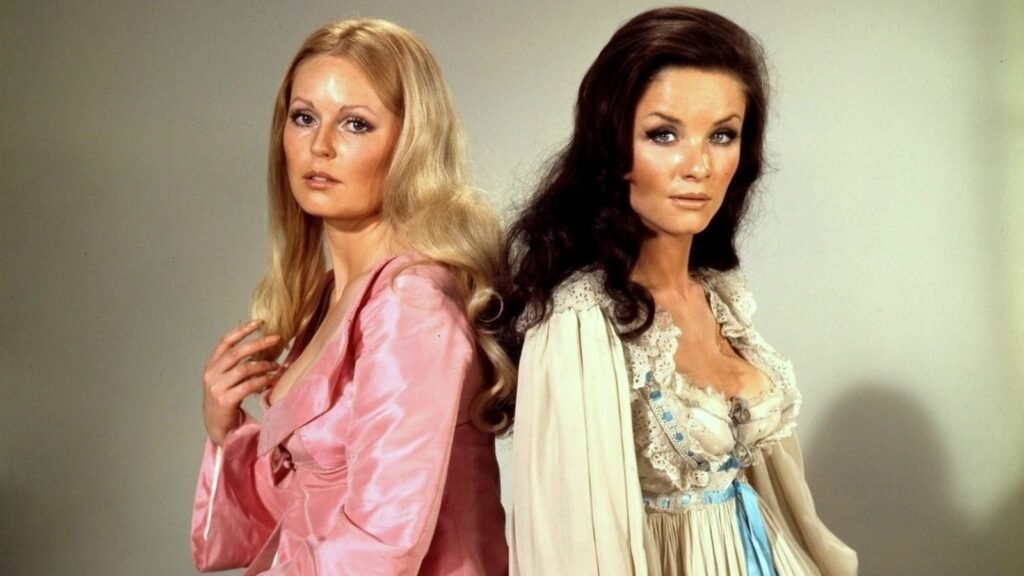
The Horror of Frankenstein (1970) is Hammer’s only Frankenstein film without Peter Cushing, a black-comedy remake starring Ralph Bates as the Baron. Sit with that for a moment, because everything strange about this film flows from it. Five times, Peter Cushing had played Baron Frankenstein for Hammer; the series and the man had become the same thing. Then, in 1970, the studio tore up its own formula and told the creation story again from the beginning — outside the Cushing continuity entirely, following nothing and setting up nothing. The new Baron is barely thirty, and the tone has changed under him: where the earlier films played the material as Gothic tragedy, this one plays it as a joke told with a straight face. The warning arrives before the story does. The opening credits unspool over a picture of a woman while a hand marks off her body parts with a felt-tip pen — a cheerful anachronism in a period Gothic, the butcher’s diagram drawn before the butchery. As Jonathan Rigby points out in the documentary Gallows Humor, that one gag announces the whole film: this Frankenstein knows exactly what he is doing, and he is enjoying it.
Quick Specs
- Director: Jimmy Sangster
- Screenplay: Jeremy Burnham and Jimmy Sangster, based on the characters created by Mary Shelley
- Producer: Jimmy Sangster
- Starring: Ralph Bates, Kate O’Mara, Veronica Carlson, Dennis Price, David Prowse
- Cinematography: Moray Grant
- Editor: Chris Barnes
- Music: Malcolm Williamson
- Art direction: Scott MacGregor
- Make-up: Tom Smith
- Studio: Hammer Film Productions
- Financed by: EMI
- Distributors: MGM-EMI Distributors (UK); Continental Films (US)
- Released: 8 November 1970 (UK), on a double bill with Scars of Dracula
- Running time: 95 minutes
A Baron who murders his way to the title
Victor Frankenstein begins the film as a cold, arrogant, womanising young genius, forbidden by his father, Baron Alphonse, to continue his anatomy experiments. Victor’s answer tells you the whole character in one gesture: he sabotages his father’s shotgun, murders him with his own hunting accident, and inherits the title of Baron von Frankenstein and the family fortune in a single shot. Understand what the film is doing here. This Victor is not the earlier Baron’s son carrying on any family work — he is Frankenstein, restarted young, and the patricide is not a fall from grace. It is an introduction.
The fortune buys him medical school in Vienna. Vienna cannot hold him: he is forced home after impregnating the daughter of the Dean — the Dean, that is, not Elizabeth Heiss; keep the women in this film straight, because Victor never does. Back at the family castle he builds his laboratory and resumes the work, buying bodies from the Graverobber, played by Dennis Price, whose wife (Joan Rice) completes the supply chain. At home there is Elizabeth Heiss, played by Veronica Carlson — Professor Heiss’s daughter, the woman who loves Victor — and Victor betrays her with his housekeeper Alys, played by Kate O’Mara. Then the experiments stop waiting for the graveyard. Victor murders for parts, and the shopping list is personal: among his victims are Elizabeth’s own father, Professor Heiss (Bernard Archard), and his friend Wilhelm Kassner (Graham James). Lieutenant Henry Becker, played by Jon Finch, is the law moving somewhere in the background of all this charm.
The creature in the cell
The composite body is assembled, part by purchased part and murdered part, and Victor brings it to life. The Creature is played by David Prowse — hold that name; it matters later — and this Baron does not recoil from his creation in horror or abandon it in disgust, the way Barons are supposed to. He keeps it chained in a cell and encourages it to kill. That is the film’s coldest idea, and its most honest one: the Cushing films always let their Baron pretend the rampage was an accident of science. Bates’s Victor skips the pretence. The monster is an instrument, and the hand on it is his.
The rampage comes anyway, and the ending refuses every satisfaction the series had trained you to expect. The Creature is not destroyed by an angry village, a burning mill or the Baron’s conscience. It is destroyed by accident: hidden in a vat, it is dissolved when a little girl causes the vat to be flooded with acid, until nothing is left of the great creation but its shoes, floating on the surface. Read that image again. Six films into Hammer’s Frankenstein series, the monster’s grand exit is a pair of empty shoes. Whether you find that bleakly funny or simply bleak rather depends on your tolerance for what this film is — but it is not an accident of tone. It is the tone, arriving exactly on schedule.
Sangster remakes Sangster
Here is the production story in one sentence: the man who wrote the original rewrote it as a comedy, and made Hammer let him direct it. The project began as a straight remake of The Curse of Frankenstein (1957). Actor and writer Jeremy Burnham brought his script to Hammer, and the studio asked Jimmy Sangster — who had written the 1957 film itself — to rewrite it. Sangster declined, until the deal grew: he would rewrite it, produce it and direct it. Then he rewrote Burnham’s straight remake as a black comedy. The screenplay credit is Burnham and Sangster both, and any listing that gives Sangster the writing alone is wrong; Burnham originated the thing Sangster transformed.
The film was Sangster’s first in full directorial charge — he had assistant-director experience behind him in the 1940s and 1950s, but this was the debut that counted — and he used the freedom on the character. Rigby’s reading, in Gallows Humor, is that Sangster wrote Victor as more of a psychopath than the sociopath of his earlier scripts: the earlier Baron was a man whose obsession overrode his conscience, while this one appears to be missing the part entirely. The titles tell the same story of a film finding its nerve. It was first to be called simply Frankenstein; when Sangster rewrote the script it became Horrors of Frankenstein; it settled, finally, as The Horror of Frankenstein — one horror, singular, and it is not the creature. Sangster went on to direct two more Hammer films, Lust for a Vampire (1971) and Fear in the Night (1972), but the Frankenstein series was done with him, and he with it.
The part Peter Cushing was never offered
Now the casting story, because the folklore has it wrong and the truth is more interesting. The circulating version says Cushing was approached for this film and was unavailable, or turned it down. The production account says otherwise: the role was never offered to Peter Cushing, who had played it five times previously for Hammer. This was a deliberate restart. Hammer was trying to build Ralph Bates — thirty years old when the film opened, and fresh from a supporting turn in Taste the Blood of Dracula — into a new star for the studio, and you do not build a new Baron by asking the old one first. Cushing does not appear in the film at all; this is the only one of Hammer’s seven Frankensteins without him, the sixth of the seven by release, with only Frankenstein and the Monster from Hell (1974) to follow. Bates’s consolation prize was real enough: the next year he played Dr Henry Jekyll in Hammer’s Dr. Jekyll and Sister Hyde (1971), a headline role that was his from the start.
And then there is the man inside the creature. In the mid-1960s, Dave Prowse had walked into the Hammer offices asking to play one of their monsters, and been abruptly dismissed. Years later, Sangster came to him. Prowse plays the Monster here — and he remains the only actor ever to play Frankenstein’s monster in more than one Hammer film, returning in Frankenstein and the Monster from Hell as a very different creature in much more elaborate make-up; the two performances share a performer and nothing else. He had already worn the traditional monster make-up once, for a gag appearance in Casino Royale (1967). You know the rest of his silhouette: Prowse went on to become the physical performer of Darth Vader in the first Star Wars trilogy. The man Hammer once turned away at the door ended up inside the two most famous monsters of the era — one of them twice.
EMI money and borrowed sets
The film exists because of a deal. It was entirely financed by EMI under a new arrangement between EMI and Hammer — the first pair of Hammer films, this and Scars of Dracula, for which the studio sought independent UK financing, with only domestic distribution arranged when production began. Keep the credits straight, because they are often merged: EMI financed the film; UK distribution was handled by MGM-EMI Distributors, and Continental Films took it in the United States. It was shot in six weeks, on sets recycled from Taste the Blood of Dracula and The Vampire Lovers — Hammer’s economy drive visible if you know the earlier films’ rooms. It opened in Britain on 8 November 1970 on a double bill with Scars of Dracula, the other half of the EMI pair: two restarts for the price of one ticket. In America, the release followed through Continental, opening regionally from late 1970 and reaching New York in June 1971.
What it cost, what it made
Hearn and Barnes, in The Hammer Story, put it at £200,000; Paul Moody, in EMI Films and the Limits of British Cinema, puts it at £176,000. “About £200,000” is the honest summary. No verified box-office gross for this film has ever surfaced: the only hard number in circulation covers the American double bill, both films together, which is not this film’s gross by any arithmetic. Even the commercial verdict is disputed between the sources: one account calls the film a critical and commercial failure, after which Bates was one-and-done as the Baron and the studio returned to Cushing for the final film; another holds that the double bill did quite well in Britain. With no gross to settle it, both assessments stand as what they are — assessments.
What the critics made of it
The contemporary notices were kinder than the film’s reputation suggests. One trade review found that the film “has an occasional lighthearted touch which adds much to its enjoyment,” and praised Bates for a “nicely suave and sardonic performance.” Howard Thompson, reviewing the New York opening in June 1971, enjoyed the first hour as “not only painless but also fun,” then turned on the final act, concluding that “it was good fun while it lasted. Hammer almost had something special.” Kevin Thomas, that December, called it “a talky affair,” lamented a Frankenstein less sympathetic than Cushing’s, and dismissed the monster as “simply a robot killer.” One British review delivered the dissent that has echoed ever since: Sangster, it argued, succeeded only in “annihilating all the power of the original myth and putting nothing in its place.”
The modern standing follows that dissent more than the trade’s praise. The film is long treated as the weakest of the seven — critics’-aggregate rankings of the Hammer Frankensteins park it last — and Kim Newman’s two-star verdict, “poor attempt,” is the one usually quoted against it. But there is a minority defence worth hearing: one modern reassessment rates Bates’s reinvention second only to Frankenstein Must Be Destroyed among the Hammer Frankensteins, which is either perverse or the beginning of the film’s rehabilitation. Decide for yourself at 2 a.m., which is the only honest hour for this one anyway.
Where the film stands
Home media has been kind to it. StudioCanal brought it to UK Blu-ray in January 2018; Shout Factory’s American Blu-ray followed in August 2019, carrying two aspect ratios, two commentaries and the Gallows Humor documentary; and in November 2025 StudioCanal gave it a restored 4K Collector’s Edition in the UK. It is rated R in the United States and carries a modern 12 certificate in Britain. The sixth Hammer Frankenstein remains the series’ deliberate oddity: a remake wearing a sequel’s clothes, a black comedy that ends with the monster’s shoes floating in acid and the Baron unpunished, unrepentant and already looking for the next body. Hammer went back to Cushing for the final film, and the experiment was never repeated. But for one film, the studio handed its crown jewel to the man who had created it, let him recast its saint and rewrite its gospel as a joke — and Bates, suave and sardonic, grins through the whole sacrilege like a man who has read the reviews in advance and decided not to care.