
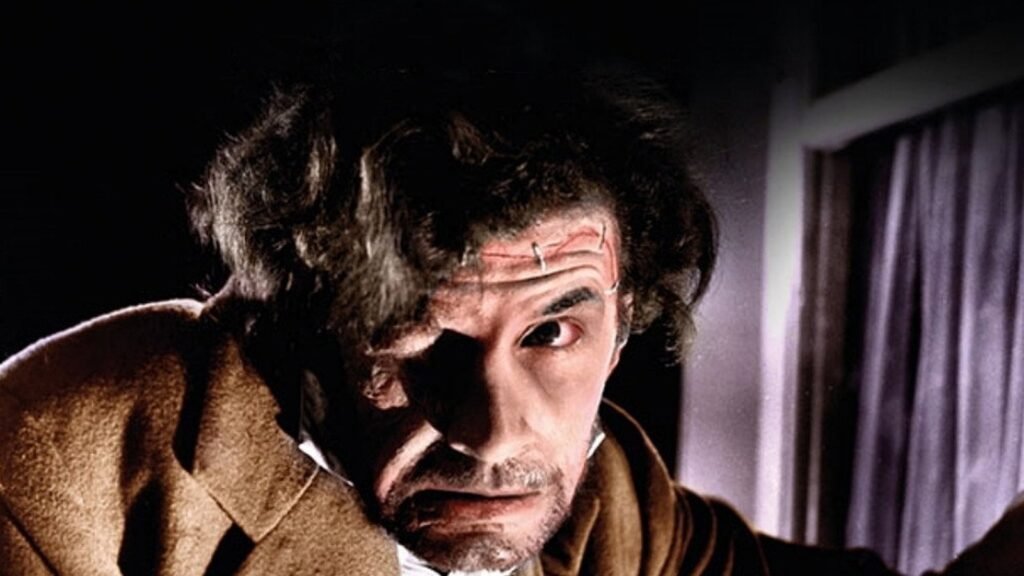
The Revenge of Frankenstein (1958) is Hammer’s first Frankenstein sequel, in which Peter Cushing’s Baron cheats the guillotine and rebuilds himself. Most sequels begin by resurrecting their monster. This one begins by resurrecting its maker — and it does it in the first reel, with a swapped corpse, a kept promise and a grave dug under the wrong name. The Curse of Frankenstein ended with Baron Victor Frankenstein walking to the guillotine for murders his creature committed. The Revenge of Frankenstein opens at that same scaffold — and then simply declines to let him die. What follows is the strangest and saddest film in Hammer’s Frankenstein series: not a rampage, but a story about a man who keeps his bargains and a patient who pays for one.
Quick Specs
- Director: Terence Fisher
- Screenplay: Jimmy Sangster
- Additional dialogue: Hurford Janes; George Baxt (uncredited)
- Producer: Anthony Hinds; associate producer Anthony Nelson Keys; executive producer Michael Carreras
- Starring: Peter Cushing, Francis Matthews, Eunice Gayson, Michael Gwynn, Oscar Quitak
- Cinematography: Jack Asher
- Editor: Alfred Cox
- Music: Leonard Salzedo
- Production design: Bernard Robinson
- Make-up: Phil Leakey
- Studio: Hammer Film Productions
- Distributor: Columbia Pictures
- Released: June 1958 (US); the UK release followed later in 1958 — the surviving listings disagree on the date, and no single one is settled
- Running time: about 90 minutes (listings run 89–91)
- Setting: 1860, then three years later in Carlsbruck
A priest dies in the Baron’s place
Get the escape right, because the folklore gets it wrong. Nobody bribed anybody. The priest who had heard the condemned Baron’s confession was substituted for him on the scaffold — executed and buried in the Baron’s place — and the switch was engineered by Karl, the crippled dwarf who served at the execution. Karl’s price was not money. It was the Baron’s promise: a perfect new body, built for the brain of a man who had spent his life being stared at. When grave robbers later crack open the Baron’s coffin, they find the priest — and the living Baron standing over them, reburying the casket beneath his own tombstone. Peter Cushing plays the whole sequence with the calm of a man reading a train timetable. Death, for this Baron, is an administrative problem.
Dr. Victor Stein of Carlsbruck
Three years later, the Baron is Dr. Victor Stein — hold the name exactly; it is the only name he practises under in this film — and he is the most sought-after physician in Carlsbruck. The rich pay him in private practice. The poor get him for free at the poor hospital, and the poor hospital quietly supplies him with something else: body parts. It is a perfect arrangement, and Terence Fisher shoots it as one — the respectable surface and the cellar laboratory are the same enterprise, separated by a staircase.
Into this walks Dr. Hans Kleve, a junior member of the local medical council, played by Francis Matthews. Hans has recognised “Dr. Stein” — he attended the Baron’s funeral, and he knows exactly whose funeral the town thinks it held — and, an admirer rather than a blackmailer in the film’s own telling, he asks to become the great man’s apprentice. Stein accepts. Margaret Conrad, played by Eunice Gayson, is the well-born volunteer who works alongside them at the hospital; her role in what follows is simple kindness, which turns out to be the most dangerous thing in the building.
Around the principals, the credits fill the town out: John Welsh as Bergman, Lionel Jeffries as Fritz, Richard Wordsworth as the Up Patient, Charles Lloyd-Pack as President of the Medical Council — the man who will eventually demand Stein prove he is not Frankenstein — George Woodbridge as the Janitor, Michael Ripper as Kurt, John Stuart as the Inspector, and Arnold Diamond as Dr. Molke. It is a company of faces Hammer audiences would come to know by heart, arranged here as a whole society — council, hospital, police, patients — for one man to hide inside.
Two actors, one Karl
Here is the credit this film is most often misread on, so read it carefully. Karl is played by two men. Oscar Quitak plays Karl in his original, deformed body — the full credits bill him simply as “the Dwarf.” Michael Gwynn plays Karl only after the transplant, in the healthy created body, billed as “Karl.” The body itself, shown to Hans in the cellar among Stein’s tanks of suspended parts, is a perfect specimen assembled from parts harvested from the Baron’s own poor-hospital patients — lacking only a brain. Karl volunteers his. It is not a theft and it is not a trick: it is a debt being honoured, the agreed payment for a rescue at the scaffold. The transplant succeeds. For one brief stretch of this film, everybody has kept their word and everybody is happy. This is a Frankenstein picture. You know how long that lasts.
The warning nobody heeded
Hans, thrilled, tells the recovering Karl that he will be exhibited as a medical sensation. Karl — who has been gawped at his entire life — panics, and persuades Margaret to loosen his straps so he can move. He flees to the laboratory to burn his preserved old body, and there the drunken janitor takes him for a burglar and strikes him on the head. It is the one thing Hans had warned against: no hard blows until the head has healed. Karl kills the janitor, and hides; Margaret finds him in her aunt’s stable, and while she goes for help, his arm and leg begin to fail. The damaged brain is progressively re-imposing the old deformities — the twisted arm, the hunched back, the lame leg — on the new body.
And there is a grimmer symptom, built into the experiment from the start. The transplant mirrors the Baron’s earlier animal trial: a chimp given an orangutan’s brain ate its mate. Hans remembers that warning sign while Karl is still recovering — and Stein, told of it, dismisses the concern and carries on. In Karl, as the new body breaks down, the same side effect rises as cannibalistic cravings and savagery. Be precise about what the film shows: Karl ambushes and strangles Gerda, a local girl. The film hints at the hunger; it does not stage it. The horror is in the diagnosis, not the dinner.
The Baron does not die
The end comes at an evening reception. Karl, his deformities fully redeveloped, bursts in, begs “Frankenstein” for help by his real name, collapses and dies. Exposed, Stein denies everything to the medical council and challenges them to prove it; they open the Baron’s grave and find the priest. At the poor hospital, the patients — who now know exactly where their doctor’s spare parts came from — beat the Baron savagely. Read the ending plainly: they do not kill him. Hans rushes him to the laboratory and transplants his brain into a replica body the Baron had prepared in his own likeness; when the police arrive, Hans shows them the Baron’s corpse, and they leave satisfied. The film closes in London, where Hans assists the revived Baron as he receives patients — under a new name at last: Dr. Franck. That name belongs to this film’s closing coda and nowhere else in the series.
A man who plans his own succession
Sit with that ending, because it is the film in miniature. The replica body was not an improvisation. The Baron had prepared it in advance, in his own likeness, against exactly the emergency that arrived — a man who had already cheated one execution making sure a beating could not finish the job either. And the pattern was set by the film’s own structure: Karl’s transplant, the great set-piece of the middle, is the rehearsal for the Baron’s. The apprentice performs on the master the operation the master performed on his rescuer, and the debt Karl owed is repaid in kind, one generation of the work handing the brain to the next pair of hands. Frankenstein’s real creation in this film is not a body. It is a procedure for never dying — tested on a dwarf who wanted to live, perfected on the man who invented it. That is why the London coda lands so coldly: nothing has been learned, nothing has been repented, and the surgery is open for business under a new name.
The sequel that was sold off a poster
The production story is pure Hammer. Carreras presold the film in America on the strength of a poster before a script existed; when screenwriter Jimmy Sangster protested — “I killed Frankenstein in the first film” — Carreras gave him six weeks before shooting and told him, “you’ll think of something.” He did. The film was shot at Bray Studios, with production commencing on 6 January 1958 — three days after filming wrapped on Dracula (1958), which likewise starred Cushing under Fisher’s direction. In America it opened in June 1958 on a double bill with Curse of the Demon, Jacques Tourneur’s film. No verified budget or box-office gross for this film has ever surfaced, so this page prints none.
The craft bench is the classic early-Hammer line-up, and it shows: Jack Asher’s Technicolor photography, Bernard Robinson’s production design building the respectable surgery and the cellar beneath it as one continuous lie, Phil Leakey’s make-up charting Karl’s regression across Gwynn’s face, and Leonard Salzedo’s score underneath it all. This is the same unit that had just redefined British horror in colour the year before, now turning its polish on a story with no rampaging creature in it — the colour, the sets and the surgery have to supply the spectacle, and they do.
It is also, in the whole Hammer Frankenstein series, the continuity exception. This is the only entry that picks its predecessor up at the exact moment it ended and honours every consequence. The line does not hold: The Evil of Frankenstein (1964) discards this film’s ending entirely and reboots the Baron’s history — its Hans is a different man from this film’s Hans Kleve, in a different continuity, and the two should never be merged. Revenge is the one time Hammer treated its Baron like a character in a serial instead of a reset button.
The sympathetic Baron
The contemporary notices were warm. Variety called it “a high grade horror film” with “rich” production values and a script “well-plotted, peopled with interesting characters.” Motion Picture Daily praised “a horror picture turned out with creative skill and imagination” and Hammer’s “stunning use of color for frightening effects.” Harrison’s Reports called it “a first-rate picture of its kind.” The Monthly Film Bulletin dissented, finding “a contrived plot and a notable lack of pace and imagination.”
Modern readings have settled on the thing that makes the film ache: this is the most human Baron Cushing ever played. Time Out’s David Parkinson described him as “a kind of Wildean martyr, alternating between noble defiance and detached cruelty,” and Empire called the film an “expertly executed example of a golden time in British cinema — one to savour.” On Rotten Tomatoes it stands at 87% from 15 reviews. The revenge of the title, in the end, is barely the Baron’s at all. It is the story’s — on every sequel that ever treated a brain transplant as a magic trick with no bill attached. Here, the bill comes due in the body of the one man who asked for nothing but a whole life, and was given it, and had it taken back by a drunk with a heavy hand. Of all Hammer’s Frankensteins, this is the one that hurts.