
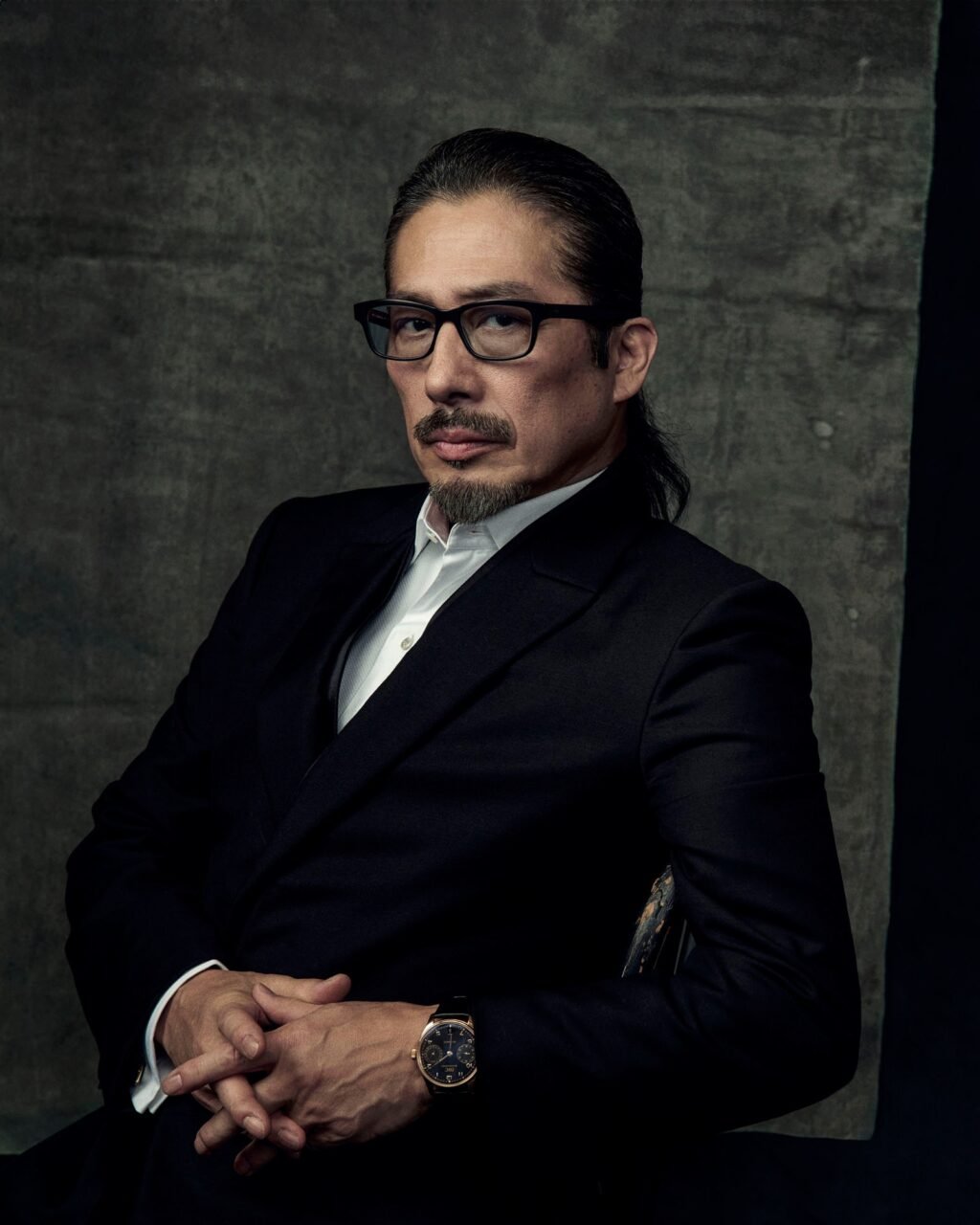
Hiroyuki Sanada (born 1960) is the Japanese actor who played Ryūji Takayama in Ringu and its Japanese sequels, and Lord Toranaga in Shōgun.
Quick Specs
| Born | Hiroyuki Shimosawa (also rendered Shimozawa), October 12, 1960, Shinagawa, Tokyo |
| Screen debut | Game of Chance (1966), aged five |
| Training | Himawari Theatre Group from age five; Shorinji Kempo and Kyokushin karate; Sonny Chiba’s Japan Action Club; Nihon University film course (graduated 1982) |
| Horror | Ryūji Takayama in Ring (Ringu, 1998), Spiral (Rasen, 1998) and Ring 2 (1999) |
| Stage | the Fool in the Royal Shakespeare Company’s King Lear (1999 to 2000) |
| Honours | honorary MBE (2002); Japan Academy Film Prize for Best Actor, The Twilight Samurai |
| Shōgun (2024) | Emmys for Lead Actor in a Drama Series and, as producer, Outstanding Drama Series; Golden Globe (January 2025) |
| Also credited as | Henry, Harry or Duke Sanada in Hong Kong and international releases |
Who He Is
Hiroyuki Sanada was born Hiroyuki Shimosawa (the name is also rendered Shimozawa) on October 12, 1960, in Shinagawa, Tokyo. He was scouted as a small child while playing with the son of the actor Kokichi Takada, who lived in the same building, modelled for children’s magazines, and joined the Himawari Theatre Group at five. That same year, 1966, he made his film debut in Game of Chance, as the son of Sonny Chiba’s character. After a few more child roles he stepped away to have an ordinary school childhood, a break that, he has said, let him watch films “as the audience.”
He trained in Shorinji Kempo and then Kyokushin karate, and in his early teens came under Chiba’s wing as a member of the Japan Action Club, Chiba’s stable of performers who could act, fight, sing, dance, do stunts and ride. He went to Horikoshi High School and graduated from the film course at Nihon University in 1982. When he relaunched as an adult with The Yagyū Conspiracy (also released as Shogun’s Samurai, 1978), it was under a new stage surname, Sanada. He was also a recording artist in his idol years, releasing albums including Movin’ Out (1986), Into the Street (1987) and Faded Town (1989).
He was married to the actress Satomi Tezuka from 1990 until their divorce in 1997, and they have two sons.
The Work, and What He Did in It
The early adult career was action. In G.I. Samurai (1979) he drew attention for a helicopter jump, with action directed by Chiba. He played the Iga ninja Kirimaru in Kinji Fukasaku’s hit Samurai Reincarnation (1981) and starred in Fukasaku’s Legend of the Eight Samurai (1983), the peak of his action-idol period. In Hong Kong he made Ninja in the Dragon’s Den (1982) and Royal Warriors (1986), opposite Michelle Yeoh. The turn to serious drama is usually dated to Makoto Wada’s Mahjong Hōrōki (The Mahjong Chronicles, 1984), and he went on to appear in every Wada film after it.
Then came the film that changed world horror. Ring (Ringu, 1998), directed by Hideo Nakata from Hiroshi Takahashi’s script of Koji Suzuki’s novel, opened in Japan on January 31, 1998, when Sanada was 37. He plays Ryūji Takayama, the ex-husband of the journalist Reiko Asakawa (Nanako Matsushima) and father of their son, Yōichi: a former medical student turned university professor with a genuine sixth sense for the supernatural. It was his second time opposite Matsushima, after the 1997 TV drama Konna Koi no Hanashi.
Where Reiko investigates as a reporter, Ryūji is the rationalist who believes the evidence. He watches the cursed tape voluntarily, works the Yamamura case with her, goes down into the well, and, believing the curse lifted, is the one Sadako comes for at the climax, crawling out of his television while Reiko hears his last moments over the phone. Sanada plays him dry and sceptical, and that is why the death lands: horror’s most famous videotape kills its most rational man.
Spiral (Rasen, 1998), directed by Jōji Iida from Suzuki’s sequel novel, opened the same day as a double-bill companion. It begins with Ryūji’s autopsy, performed by his friend Andō, who finds the post-mortem message that restarts the curse, and Ryūji returns within the story as a resurrected, prophesying presence: “Many years will pass before our world will be at peace.” Spiral flopped and was replaced as the official sequel by Ring 2 (1999), which Nakata directed and which ignores it. Released on January 23, 1999, Ring 2 brings Ryūji back as a spirit in the climax: inside the well he absorbs Yōichi’s fear and summons the rope that guides Mai Takano to safety. It was the second-highest-grossing Japanese film of 1999. Those two films are his whole sequel record. He is not in the American The Ring Two (2005).
In 1999 and 2000 he played the Fool, in English, to Nigel Hawthorne’s Lear in Yukio Ninagawa’s King Lear for the Royal Shakespeare Company. The engagement brought him an honorary MBE in 2002 for his contribution to spreading British culture in Japan.
The Twilight Samurai (Tasogare Seibei, 2002) is his dramatic peak. In Yoji Yamada’s film he is Seibei Iguchi, a low-ranking widowed samurai working as a clerk to support two daughters and a senile mother, who has pawned his sword and is ordered into one last duel. The Japan Action Club star played a man who has put the sword away, and the film swept Japan: twelve Japan Academy Film Prizes including Best Picture, with Best Actor for Sanada, who also took Best Actor honours from Kinema Junpo, Mainichi and Nikkan Sports. It was nominated for the Oscar for Best Foreign Language Film. He was 42 when it opened, and he was in New Zealand filming The Last Samurai (2003) when the Japanese prizes were handed out. In that film, his international breakthrough, he is Ujio, the master swordsman of Katsumoto’s village, opposite Tom Cruise and Ken Watanabe.
The English-language run followed: Matsuda in Merchant Ivory’s last film, The White Countess (2005); a Mandarin-speaking role in China’s The Promise (2005); Kaneda, captain of the Icarus II, in Danny Boyle’s Sunshine (2007), reunited with Michelle Yeoh; Kenji in Rush Hour 3 (2007), his first film with his old friend Jackie Chan; and Mr. Musha in Speed Racer (2008). On American television he was Dogen, the temple guardian of the final season of Lost (2010), then appeared in Revenge, Extant and Helix. He played Shingen Yashida in The Wolverine (2013), was in 47 Ronin and The Railway Man (both 2013), and played Tamiki Umezawa opposite Ian McKellen in Mr. Holmes (2015).
His elder-statesman action run cast him as the still point inside chaos: a brief turn as the yakuza boss Akihiko in Avengers: Endgame (2019), Hanzo Hasashi, Scorpion, bookending Mortal Kombat (2021), the Elder in Bullet Train (2022), and Koji Shimazu, manager of the Osaka Continental, opposite Keanu Reeves and Donnie Yen in John Wick: Chapter 4 (2023).
Shōgun (2024) was the summit. Created by Rachel Kondo and Justin Marks for FX from James Clavell’s 1975 novel, it cast Sanada as Lord Yoshii Toranaga, modelled on Tokugawa Ieyasu, and gave him the first producer credit of his career. He had joined as an actor and was asked to produce, and his condition was that he could build the authenticity apparatus himself. He hired Japanese specialists into every department, samurai-drama experts for wigs, costumes and props and a “master of gesture” for period movement, and oversaw a script pipeline in which English drafts were translated into period Japanese and back, by his account roughly twenty rounds per episode. The performance is stillness as strategy, a lord who wins by waiting, played mostly in Japanese in an American series.
The series won 18 Emmys in one season, a record, 14 of them at the Creative Arts ceremonies. On September 15, 2024, at 63, Sanada won two himself: Lead Actor in a Drama Series and, as a producer, Outstanding Drama Series. He was the second actor of Asian descent to win Lead Actor in a Drama, after Lee Jung-jae for Squid Game. In January 2025, at 64, he added the Golden Globe for Best Actor in a Television Series, Drama.
Cool Verified Facts
- He is the only actor in all three Japanese Ring films of 1998 and 1999: alive in Ring, a corpse and an oracle in Spiral, a ghost in Ring 2.
- His first film role, at five, was as Sonny Chiba’s son. Chiba became his martial-arts mentor.
- The MBE is often reported as a reward for being the first Japanese actor with the Royal Shakespeare Company. He was not the first: Togo Igawa performed with the RSC in 1985 and joined the company in 1986. The honour was for spreading British culture in Japan.
- The first Shōgun adaptation’s Mariko, Yoko Shimada, won the Golden Globe for Best Actress in 1981. Anna Sawai won the same Globe for the same role in 2025, the year Sanada won his.
- He knew Michelle Yeoh from the Hong Kong circuit long before Sunshine, and Jackie Chan long before Rush Hour 3, their first film together.
Signatures, Habits and Behind the Scenes
Authenticity is his crusade, and Shōgun gave it authority. For about two decades on Western sets he corrected sword grips, costume details and background movement informally between takes, with no title that made anyone listen. The producer credit changed that. As he put it, “they listen to me.” Co-creator Justin Marks has said that beyond being first on the call sheet, Sanada’s job was “making sure we were getting everything absolutely right,” down to climbing off his horse in full armour after battle scenes to check background movement at the monitor.
It started earlier. Sanada later said that on The Last Samurai he coached Tom Cruise on Japanese sword grip, stance and use of the eyes during their months of training, and that Cruise “was a good learner and a hard worker.”
His method is less is more: build everything around the character beforehand, then on camera “just be there as a character with emotion.” It is the same dryness that makes Ryūji work. Sanada underplays and lets the supernatural do the shouting.
He did his own stunts as a young star, and was frank about the fear. In a July 1981 interview, at 20, discussing karate fights, a fight on a moving double-decker bus and a 25-metre helicopter jump into the sea without a double, he said: “I’m always scared. That’s why I become cautious… once I confirm safety, I can be bold.”
Why He Matters
For horror, Hiroyuki Sanada is the human face of the Ring revolution. J-horror conquered the world on atmosphere rather than gore, and its founding film needed a sceptic the audience could stand inside. Ryūji’s dry, professorial calm, and his death by television, made Sadako’s curse feel like a fact of modern life rather than a folk tale. He then carried the role through Spiral and Ring 2, the thread through all three Japanese films.
His filmography also bridges more of screen history than almost anyone’s: child actor in 1966, Japan Action Club idol, Wada and Nakata dramatic lead, RSC Shakespearean, Japan Academy Best Actor, Hollywood’s resident swordsman, and finally the first Japanese actor to win an Emmy, as actor and producer. Along the way he changed who holds authority on a Western set. The Shōgun model, the Japanese star as producer, hiring the gesture master and the wig specialists and proving the bet with a record awards haul, was built out of the corrections he had been making unpaid since The Last Samurai.