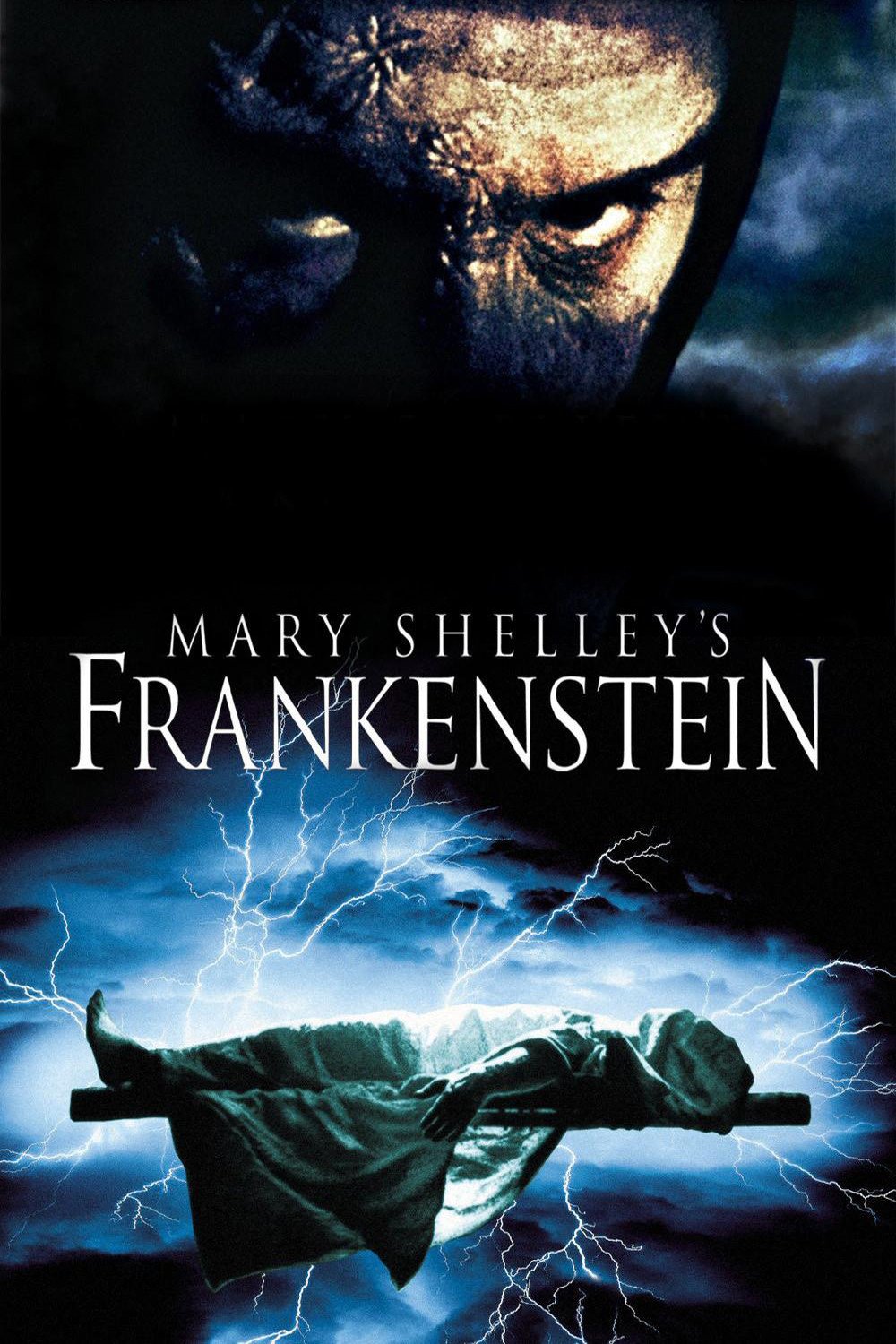
Mary Shelley’s Frankenstein (1994) is a Gothic horror film directed by Kenneth Branagh, who also plays Victor Frankenstein. Robert De Niro plays the Creature, called “the Creation” in the film. Tom Hulce, Helena Bonham Carter, Ian Holm, John Cleese and Aidan Quinn co-star. Produced by Francis Ford Coppola after he directed Bram Stoker’s Dracula (1992), it was written by Steph Lady and Frank Darabont. It is often described as one of the most faithful screen versions of Mary Shelley‘s 1818 novel. It keeps the Arctic frame story, the Creature’s education and his revenge, but adds a resurrected bride. It got mixed reviews and grossed $112 million worldwide on a $45 million budget. That was well short of Dracula, and both of its writers later disowned it.
At a glance
| Release date | November 3, 1994 (London Film Festival); November 4, 1994 (US and UK) |
| Director | Kenneth Branagh |
| Writers | Steph Lady and Frank Darabont |
| Based on | Frankenstein; or, The Modern Prometheus by Mary Shelley |
| Starring | Robert De Niro, Kenneth Branagh, Tom Hulce, Helena Bonham Carter, Aidan Quinn, Ian Holm, John Cleese |
| Runtime | 123 minutes |
| Rating | R (US) |
| Budget | $45 million |
| Box office | $112 million |
| Franchise | Frankenstein on film |
Plot summary
In 1794, Captain Walton’s (Aidan Quinn) ship is trapped in Arctic ice on the way to the North Pole. A cloaked man appears out of the mist, and his sled dogs are killed by something unseen. The stranger is Victor Frankenstein, and he tells Walton his story. Victor grew up in Geneva with his adopted sister, Elizabeth (Helena Bonham Carter). When his mother died giving birth to his brother William, he vowed to conquer death. At the University of Ingolstadt, he and his friend Henry Clerval (Tom Hulce) study under Professor Waldman (John Cleese), whose notes describe how to create life. Waldman warns him never to use them.
Waldman is murdered by a patient during a smallpox inoculation, and the killer is hanged. Victor builds a creature from the killer’s body and Waldman’s brain and brings it to life. Horrified by what he has made, he tries to kill it, but the Creature (Robert De Niro) escapes in Victor’s coat. Hiding in a family’s barn, he learns to speak and read by watching them. He secretly helps them and befriends their blind grandfather. When the rest of the family sees him, they drive him away. From Victor’s journal he learns how he was made, and he swears revenge on the man who brought him into a world that hates him.
Spoiler section: the bride and the ice
Victor’s brother William is murdered, and the servant Justine is blamed and hanged by a mob. The Creature confesses and demands a female companion, but Victor refuses when he insists on using Justine’s body. In revenge, the Creature kills Victor’s father, then rips out Elizabeth’s heart on her wedding night. Mad with grief, Victor reanimates Elizabeth with her head and hands stitched onto Justine’s body. When the Creature claims her, she sees what she has become and sets herself on fire. Back in the Arctic, Victor dies of pneumonia. Walton finds the Creature weeping over him. The Creature refuses to come aboard and burns himself alive on Victor’s funeral pyre, and Walton turns the ship for home.
Production and behind the scenes
Steph Lady’s original script was sold to Coppola’s American Zoetrope. Coppola first meant to direct it himself after Dracula, then chose to produce. Above all, he wanted De Niro as the Creature, over Gérard Depardieu and Andy GarcÃa, and De Niro chose Branagh to direct. Branagh brought in Darabont for a second draft. He insisted on more of the novel and on “explicitly sexual birth images,” and he drew on Mary Shelley’s own life “surrounded by images of death.” He added the resurrected bride, which isn’t in the novel, because he felt it made “psychological sense.” He contrasted it with James Whale’s films, which he described as “high camp.” Branagh called it “a family tragedy, like Shakespeare,” with echoes of Hamlet. In his view, Victor resists death rather than philosophizing about it. To prepare the Creature’s voice, De Niro studied stroke victims. Filming ran from October 21, 1993, to February 25, 1994. Patrick Doyle composed the score.
Release and reception
TriStar released the film on November 4, 1994, the day after its London Film Festival premiere. It opened at No. 2 in the US with $11,212,889, behind Stargate, and finished with only $22,006,296, more than half of it from the opening weekend. It did better in the UK and Ireland, where it opened at No. 1 and stayed there for a second week. Foreign earnings of $90 million brought the worldwide total to $112 million.
Rotten Tomatoes lists 42% of 52 reviews as positive, with a consensus calling it “ambitious and visually striking,” but with an “overwrought tone and lack of scares.” Roger Ebert gave it two and a half stars. He admired De Niro’s scenes but called the rest “so frantic, so manic.” Janet Maslin of The New York Times wrote that “Branagh is in over his head.” James Berardinelli gave it three stars, preferring its “overambition” to Hollywood fluff. Peter Travers named it the third-worst film of the year and Maslin the ninth. It received an Oscar nomination for Best Makeup and a BAFTA nomination for Tim Harvey’s production design. It also got seven Saturn nominations.
Legacy and influence
Both writers turned on the finished film. Lady called it “a misshapen monster born of Kenneth Branagh’s runaway ego.” Darabont called it “the best script I ever wrote and the worst movie I’ve ever seen,” saying it had “no patience for subtlety” while “Shelley’s book… whispers at you.” Even so, it is still often listed among the most faithful film versions of the novel. For other major versions, see Universal’s Frankenstein (1931) and Bride of Frankenstein (1935), Hammer’s The Curse of Frankenstein (1957) and Guillermo del Toro’s Frankenstein (2025).
Trivia
- Richard Briers plays the blind grandfather, Robert Hardy plays Professor Krempe, and Trevyn McDowell plays Justine.
- The resurrected Elizabeth is the film’s own version of the Bride of Frankenstein.
- A video game based on the film was released on several home consoles in 1994.
- Sega Pinball released a Mary Shelley’s Frankenstein pinball machine in early 1995. It is included in the simulator The Pinball Arcade.
- De Niro’s Saturn nomination was for Best Supporting Actor. Branagh and Bonham Carter were nominated in the lead categories.
Related links
- Frankenstein’s Monster and Victor Frankenstein (characters)
- Frankenstein on film
- Bram Stoker’s Dracula (1992), Coppola’s earlier Gothic adaptation
- Frankenstein (1931) and The Curse of Frankenstein (1957)
- Mary Shelley (author)
Trailer
Go Behind the Screams
Check out these behind-the-scenes looks at how Mary Shelley’s Frankenstein (1994) was made:
Vintage Interviews
Kenneth Branagh discusses Mary Shelley’s Frankenstein (1994) in this 1994 interview from the Bobbie Wygant Archive: