Horror Locations is Think Horror’s guide to the real places where famous horror films were shot, and what they look like today.
At a Glance
- Scope: real-world filming sites and the inspirations behind fictional horror settings
- Eras covered: silent cinema to the slasher boom and beyond
- Featured sites: Timberline Lodge, the Exorcist steps, the Kingsland Chain Saw house, South Pasadena’s Myers house, Camp No-Be-Bo-Sco, Evans City Cemetery, Orava Castle
- Related hub: Horror Movies
- Visiting note: many sites are private homes or working businesses, so check access rules before traveling
Overview
Horror depends on place. A cursed hotel, a farmhouse at the end of a dirt road or a lakeside summer camp can define a film as much as its villain does. Many of the genre’s most famous settings are real buildings that still stand, and some have become pilgrimage sites for fans. This page collects the most significant ones, explains how they were used, and notes where the screen version differs from reality. It works the way our film pages do, but the subject is the ground rather than the story: the summary below takes you on a tour, the “ending” covers how these places have been reshaped by their fame, and the trivia gathers the strangest facts.
The Tour
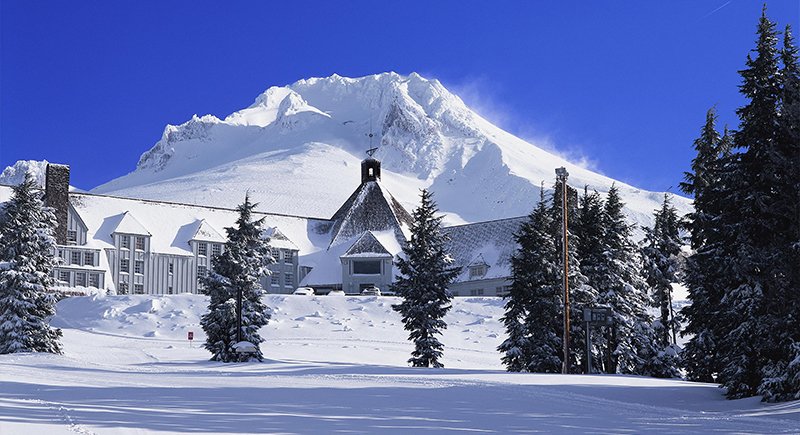
Timberline Lodge, Oregon. Stanley Kubrick’s The Shining (1980) used this Depression-era lodge on the slopes of Mount Hood for exterior shots of the Overlook Hotel. The interiors were built on soundstages at Elstree in England. Stephen King’s original inspiration was a different building, the Stanley Hotel in Estes Park, Colorado, where he stayed in 1974.
The Exorcist steps, Washington, D.C. The steep stone staircase beside the house in Georgetown provides the setting for Father Karras’s fatal fall in The Exorcist (1973). The crew padded the steps with rubber for the stunt and built a false-front extension so the house appeared to sit right at the top. The stairs are a public right of way and are now one of the most visited film locations in the city. The film’s prologue was shot in northern Iraq.
The Chain Saw house, Texas. The farmhouse where Leatherface’s family lives in The Texas Chain Saw Massacre (1974) originally stood near Round Rock. In the late 1990s it was dismantled and moved to Kingsland, Texas, where it was restored and turned into a restaurant.
The Myers house, South Pasadena. Although Halloween (1978) is set in Illinois, John Carpenter shot it in and around South Pasadena and Hollywood in the spring. The house used for young Michael’s home was saved from demolition in 1987 and moved to a new site in town, where it now holds offices.
Camp No-Be-Bo-Sco, New Jersey. The Boy Scout camp near Blairstown in Hardwick Township stood in for Camp Crystal Lake in Friday the 13th (1980). It is still an active scout camp and has occasionally opened for organized fan tours.
Evans City Cemetery, Pennsylvania. The opening graveyard attack in George A. Romero’s Night of the Living Dead (1968) was filmed here, north of Pittsburgh, and the cemetery chapel remains recognizable.
Orava Castle, Slovakia. F. W. Murnau used this clifftop fortress as Count Orlok’s castle in Nosferatu (1922); the German towns of Wismar and Lübeck provided the port city scenes.
Spoiler: The Ending
Fame changes these places. Some, like the Chain Saw house, were physically relocated and repurposed; others, like the Exorcist steps, gained plaques and tourist traffic. Hotels have learned to embrace their reputations, and the Stanley Hotel now runs ghost tours that trade on its link to King. At the same time, several sites sit on private land, and residents of famous film houses have long asked visitors to keep their distance. The lasting lesson is that horror’s most frightening houses are usually ordinary buildings that cameras taught us to fear.
Production
Location work shaped horror’s style. Low-budget filmmakers such as Romero and Tobe Hooper shot on real farms and cemeteries because they could not afford sets, and that authenticity became part of the terror. Studio productions like The Shining blended real exteriors with built interiors. Psycho’s house and motel, by contrast, were constructed on the Universal backlot, where versions of them still stand on the studio tour.
Themes
The genre returns again and again to isolated homes, abandoned institutions and places with a past. Real locations give audiences the uneasy sense that a film’s events could have happened in a building they might pass on a drive. That blend of fact and fiction is why fans still travel to these sites decades later.
Trivia
- Kubrick changed the Overlook’s haunted room from King’s 217 to 237, a change widely attributed to the lodge’s concerns about guests avoiding Room 217.
- The Exorcist stairway was nicknamed the “Hitchcock steps” by locals before the film, and is now known by the film’s name.
- The restored Chain Saw house in Kingsland has operated as the Grand Central Cafe.
- Halloween’s autumn leaves were painted props, because the film was shot in spring in California.
- In 2015 Washington, D.C. formally recognized the Exorcist steps as a landmark, unveiling a plaque at their base with William Friedkin and William Peter Blatty present.
- Psycho’s backlot house is a façade, not a complete building.