
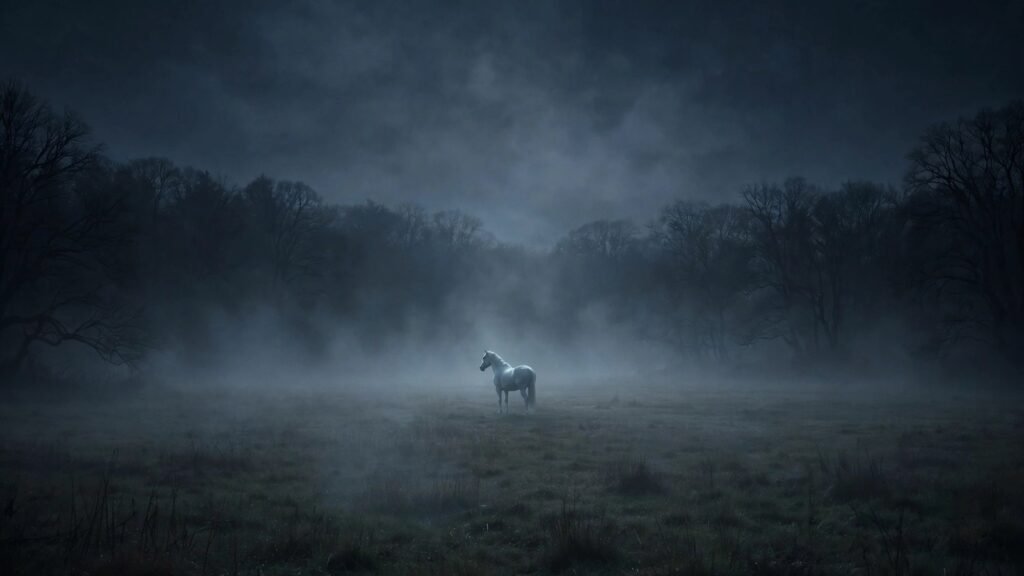
Halloween II (2009) is a 2009 American slasher film written, directed and produced by Rob Zombie — the sequel to his Halloween (2007), the tenth film in the Halloween franchise, and not a remake of Halloween II (1981), despite the title. Where the 2007 film restaged Carpenter’s night, this one leaves the template behind almost entirely: it is a film about what the first film’s night did to the people who survived it. Laurie Strode, living with Sheriff Brackett and his daughter Annie, is coming apart — drinking, raging, in therapy — while her brother Michael, missing and presumed dead, lives rough in the countryside, guided by visions of their dead mother leading a white horse. Dr. Loomis, meanwhile, has survived too, and reinvented himself as a celebrity true-crime author touring a book that will tell Laurie the one secret everyone kept from her. Shot in eight months from signing to screen, on grainy Super 16mm in rural Georgia, the film was the worst-reviewed Halloween of its era and opened third behind The Final Destination. It has also become the franchise’s most argued-over entry: the director’s cut — two years later instead of one, and with an ending in which nearly everyone dies — is now championed by the BFI and a generation of critics as the bleakest and most personal film in the series. It was Zombie’s last Halloween.
At a glance
- Director: Rob Zombie
- Written by: Rob Zombie, based on characters by John Carpenter and Debra Hill
- Produced by: Malek Akkad, Andy Gould, Rob Zombie
- Starring: Scout Taylor-Compton, Tyler Mane, Malcolm McDowell, Brad Dourif, Danielle Harris, Sheri Moon Zombie
- Cinematography: Brandon Trost
- Edited by: Glenn Garland, Joel T. Pashby
- Music: Tyler Bates
- Production companies: Dimension Films, Trancas International Films, Spectacle Entertainment Group
- Release date: August 28, 2009
- Running time: 105 minutes (theatrical cut); 119 minutes (unrated director’s cut)
- Budget: $15 million
- Box office: $39.4 million worldwide
- Rating: R (theatrical cut); Unrated (director’s cut)
Plot
The film opens in the past: at Smith’s Grove Sanitarium, young Michael tells his mother Deborah about his dream of a white horse, and she gives him a white horse figure. It then picks up on the night of the first film — and the opening is the most misreported sequence in the franchise, so it is worth stating exactly. Laurie, in shock after shooting Michael, is found by Sheriff Brackett and rushed to hospital. Annie and Loomis are brought in alive. Michael’s body is loaded into a coroner’s van — which crashes into a cow on the road. Michael revives, beheads the surviving coroner, and walks off into the dark toward a vision of Deborah in white, leading a white horse. His body is never recovered. That much really happened. What follows — Michael stalking through the hospital, murdering nurses and a security guard, hunting Laurie through the wards and cornering her in a gatehouse — is Laurie’s nightmare. She wakes screaming in her bed at the Brackett house.
One year later (the director’s cut makes it two), Laurie lives with Sheriff Brackett and Annie. The two girls survived the same night and are handling it in opposite ways — Annie quiet and scarred, Laurie loud, drinking, reinventing herself in thrift-store grunge, working at a local book and coffee shop with her friends Mya and Harley, and unravelling in therapy with Barbara Collier. Michael is presumed dead. He is not: bearded and living rough in the countryside, he is guided by visions of Deborah, dressed in white with the white horse, and of his younger self — telling him the time is coming to bring Laurie home so the family can be together again. On his walk back toward Haddonfield he kills a farm family and their dog.
Dr. Loomis survived too, and he has a book to sell: The Devil Walks Among Us, a celebrity true-crime tour complete with a publicist, talk-show appearances and public confrontations — including a signing where Lynda’s father pulls a gun on him. It is the book that breaks Laurie. Reading it in the shop, she learns what Loomis never told her: she is Angel Myers, Michael’s baby sister. She spirals — and on Halloween night she goes with Mya and Harley to the Phantom Jam party to outrun it. Michael kills Harley at the party, then goes to the Brackett house and attacks Annie. Laurie and Mya come home to find Annie dying in the bathroom; she dies in Laurie’s arms. Michael kills Mya, chases Laurie, flips the car she flags down, and carries her, unconscious, to an abandoned shack.
Inside the shack, Laurie — who by now sees Deborah and young Michael too, the film’s suggestion being that the siblings share the same sickness — is held in the family tableau by the visions. Loomis arrives as police surround the building and goes in to reason with Michael. In the theatrical ending, Michael stabs Loomis to death; Brackett shoots Michael through the window and he falls, impaled on a rake; Laurie takes Michael’s own knife, stabs him repeatedly, and walks out of the shack wearing his torn mask. The final scene finds her alone in a psychiatric ward, grinning, as Deborah’s ghost approaches her leading the white horse.
The director’s cut ending
The director’s cut — Zombie’s preferred version — changes the jump to two years and ends far more bleakly. At the shack, Michael hurls Loomis through the wall, tears off his own mask and, speaking the only word he says in either of Zombie’s films, yells “Die!” as he stabs Loomis dead. Police gunfire kills Michael. Laurie, dazed, picks up his knife and moves toward Loomis’s body — and despite Brackett’s shouted protests, the police shoot her dead. The ward, Deborah and the white horse appear as her dying vision, over Nan Vernon’s cover of “Love Hurts.” This ending was not invented for home video: it was filmed during production and described from the set in 2009; the director’s cut restores it.
Production
Zombie did not want to come back. “I was so burnt out after making Halloween,” he said in 2009. “Halloween was a very difficult shoot. It was not particularly enjoyable.” With him assumed out, the producers turned to Julien Maury and Alexandre Bustillo, the French directors of Inside, who confirmed themselves as the sequel’s directors in August 2008. Their account, given later, is that Bob Weinstein and Malek Akkad loved their script and that handing the seat back was “a relief”; Akkad’s account is that something was “lost in the translation” and the producers “really wanted Zombie to return.” Nobody fired anybody — Akkad simply offered Zombie terms no director turns down: “Don’t feel hindered by any of the rules we’ve had in the past. I want this to be your vision and I want you to express that vision.” Variety reported Zombie’s signing on December 15, 2008. His own accounts of why he returned differ by telling — that he traded the film against release from a three-picture Weinstein deal, and that, having missed the actors, he came back curious when he learned the sequel had no script at all — and both are his to tell.
What followed was fast to the point of violence: signed in mid-December, shooting by February 23, 2009, in cinemas August 28 — roughly eight months, signing to screen. “Everything has been fast and furious with this one,” Zombie said during production. He shot in Georgia — Covington’s town square and Newborn’s houses standing in for a Haddonfield far more rural than Carpenter’s — partly for the tax breaks but, by his account, mainly because his other candidate locations were still snowbound and Georgia had the look. And he shot on Super 16mm with cinematographer Brandon Trost, the deliberate opposite of the first film: “We went back and shot it on super-16mm and it’s got a dirty vibe that’s my thing. I felt on the last movie my thing had been removed.” One casting change was forced: Daeg Faerch, the young Michael of 2007, had grown too tall over the intervening years and was recast with Chase Wright Vanek — footage of Faerch shot as a test still made it into the first teaser trailer, which is why he appears to be in a film he is not in.
Zombie’s stated intentions were on the record throughout: the film would be about “the idea that they share similar psychological problems” — Laurie slipping into the family insanity in her own way while Michael, unchanged since he was ten, simply walks toward home. Loomis, channelled in part from Manson prosecutor-turned-author Vincent Bugliosi, would be a sellout. And the score would hold Carpenter’s theme back to the very end: Zombie and Tyler Bates kept trying it elsewhere and it “just wouldn’t feel right.”
Release
The film opened August 28, 2009, in 3,025 theatres — directly against Warner’s The Final Destination, which took the weekend with $27.4 million while Halloween II opened third with $16.3 million; the Los Angeles Times framed it as the two horror films splitting the horror audience. Even so, that single weekend out-grossed the entire runs of three earlier Halloween sequels. It finished at $33.4 million domestic and $39.4 million worldwide on its $15 million budget, and was re-released on October 30, 2009 for the Halloween weekend. On home video from January 12, 2010, it began its second life: the US Blu-ray carried the unrated director’s cut only, and it is the director’s cut — longer, restructured, with the restored ending — that has circulated ever since.
Reception
Contemporary critics were harsh: 25% on Rotten Tomatoes, 35 on Metacritic. Variety‘s Rob Nelson called the Deborah and white-horse material “silly” and the film rushed and “slapped together.” The Boston Globe‘s Tom Russo found the dream imagery “pretentiously silly” while conceding it broke up the violence strangely, at moments like “Tim Burton doing straight horror.” Dread Central called it the most plodding entry in the franchise to date, while singling out Brad Dourif as its high point. But there were early defenders: Joe Neumaier in the New York Daily News wrote that Zombie “has found himself” — a successful character-based monster movie with “terrifically odd” music choices — and Time Out judged that the hospital opening bested the 1981 sequel in just about every respect and praised Taylor-Compton’s “intense, nontrivializing dedication to the role.”
The reappraisal has been sustained. In 2022 the British Film Institute’s “great horror film for every year” survey picked Halloween II for 2009, calling it the best since the original. Brian Collins’s 2015 defence at Birth.Movies.Death argued the director’s cut is “the only one to watch” — it restores Danielle Harris’s role, cut down theatrically, and ends with everyone dead. Assignment X called it “more arthouse than horror movie,” and ScreenRant’s defence line — that Zombie’s Halloween films “aren’t bad, they’re misunderstood” — has become the standard framing. The film is now widely described, by the critics who defend it, as the bleakest entry in the series and the most personal film Zombie made inside a franchise.
Legacy
Zombie’s “never” to a third film was on the record before this one even opened, and he kept it: Halloween II ended his tenure, making him at the time the only director to helm two consecutive franchise entries. The Weinsteins announced a Halloween 3D within days of the opening — a film which, remarkably, would have retconned this film’s ending so that Laurie had killed Loomis, not Michael — but it was removed from the schedule in 2012. Dimension lost the franchise rights in 2015; Blumhouse acquired them in 2016, and Halloween (2018) restarted the series as a direct sequel to the 1978 original, erasing the Zombie films along with every other sequel. What survives of them is the argument — and, in the director’s cut, the darkest ending any Halloween film has ever had.
Trivia
- Michael Myers speaks exactly one word across both of Zombie’s films — “Die!” — and only in the director’s cut of this one. In the theatrical cut he never speaks at all.
- Loomis’s book, The Devil Walks Among Us, is his second on Michael; the first, in the 2007 film, was The Devil’s Eye. The talk-show sequence he promotes it in features Chris Hardwick as the host and “Weird Al” Yankovic as himself.
- Carpenter’s Halloween theme is deliberately withheld until the closing stretch of the film — a decision Zombie and Tyler Bates made after finding it “wouldn’t feel right” anywhere earlier.
- The Phantom Jam party band, Captain Clegg and the Night Creatures, is fictional — but Zombie released a real album under their name on the film’s opening day.
- Nan Vernon, who covered “Mr. Sandman” for the 2007 film, returned to cover “Love Hurts” for this one; it plays over both endings.
Related links
- Halloween (2007)
- Rob Zombie
- Michael Myers
- Halloween (1978)
- Halloween II (1981)
- Halloween (2018)
- Halloween franchise
- John Carpenter
- Jamie Lee Curtis
- Sheri Moon Zombie
- Brad Dourif
- Caroline Williams
- Movies index