
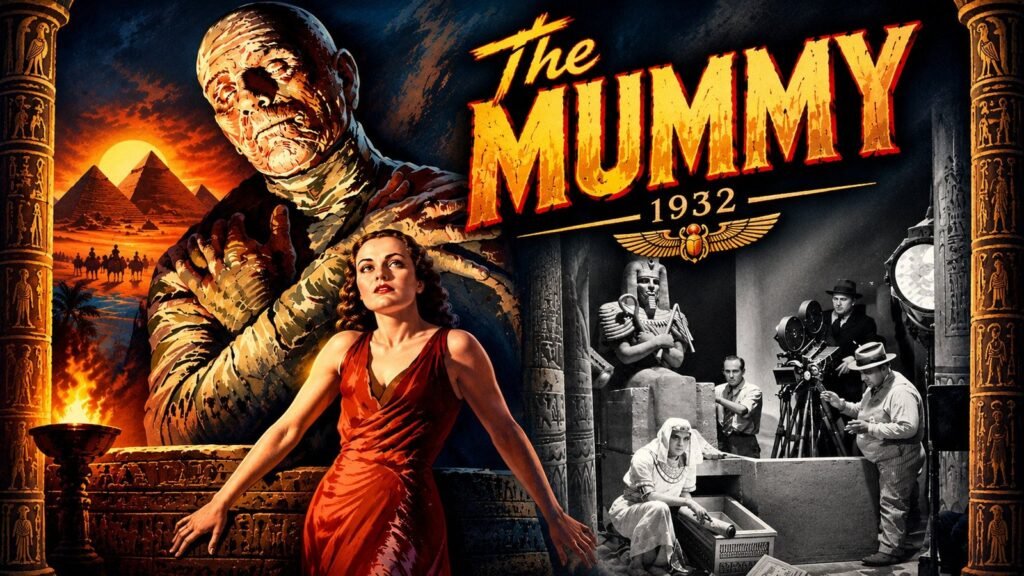
The Mummy (1932) is Universal’s pre-Code horror film in which Boris Karloff’s Imhotep hunts the reincarnation of his lost princess.
Every monster in the Universal stable arrived with a famous book or a famous stage play behind it — except this one. The Mummy was built from scratch in a year when Egypt was the hottest property in the newspapers, and it gave Boris Karloff the follow-up role that proved Frankenstein was no fluke. He was billed, simply and perfectly, as “Karloff the Uncanny.”
This is the quiet one of the classic cycle. No mob storms the castle; no laboratory crackles. A dried hand stirs in a casket, a young man laughs himself mad, and a three-thousand-year-old priest in modern dress spends the rest of the picture trying to reclaim the woman he lost. Mood does the heavy lifting here, creeps — and the mood is magnificent.
Quick Specs
- Title: The Mummy
- Year: 1932
- Director: Karl Freund
- Producer: Carl Laemmle Jr.
- Screenplay: John L. Balderston
- Story: Nina Wilcox Putnam and Richard Schayer
- Starring: Boris Karloff, Zita Johann, David Manners, Arthur Byron, Edward Van Sloan
- Studio: Universal Pictures
- Released: December 22, 1932 (USA)
- Runtime: 73 minutes (most listings; AFI lists 72 or 78)
- Budget: About $196,000 (estimated)
The Story of Imhotep
In 1921, a British expedition led by Sir Joseph Whemple uncovers the tomb of Imhotep, an ancient Egyptian high priest. The examination tells a grim story: the viscera were never removed, there is no embalmer’s incision — Imhotep was buried alive, punished for trying to resurrect his forbidden lover, the Princess Ankh-es-en-Amon.
Dr. Muller warns them off in terms that could not be plainer: put it back, bury it where you found it. Sir Joseph’s assistant, Ralph Norton, does the opposite. Alone with the casket, he opens the Scroll of Thoth, translates it, and reads the life-giving words aloud. The film shows us the Scroll’s text itself, just after the credits: herein are set down the magic words by which Isis raised Osiris from the dead — “Death is but the doorway to new life. We live today — we shall live again.” The mummy’s eyes open. Norton is found laughing hysterically, quite mad, and Imhotep is gone, Scroll in hand.
Ten years later, a gaunt Egyptian calling himself Ardath Bey presents himself to Sir Joseph’s son Frank and Professor Pearson, and helpfully points them to the untouched tomb of Ankh-es-en-Amon. The treasures go to the Cairo Museum. The real prize, for Ardath Bey, is Helen Grosvenor, a young woman living in Cairo whom he knows — knows — is the princess reborn.
What follows is a siege conducted with hypnotic patience. Imhotep kills Sir Joseph to keep the Scroll from the fire. He draws Helen to him across the city. And in the temple climax, with Helen dressed in the princess’s own clothes and jewels, he burns Ankh-es-en-Amon’s mummy — leaving her soul nowhere in this world to return to but the living woman in front of him. He means to kill her, embalm her, and raise her to walk eternity beside him.
Spoiler, boils and ghouls — the ending. Helen, possessed by the princess’s returning memory, does the one thing nobody in this picture thinks to do: she prays. She appeals to Isis — and the statue of the goddess raises its arm. The Scroll of Thoth burns. The spell that has sustained Imhotep for three thousand years breaks, and before Frank’s eyes the priest ages, dies, and crumbles to dust. Helen wakes as herself, in Frank’s arms.
Born as Cagliostro
Here is the part that surprises people: there is no novel behind The Mummy, and no play. Carl Laemmle Jr. wanted one — Dracula and Frankenstein had both come off the shelf — so story editor Richard Schayer went hunting for an Egyptian horror property and found nothing that fit, only a vaguely suggestive Arthur Conan Doyle tale, The Ring of Thoth.
So Schayer and Nina Wilcox Putnam wrote one. Their nine-page treatment, “Cagliostro,” told of a 3,000-year-old magician keeping himself alive with nitrate injections in modern San Francisco, killing women who resembled a lost love. Laemmle then hired John L. Balderston — a veteran of both Dracula and Frankenstein who had covered the opening of Tutankhamun’s tomb as a newspaper reporter — to write the screenplay. Balderston moved the story to Egypt, traded the science for the supernatural, and renamed his villain Imhotep, borrowing the name of the real Third Dynasty architect. He delivered the script on September 12, 1932, under the title Im-Ho-Tep. The picture also carried the working title The King of the Dead before settling on the name that stuck.
The shoot itself was swift, the way Universal liked them: interiors on the studio lot, filmed from mid-September to mid-October 1932, in black and white at the old Academy ratio of 1.37:1, and copyrighted on December 14, 1932 — eight days before it opened. A poem of doom, produced on a schedule like a sausage.
The Tutankhamun connection deserves one precision, because it is usually told wrong. Howard Carter’s 1922 tomb opening and the “Curse of the Pharaohs” newspaper sensation absolutely supplied the commercial climate — Egypt was selling papers, so Egypt would sell tickets. But the curse is not the engine of this film. The curse on the Scroll’s casket is read aloud once, and nobody in the picture is punished for disturbing a tomb. Imhotep kills for practical, personal reasons: love, and keeping his Scroll out of the fire. One scholarly study of the film goes further and argues it is close enough to Dracula — the same expert in the occult, the same young fiancé, the same hypnotic powers in a city setting — to be called a disguised remake. That is a critical view, not a fact, but watch the two back to back and you will feel the family resemblance.
The Man Behind the Camera
Karl Freund had photographed Dracula and Murders in the Rue Morgue for Universal, and The Mummy was his first directorial effort for the studio — his American directorial debut, though he had directed earlier in Germany. This was the cinematographer of Metropolis, a pioneer of the unchained camera, and it shows in every frame: the picture drifts and glides like something half-asleep and dreaming badly. Keep the name; you will meet it again in the strangest place. Two decades later, Freund would photograph I Love Lucy — the man who lit Imhotep’s tomb ended up lighting American television comedy, and changed how all of it was shot.
The cast is a reunion of the studio’s new horror stock company. David Manners, Dracula‘s Jonathan Harker, plays Frank Whemple. Edward Van Sloan, who had been Van Helsing, is Dr. Muller — the occult expert who understands the danger from the first reel. Arthur Byron plays Sir Joseph, Bramwell Fletcher the doomed Norton, and Noble Johnson the Nubian servant. The smaller credits hold their own charms: Kathryn Byron as Frau Muller, Leonard Mudie as Professor Pearson, and James Crane as the Pharaoh — spelled “Pharoh” in the credits themselves, a typo now set in stone for ninety years. At the center, in the dual role that the whole picture hangs on, Karloff does something nobody expected after the Monster: he whispers. He was 44 years old during the shoot and turned 45 that November, a month before the premiere — the Monster’s voice, all but silent a year earlier, now carrying a film on diction and patience.
Eight Hours in the Chair
Jack Pierce, Universal’s makeup chief, built Karloff’s mummy from cotton strips dipped in collodion with Fuller’s earth brushed over the top for that dry, excavated look. The full application is most often put at eight hours, though some accounts say seven — call it the better part of a working day spent becoming a corpse. The punchline, and it is a good one, is that Karloff wears the full bandaged makeup for only a few minutes of screen time. The rest of the picture he plays Ardath Bey: withered, sunken-eyed, moving like a man conserving a three-thousand-year-old battery.
Something else was filmed and never seen. Freund shot a “past lives” sequence — Helen’s soul glimpsed across the centuries as an ancient Christian, a medieval princess, a Norse Viking, a French noble — and cut it for time. Actor Henry Victor, cast as a Saxon warrior in that sequence, remains in the credits of the finished film despite never appearing in it. One of horror’s great phantom performances: billed, paid, and on the cutting-room floor.
What the Critics Said
Contemporary critics were split. The New York Times, reviewing the film at New York’s RKO Mayfair, conceded two scenes were “weird enough in all conscience” — the revival, and the flashback of Imhotep embalmed alive — before dismissing most of the picture as “costume melodrama for the children.” The Los Angeles Times was warmer, and audiences were kinder than the notices: the film was a modest box-office success, and a particular success in England and Australia. No verified gross figure survives from the rentals era, and any source that gives you one is guessing.
Time has ruled in the film’s favor. It now stands at 90% on Rotten Tomatoes across 48 critics’ reviews, with an average score of 7.9 out of 10 — the consensus praising a film that relies on mood and atmosphere over thrills and set the template every mummy picture since has followed. The American Film Institute nominated the film for its 100 Thrills list in 2001, and nominated Imhotep as a villain for its Heroes & Villains list in 2003.
The Mummy Who Wasn’t Kharis
Unlike Frankenstein and Dracula, the 1932 film never received a sequel — a fact that confuses people, because Universal made plenty of mummy movies afterward. The 1940s pictures are a re-imagining, not a continuation, and their mummy is a different creature entirely: Kharis, played by Tom Tyler in The Mummy’s Hand (1940) and by Lon Chaney Jr. in The Mummy’s Tomb (1942), The Mummy’s Ghost (1944) and The Mummy’s Curse (1944). Those films run on brewed tana leaves, a device that does not exist in 1932 — here, the Scroll of Thoth does all the work. Karloff appears in none of them; in The Mummy’s Hand you can spot him only in recycled 1932 footage inside Kharis’s origin flashback, uncredited. The line ends in affectionate parody with Abbott and Costello Meet the Mummy (1955), whose mummy is not even Kharis — he’s Klaris.
The Other Mummies
Keep the family tree straight, fiends. Hammer’s The Mummy (1959), with Christopher Lee, was built on Universal’s 1940s Kharis films — The Mummy’s Hand and The Mummy’s Tomb — not on this picture. Universal’s own The Mummy (1999) keeps Imhotep’s name and his tragic love, then changes nearly everything else: an action-adventure around the lost city of Hamunaptra, where the heroine is nobody’s reincarnation, Ardeth Bay is a separate Medjai character rather than Imhotep’s alias, and the heroes defeat him outright — no goddess required. That version spun off The Mummy Returns (2001), The Mummy: Tomb of the Dragon Emperor (2008) and a prequel, The Scorpion King (2002) — a whole action dynasty from a spine this quiet film supplied. The 2017 Mummy with Tom Cruise was meant to launch a shared Dark Universe that its reception promptly buried. And the newest bearer of the name, Lee Cronin’s The Mummy (2026), is a possession story from a different studio family entirely, unconnected to Imhotep’s tale.
The historical footnote, in one breath: the real Imhotep was a Third Dynasty chancellor, architect and physician in the court of Pharaoh Djoser. The film’s lovesick high priest is fiction wearing a great man’s name — which is, when you think about it, exactly the kind of theft Imhotep himself would commit.
Why It Still Walks
Every shambling bandaged figure in every tomb since 1932 is walking in this film’s footprints — and yet the original barely shambles at all. Its monster is a gentleman. He knocks. He converses. He waits ten years and crosses a city with his hat in his hands, and the horror is that his claim on Helen, in his own mind, is entirely legitimate. Karloff plays him as the most polite catastrophe in the Universal Monsters cycle, and Freund shoots the whole thing like a séance.
That is why it endures. The Mummy is the proof the classic cycle ran on atmosphere as much as makeup — a love story three thousand years past its expiration date, told in whispers, by the uncanniest whisperer of them all. Sleep tight, creeps — and if a gaunt stranger offers to show you where to dig, perhaps let the tomb keep its secrets.