
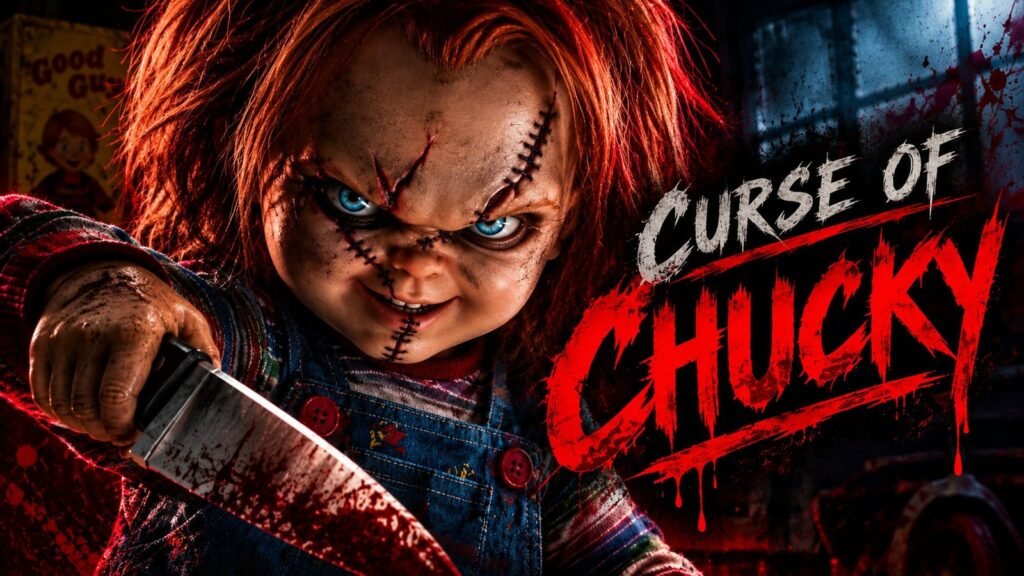
Curse of Chucky is the 2013 direct-to-video sequel that took Chucky back to straight horror — one house, one family, one stormy night.
Nine years after Don Mancini‘s Hollywood experiment split the fanbase, the doll came home. Curse of Chucky is the sixth film in the Child’s Play franchise, the first made for home video, and the one that reminded everyone what a two-foot ventriloquist’s nightmare could do in the dark. It is a sequel — fully, deliberately, in continuity with all five films before it — whatever the word “reboot” has been allowed to suggest. Mancini’s own term was a “tonal reboot”: the tone went back to 1988. The story never left.
Three clarifications, because this film attracts errors like a porch light attracts moths: Nica does not die at the end. Chucky does not successfully possess Alice in this film. And there is no box-office figure — there was no theatrical run, and any gross you have seen attached to this title is home-video money wearing a costume.
Quick Specs
Director: Don Mancini
Written by: Don Mancini
Producer: David Kirschner
Starring: Fiona Dourif, Danielle Bisutti, Brennan Elliott, Maitland McConnell, Chantal Quesnelle, with Brad Dourif as the voice of Chucky
Production company: Universal 1440 Entertainment
World premiere: August 2, 2013, Fantasia Festival, Montreal
Released: September 24, 2013 (VOD); October 8, 2013 (DVD/Blu-ray), Universal Studios Home Entertainment
Runtime: 97 minutes in most listings (some list 96)
Rated: R
Budget: Reported figures range from $2.8 million to $9 million (see below)
The Cast
The film belongs to Fiona Dourif. As Nica Pierce — a paraplegic woman who has used a wheelchair since birth, written with a specificity the genre rarely bothers with — she carries nearly every scene, much of it alone against a doll. Yes, she is Brad Dourif’s daughter; no, that is not how she got the part. Mancini has told the story himself: “A lot of people immediately think Fiona got the role because of who her dad is, but that wasn’t the case at all. When she originally read for the role, it was actually for the role of the sister and while I was watching her read I thought that she would actually be a great Nica.” Danielle Bisutti plays her older sister Barb; Brennan Elliott plays Barb’s husband Ian; Maitland McConnell is Jill, the live-in nanny; Summer H. Howell plays young Alice; Chantal Quesnelle plays the family matriarch, Sarah; and A Martinez appears as Father Frank. Jennifer Tilly turns up late in a cameo that rewires the whole evening, and in the post-credits scene — six months later, and not the film’s main ending — Alex Vincent returns as the adult Andy Barclay, in a moment worth staying in your seat for.
The Plot
A package arrives at the Pierce house with no return address: a Good Guy doll. Sarah Pierce throws it in the garbage. That night her daughter Nica hears her scream, and finds her dead of a stab wound — a death ruled a suicide, with the doll sitting in a nearby chair, watching. Note what the film actually shows: no murder. A body, a ruling, and a doll’s painted eyes. What happened in that room is the film’s first withheld answer.
The family gathers: Barb, Ian, Alice, Jill, and Father Frank, the family priest. Alice bonds with the doll instantly. At dinner, eating the chili Nica and Alice made, Father Frank drives home and is decapitated in a car accident — nobody at the table knows Chucky laced one of the bowls with rat poison. Jill dies next, electrocuted when Chucky kicks a bucket of rainwater across the floor’s outlets and blacks out the house. Nica, researching online while the lights die, finds the old news stories: the unsolved murders, the name Charles Lee Ray. Barb goes to check on Alice and is found with her eye gouged out. Nica crawls up the stairs by hand — the elevator is dead with the power — and arrives too late, face to face with a doll that finally stops pretending.
Ian, convinced Nica is the killer, disarms her and locks her in the garage — then reviews the hidden camera he had planted on the doll earlier, hunting evidence of Barb’s affair with Jill, and sees two things: Alice, locked in a closet, and the doll, moving on its own. Chucky kills him with a hatchet before he can act on either. Then comes the film’s buried heart. Cornered, Nica demands to know why, and the flashbacks answer. The film has been seeding it quietly — the family’s old home movies hold glimpses of a human Charles Lee Ray at the edges of the Pierce family’s happiest days, years before any doll arrived — and now it pays off: as Ray, he was a friend of this family, in love with Sarah. He murdered Nica’s father, kidnapped the pregnant Sarah, and when she betrayed him to the police, he stabbed her in the stomach — the wound that left Nica paraplegic from birth. His flight from that arrest is the chase that ended with his human death in a toy store in 1988. Every family since — the Barclays, the Kincaids, the Tillys — was a way station. This house was always the destination.
Nica fights him to a standstill, but the arriving officer sees only a bloody knife in her hands and Barb’s body upstairs. Some time later Nica is convicted of the murders — declared criminally insane and institutionalized, alive, insisting on a truth nobody will print. The doll, kept as a trial exhibit, is collected by the arresting officer; in his car, he notices the bag breathing. Tiffany, hidden in the back seat, cuts his throat and takes Chucky home: “Who’s next?” And at her grandmother’s house, little Alice comes home from school to find the doll waiting, and agrees to play a game he calls Hide the Soul — the transfer chant begins, and her grandmother, tied up and gagged with a bag over her head but alive, sits bolt upright behind them. The chant stops. What happened next is not in this film, and this page will not pretend otherwise.
A Tonal Reboot, Not a Reboot
The path here ran through a graveyard of plans. In 2008, Mancini and Kirschner spoke publicly of remaking the original film outright — fans, they said, wanted a scary Chucky again. A sequel under the working title Revenge of Chucky circulated after that. What finally got confirmed, in June 2012, was neither: a direct-to-video sequel through Universal 1440, the studio’s home-video arm, with Mancini writing and directing. He has been precise about the mission ever since: “In terms of continuity this is a sequel, but in terms of tone it’s a reboot.” And: “After Bride and Seed, which of course were comedies, we wanted to take a severe turn back into gothic horror territory.” The Gothic is the design brief — “the spooky mansion, the stormy night, the girl in the wheelchair” — and the doll was rebuilt to match, his design pulled back toward the first three films.
The reset also restores the series’ oldest weapon: nobody in the house believes Nica. In Bride and Seed, Chucky was a celebrity in his own world, wisecracking in the open. Here he is a rumor in a wheelchair-bound woman’s mouth — a doll who sits still whenever anyone but his victim is watching, letting the family do his isolating for him. It is the 1988 engine rebuilt with 2013 patience, and it is why the film’s middle hour, much of it a woman alone in a dark house insisting on an impossible truth, plays tenser than the louder entries ever managed.
Filming ran in Winnipeg, Manitoba, from September 5, 2012 into mid-October, with Joseph LoDuca scoring, Michael Marshall shooting, and James Coblentz editing. Tony Gardner — the effects designer who had built Chucky for Seed — returned to the production team, and the continuity shows in the doll’s face. The budget is a genuine fog: figures of $5 million, $2.8 million and $9 million all circulate, none of them from a trade source, and this page prints the range rather than choosing one. What the money bought is visible: one location, practical atmosphere, and time spent on dread instead of spectacle.
Release and Reception
Curse premiered at Montreal’s Fantasia Festival on August 2, 2013 — where it won an award at its world premiere — then played London’s Film4 FrightFest on opening night, August 22, alongside a screening of the original trilogy. It reached VOD on September 24, 2013, and DVD and Blu-ray (carrying both rated and unrated cuts) on October 8 in the US and October 21 in the UK. It also received its own scarezone at Universal Studios Hollywood’s Halloween Horror Nights in 2013. There was no theatrical release and there are no box-office figures; the film’s home-video sales are reported in the region of $3.4 to $3.8 million in DVD sales, with the sources disagreeing — sales, not grosses, and this page labels them so.
The critics, deprived of a cinema to see it in, found it anyway — and Mancini’s summary at the time, “we’re getting the best reviews in the history of the franchise,” was closer to the truth than a director’s boasting usually is. Rotten Tomatoes’ own editorial gallery listed the film at 81%, a series high at the time; snapshots since have drifted through the high 70s as reviews accumulated, and the site’s live page today leads with its critics consensus: the franchise’s hex of disappointing sequels “is broken by going back to basics in this chilling entry.” The Hollywood Reporter‘s John DeFore summed it up as a series wooing fans “by returning to its straight-horror roots.” Jeffrey M. Anderson opened his three-star review with the disbelief the whole run shared: “I know it’s hard to believe, but this sixth movie in the Child’s Play/Chucky slasher series is actually surprisingly well made.” Even the reservations conceded the craft — IGN’s Chris Tilly called it “a strange and not entirely successful hybrid of continuation and reboot,” a hybrid nonetheless. David Nusair’s three-star review noted it is “clear immediately that Curse of Chucky marks an effort to return to the more-horrific-than-comedic atmosphere of the series’ first installment.” The dissent, where it came, aimed at the ending: Common Sense Media’s Brian Costello, at two of five, found that “the attempts to tie everything up into a neat bow at the end feel jarring, abrupt, and rushed” — a fair description, arguably, of a film that was busy tying itself to five predecessors and one successor at once.
What It Set Loose
Universal confirmed a sequel on December 2, 2013, barely two months after the disc landed. That sequel, Cult of Chucky (2017), picks Nica’s story up inside the institution — and it is there, not here, that the fate of Alice is revealed: she died between the two films. Curse keeps its own ending; the interrupted chant stays interrupted. From Cult’s cliffhanger, Nica’s story runs straight into the Chucky television series (2021–2024), where she remains possessed by a piece of Chucky’s soul and spends a year as Tiffany’s captive before Glen and Glenda help her escape in season two — and where season three eventually reveals she had set up Tiffany’s arrest in the aftermath. Fiona Dourif’s Nica, introduced in a film with no theatrical release at all, became the human spine of the franchise’s entire modern era.
Standing back: this is the film that proved the franchise’s center of gravity was never the comedy. It was the house, the storm, and a doll in a chair, watching. The hex, as the consensus says, was broken by going back to basics — and everything Chucky has done since, he has done in this film’s shadow. Not bad for a sequel the studio sent straight to the home-video shelf, largely sight unseen by the very critics who would end up praising it.